Economics of Organisations - terminology
 Call Kai
 Learn
Learn Practice Test
 Spaced Repetition
 Match
Match Flashcards
 Knowt Play
1/26

There's no tags or description
Looks like no tags are added yet.
Name | Mastery | Learn | Test | Matching | Spaced | Call with Kai |
|---|
No analytics yet
Send a link to your students to track their progress
27 Terms
appropriable quasi-rents
appears when some assets/investments are more valuable within the transaction than outside it
they are a temporary economic rent obtainable by the owner of an asset with temporary supply constraints
the difference between the value of the asset in its present use (ex-ante) and its next best alternative use (opportunity cost)
hold-up problem
when opportunism leads parties to haggle and change contractual terms in order to capture appropriable quasi rents
this can prevent efficient transactions from happening
when appropriable quasi-rents are high, integrating the transaction within the firm is optimal
asset specificity
relates to the inter-party relationships of a transaction
it is the degree to which an asset of value can be readily adapted for other purposes
an asset with high specificity is useful only for certain tasks or in certain circumstances
an asset with low specificity is a more flexible resource, and therefore a more valuable asset
applies to many settings
eg designing a software specific for a client (high)
worker learning a production method in a firm (high)
results in hold-up problems
backhaul (Baker and Hubbard, 2004)
the transportation of cargo on the return trip from point B to original point A
integration
unification of control rights
double marginalization
multiple firms in the supply chain applying their own markups, leading to higher prices
alienable capital
able to transfer ownership
eg physical capital
inalienable capital
not able to transfer ownership
eg human capital
vertical integration
downstream producer acquires an upstream supplier
activities all carried out by the producer
spot markets
the total amount of input the supplier producers and is price are determined in a competitive market based on the interaction of demand and supply
price is determined on a transaction by transaction basis
OLS method
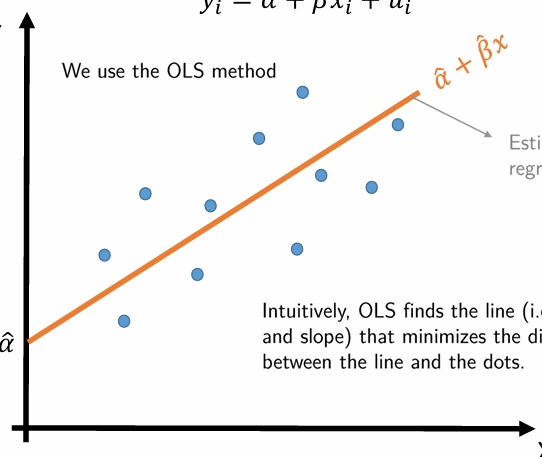
we use this when we have some data and we estimate the linear relation
OLS finds the line (ie intercept and slope) that minimizes the (squared) distance between the line and dots
beta is not identified
there are more regressors than equations
we see this when we have OVB
confounder
omitted variable
noise
random (not correlated with any variable)
zero mean (moves x up or down)
attenuation bias
biases a variable towards zero
residuals
the difference between an observation and the OLS line
balance tests
hard to prove ‘random’ allocation of treatment T in natural experiments
need evidence that T is ‘exogenous’ or ‘uncorrelated’ with any determinant of outcome
don’t observe every possible variable but we can test if it is uncorrelated with some ‘observed’ determinants
not perfect, but strongly suggestive test
ie we are carrying this to prove that results are not driven by some pre-existing characteristics
LATE theorem
it is possible to show that the coefficient from the IV regression (where Z is a dummy and X is also a dummy) captures the causal effect of X on Y among the compliers
compliers: X = 1 if Z=1 and X= 0 otherwise
other alternatives:
never takers: X = 0 always
always takers: X = 1 always
defiers: X = 1 if Z = 0 and X = 0 otherwise (assume they don’t exist because this is an odd relationship)
fixed effects
set of dummies that ‘absorb’ any characteristic that changes at the defined level
interpret in the same way as dummies
eg effect of CEO pay on profits when comparing firms within same State
only works for observations that occur over time
absorbs any heterogeneity at that level
productivity
efficiency with which organisations transform inputs into outputs
not only firms but any organisation (schools, hospitals, government, etc)
r-squared
measure of the explanatory power of the independent variable(s)
when the regression line fits more of the observations in the dataset, it has a higher explanatory power
how much does the independent variable explain the variation in y?
incidental parameters problem
when the presence of incidental parameters affects the maximum likelihood estimates of other parameters of interest
problem usually arises in the context of panel data, where individual-specific parameters may relate to consumer, firm, or country fixed intercept effects
it leads to inconsistent estimates of common panel regression coefficients, as the incidental parameters only figure in a finite dimensional probability law, involving only a finite number of observations
relates to Hoffman and Tadelis (2021) where they did not include worker FE to avoid this issue
linear in means
have averages for the variables and the averages enter the equation linearly
reflection problem in peer effects
arises when it is difficult to distinguish between the influence of peers on an individual and the influence of an individual’s traits on their peers
can lead to underestimation
peter principle
in a hierarchy, employees tend to be promoted until they reach a level at which they are incompetent
managerial fiat
the idea that workers only do things because their managers tell them to do it
hawthorne effect
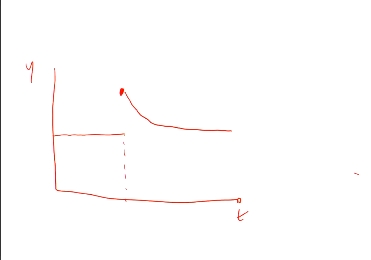
a policy may create a short-run improvement that fades out
ie workers notice there is a policy change so they increase their effort, but this eventually converges (due to behavioural responses)