4.5 the role of the state in the macroeconomy
 Call Kai
 Learn
Learn Practice Test
 Spaced Repetition
 Match
Match Flashcards
 Knowt Play
1/42

There's no tags or description
Looks like no tags are added yet.
Name | Mastery | Learn | Test | Matching | Spaced | Call with Kai | Chat |
|---|
No analytics yet
Send a link to your students to track their progress
43 Terms
capital expenditure
Capital expenditure refers to government spending on long-term investments and assets that are expected to provide benefits over multiple years.
Examples include infrastructure projects (e.g., roads, bridges), public buildings, and investments in education or healthcare facilities.
Capital expenditure contributes to economic growth and productivity by enhancing a country's physical and human capital.
current expenditure
Current expenditure consists of day-to-day government spending on recurring items, such as salaries, maintenance, and operational costs.
Current expenditure maintains the existing level of public services but does not typically contribute directly to long-term economic growth.
transfer payments
Transfer payments are government payments made to individuals or groups without any expectation of goods or services in return.
Examples include social welfare payments (e.g., unemployment benefits, pensions), subsidies to specific industries, and grants to local governments.
productivity and growth
Higher levels of public expenditure on investments like education, healthcare, and infrastructure can enhance human capital and physical capital, thereby contributing to productivity and long-term economic growth.
expenditure on living standards
Public expenditure on welfare programs, healthcare, and education can improve living standards by providing essential services and social safety nets.
crowding out
Excessive government spending can lead to crowding out, where increased government borrowing raises interest rates, potentially reducing private sector investment and economic growth.
level of taxation - how does this effect public spending?
The level of public expenditure is often linked to taxation policies. Higher public expenditure may require higher taxes, which can impact disposable income and economic incentives.
equality - how does this impact public spending
Public expenditure can reduce income inequality by providing social support to disadvantaged groups and funding education and healthcare accessible to all citizens.
microeconomic reasons for public expenditure
Correcting Externalities: Funding for initiatives that reduce negative externalities (e.g., pollution control) or boost positive ones (e.g., vaccination programs).
Correction of Market Failure: The market may under-provide merit goods (healthcare, education) or fail to provide public goods (national defense, street lighting). Government spending corrects this.
macroeconomic reasons for public expenditure
Economic Growth and Stabilization: During recessions, government increases spending (fiscal policy) to boost Aggregate Demand (AD), stimulating growth and reducing unemployment.
Managing the Economic Cycle: Governments use spending to reduce the severity of recessions (expansionary) or cool down inflation (contractionary), acting as an automatic stabilizer.
how does demand for public services impact the size of expenditure
Rising demand for public services directly increases the size of public expenditure, particularly through demographic changes like an aging population (higher health/pension costs) and higher income levels, which boost demand for superior public services
how does size and age distribution of the population impact the size of expenditure
Population size and age distribution heavily influence public expenditure by driving demand for services and transfer payments. A larger population increases overall demand for public goods, while an aging population specifically boosts spending on pensions and healthcare. Conversely, a younger population demands higher educational investment
how the trade cycle impact the size of expenditure
During recessions, spending increases on unemployment benefits and stimulus projects. In booms, lower demand for social support and reduced stimulus needs often shrink spending, as governments focus on reducing deficits.
how does interest on the national debt impact the size of expenditure
Interest on the national debt increases the total size of public expenditure by requiring a significant portion of tax revenue to be spent on debt servicing rather than public services
how does the rate of inflation impact the size of expenditure
Real vs. Nominal Value: If inflation is higher than the rate at which government budgets are increased, the real value of public spending falls, meaning the government can purchase fewer goods and services.
Austerity Effect: When public services operate on fixed cash budgets, higher-than-expected inflation acts as an "unintended dose of austerity," forcing departments to cut services.
Public Sector Pay: Inflationary pressures usually lead to demands for higher public sector wages, which, if met, increase nominal spending.
Fiscal Drag: Inflation can boost tax revenues, which might allow the government to finance more spending, but this rarely keeps pace with the increased cost of procurement.
progressive tax
A tax where the proportion of income paid in tax rises as income rises
Examples – income tax, stamp duty
regressive tax
A tax where the proportion of income paid in tax falls as income rises
Examples – VAT, council tax
proportional tax
The proportion of income paid in tax stays constant as income rises
Example – flat rate taxes (e.g. 20% on all income)
reasons for tax
To pay for government expenditure
In the short run, borrowing can pay for expenditure, but in the long run taxation must cover spending
To correct market failure
Increasing resource allocation through taxation of, e.g., tobacco, alcohol, etc.
To manage the economy
Tax rates can be used to influence unemployment, inflation, etc.
To redistribute income
Taxing different groups of people at different rates may redistribute income in the economy
progressive tax on equality
Increased income equality
Greater redistribution effect - especially if used to target higher earners
Can be combined with spending policies that target the poorer in society
Evaluation
Depends on how tax revenues are used and whether other fiscal changes offset the impact of the higher marginal tax rate.
progressive tax on incentives to work
Impact on incentives to work
Could act as disincentive to take higher paid jobs
Negative impact on the supply-side of the economy (productive capacity)
Evaluation
Workers might work harder to maintain standard of living
i.e. the higher paid need to work more hours to protect net income levels
Lower taxation on the poorest may increase the incentive to take paid work for the unemployed
progressive tax on tax revenues
Tax revenues/public finances
Raising of tax levels should raise tax revenue
Could be used as part of an objective of reducing budget deficit
Evaluation
Depends at what rate of tax that tax revenues are maximised
Laffer curve analysis
Depends on position along curve
Also depends on overall impact on AD & economic growth
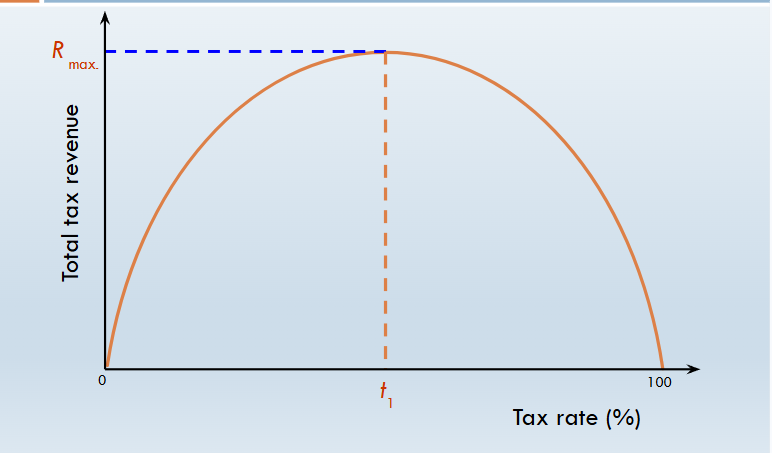
the laffer curve
Tax rate rises may cause a disincentive effect – reducing the number of taxable work hours
Tax rate rises may cause greater levels of tax avoidance or evasion
Used as a justification for lowering the rate of tax
Whether lowering tax rate leads to a rise in tax revenue depends on tax rates being above t1
could progressive tax lead to tax avoidance or tax evasion
Could cause an increase in tax evasion (illegal) and tax avoidance (legal)
Creates a greater incentive to find methods avoid paying tax
Evaluation
Depends on tax structure – if there are many tax loopholes then avoidance is easier
Depends on powers of tax authorities to collect taxes and enforce payment
progressive tax on tax exiles
Might cause an increase in number of tax exiles
Richer people have an incentive to move to countries with lower top rates of tax
Evaluation
Income tax is not the only factor which influences a person’s decision on where to live
taxes on consumption
Taxes like income tax and national insurance reduce disposable income – the result is a fall in consumption and a fall in AD
A fall in the price level, a fall in employment (rise in unemployment), a fall in real output
Evaluation
If the revenue from taxes is spent by the government, the impact may be neutral, or even stimulative
Redistributing from richer to poorer may increase consumption due to the higher MPC of poorer consumers
progressive taxes on the trade balance
A rise in taxes on households will reduce disposable income and therefore levels of consumption
This means less spending on imports, improving the balance of trade
Evaluation
If the drop in aggregate demand leads to spare capacity, there may be a subsequent fall in investment
This could harm the long run competitiveness of domestic firms which could worsen the trade balance
progressive tax on FDI
FDI is investment by a foreign company where they acquire an interest in a domestic company
Countries compete to attract FDI because of its positive impact on employment and output
One way to attract FDI is to lower corporation tax
Evaluation
Can lead to a race to the bottom – if all countries lower their corporation taxes then it simply leads to a lowering of tax revenues
Difference between automatic stabilisers and discretionary fiscal policy
Automatic stabilisers:
Automatic tax/spending changes that stabilise the economy without government action.
Discretionary fiscal policy:
Deliberate government changes to tax or spending to influence the economy.
distinction between structural and cyclical deficits
Structural deficit:
Persistent deficit even when the economy is at full capacity. difficult to correct
could be due to large tax avoidance culture, poor governing of funds
Cyclical deficit:
Temporary deficit caused by economic downturns (falls in tax, rises in spending).
factors impacting the size of national debt
Size of fiscal deficits (bigger deficits → more debt)
Economic growth (higher growth → reduces debt ratio)
Interest rates (higher → more debt servicing)
Inflation (reduces real value of debt)
Government policies (spending & taxation decisions) expansionary fiscal policy can increase the national debt
aging population (economically inactive,more spending on welfare/pensions)
Explain how a government might use macroeconomic policies to respond to external shocks to the global economy (financial crisis/recession)
External shocks - unanticipated events
Subsides - these can help domestic firms recover
Cutting Interest Rates: Central banks (e.g., the Federal Reserve or Bank of England) cut base interest rates to lower borrowing costs, encouraging businesses to invest and households to consume.
Expansionary fiscal policy:
Increased Government Spending: Governments directly inject funds into the economy, often targeting labor-intensive infrastructure projects, to create jobs and boost aggregate demand.
Tax Cuts: Reducing direct income taxes or indirect taxes (like VAT) increases households' disposable income, encouraging consumption.
Bank bailouts
Bank Recapitalization and Bailouts: To prevent a banking crisis, governments may use public funds to recapitalize banks (inject capital) or provide guarantees for bank bonds, as seen in the 2008 financial crisis.
however … they impose massive costs on the taxpayer and are criticised for rewarding bad behaviour
Explain how a government might control global companies operations through regulating transfer pricing
tax authorities around the world have been increasing their scrutiny of transfer pricing practices, and have been developing regulations and guidelines to ensure that multinational corporations are not engaging in tax avoidance or other harmful practices. (HMRC) will investigate companies that do not pay sufficient tax
joint ventures
some developing countries may not allow TNCs to invest without a joint venture , allows for profits to be retained and knowledge and technology are transferred
Explain the limits to government ability to control global companies
Footloose" Mobility: Multinational corporations (MNCs) can easily move production to countries with lower taxes, weaker labor laws, or fewer environmental regulations.
Transfer Pricing and Tax Avoidance: Companies set artificial prices for transactions between subsidiaries in different countries to shift profits to low-tax jurisdictions, reducing the tax revenue a specific country can collect
Asymmetric Information: Governments often lack complete knowledge of a firm's global operations, making it difficult to regulate or identify unethical behavior.
Explain how governments may face the following problems when applying policies
Information Gaps and Misdiagnosis
Policies are often designed without perfect information regarding the economic, social, or technical landscape, leading to misdiagnosed problems. (figures are released for previous months)
Misleading Data: Governments may rely on inaccurate or outdated data, resulting in policies that are not targeted correctly.
Unforeseen Consequences: Because of the complexity of social systems, policies often have unintended side effects that undermine their original goals
fiscal deficit + national debt - whats the difference?
the level of government spending is greater than tax revenue in any given year (adds onto the national debt)
national debt - the accumulation of all the money a government owes
factors due to fiscal deficit
unemployment
tax avoidance
unforeseen events (wars,recessions) external shocks
government aims (austerity measures)
impact of the size of fiscal deficits and national debts
the higher the gov. debt the more reluctant the lenders will be - higher int. rates as a result
This can lead to CROWDING OUT the private sector cant get finance as easily
can lead to a foreign currency gap if the repayments are made in foreign currency
measures to reduce fiscal deficits and debts
raise taxes - conflicts with goal of economic growth, may lead to unemployment
cut government spending - opportunity cost of areas that are needed
measures to reduce poverty and inequality
more progressive tax policies
transfer payments (redistributing income between the rich and poor)
Legislation ^ minimum wage
policies to increase international competitiveness
deregulation - allows UK firms to lower costs > lower export prices
devalue the currency > weaker pound imports expensive > exports cheaper (marshall lerner and J curve,cost push inflation
Lower taxes > more profits > more invested
export subsidy
inability to control external shocks
events that are unanticipated out of a business control
gov. unable to control/prepare and therefore protect the economy due to their unpredictability