Exam 2 - Infant Psych
 Call Kai
 Learn
Learn Practice Test
 Spaced Repetition
 Match
Match Flashcards
 Knowt Play
1/140

There's no tags or description
Looks like no tags are added yet.
Name | Mastery | Learn | Test | Matching | Spaced | Call with Kai |
|---|
No analytics yet
Send a link to your students to track their progress
141 Terms
Motor Development involves increasing…
agency
prospectivity
behavioral flexibility
means-end understanding
Agency
sense of control
Prospectivity
looking ahead
Behavioral flexibility
adapting to circumstances
Means-end understanding
understanding links between actions and goals
Dynamic systems theory
dependent on the interplay of many factors
it affects other aspects of development (cognitive, social, communication, etc)
Postural control
a complex sensorimotor behavior that maintains balance by counteracting gravitational forces and by anticipating postural challenges induced by external demands and perturbations
cephalocaudal trend
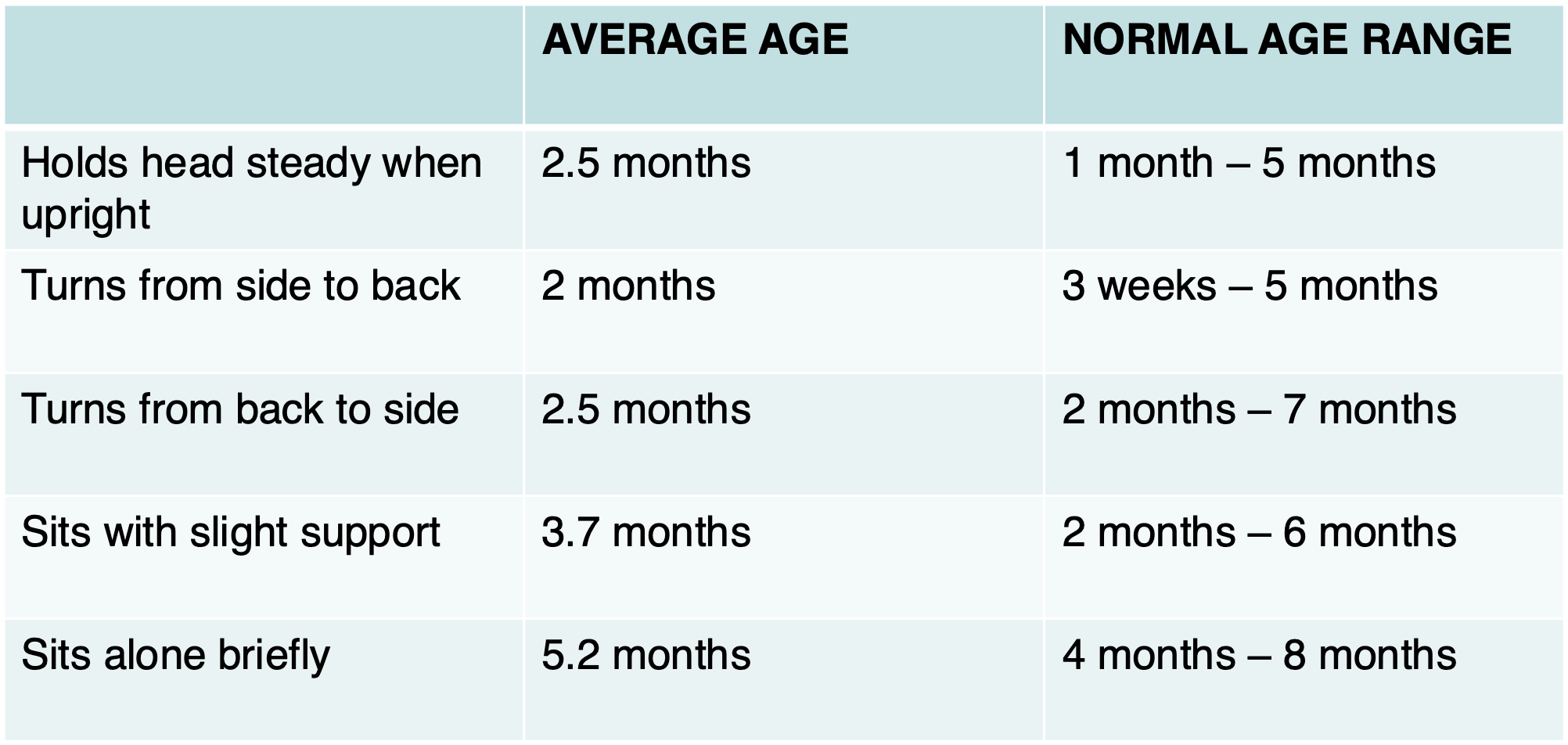
Head and body control
Reaching and grasping: birth
Pre-reaching movements - clumsy motions in direction of target object
Reaching and grasping: 3-4 months
Looks at and swipes at object, retains object placed in hand.
Reaching and grasping: 4-5 months
contacts toy placed on table
Reaching and grasping: 5 months
Sits with support and grasps object
Reaching and grasping: 6-7 months
Bangs, shakes, rattles, explores, transfers object from hand to hand
Reaching is increasingly prospective (anticipatory)
5 months - contact, then form hand
7.5 months - pre-form hand in anticipation of dowel orientation
9 months - open hand while reaching, begin to close in anticipation of contacting object
Reaching lays groundwork for perceptual and cognitive advances
Inter-sensory integration (visual-tactile)
Tool use
Means-end understanding
Needham, Barrett & Peterman, 2002
Infants wore velcro mittens and had opportunity to interact with toys covered in velcro (blocks, rings, cubes)
Mitten group:
Explored more
Swatted more
Used more swats with looking
What is the most important take-home message from the velcro mitten study?
Motor development and cognitive development are inextricably intertwined in infancy
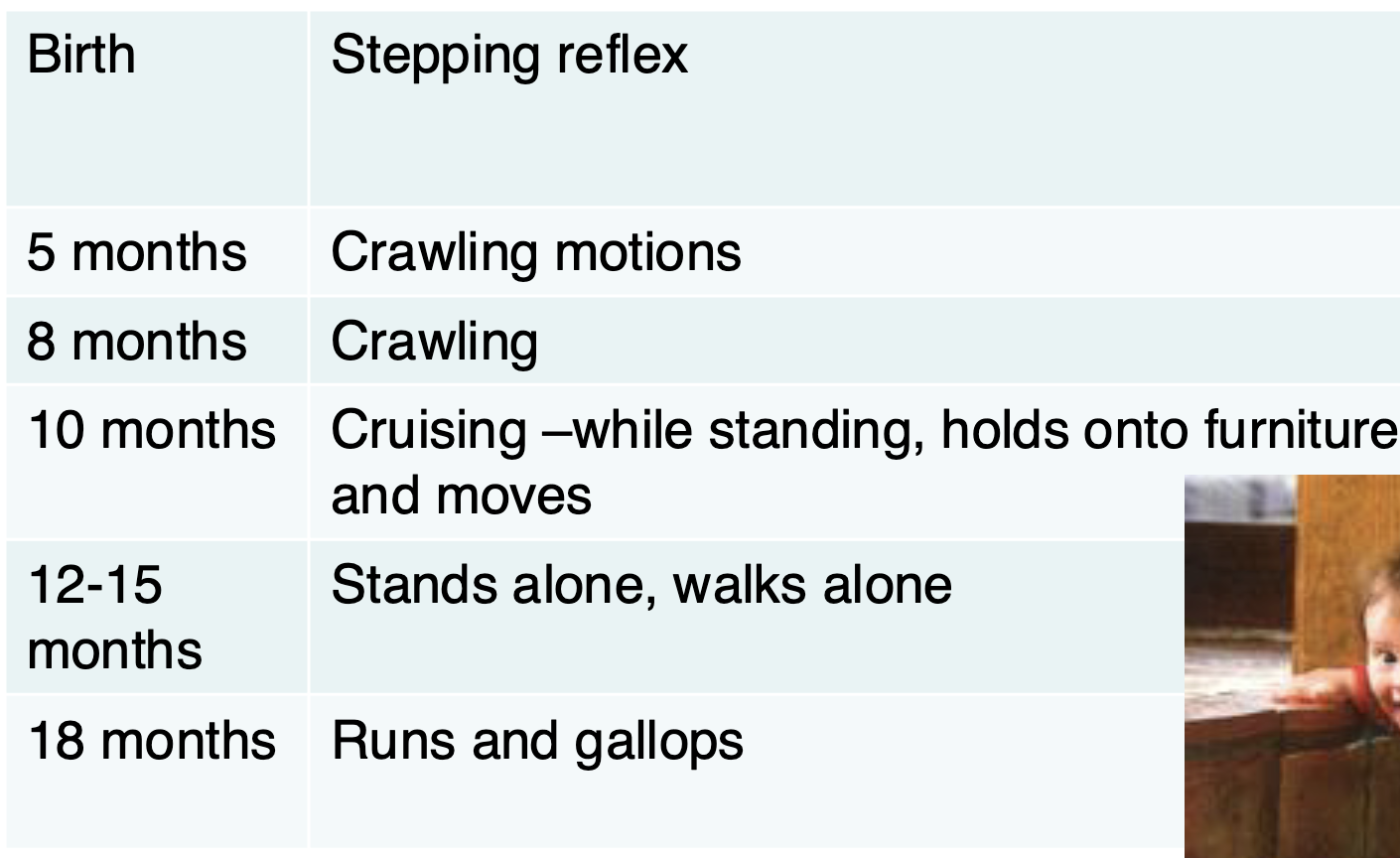
Locomotion
highly variable progression
Changes with increasing walking experience:
Increased step length
Less variable step length
Less lateral movement
Less flat-footed
More symmetrical steps (one leg back as one leg forward)
Better balance
Better able to adjust to different surfaces, slopes
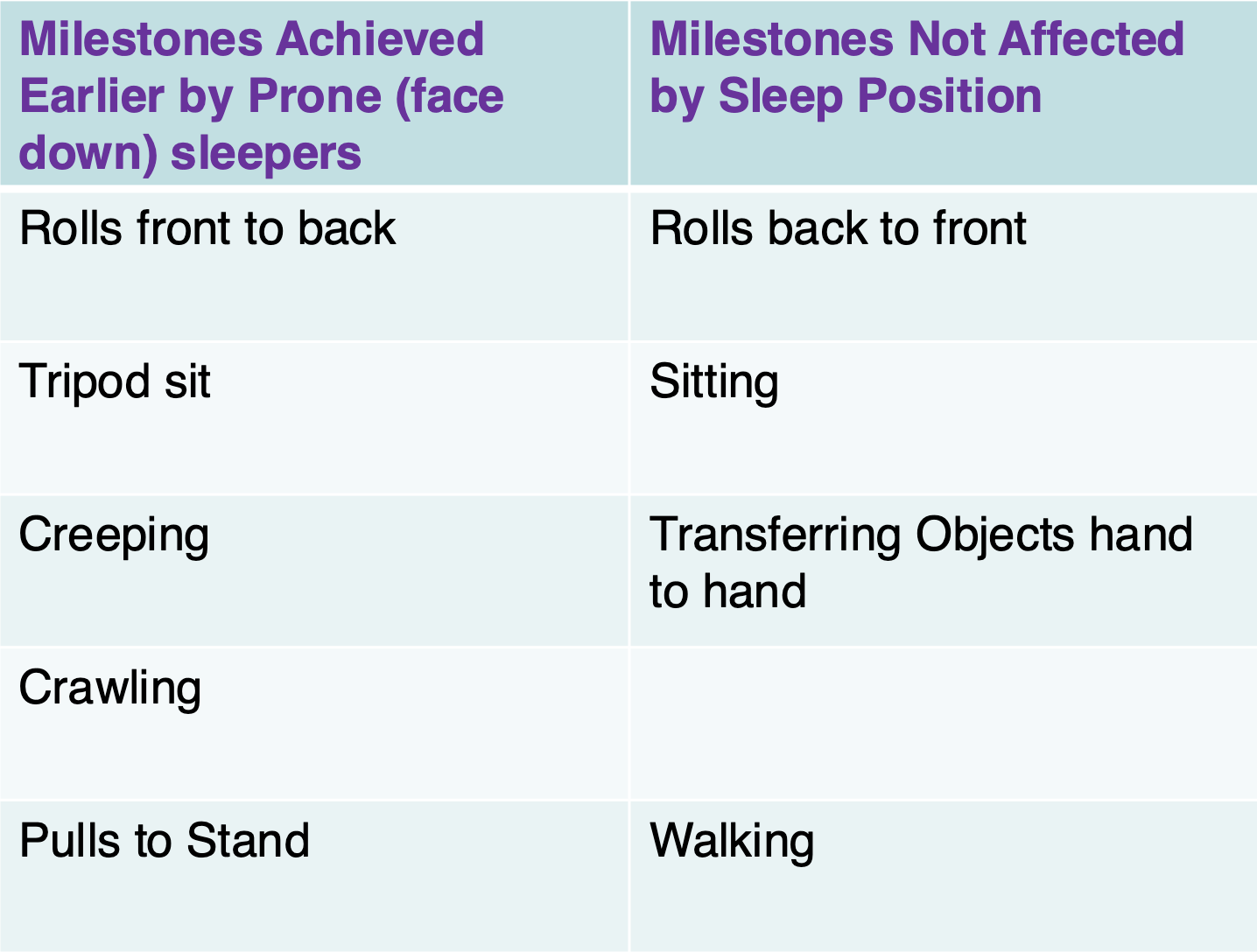
Prone
face down
Supine
face up
Prone vs Supine
Crawling as a developmental organizer
Other changes at at about the same time (8-9 months)
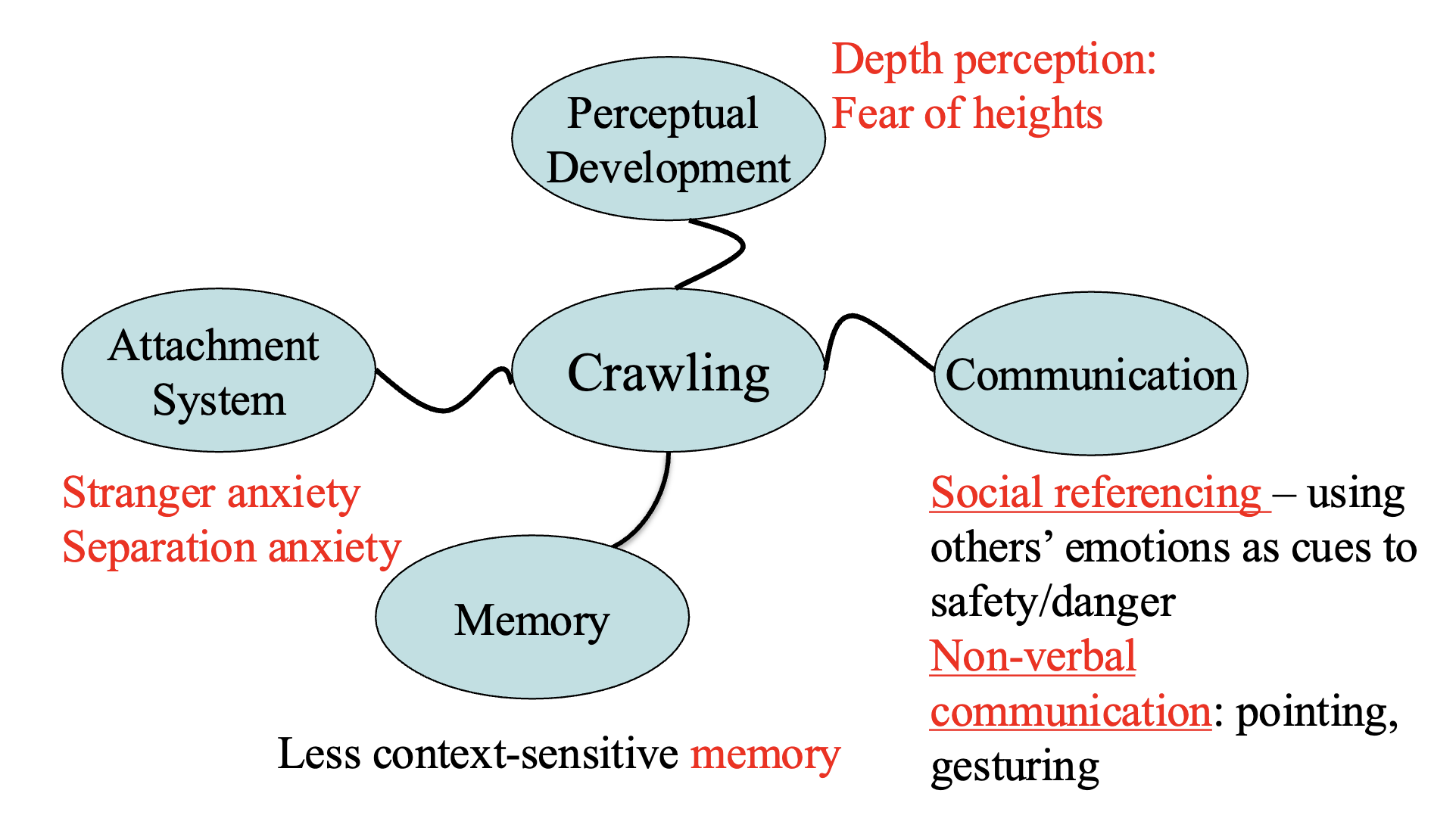
Social referencing
using others’ emotions as cues to safety/danger
Non-verbal communication
pointing, gesturing
Crawling and depth perception
Bertenthal, Campos, Kermoian, 1992
The visual cliff
infants with little crawling experience will cross
infants with more crawling experience won’t cross
11 days crawling experience: 30-50% avoid deep
41 days crawling experience: 60-80% avoid deep (Does not depend on age)
Measure of fear:
increased HR when placed on deep side
Crawling experience drives fear of heights
The veritable cliff (Adolph, 2002)
Infants accurately judged what they could reach in sitting, but not crawling posture
Similar results for crawling to walking transition
Each new posture involves re-learning what is safe and possible
Challenges with studying infant perception
They can’t tell us what they see
They can look more or less at things
Researchers have to infer what they are perceiving based on differences in looking time
Do infants prefer faces that are looking at them? (Farroni, Menon & Johnson, 2002)
Infants don’t have a general understanding of gaze, but prefer faces that match a simple head-on face template

Studying infant abilities: Preference
preference for one implies discrimination
lack of preference implies NOTHING
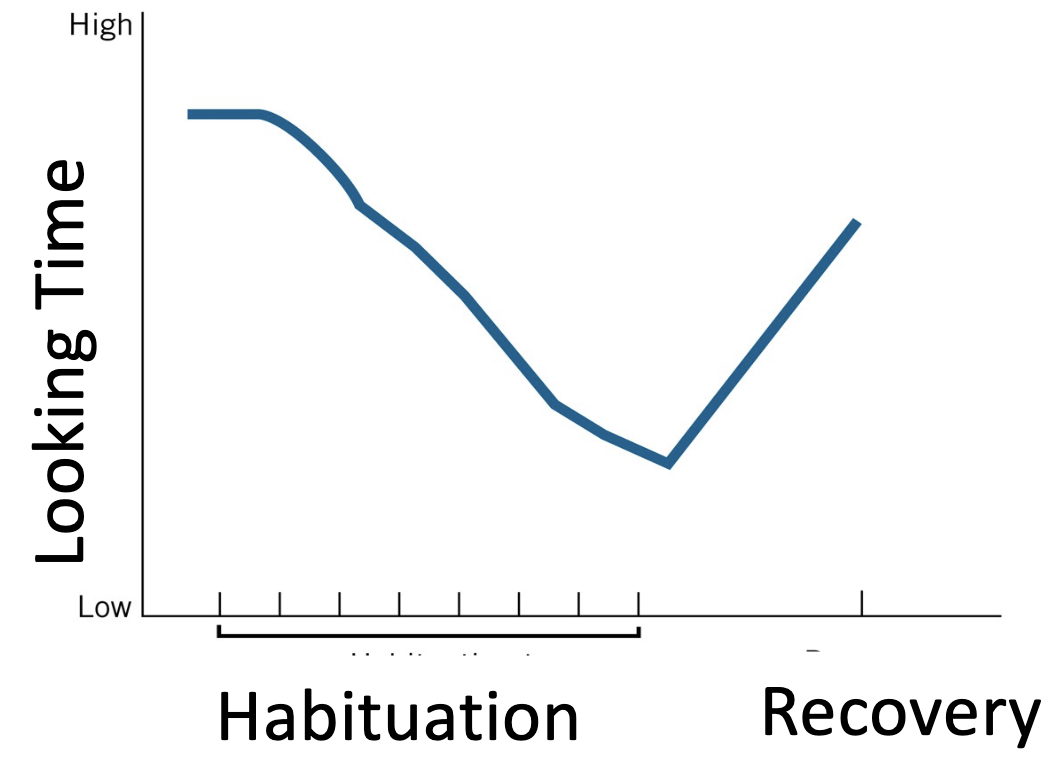
Studying infant abilities: Habituation / Familiarization
Show infant repeated presentations of stimulus until looking time drops, then show new stimulus
Increased looking time (recovery from habituation) implies discrimination of 2 stimuli
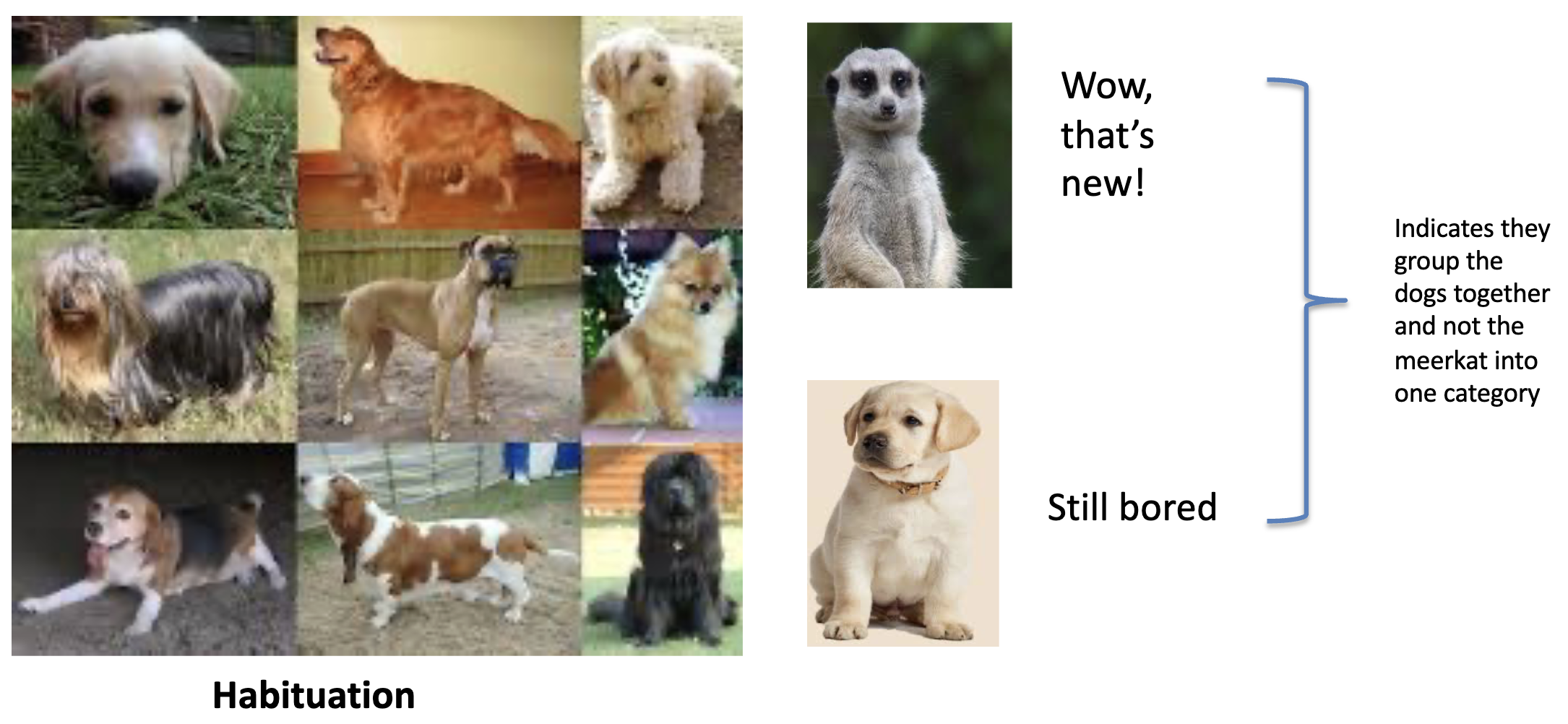
example: if you show a dog until habituated and looking time drops, and then show a meerkat and the dog they should prefer the meerkat IF they can tell the difference
Habituation/Familiarization + Preference
can be used to ask questions about infant categories
example: if habituated to many photos of dogs, and then shown the a picture of another dog and a meerkat preference for the meerkat shows its new to them and they group the dogs together and not the meerkat into one category
Studying infant abilities: Violation of Expectation (VOE)
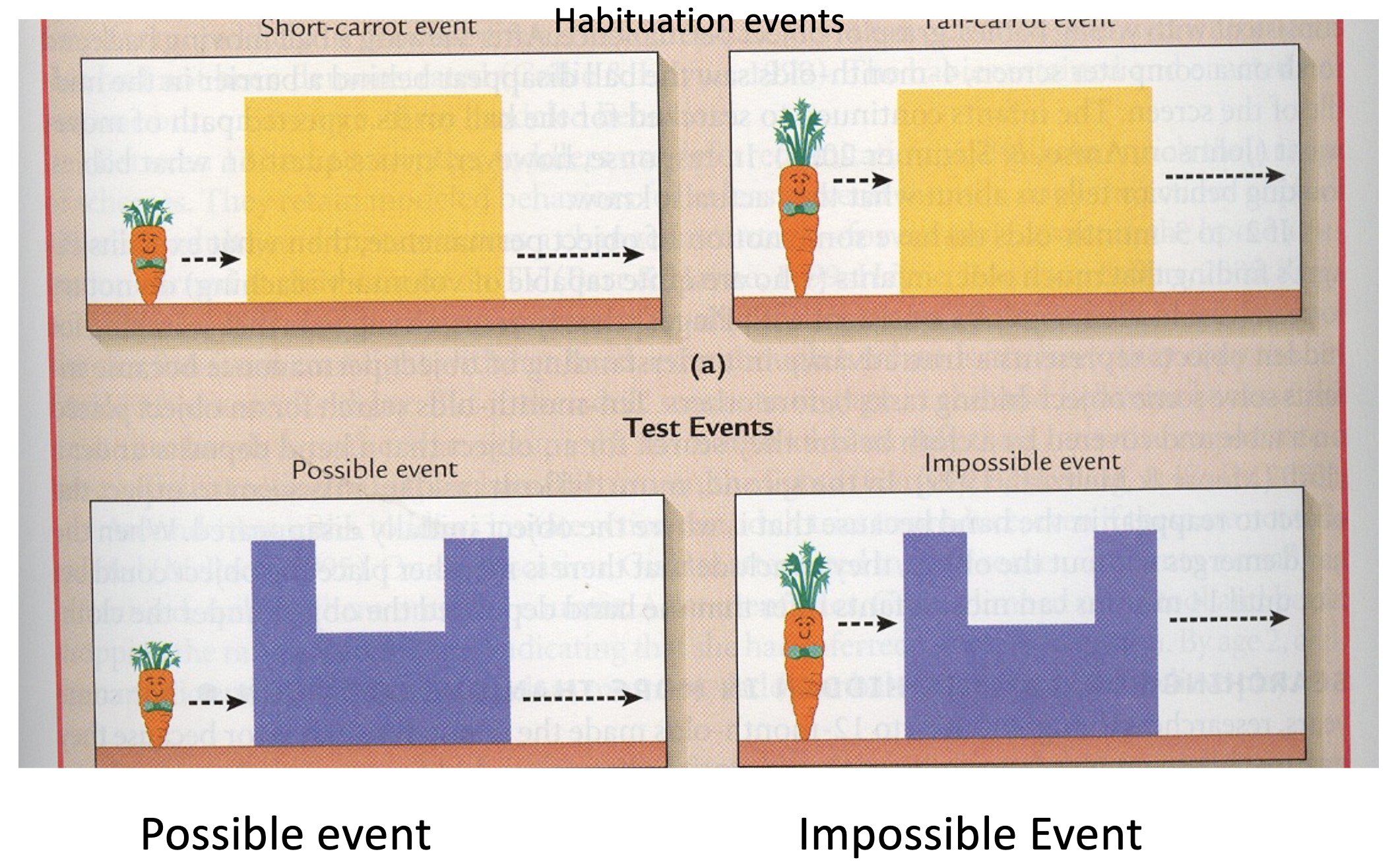
Show infants events that violate their expectations
If expectations are violated, they will look longer
You can learn what they expect
Contrast looking times to Possible and Impossible Events
Game: make Possible and Impossible events as similar as possible in every way to eliminate alternative explanations for differences in looking times
Perception: 2 Theoretical Positions
construcivism
jean piaget
top down
ecological view
J.J. Gibson
bottom up
Is the infant born prepared to interpret visual stimuli in a meaningful way?
Piaget (Constructivist)
NO – The infant learns meaning through associating different experience
Gibson (Ecological View, more nativist)
YES, somewhat – The infant’s visual system is constructed to be prepared to perceive the world
Static monocular cues
interposition
linear perspective
relative size
texture gradient
Kinetic cues: motion parallax
as we move, the image of objects closer to us moves faster than the image of farther objects
Depth cues
binocular cues
static monocular cues
motion cues
Binocular cues
Binocular disparity, convergence
Static monocular cues
Interposition, relative size, texture gradient
Motion cues
Motion parallax, things that move together belong together
Development of stereoacuity: Held, Birch & Gwiazda (1980)
Preferential looking method
Infants wear goggles with 2 different images presented to each eye (like stereo glasses at the movies)
Assumption: infants prefer display with depth cues if they can detect them
Longitudinal study, 10 to 30 weeks
Findings – preference for displays including binocular disparity as a depth cue emerges suddenly, around 4 months of age
Sensitivity to monocular depth cue of interposition develops between. . .
5 and 7 months
Kinetic cues
Studies suggest motion cues may be some of the earliest to be detected
looming and motion parallax
Looming
expansion as cue to approach
texture expands as object approaches
newborns draw back their heads and blink in response to looming
Motion parallax
as we move, the image of objects closer to us moves faster than the image of farther objects
Motion parallax: Slater, Rose & Morrison (1984)
Study 1: Showed newborns 3D objects and 2D photos of the same things paired
Infants strongly preferred 3D
Could be binocular disparity
Or motion parallax (as they move)
Study 3: –monocular presentation
Still preferred 3D, though not as much
Must be using motion parallax to detect 3D
CONCLUSIONS
Newborns can distinguish 3D objects from 2D representations
Newborns can use motion parallax (a kinetic cue) to detect depth
Perception of 3D world: Impossible objects (Shuwairi, 2007)
4 months
Infants looked longer to impossible cube, suggesting they discriminate 2D representations of 3D from 2D representations that do not depict depth
Object unity
perceiving different parts of object as distinct
Object segregation
perceiving separate objects as distinct
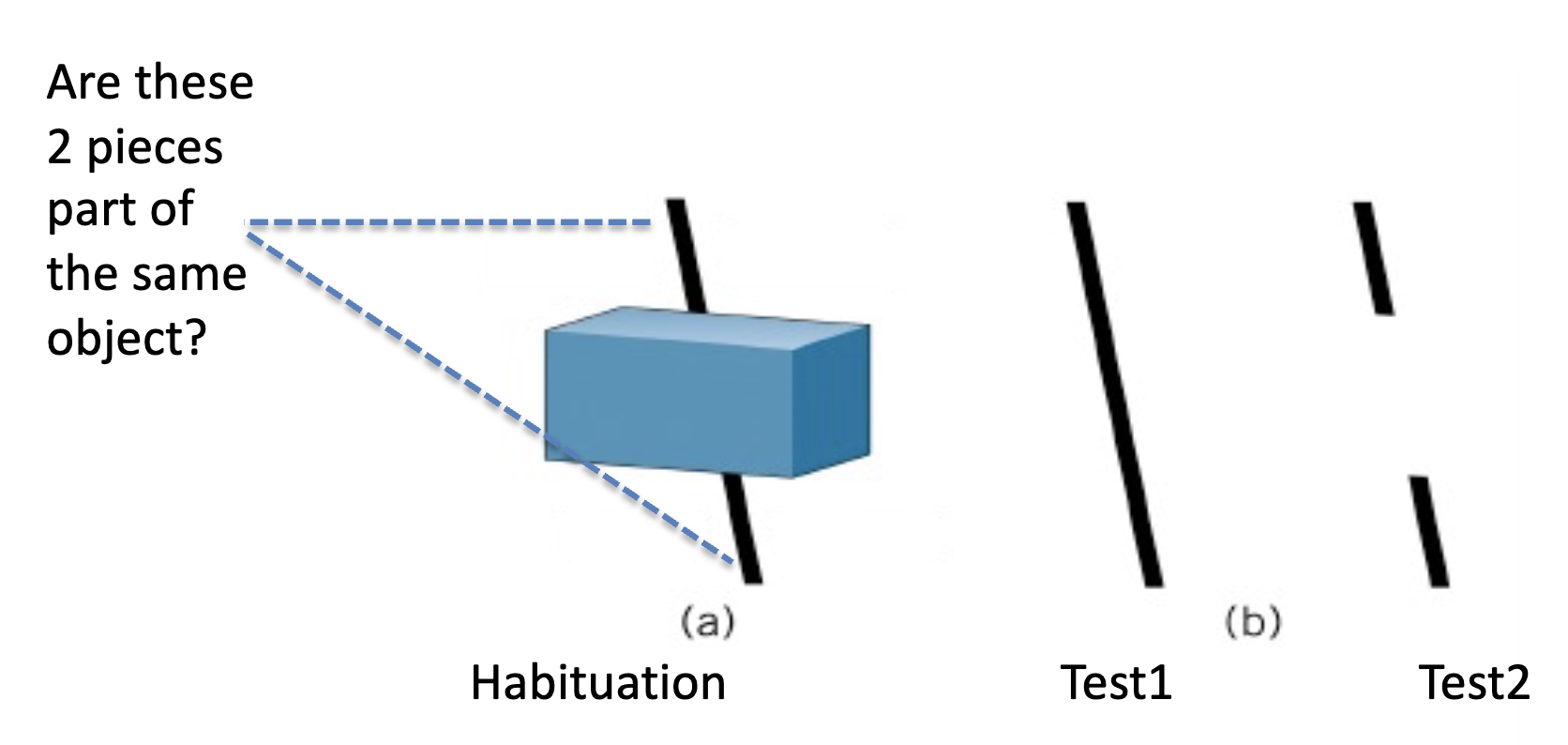
At what age can infants use continuity to unify partially occluded objects?
when stationary, 7 month olds looked longer at broken rod (showing it doesn’t make sense to them) while 4 month olds did not (not yet sensitive to continuity as a cue)
BUT when rod is in motion, 4 month olds preferred to look at broken rod
used continuity as a cue as long as motion was present
CONCLUSION: MOTION is an important cue to object boundaries early in development
Younger infants and continuity
Newborns (Slater et al., 1990)
Newborns preferred the complete rod
They perceived it as more novel
Did NOT appear to be sensitive to continuity, even with motion
2-month-olds (Johnson & Aslin 1995)
2 month-olds preferred broken rod (completed rod in spite of occlusion) IF the occluder was narrow
A late developing skill in terms of infant perception of objects
using object properties such as color, texture or pattern to break a scene into separate objects
Using object properties to identify object unity (Needham & Baillargeon 1997)
8-month-olds looked longer at the Move-together event while 4.5 month olds looked about equally
BUT 4.5 mo who are given brief exposure to either object alone DO look longer at move together event (they’re surprised by it)
Theorists differ on whether infants should be able to perceive objects in a 3D world without experience
Constructivists — NO
Ecological theorists — YES
Do infants prefer faces over other stimuli? Fantz (1961)
Fantz’s conclusion:
Young infants do prefer faces over other stimuli
BUT, not because of their organization as faces.
Early on, preference for faces is driven by lower-level properties of faces
E.g., high contrast, curvature
Newborn ability to distinguish face from non-face (Johnson & Morton, 1991)
Infants tracked images with features in face-like organization (2 dots above 1 dot) more than other images
Difference declines at 4-6 weeks of age
From birth, infants are biased to attend to faces
Initial bias probably reflects subcortical mechanism
Perhaps not the same as real understanding of faces as special
Is this preference for face-like organization present prior to birth?
Yes!
Shined patterns of dots through the mother’s abdomen
Using ultrasound, recorded fetus’ turns toward or away from light
Recognizing mom’s face
Newborns appear to distinguish mom’s face (vs a strangers) in the first few days
They need all the information they can get (dependent on features such as hairstyle)
Specialization of processing human faces (Pascalis, DeHaan & Nelson 2002)
Humans better at human than monkey discrimination, while opposite holds true for monkeys
6 month-olds looked longer at novel monkey and novel human faces
9 month-olds looked longer at novel human faces, but not at novel monkey faces
Do infants also specialize in processing faces of their own race?
Yes, as they get more exposed to their race the get worse at discriminating between another
Perceiving faces of other races Kelly et al., 2007
3, 6, 9 month olds
3 months: good at task regardless of race of face
6-month-olds good at Chinese and Caucasian, not African or Middle-Eastern
9-month-olds good only at Caucasian
perceptual narrowing hypothesis
How well do 5-month-old infants recognize the same expression across different faces?
5-month-olds categorize smiling faces together and as different from fear, even when displayed by different faces
How well do 5-month-old infants recognize the same face across different expressions?
they recognize a new face as novel, meaning they discriminate between them
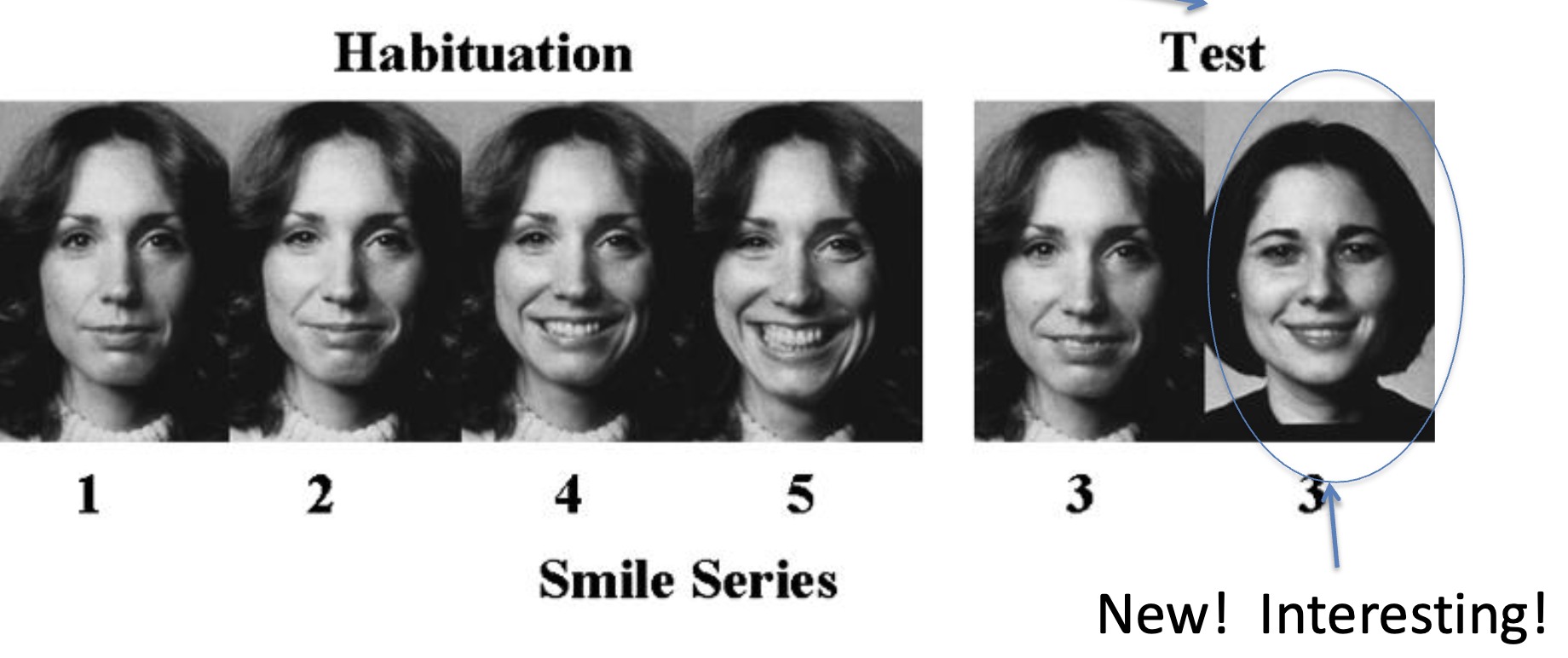
Facial expressions and vocal expressions
ex. happy face and happy voice
do earliest for mom, and generally earlier for women than men
Modality
the sensory channel carrying certain information (visual, auditory, tactile…)
Amodal
not tied to a particular sense
Invariant
not changing, constant
Ecological View: Amodal invariants
Abstract similarities or correspondences in the information coming in from different senses
Important in detecting correspondences between senses, and in detecting information about the world
Can 1-month-olds relate visual and tactile information? (visual-haptic)
sucked on smooth vs nubby pacifier (habituated) and then saw pictures of the pacifier they sucked on and the other one (test)
they preferred photo of one they sucked on
1-month-old infants have some ability to integrate visual and tactile information for shape
Vision and Audition
They turn different amounts depending on location of sound
ushaped curve, they get worse up until 80 days and then begin to improve again
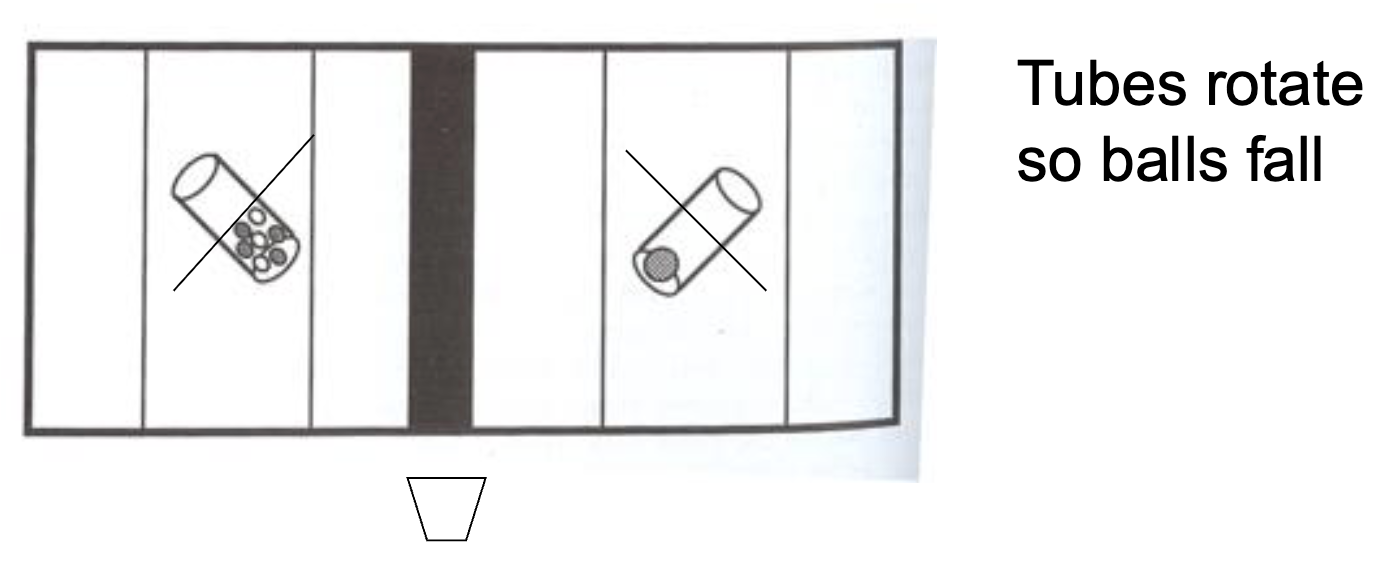
Can 3-month-olds link visual and auditory events by synchrony?
Experiment 1: Are they sensitive to the correspondence between visual and auditory timing (simultaneity)?
Experiment 2: Are they able to match by tempo (fast vs. slow) even when the tracks are out of synchrony?
Kangaroo or donkey bouncing fast or slow
3-month-olds can use synchrony and tempo to match visual and auditory events
Refinement in the first year (Bahrick, 1987)
4-month-olds prefer displays that are synchronous, but don’t distinguish single from multiple balls
6-month-olds are sensitive to one vs. many differences
Newborn Imitation (Meltzoff & Moore 1978)
48 hours old
Tongue protrusion
Mouth opening
Lip protrusion
Finger waving
Replicated in hour-old infants
Strongest results for tongue protrusion and mouth opening
newborn chimps also do the same thing!!
What to control for in Meltzoff and Moore imitation study
is adulting imitating infant
Is infant just more likely to show a facial expression because of general excitement?
are researchers biased to code for imitation
Features of Jean Piaget’s theory
Stages
qualitative change
invariant sequence
constructivism
Neither nativist (knowledge is innate) nor empiricist (knowledge comes from experience)
Knowledge is built by the child in an active process
Schemes
Basic element of knowledge
Start as reflexes, then action schemes, then mental representations, around 18 months
Knowledge originates in actions
Schemes
A baby has a grasping scheme
What is graspable?
How can I grasp this particular object?
What will happen when I do?
Piaget’s Stages
sensorimotor (birth — 18-24 months)
preoperational (2-6 years)
concrete operational (8-12 years)
formal operational (12+ years)
Piaget’s account of the Sensorimotor stage
achievements
distinguish self from the world
understand the difference between cause and effect, and learn specific means end relationships
develop concept of object
Limitations
no planning
no remembering
no bringing concepts of absent objects to mind
Stage 2 (Piaget’s 6 substages of sensorimotor development)
1 - 4 MONTHS: Primary Circular Reactions
Cause - effect:
discover actions on their own bodies and learn to repeat
Object Concept
tracks moving objects with anticipation; fails to reach for partially hidden objects
Stage 3 (Piaget’s 6 substages of sensorimotor development)
4 - 8 months: Secondary circular reactions
Cause - effect:
Discovers actions on objects, learns to repeat (e.g., shake rattle)
Object Concept
Reaches for partially hidden objects; fails to reach for fully hidden objects
Stage 4 (Piaget’s 6 substages of sensorimotor development)
8-12 months: Coordination of secondary circular reactions
Cause - effect:
intentionally put 2 schemas together to solve a problem (e.g. push box aside in order to reach toy)
Object Concept
reaches for completely hidden objects (make A not B error)
Object permanence
the understanding that objects persist, continue to exist when we cannot see them
Stage 5 (Piaget’s 6 substages of sensorimotor development)
12-18 months: Tertiary Circular reactions
Cause - effect:
use of new means discovered by chance for new ends
deliberate variation of means to end
Object Concept
searches for object visibly displaced, but fails with invisible displacement
Stage 6 (Piaget’s 6 substages of sensorimotor development)
18-24 months: Coordination of Secondary Circular reactions
Cause - effect:
insightful problem solving
Object Concept
solves search tasks with invisible displacement
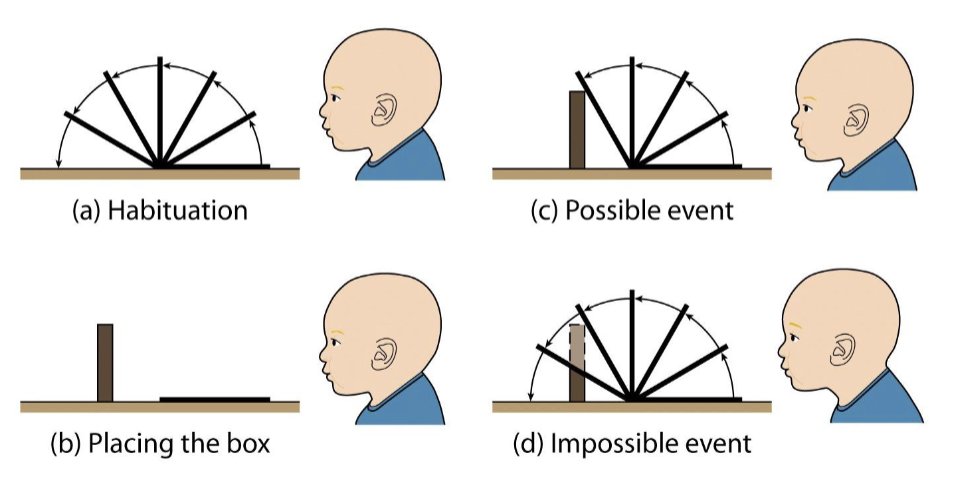
Will infants show surprise (increased looking) when objects spontaneously cease to exist?
5 month olds
looked longer at impossible event (were suprised)
finding was later extended to 3.5 month olds c vc v
A not B error
8-12 months
hide object at A several times
infant finds successfully
hide object at B
infant searches at A
Response Perseveration
infant can’t stop repeating previously awarded response
IN FAVOR: Route finding task, Pick and Lockman 1982
step one: infant finds shortest route to mom
step two: mom moves and infant takes the same route as before even though longer
AGAINST:
infant still sometimes makes the error even if they only watch A trials and never reach
Memory interference
2 hiding locations are so similar, they are easy to confuse in memory
IN FAVOR:
more distinctive the hiding location, error down
longer delays, error up
AGAINST:
infants still make the error with transparent cover (no memory required)
Insightful problem solving from Piaget (19 months)
For the first time Lucienne plays with a doll carriage whose handle comes to the height of her face. When she comes against a wall, she pulls, walking backward. But as this position is not convenient for her, she pauses and without hesitation, goes to the other side of the carriage to push the carriage again. She therefore found the procedure in one attempt, apparently through analogy to other situations, but without training, apprenticeship or chance.
Joint Attention Behaviors
gaze following
showing
pointing
following a point
Social referencing
using another’s emotional signals as info in an uncertain situation
When is the transition from dyadic to triadic engagment?
around 8-9 months
Rich interpretation vs lean interpretation
Rich interpretation involves a deep, contextual analysis that seeks to uncover underlying meanings, nuances, and complexities.
Lean interpretation focuses on a surface-level, efficient understanding that prioritizes core facts and immediate takeaways without extensive context
Triadic engagement
interacting and engaging between infant, another person, AND an object
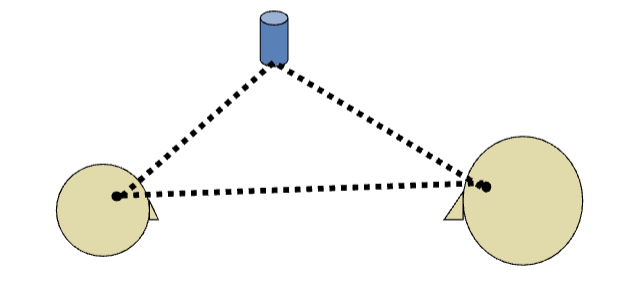
Communicative and social skills (Carpenter, Nagell, and Tomasello 1998)
between 9 and 15 months
dramatic increase within 9 and 13 months
age of emergence: age when first able to perform a task
Following adult gaze Showing, Pointing Requesting Assistance
Specific impairments in joint attention: Autism
children with autism have impairments in exactly the social communicative skills that typically develop between 9 and 13 months
thought to have impairments in understanding others’ mental states
When do infants really follow gaze direction, and not simply head turn direction? (Brooks and Meltzoff 2005)
eyes open vs closed
9 mo turn as much when actor has eyes open as when closed
10 mo only turn if actors eyes are open
emerges suddenly SOMEWHERE between 9 and 10 months
Further development in gaze following: blindfold task
Would infants follow gaze more when Experimenter wore a headband (eyes free) or a blindfold (eyes covered)?
12 NO
14 and 18 mo YES
Conclusion: 12-month-olds don’t know yet about how occluders (like blindfolds) block visual contact with objects, but 14-month-olds do.
Theory of mind
Understanding of other people’s actions in terms of psychological concepts like beliefs, desires, emotions, and perceptual experiences
Why might goals and intentions be difficult for infants?
they are invisible
they are abstract
and they must be inferred from visible behavior
Explore top notes

