International Relations Final
 Studied by 0 people
 Call Kai
 Learn
Learn Practice Test
 Spaced Repetition
 Match
Match Flashcards
 Knowt Play
1/236

Earn XP
Description and Tags
Thurs Dec, 18th, 3-5 pm
Name | Mastery | Learn | Test | Matching | Spaced | Call with Kai |
|---|
No analytics yet
Send a link to your students to track their progress
237 Terms
What do civil war and terrorism have in common?
Use of violence for political goals by non state actors
Rebel groups and terrorists share some similar strategies
There is a very close empirical relationship between civil wars and the incidence of terrorism
Are civil wars (intrastate) or interstate wars more common? (1816-2019)
Why does war occur within states?
Conflicts of interests - Grievances, Greed, Separatism, and plots against the government
What are grievances in the causes of civil war (conflicts of interest)
Grievances can arise when government policies discriminate against members of a particular group, whether by repressing their language or culture, blocking their access to jobs or political office, or denying them government services, such as education, health care, and public infrastructure.
Ex) Iraq’s Treatment of Kurds
What is greed in the causes of civil war (conflicts of interest)
Greed is a group’s desire to control more of the country’s economic resources
Ex) Central Africa has many conflicts over access to lucrative natural resources like diamonds, gold, and oil
What is separatism in the causes of civil war (conflicts of interest)
Separatism is when a rebel group seeks to carve out a piece of the state’s territory. A group is separatist if it wants to create its own independent state in the territory.
Ex) The South seceding in the US Civil War
Plots - causes of civil wars (conflicts of interest)
Plots to overthrow the national government
Ex) Syria and Libya
Why does war occur within states?
Collective action problem, group level factors, country level factors, international factors, bargaining failures
What are Collective Action Problems (Why does war occur within States)
A collective action problem or social dilemma is a situation in which all individuals would be better off cooperating but fail to do so because of conflicting interests between individuals that discourage joint action - We need to figure out how to overcome it
What are Group-level factors (Why does war occur within States)
Groups organize for rebellion when they share ethnic, religious, or linguistic affinity; have access to resources to garner support; and/or share a sense of injustice directed at the government.
What are the two steps in studying civil war and terrorism?
First, identifying factors that bring together groups willing to use violence for their interests. Second, examining why interactions between these groups and their targets sometimes lead to costly, protracted conflicts
What are Country-Level Factors (Why does war occur within States)
National wealth and regime type: armed rebellion more likely when country is poor and/or undemocratic
Geography and population: armed rebellion more likely if country has difficult terrain or large populations that make it hard to find rebels.
What are International factors (Why does War occur within States)
Foreign states may be arming or aiding rebels whom they support, or they may be sanctioning the government that they do not support such as proxy wars.
Example of Group-Level factors - Causes of War within States
Kashmiri Hizbul Mujahideen struggle against India is a group-level conflict pitting separatist Kashmiris against Indian rule.
What is the Hizbul Mujahideen
Members of the Kashmiri separatist group Hizbul Mujahideen have sued terrorism to impose costs on India to compel an end to Indian rule in Kashmir so that the region can join Pakistan
Example of International Level Factors? (Causes of Civil War)
Civil War in the Democratic Republic of the Congo 1996 - Fueled by intervention of neighboring states
What was the Arab Spring?
Mass protests in various countries, including Tunisia, Libya, Egypt, Syria, Yemen, and Bahrain.
All the protests were driven to some degree by the same set of factors: a large number of unemployed young men, an increase in food prices, and long-standing dissatisfaction with corrupt and repressive governments.
In all cases, the protesters demanded the removal of government officials and/or liberalization of the regimes.
Outcomes varied
Why do some protests escalate into war but others remain peaceful?
Depends on how the state responds - peacefully or violently
Foreign intervention
What truly fuels civil wars - Grievance or Greed?
Grievances - but they can flow into each other
Grievances can come out of greed - when there is discrimination, only some groups are given access
What was outcome of Arab Spring in Tunisia?
Mass protests in Tunisia led to the resignation of president Zine al-Abidine Ben Ali in January 2011 and the establishment of a new government without largescale violence
What was outcome of Arab Spring in Syria?
Yet, in Syria a violent crackdown ended in full scale civil war that has spread into neighboring sites and facilitated the spread of the Islamic State
Why does war occur within states - What are types of bargaining failures?
Information asymmetries, public information matters, commitment problems, indivisible goods
What is information asymmetries (why does war occur within states?)
both sides hide private information about strength, resolve, or resources
What are public information matters? (why does war occur within states?)
Civilians can reveal valuable info about both government and insurgents
What are commitment problems (Why does civil war occur within states)
Neither side can trust the other to keep peace deals •Example: Sudan–South Sudan oil-sharing agreement collapse •Issues: disarmament, shifting power, multiple rebel groups
What are indivisible goods (Why does civil war occur within states)
disputes seen as zero-sum (e.g., territory, sovereignty, resources)
Ex) South Sudan’s oil wealth viewed as indivisible
Strategies and resolving civil wars - A Summary
Insurgency, counterinsurgency, conventional military forces
What is insurgency (Strategies and resolving civil wars)
The most common strategy in civil war; asymmetric warfare conducted by rebel groups or terrorists fighting strong states.
Small units of lightly armed rebels target government, civilian, or military sites in hit-and-run attacks. They do not seek to capture and hold territory.
What is counterinsurgency (Strategies and resolving civil wars)
Conventional military forces are not always very effective against insurgencies. Often, conventional armies inflict collateral damage by killing women, children, and noncombatants, as rebels tend to embed themselves in local populations or remote outposts that are difficult to target with precision
What are conventional military forces (Strategies and resolving civil wars)
“Hearts and minds” - Emphasizes building goodwill among the population by providing security, jobs, infrastructure, goods, and services
Example of insurgent strategies/groups
Al-Rahman Corps - Many of the small armed groups involved in the Syrian Civil War, including the Al-Rahman Corps, have used insurgent strategies in their fight against the Syrian government
Puzzles about terrorism
“Ancient hatreds” alone do not explain terrorism - it can be understood as a bargaining failure
Terrorism as a bargaining failure (types)
Incomplete information, commitment problems, indivisibilities
Terrorism and Incomplete Information
Target states often lack reliable information about terrorist groups, they make information secretive and scarce, and tend to exaggerate strength and resolve attacks
Terrorism and Commitment Problems
Terrorists have a difficulty to commit to peace/threats cannot be seen as credible
Terrorists can most credibly demonstrate their commitment to peace by publicly renouncing terror, disarming, and giving the target or some neutral third party full access to the network so as to alleviate any lingering information problems
Example of Terrorism commitment problems
Basque separatist group Euskadi Ta Azkatasuna (ETA) carried out terror attacks in effort to gain independence from Spain, where both sides wanted peace for a long time before ETA finally dissolved in 2018.
What are terrorist strategies?
Coercion, provocation, spoiling, outbidding
What is coercion (Terrorist Strategies)
Seeks policy change by imposing or threatening costs on the target. Uses fear to pressure citizens to demand government action
Example of coercion (terrorist strategies)
Al Qaeda’s 9/11 attacks aimed to force US withdrawal from the Arabian Peninsula and end support for Saudi Arabia
What is provocation (Terrorist strategies)
A strategy of terrorist attacks intended to provoke the target government into making a disproportionate response that alienates moderates in the terrorists’ home society or in other sympathetic audiences.
Example of Provocation (terrorist strategies)
After 9/11, US actions in the middle east (invasion of Iraq) and drone strikes which killed civilians led to more recruitment/support of terrorist groups
What is spoiling (Terrorist strategies)
Terrorists use violence to sabotage (“spoil”) peace negotiations. Undermine trust between target state and moderate leaders, states doubt moderate’s sincerity about peace
Likely to occur during/shortly after peace negotiations
What is outbidding (terrorist strategies)
When two or more terrorist groups attempt to outbid/out-do demonstrations to gain support in home population
Counterterrorism strategies
Preemption, defensive measures, criminalization, negotiation and compromise are all used. Very difficult to deter
What is preemption (counterterrorism strategies)
Stopping terrorists before they strike - can get problematic fast
Ex) US Using remotely piloted drones to target suspected terrorists (can cause civilian casualties)
Example of negotiation and compromise in counterterrorism strategies
Good Friday Agreement of 1998 between Ireland and Northern Ireland (UK).
Free movement needed to be upheld in during Brexit (2021)
True or False: A proxy war is an example of how a country-level factor may contribute to a civil war.
What’s so good about trade?
Trade is mutually beneficial!
Who are the actors in trade?
Producers, consumers, importers, and exporters
Opportunities (Whats so good about trade)
Offers opportunities to producers
New Markets (What’s so good about trade)
Producers can sell to new markets and expand business
More efficiency (What’s so good about trade)
Producers can increase efficiency
Cheaper products (What’s so good about trade)
Consumers get less expensive goods, freeing wealth for other uses
Division of labor (What’s so good about trade)
Instead of self-sufficiency, each actor concentrates on and earns income from what he does best and trades for remaining needs.
Specialization (What’s so good about trade)
Each country can specialize in an area in which it has an advantage
Ex) agricultural, industrial, natural resources, high tech production
Absolute advantage (What’s so good about trade)
One country is more efficient than another at one product
What is an example of absolute advantage (What’s so good about trade)
The US is very efficient in financial services, while China is very efficient in assembling material products
Comparative Advantage (What’s so good about trade)
Even if a country is not the most efficient at a given product when compared to other countries, it should specialize in this field if that is what it does best. Producing other products less efficiently wastes resources
What are the factors of production?
The inputs needed for creating a good or service - Land, labor, and capital
Heckscher-Ohlin Trade Theory
Nations export goods that use their abundant factors intensively
Capital-abundant countries → export capital-intensive goods (e.g., high-tech, finance).
Labor-abundant countries → export labor-intensive goods (e.g., manufacturing, assembly).
How does the Idonesia Textile Industry example the Heckscher-Ohlin Theory?
Shows how specialization by factor abundance promotes mutual gains from trade
Indonesia — abundant in unskilled labor → exports labor-intensive goods.
Textile and garment industries benefit from low labor costs and global demand
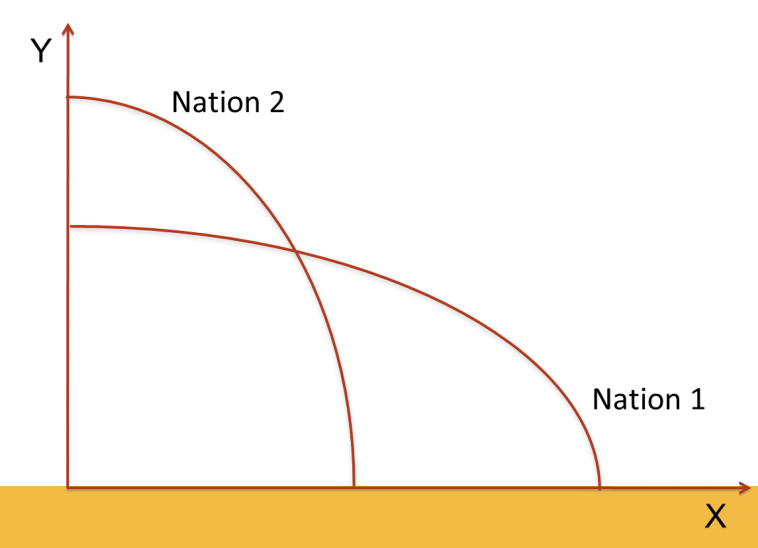
What is this image?
What is Intrafirm Trade?
Modern trade often occurs within firms, not just between countries.
About one-third of U.S. trade is intrafirm — showing that trade can reflect corporate networks, not just national advantages.
ex) Coca-Cola has 225 bottling partners in 200+ different countries
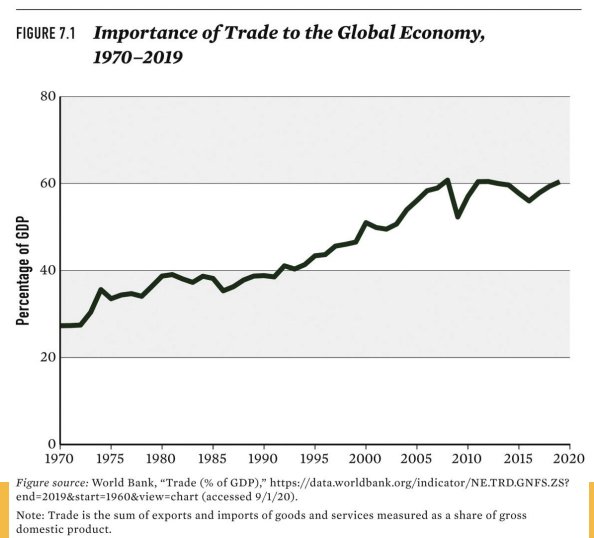
Importance of trade to the global economy, 1970-2019
Trade has become an increasingly large part of the global economy since 1970
Types of trade restrcitions
Tariffs, quotas, nontariff barriers, subsidies, and prohibitions
What are tariffs (Trade Restrictions)
Taxes on the import or export of a good
What are quotas (Trade Restrictions)
Limits on the volume or values of goods that can be traded
Ex) In the 1980s, the US restricted the number of Japanese cars that could be imported
What are nontariff barriers (Trade Restrictions)
Barriers that are not taxes
Ex) Legislated preferences (“Buy American”), health and safety standards, and anti-dumping penalties
What are prohibitions (Trade Restrictions)
Some exports are prohibited. Often these are sensitive military technologies
What are subsidies (Trade Restrictions)
Government payments to businesses producing goods and services to export
Ex) EU and US Agricultural subsidies are notorious
How can subsidies be problematic? (example) (Trade Restrictions)
Brazil brought a case against the United States in the WTO, complaining that U.S. cotton subsidies were hurting Brazil’s cotton exporters on world markets. The WTO ruled in favor of Brazil
What do trade barriers do?
Trade barriers shift income from consumers & foreign producers → domestic producers. With less competition, domestic firms can raise prices and profits
What is protectionism? (trade barriers)
The imposition of trade barriers to restrict imports
*Most of today’s rich countries were strongly protectionist at some point in their history.
Why do domestic firms support protectionism?
With less competition, domestic firms can raise prices and profits and gain stronger political influence due to collective action advantages.
What is a downside of protectionism?
Protectionism creates deadweight loss and higher consumer prices
What is an example of producer interests shaping protectionist policy?
Arbenz Case in Guatemala - CIA Backed Coup
How has public opinion on trade changed from 2002 to recent years?
From 2002 to 2011, negative views of trade rose by 11%, but in recent years, a majority now see trade as an opportunity for growth
What are domestic preferences in trade policy?
Factor-based preferences (The Stolper-Samuelson approach)
What is the Stolper-Samuelson approach?
Trade affects income distribution between factors of production (labor vs. capital). Owners of abundant factors benefit from trade liberalization, while owners of scarce factors lose
What are Specific Factors-Based Preferences/Ricardo-Viner approach?
Actors’ preferences stem not from their ownership but their employment or industry.
Everyone (workers, managers, investors) in a competitive industry will favor free trade, as in the U.S. software sector
Everyone in an uncompetitive sector will favor restrictions, as in the U.S. textile industry
Example of Ricardo-Viner Model
US Steel Industry - The U.S. steel industry seeks protection from cheap imported steel because steel-making equipment is industry-specific and assets cannot easily be repurposed
Assets are “stuck” in the industry, producers care about steel-sector profits, not the overall economy. This illustrates how sector-based interests shape trade preferences and lobbying for protection.
How do sector-based interests shape trade policy?
Producers care about profits in their specific industry rather than the overall economy, influencing lobbying for protection.
What is an example of Collective Action and Trade Politics (Domestic Political Economy of Protection)
USMCA (2018) - Regional Trade Agreement containing US, Mexico, and Canada. Focused on trade barriers in key sectors like dairy and automobiles. Reflects how domestic industries lobby for protection or access
What do trade agreements do?
Balance competing interests - Producers seek PROTECTION, consumers seek LOWER PRICES
What shapes attitude towards trade?
Sometimes, Non-economic factors such as national pride - Some citizens believe domestic goods are superior, nationalists skeptical of globalization and free trade
What is the significance of CETA and TTIP?
Generated massive public and political debate about globalization, democracy, public services, and regulatory sovereignty, influencing trade policy discussions worldwide.
Sparked public protests (e.g., in Poland) over threats to domestic agriculture and consumer rights
Reflected rising skepticism toward globalization and multinational trade deals.
What broader political trend do CETA, TTIP, Trump’s election, and Brexit illustrate?
A shift away from free trade toward protectionist and economic populist politics.
What are interactions in International Institutions and Trade Policy?
Trade policy of one country depends in part on policies of other countries,
How are interactions in international trade affected by international economic conditions?
Depression or growth in economic conditions influences costs and benefits of trade
Ex) 2008 financial crisis and Eurozone crises → reduced global demand, hurting exporters.
Ex) Great Depression (1930s): world trade volume fell by 67%.
How do international institutions affect trade policy?
Institutions promote cooperation and reduce uncertainty among states
How is the prisoner’s dilemma present in international trade/mutual liberalization?
Countries acting as mercantilists preemptively close markets, fail to cooperate, and create inefficiency and mutual losses. Cooperation improves with fewer states, repeated interactions, information sharing, linked concessions, and institutional support.
What is the prisoner’s dilemma in International Trade
A & B view trade as a zero-sum game → Believe that one country’s gain must come at another country’s loss.
Seek to reduce imports and expand exports → Protect domestic industries through tariffs or import restrictions.
Distrust free trade and mutual openness → Close markets preemptively, fearing that the other side will do the same (“tit-for-tat”).
As a result, both countries fail to cooperate → Leading to inefficiency and mutual losses.
Barriers to cooperation in International Trade Prisoner’s Dilemma can be overcome when
Fewer states are involved, less information problems, increased interactions, concessions linked to various areas, and institutions promote trade
What was GATT (International Institutions and Trade Policy)
At the end of World War II, Western powers formed the General Agreement on Tariffs and Trade (GATT) - lowered barriers, but its goal was not complete liberalization. Replaced by WTO in 1994
What is the World Trade Organization (WTO)?
more structured, more formal, and more encompassing than the GATT, although its goal is very similar: to encourage the expansion of an open international trading system
Differences between WTO and GATT/Traits of WTO
WTO has larger membership; membership and WTO rules cover about 80 percent of all world trade.
WTO can enforce its provisions; it can authorize sanctions for violators of rules; monitors compliance
WTO’s goal is complete liberalization of all trade.
GATT addressed the easiest issues, such as visible tariffs, yet stalled on more contentious ones, such as services and agriculture
Why are there demonstrations against the WTO?
WTO Creates winners and losers - Some states see the WTO as biased towards rich states, and some may be harmed by trade liberalization. Agriculture remains major source of conflict
Examples of demonstrations against the WTO
2003 Cancun protests where exporters demanded market access and an end to subsidies
1999 Seattle protests ?
What is cross-border investments?
Cross-border investment is the movement of capital (money, assets) across national borders, where individuals, companies, or governments invest in foreign markets for growth, diversification, or strategic resources.
Two categories of foreign investment: Portfolio and Direct
What is a portfolio investment (Cross-Border Investment)
A portfolio investment gives the investor a claim on some income but no role in managing the investment.
 Note
Note  Flashcards (44)