Energy from Food & Mitochondria Chapters 13 and 14
 Call Kai
 Learn
Learn Practice Test
 Spaced Repetition
 Match
Match Flashcards
 Knowt Play
1/10

There's no tags or description
Looks like no tags are added yet.
Name | Mastery | Learn | Test | Matching | Spaced | Call with Kai |
|---|
No analytics yet
Send a link to your students to track their progress
11 Terms
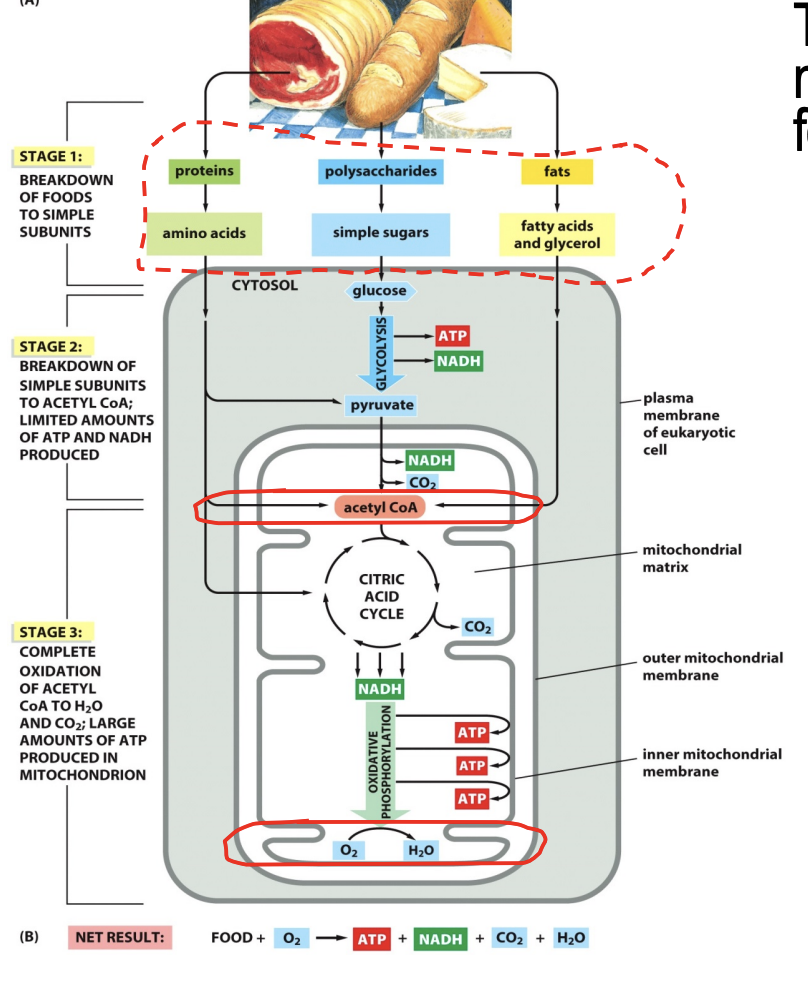
3 steps of cellular metabolism
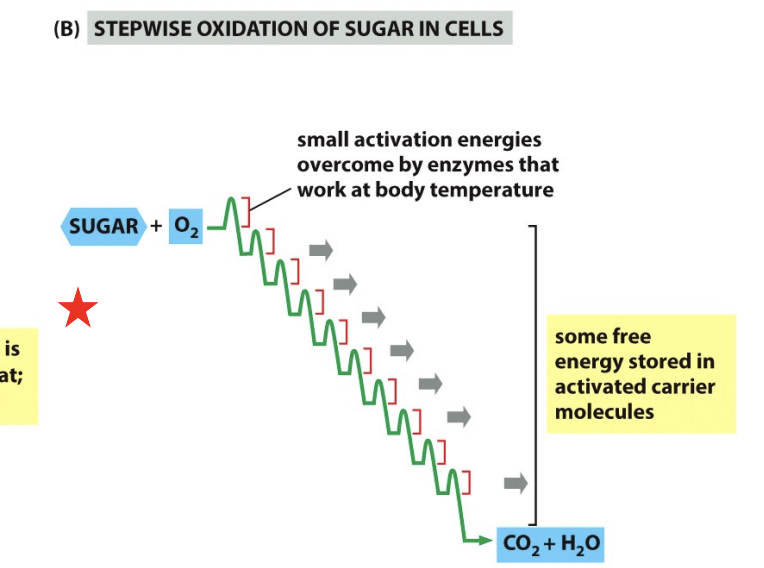
controlled oxidation of sugar (where does the free energy go)
enzymes reduce the activation energy barrier ; so the reaction can occur
the ezyme catalzes the oxidation of sugar and hte free energy is transferred ot carrier molecules; ATP and NADH
the total free energy released in controlled oxidation is the same as directly buring
Glycolysis
2 ATP molecules initiate
Glucose —> • Fructose 1,6 bisphosphate —> glyceraldehyde 3-phosphate (G3P) —> broken into 2 molecules of pyruvate + 4 ATP + 2 NADH.
Net gain: 2ATP + 2NADH.
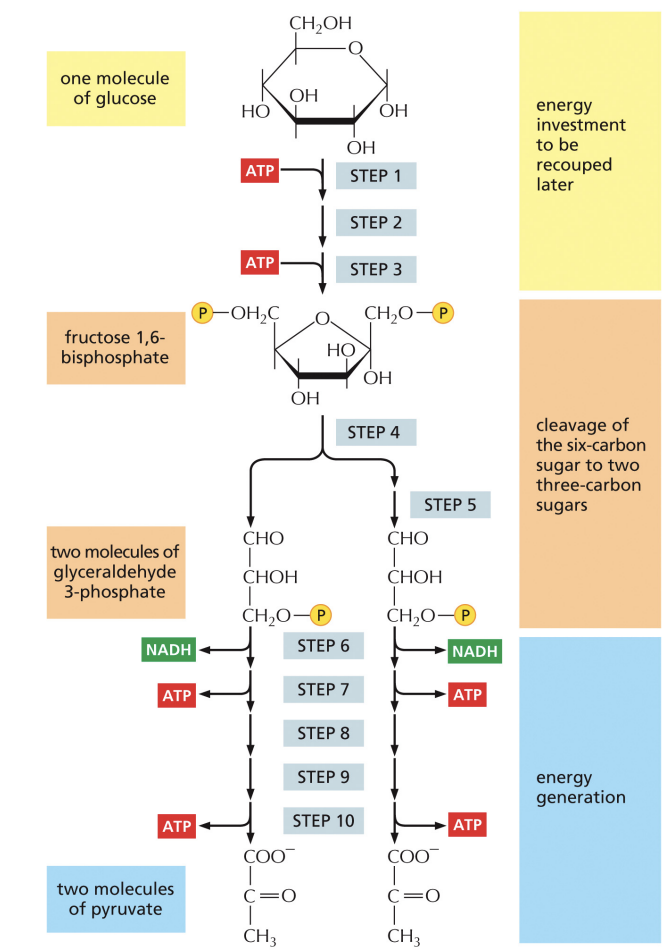
substrate-level phosphorylation -
Involves the transfer of a phosphate group directly from a substrate molecule
where does glycolysis occur
cytosol
Fermentation
pyruvate is turned into lactate —> accepts the hydrogen —> this restores NAD+ that is consumed in glycolosis
much less energy is used
pyruvate —> acytel CoA
imported into the mitochondrial matrix
pyruvate dehydrogenase —> acytel CoA + CO2 +NADH
Citric Acid cycle (how it starts; why it is a cycle; products?)
oxaloacetate accepts acetyl CoA
oxaloacetate is regenerated (why it is a cycle)
Acetyl CoA —> 2C is removed and bonds with O2 (from H2O) to form CO2
GTP, 3 NADH and FADH2 (high energy electron carriers produced)
Fatty acids (what is FADH2 reduced to; whta is produced)
Fatty acids are a primary energy source (along w/ sugars)
ezymes remove 2 carbons and produce acetyl CoA + NADH +FADH2 with each turn
FADH2 is reduced flavin adenine dinucleotide.
why is the fatty acid cycle a cycle
2 carbosn are removed at a time
Gluconeogensis (when does it happen; initated when…is abudant)
process in which blood glucose is synthesized from small
non-carbohydrate organic molecules such as lactate, pyruvate, or amino acids.
require an input of energy,
whereas glycolysis as a whole is an energetically favorable set of reactions.
glucose is broken down when energy is running low ; opposite if hter eis sufficient reserves in liver cells
Glycolosis is activated by AMP, ADP and inorganic phosphate (the byproducts of ATP hydrolysis), and inhibited by ATP, citrate, and fatty acid

