SCM training
 Call Kai
 Learn
Learn Practice Test
 Spaced Repetition
 Match
Match Flashcards
 Knowt Play
1/42

There's no tags or description
Looks like no tags are added yet.
Name | Mastery | Learn | Test | Matching | Spaced | Call with Kai |
|---|
No analytics yet
Send a link to your students to track their progress
43 Terms
JKM- 5 c of philosophy
committed to the welfare, positive growth, and development, of indivuals being served
Provide consistency- kids must be able to predict
Must have competency
Courage- do what is right!- Advocate for the kids.
What is the most importantly rational for training?
Safety
The DCH believes this about the kids and staff safety
Kids safety is more important than staffs safety.
What are the 5 rationales for training
safety
Creating and maintaining a trauma sensitive culture
Reality of individuals
Liability- documentation is important!
Professional performance expectations
Gross negligence/simple negligence
Error that causes little harm.
Dysfunctional Pathways Most critical time
3-6 years
Dysfunctional pathway
Dysfunctional interactions are models
→ poor social skills acquired
→ Behavior of concern ( when they are out of that Env those cooping skills don’t work)
→ Peer and adult rejection
→Assocation with “out group” of Rejected and Failing peers
→ Amplification of Deviance within peer group and Emegence of Deviant subculture
Types of stress
positive stress
Tolerable stress
Toxic stress
Positive stress
Leads to increase in heart rate and mild elevation in stress hormone; can be helpful in supporting our ability to complete task and stay motivated
Tolerable stress
Is predictable, Moderate, can be serious but temporary and buffered by suppoartive relationships; leads to resilience
Toxic stress
long-term, intense stress that occurs when a person experiences strong or repeated adversity without enough support or protection from caring relationships.
Survival brain
The brain stem- primary function is to relay information between the body and brain. Responsible for basic survival functions such as breathing/heartbeat. Prepares the body react when there is a threat.
Emotional brain
Limbic Responsible for processing emotions and memory. Includes the amygdala (smoke alarm) - prep fight/flight/freeze response, hypothalamus -(walki talki) -tells the body what to do, and hippocampus (files save) -stores memory
Thinking Brain
Neocortex- prepares for conscious though, decision-making, logic.
What are the social needs
-power
-Achievemnet
-Affiliation
What are the Roles of polsky’s diamond
Leaders
lieutenants
Members
Status serves
Scapegoats
What are the defining behaviors
-measurable
Observable
Objective
in defending behavior it must be measurable what does that mean?
Time, counted. “How many times?”, “How long?” “How far”
What does it mean for the defining behavior to be observable. When documenting?
Visible descriptive “would someone who was not present be able to accurately ‘picture this’
Objective
Like the pbesevered in an experiment
What are the three types of behavior
behavior of concern
Desired behavior
Replacement behavior
What are common sources of behavior of concern?
Carry in behavior
Carry on behavior
Tune in behavior
Describe the behavior cycle
Behavior Cycle
The behavior cycle refers to the sequence of events or stages that can lead to the development and maintenance of a behavior, often involving triggers, actions, and consequences. It typically includes the following stages: 1. Trigger: An event or situation that initiates a behavior. 2. Action: The behavior that is performed in response to the trigger. 3. Consequence: The outcome or result of the behavior that influences future occurrences of that behavior.
Behaviors are potentially aggressive
Aggression is fueled by emotion, which can be cumilitve and transferable
Describe counter aggression and why is it important
Aexithymia
The condition in which the individual cannot verbalize the emotions they are experiencing
What are the professional boundaries
-be respectful
-provide personal space
-maintain professional Relations
-use Appropriate levels of affection
-follow through ( ensuring commitments)
-model acceptable behavior
-provide and maintain privacy
Ineffective communication styles
Passive communication
Passive aggressive communication
Aggressive communication
When talking with kids should you use open or close ended question
Open needed questions
Use appropriate tone, regulation, rate and volume of voice
Explanation
What are the attending skills egan’s listening process
Sit squarely- 5’ock is preferred
Open posture
Lean
Eye contact
Relax
Assertive communication
Think before you speak
Speak clearly
Make eye contact with there audience
Show humility
Own their mistakes
Advocate for what is right
Management of the ENV
strategic positioning
Use movement
Se and hear all indivuals
Communication devices
Exits
Potential Hazards and sensory stimulation
START
Stop
Think
Analyze
Respond
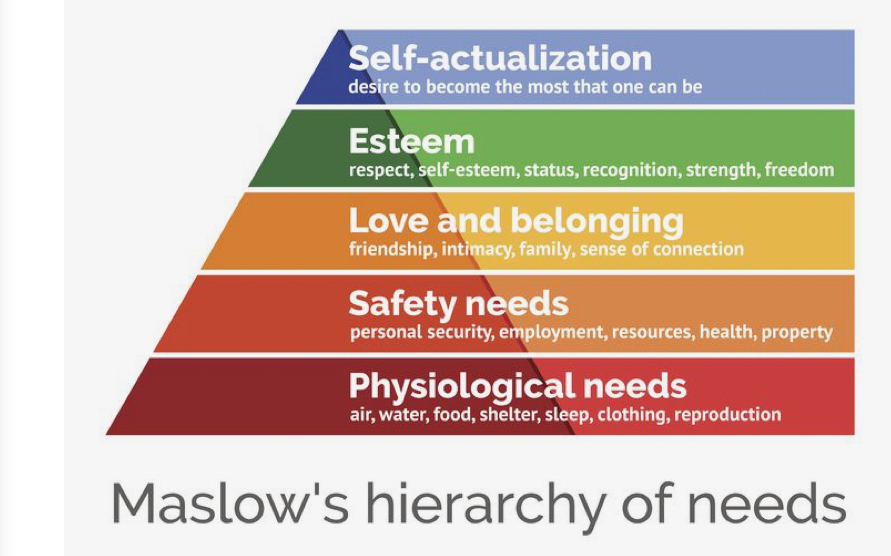
What are Maslow’s Hierarchy
-self actualization
-esteem
loving and belonging
Safety needs
Providing positive reinforcement for placement and desired behaviors while withholding reinforcement of behaviors
Differential reinforcement
What are the Intervention Judgemnt Reminders types
Understanding Individuals
Understanding Behavior
Universal principals and practices
What are the verbal Interventions that are encouragement
Indicate concern
Use clear language
Offer Assistance
Attempt to Divert Focus
Recommend use of replacement behavior
Offer choices
Appeal for cooperation and participation
What are the types of verbal interventions
Encouragement
Discussion
Direction
What are the types of discusion in verbal interventions
open ended questions and phrases
Paraphrases
Validate
Use minimal encouragement and pauses
Perception checking
Expolre solutions
Provide feedback and summarize
Direction strategies
Reiterate safety
Benign confrontation
Positive problem solving
Redirection
Positive correction
Limit setting
Consequence Reminder y

