MANA 3335 Exam 2
 Call Kai
 Learn
Learn Practice Test
 Spaced Repetition
 Match
Match Flashcards
 Knowt Play
1/102

There's no tags or description
Looks like no tags are added yet.
Name | Mastery | Learn | Test | Matching | Spaced | Call with Kai |
|---|
No analytics yet
Send a link to your students to track their progress
103 Terms
resources
the assets, capabilities, processes, employee time, information, and knowledge that an organization uses to improve its effectiveness and efficiency and create and sustain competitive advantage
competitive advantage
providing greater value for customers than competitors can
sustainable competitive advantage
a competitive advantage that other companies have tried unsuccessfully to duplicate and have, for the moment, stopped trying to duplicate
valuable resource
a resource that allows companies to improve efficiency and effectiveness. resources that are congruent with company goals (for example, a phone company wouldn't be buying tea leaves)
rare resource
a resource that is not controlled or possessed by many competing firms
imperfectly imitable resource
a resource that is impossible or extremely costly or difficult for other firms to duplicate (for example, social networks within a company that a competitor can't recreate)
nonsubstitutable resource
a resource that produces value or competitive advantage and has no equivalent substitutes or replacements (for example, copyrights and patents)
competitive inertia
a reluctance to change strategies or competitive practices that have been successful in the past
strategic dissonance
a discrepancy between a company's intended strategy and the strategic actions managers take when implementing that strategy
situational (SWOT) analysis
an assessment of the strengths and weaknesses in an organization's internal environment and the opportunities and threats in its external environment (strengths, weaknesses, opportunities, threats)
core capabilities
the internal decision-making routines, problem-solving processes, and organizational cultures that determine how efficiently inputs can be turned into outputs
strategic group
a group of companies within an industry against which top managers compare, evaluate, and benchmark strategic threats and opportunities
core firms
the central companies in a strategic group
secondary firms
the firms in a strategic group that follow strategics related to but somewhat different from those of the core firms
strategic reference points
the strategic targets managers use to measure whether a firm has developed the core competencies it needs to achieve a sustainable competitive advantage
corporate-level strategy
the overall organizational strategy that addresses the question "What business or businesses are we in or should we be in?"
diversification
a strategy for reducing risk by buying a variety of items (stocks or, in the case of a corporation, types of businesses) so that the failure of one stock or one business does not doom the entire portfolio
portfolio strategy
a corporate-level strategy that minimizes risk by diversifying investment among various businesses or product lines
acquisition
the purchase of a company by another company
unrelated diversification
creating or acquiring companies in completely unrelated businesses
BCG matrix
a portfolio strategy developed by the Boston Consulting Group that categorizes a corporation's businesses by growth rate and relative market share and helps managers decide how to invest corporate funds
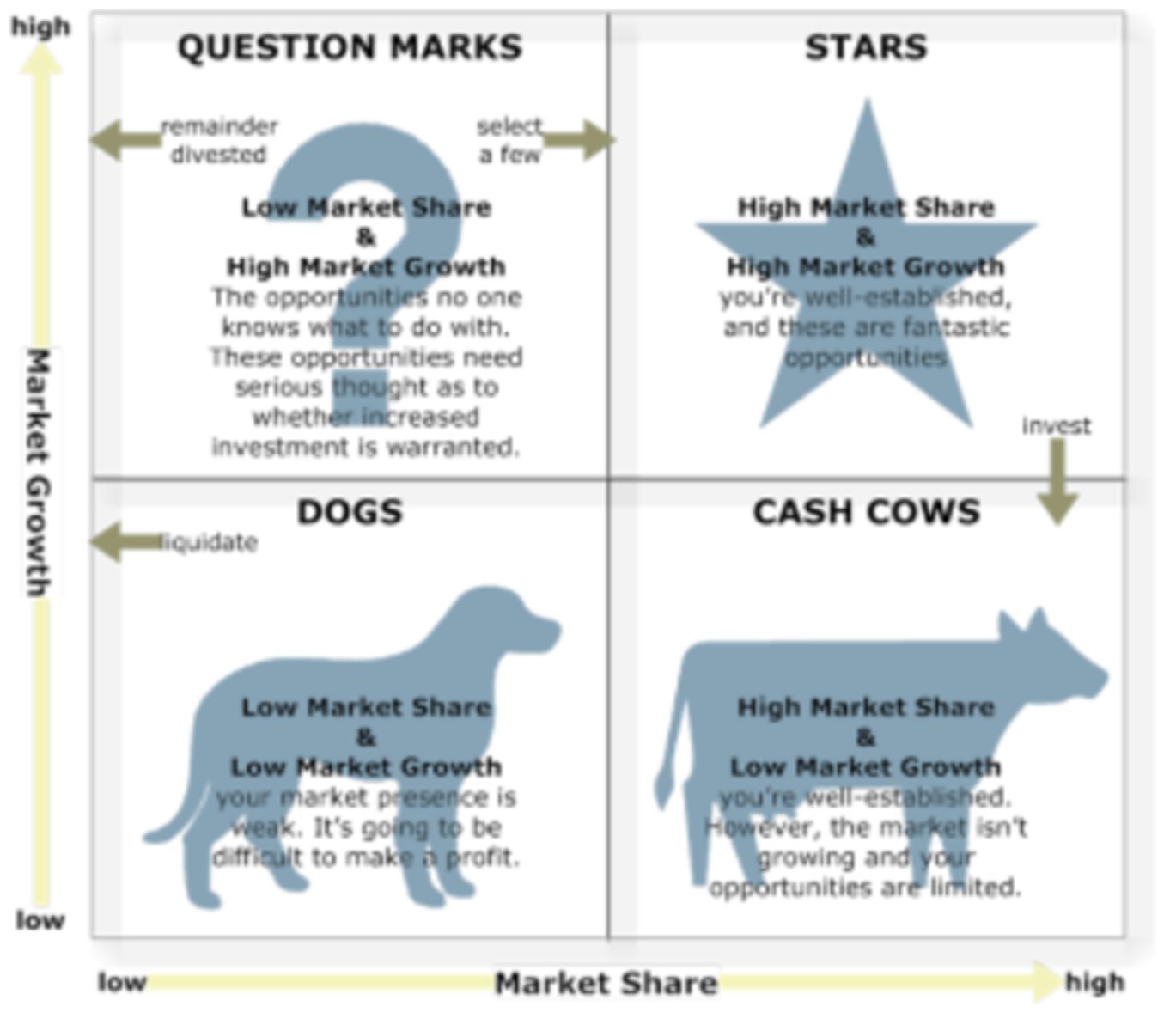
star
On the BCG matrix, a company with a large share of a fast-growing market
question mark
On the BCG matrix, a company with a small share of a fast-growing market
cash cows
On the BCG matrix, a company with a large share of a slow-growing market
dogs
On the BCG matrix, a company with a small share of a slow-growing market
related diversification
creating or acquiring companies that share similar products, manufacturing, marketing, technology, or cultures
grand strategy
a strategy that focuses on increasing profits, revenues, market shares, or the number of places in which the company does business
stability strategy
a strategy that focuses on improving the way in which company sells the same products or services to the same customers
retrenchment strategy
a strategy that focuses on turning around very poor company performance by shrinking the size or scope of the business
recovery
the strategic actions taken after retrenchment to return to a growth strategy
character of the rivalry
One of the five industry forces. A measure of the intensity of competitive behavior between companies in an industry
threat of new entrants
One of the five industry forces. A measure of the degree to which barriers to entry make it easy or difficult for new companies to get started in an industry
threat of substitute products or services
One of the five industry forces. A measure of the ease with which customers can find substitutes for an industry's products or services
bargaining power of suppliers
One of the five industry forces. A measure of the influence that suppliers of parts, materials, and services to firms in an industry have on the prices of these inputs
bargaining power of buyers
One of the five industry forces. A measure of the influence that customers have on a firm's prices.
cost leadership
the positioning strategy of producing a product or service of acceptable quality at consistently lower production costs than competitors can, so that the firm can offer the product or service at the lowest price in the industry
differentiation
the positioning strategy of providing a product or service that is sufficiently different from competitors' offerings that customers are willing to pay a premium price for it
focus strategy
the positioning strategy of using cost leadership or differentiation to produce a specialized product or service for a limited, specially targeted group of customers in a particular geographic region or market segment
defenders
companies using a adaptive strategy aimed at defending strategic positions by seeking moderate, steady growth and by offering a limited range of high-quality products and services to a well-defined set of customers
prospectors
companies using an adaptive strategy that seeks fast growth by searching for new market opportunities, encouraging risk taking, and being the first to bring innovative products to market
organizational innovation
the successful implementation of creative ideas in organizations
technology cycle
a cycle that begins with the birth of a new technology and ends when that technology reaches its limits and is replaced by a newer, substantially better technology
s-curve pattern of innovation
a pattern of technological innovation characterized by slow initial process again as a technology matures and reaches its limits
innovation streams
patterns of innovation over time that can create sustainable competitive advantage
begins with technological discontinuity
followed by discontinuous change
pursued by dominant design
leads to incremental change
technological discontinuity
the phase of an innovation stream in which a scientific advance or unique combination of existing technologies creates a significant breakthrough in performance or functions
discontinuous change
the phase of a technology cycle characterized by technological substitution and design competition
technological substitution
the purchase of new technologies to replace older ones
design competition
competition between old and new technologies to establish a new technological standard or dominant design
dominant design
a new technological design or process that becomes the accepted market standard
technological lockout
the inability of a company to competitively sell its products because it relies on old technology or a nondominant design
incremental change
the phase of a technology cycle in which companies innovate by lowering costs and improving the functioning and performance of the dominant technological design
creative work environments
workplace cultures in which workers perceive that new ideas are welcomed, valued, and encouraged
flow
a psychological state of effortlessness, in which you become completely absorbed in which you're doing the time seems to pass quickly
experiential approach innovation
an approach to innovation that assumes a highly uncertain environment and uses intuition, flexible options, and hand-on experience to reduce uncertainty and accelerate learning and understanding
design iteration
a cycle repetition in which a company tests a prototype of a new product or service, improves on that design, and then builds and tests the improved prototype
product prototype
a full-scale, working model that is being tested for design, function, and reliability
testing
the systematic comparison of different product designs or design iterations
milestones
formal project review points used to access progress and performance
multifunctional teams
work teams composed of people from different departments
compression approach to innovation
an approach to innovation that assumes that incremental innovation can be planned using a series of steps and that compressing those steps can speed innovation
generational change
change based on incremental improvements to a dominant technological design such that the improved technology is fully backward compatible with the older technology
organizational decline
a large decrease in organizational performance that occurs when companies don't anticipate, recognize, neutralize, or adapt to the internal or external pressures that threaten their survival
occurs when companies don't recognize the need for change
change forces
forces that produce differences in the form, quality, or condition of an organization over time
resistance forces
forces that support the existing conditions in organizations
support to the status quo
resistance to change
opposition to change resulting form self-interest, misunderstanding and distrust, and a general intolerance for change
People may do this out of fear that change will result in a loss of pay, power, responsibility, or one's job
unfreezing
getting the people affected by change to believe that change is needed
change intervention
the process used to get workers and managers to change their behaviors and work practices
refreezing
supporting and reinforcing new changes so that they stick
coercion
the use of formal power and authority to force others to change
results-driven change
change created quickly by focusing on the measurement and improvement of results
general electric workout
a three-day meeting in which managers and employees from different levels and parts of an organization quickly generate and act on solutions to specific business problems
organizational development
a philosophy and collection of planned change interventions designed to improve an organization's long-term health and performance
change agent
the person formally in charge of guiding a change effort
work team
a small number of people with complementary skills who hold themselves mutually accountable for pursuing a common purpose, achieving performance goals, and improving interdependent work process
cross-training
training team members to do all or most of the jobs performed by the other team members
social loafing
behavior in which team members withhold their efforts to fail to perform their share of the work
traditional work groups
a group composed of two or more people who work together to achieve a shared goal
employee involvement team
team that provides advice or makes suggestions to management concerning specific issues
semi-autonomous work groups
a group that has the authority to make decisions and solve problems related to the major tasks of producing a product or service
self-managing team
a team that manages and controls all of the major tasks of producing a product or service
self-designing team
a team that has the characteristics of self-managing teams but also controls team design, work tasks, and team membership
cross-functional team
a team composed of employees from different functional areas of the organization
virtual team
a team composed of geographically and/or organizationally dispersed coworkers who use telecommunication and information technologies to accomplish an organizational task
project team
a team created to complete specific, one-time projects or task within a limited team
norms
informally agreed-on standards that regulate team behavior
cohesiveness
the extent to which team members are attached to a team and motivated to remain in it
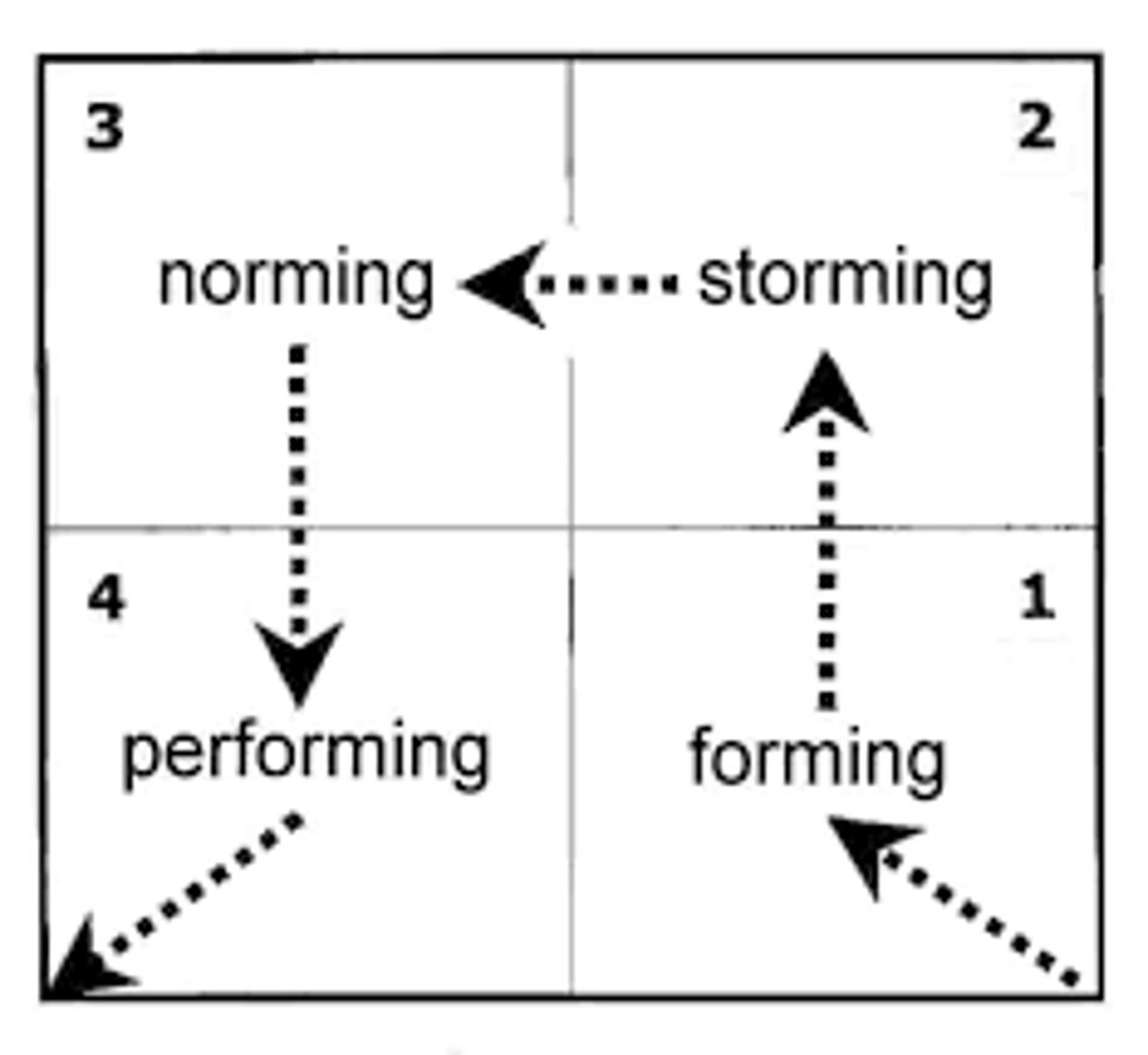
forming
the first stage of team development, in which team members meet each other, form initial impressions, and begin to establish team norms
storming
the second stage of development, characterized by conflict and disagreement, in which team members disagree over what the team should do and how it should do it
norming
the third stage of team development, in which team members begin to settle into their roles, group cohesion grows, and positive team norms develop
performing
the fourth and final stage of team development, in which performance improves because the team has matured into an effective, fully functioning team
de-norming
a reversal of the norming stage, in which team performance begins to decline as the size, scope, goal, or members of the team change
de-storming
a reversal of the storming phase, in which the team's comfort level decreases, team cohesion weakens, and angry emotions and conflict may flare
de-forming
a reversal of the forming stage, in which team members position themselves to control pieces of the team, avoid each other, and isolate themselves from team leaders
stages of team development
structural accommodation
the ability to change organizational structures, policies, and practices in order to meet stretch goals
bureaucratic immunity
the ability to make changes without first getting approval from managers or other parts of an organization
individualism-collectivism
the degree to which a person believes that people should be self-sufficient and that loyalty to one's self is more important than loyalty to team or company
team level
the average level of ability, experience, personality, or any other factor on a team
team diversity
the variances or differences in ability, experience, personality, or any other factor on a team
interpersonal skills
skills, such as listening, communicating, questioning, and providing feedback, that enable people to have effective working relationships with others

