Unit 5.3 Ecosystem Ecology
0.0(0)
 Studied by 3 people
 Call Kai
 Learn
Learn Practice Test
 Spaced Repetition
 Match
Match Flashcards
 Knowt Play
Card Sorting
1/108

Earn XP
Description and Tags
Last updated 6:57 PM on 12/3/22
Name | Mastery | Learn | Test | Matching | Spaced | Call with Kai |
|---|
No analytics yet
Send a link to your students to track their progress
109 Terms
1
New cards
Ecosystem
1. Energy Flow and Chemical Cycling
- Ecosystem
- Physical Laws
a. Conservation of Energy
b. Conservation of Mass
- Energy, Mass, and Trophic Levels
a. Feeding relationships
2. Energy and Primary Production
- Ecosystem Energy Budgets
a. The Global Energy Budget
b. Gross and Net Production
- Aquatic Ecosystems
a. Light Limitation
b. Nutrient Limitation
- Terrestrial Ecosystems
a. Nutrient Limitations and Adaptations
- Effects of Climate Change
3. Trophic Level Energy Transfer
- Production Efficiency
- Trophic Efficiency
- Ecological Pyramids
4. Biological and Geochemical Processes
- Decomposition and Nutrient Cycling
- Biogeochemical Cycles
a. Water cycle
b. Carbon cycle
c. Nitrogen cycle
d. Phosphorus cycle
- Cycle Analysis
5. Restoration Ecologists
- Bioremediation
- Biological Augmentation
- A Review on Ecosystems
- Ecosystem
- Physical Laws
a. Conservation of Energy
b. Conservation of Mass
- Energy, Mass, and Trophic Levels
a. Feeding relationships
2. Energy and Primary Production
- Ecosystem Energy Budgets
a. The Global Energy Budget
b. Gross and Net Production
- Aquatic Ecosystems
a. Light Limitation
b. Nutrient Limitation
- Terrestrial Ecosystems
a. Nutrient Limitations and Adaptations
- Effects of Climate Change
3. Trophic Level Energy Transfer
- Production Efficiency
- Trophic Efficiency
- Ecological Pyramids
4. Biological and Geochemical Processes
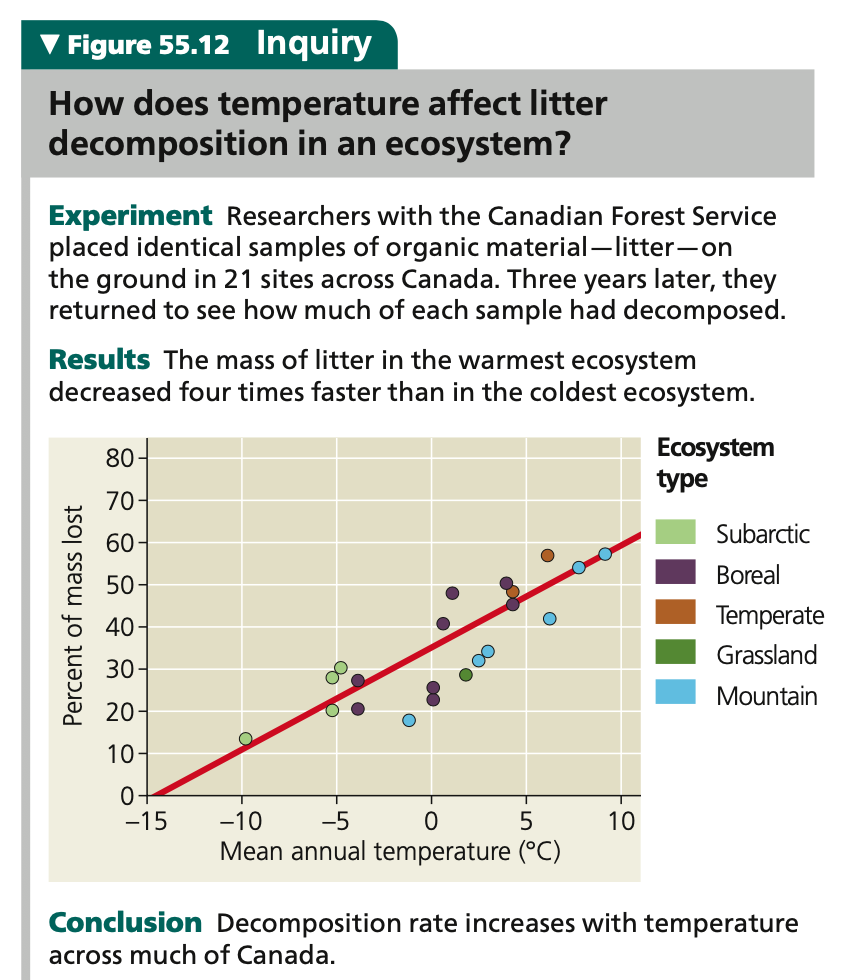
- Decomposition and Nutrient Cycling
- Biogeochemical Cycles
a. Water cycle
b. Carbon cycle
c. Nitrogen cycle
d. Phosphorus cycle
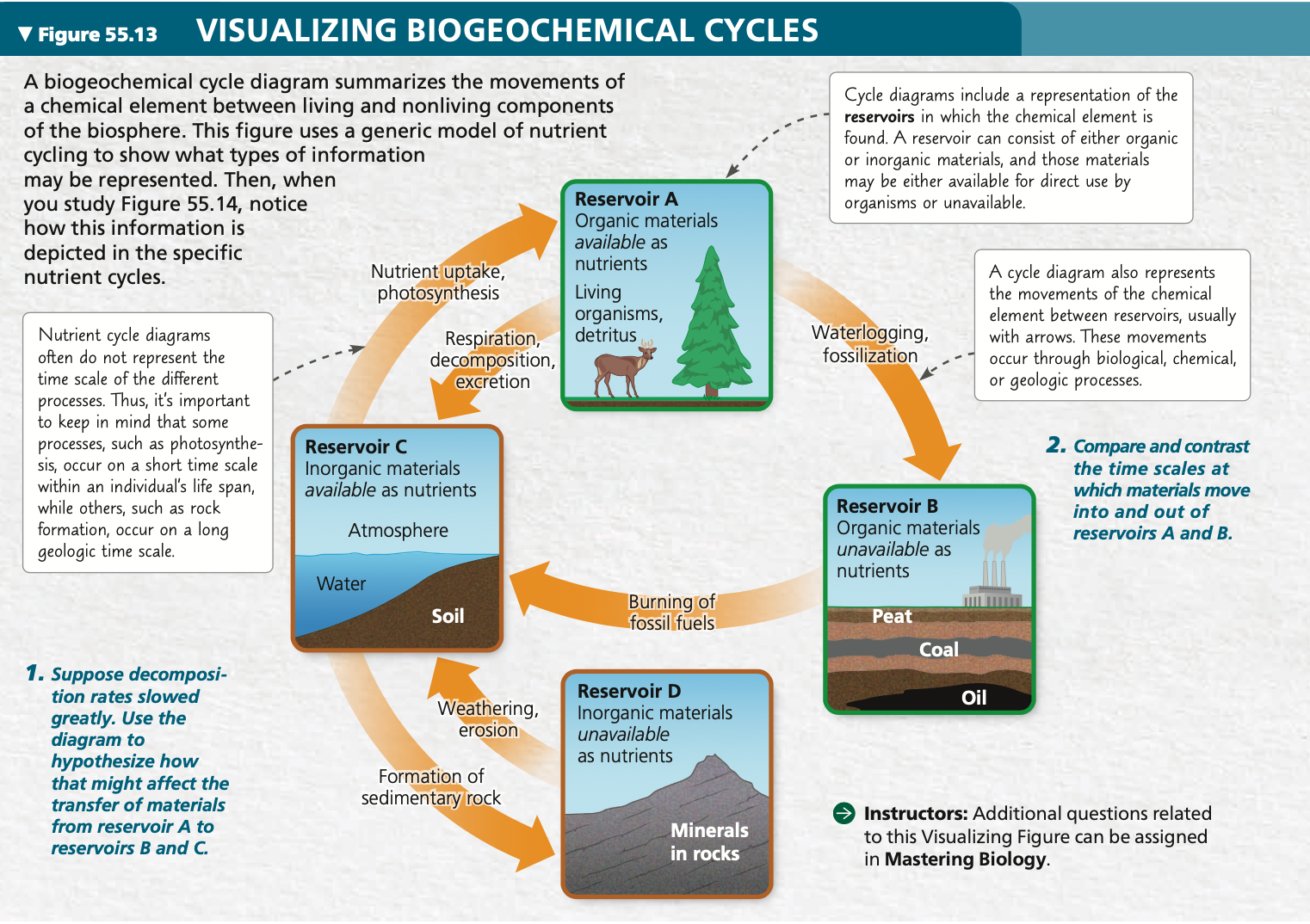
- Cycle Analysis
5. Restoration Ecologists
- Bioremediation
- Biological Augmentation
- A Review on Ecosystems
2
New cards
Energy Flow and Chemical Cycling
- Ecosystem
- Physical Laws
a. Conservation of Energy
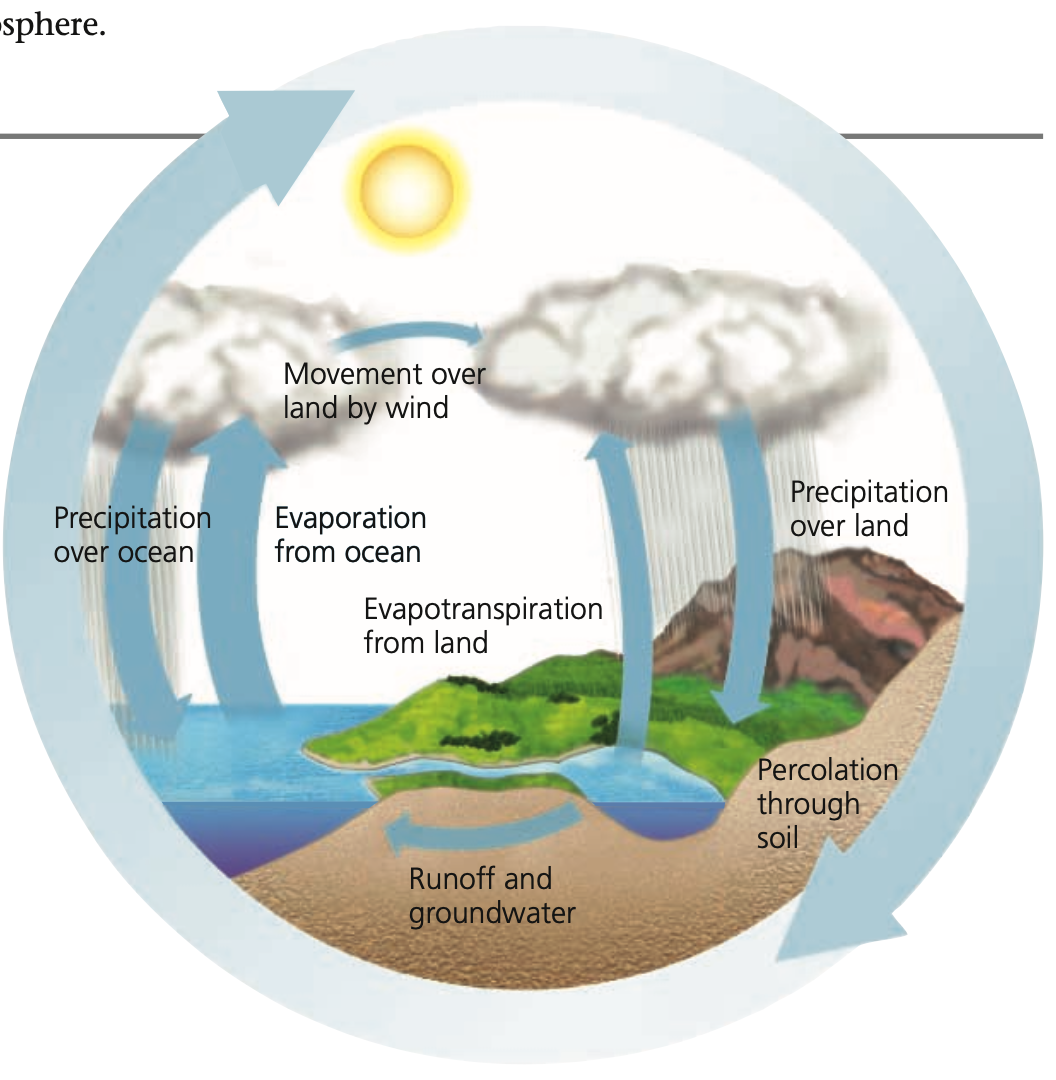
b. Conservation of Mass
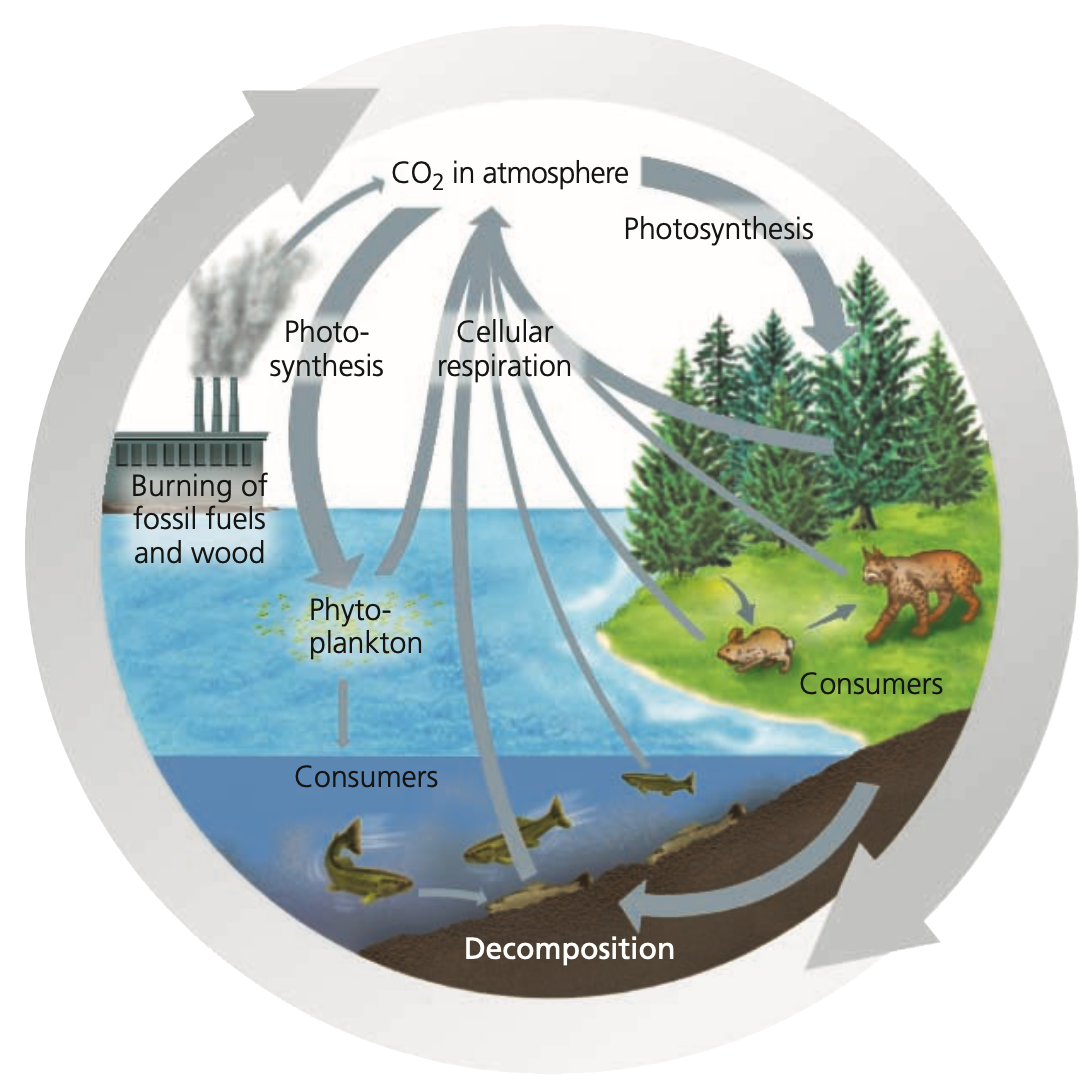
- Energy, Mass, and Trophic Levels
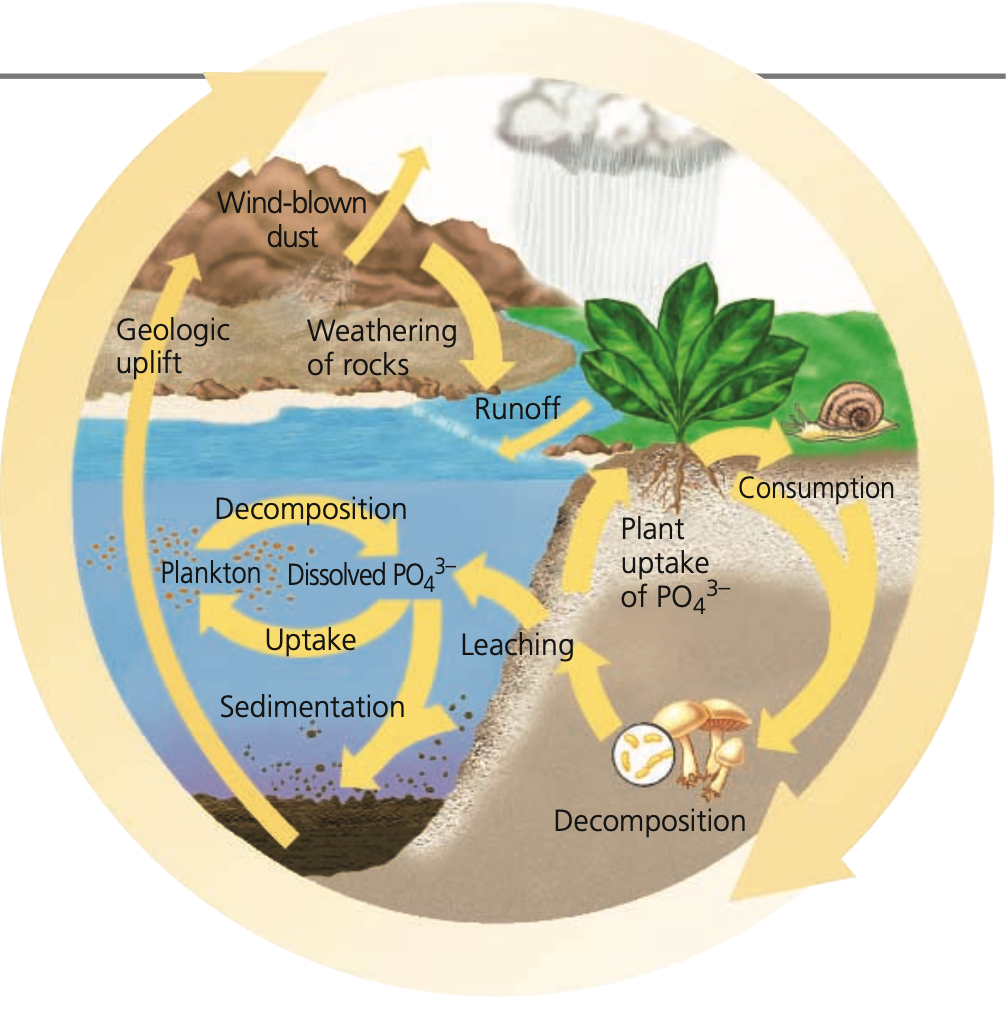
- Physical Laws
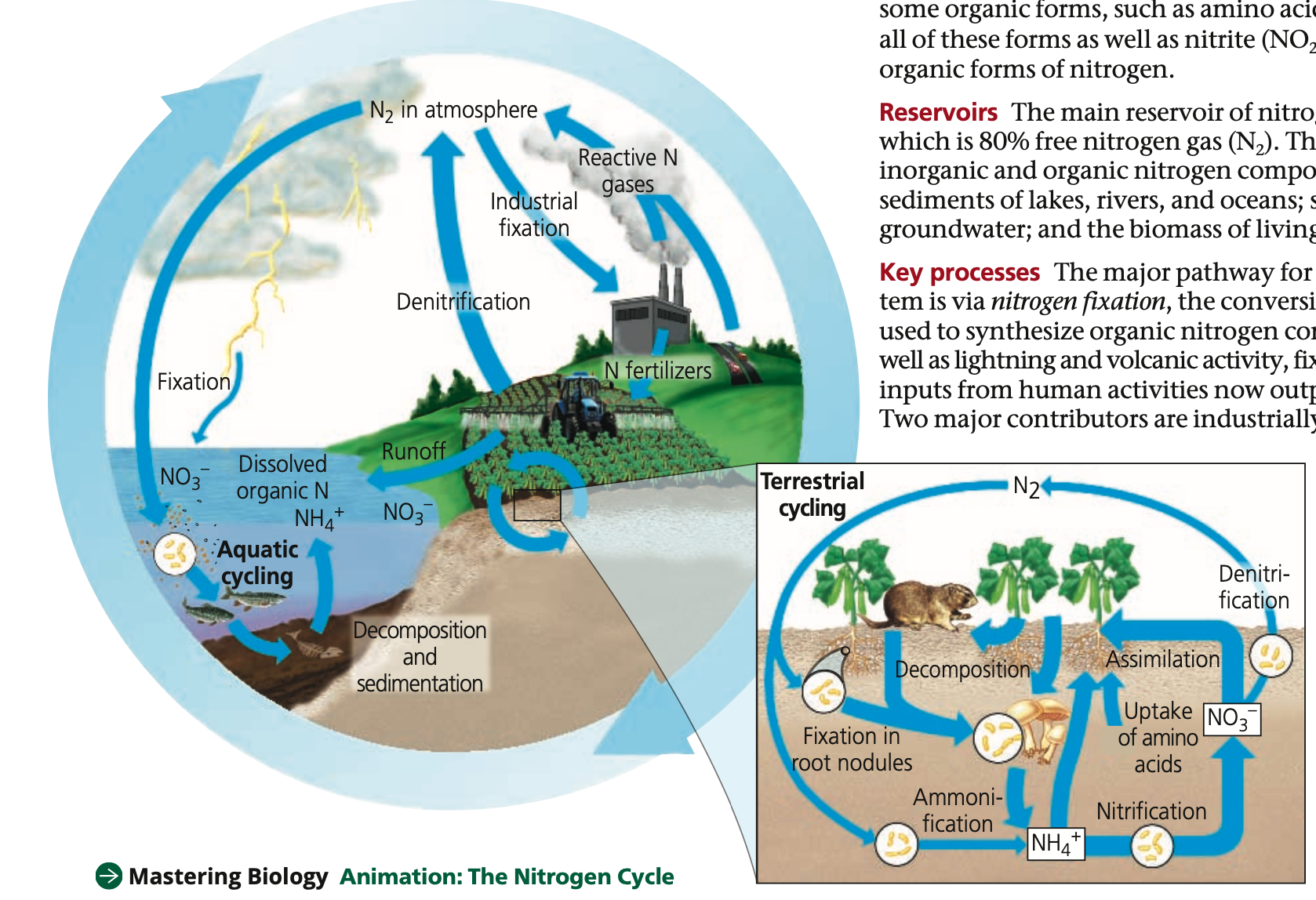
a. Conservation of Energy
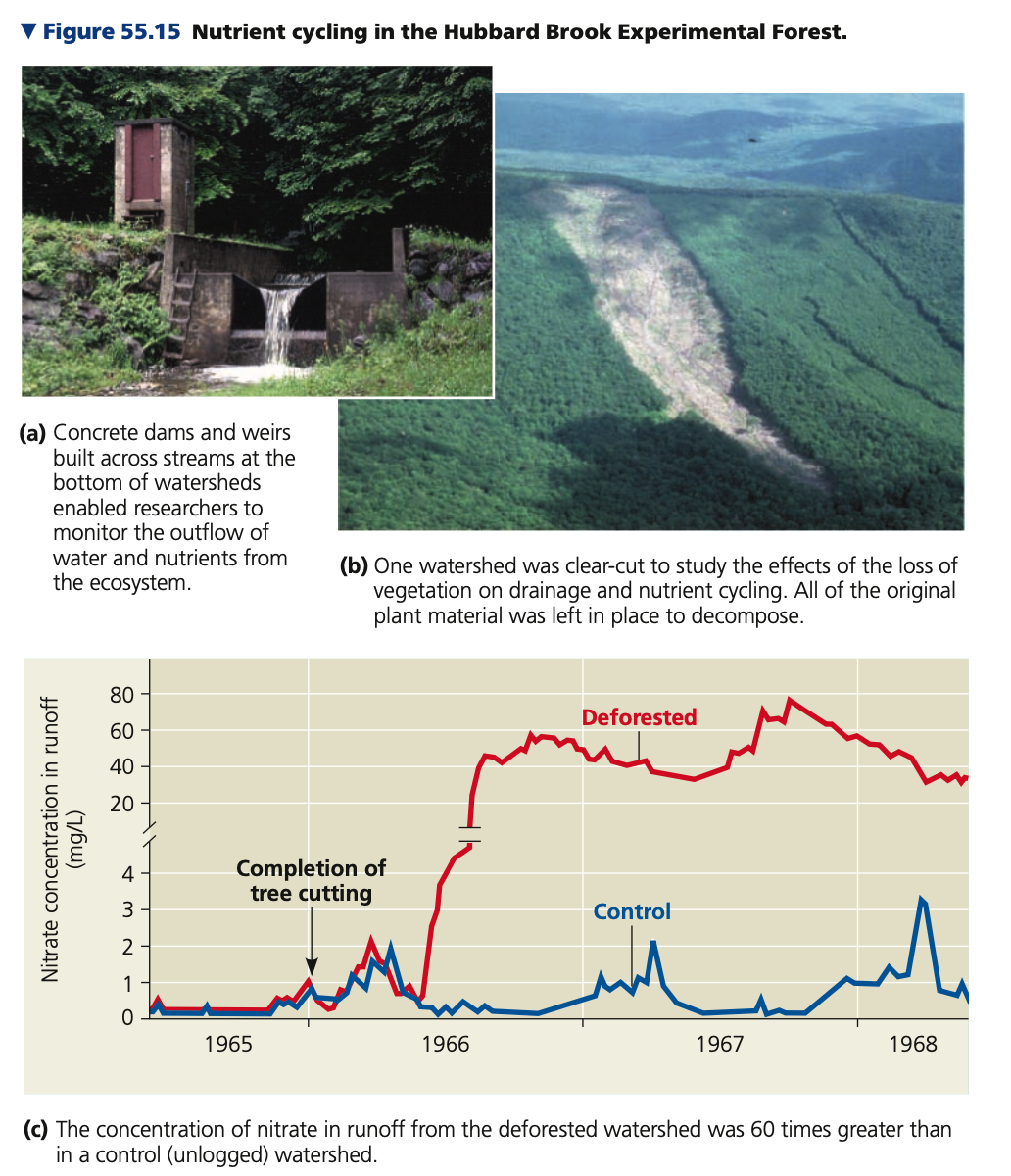
b. Conservation of Mass
- Energy, Mass, and Trophic Levels
3
New cards
Ecosystem
● Living organisms in a given area + abiotic factors they interact with
4
New cards
Biosphere
➔ A global ecosystem
◆ Italicize what the prof said !!!
➔ Composite f all local ecosystems on Earth
◆ Italicize what the prof said !!!
➔ Composite f all local ecosystems on Earth
5
New cards
emergent
Ecosystem
● Two key ______ properties:
1. Energy flow
2. Chemical cycling
● Two key ______ properties:
1. Energy flow
2. Chemical cycling
6
New cards
sunlight, chemical, heat
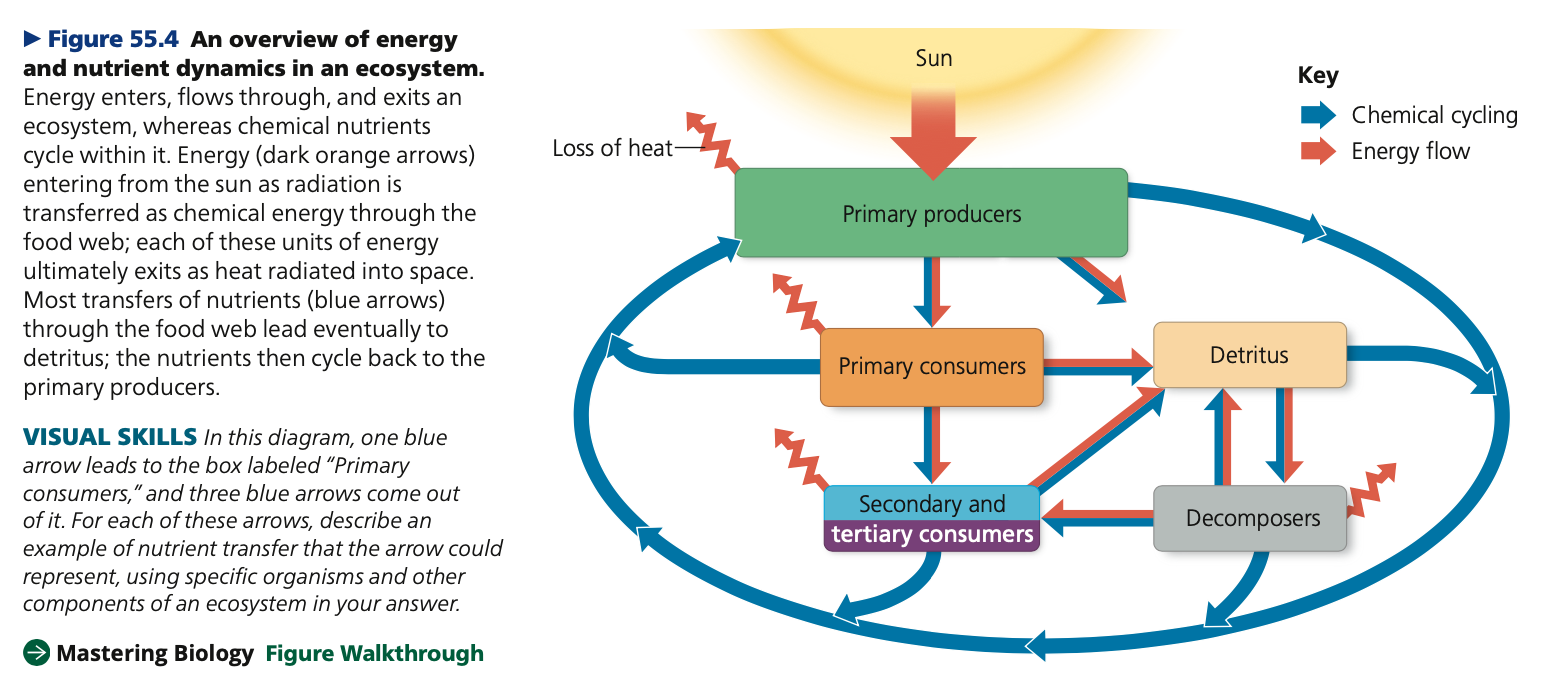
Energy flow
○ Energy enters most ecosystem as ______
○ Is converted into ______ energy by autotrophs
○ Passed in organic compounds as food
○ Dissipated as ____
○ Energy enters most ecosystem as ______
○ Is converted into ______ energy by autotrophs
○ Passed in organic compounds as food
○ Dissipated as ____
7
New cards
Carbon, nitrogen, photo, chemo, biomass, metabolic, decomposers
Chemical cycling
○ _____ and ______ are passed between biotic and abiotic factors
○ Taken up by ____synthetic and ____synthetic organisms and are incorporated into their ______—consumed by animals
○ Elements are returned inorganic form by ______ processes of organisms and by ________ which break down organic wastes
○ _____ and ______ are passed between biotic and abiotic factors
○ Taken up by ____synthetic and ____synthetic organisms and are incorporated into their ______—consumed by animals
○ Elements are returned inorganic form by ______ processes of organisms and by ________ which break down organic wastes
8
New cards
recycled
Ecosystem
● Photosynthesis and feeding relationships transform both energy and chemicals
○ Energy cannot be ______ since it is dissipated as heat
● Ecosystem processes yield resources critical to human survival and welfare
● Photosynthesis and feeding relationships transform both energy and chemicals
○ Energy cannot be ______ since it is dissipated as heat
● Ecosystem processes yield resources critical to human survival and welfare
9
New cards
Physical Laws
● Cells transform energy and matter, subject to the Laws of Thermodynamics
1. Conservation of energy
2. Conservation of mass
1. Conservation of energy
2. Conservation of mass
10
New cards
Conservation of energy
1. First Law of Thermodynamics
2. Second Law of Thermodynamics
2. Second Law of Thermodynamics
11
New cards
transformed
First Law of Thermodynamics
○ Energy cannot be created nor destroyed but only transferred or _________
○ Example: Solar energy is converted to chemical energy through photosynthesis, yet total amount of energy does not change
○ Amount of energy stored in organic molecules = total solar energy intercepted by the plant, minus amounts reflected and dissipated as heat
○ Energy cannot be created nor destroyed but only transferred or _________
○ Example: Solar energy is converted to chemical energy through photosynthesis, yet total amount of energy does not change
○ Amount of energy stored in organic molecules = total solar energy intercepted by the plant, minus amounts reflected and dissipated as heat
12
New cards
entropy
Second Law of Thermodynamics
○ Every exchange of energy increases the _____ of the universe
■ Energy conversions are inefficient—some lost as heat
■ Each unit of energy eventually exits as heat, and flows, but not cycles within the ecosystem
○ Every exchange of energy increases the _____ of the universe
■ Energy conversions are inefficient—some lost as heat
■ Each unit of energy eventually exits as heat, and flows, but not cycles within the ecosystem
13
New cards
Conservation of mass
Matter, like energy, cannot be created nor destroyed
14
New cards
elements, cycled, fixation, denitrified, balance
Conservation of mass
● Because mass is conserved, the amount of cycled chemical ______, along with the amount lost or gained in an ecosystem can be determined
● Elements are ____ unlike energy
● Elements can be gained or lost
○ Nitrogen is supplied as nitrates/nitrites through nitrogen _____, but is also lost as such is ______ to its original form
● The ______ between inputs and outputs is important because it determines whether an ecosystem stores or loses a given element
○ If outputs exceed inputs, production will be limited
● Because mass is conserved, the amount of cycled chemical ______, along with the amount lost or gained in an ecosystem can be determined
● Elements are ____ unlike energy
● Elements can be gained or lost
○ Nitrogen is supplied as nitrates/nitrites through nitrogen _____, but is also lost as such is ______ to its original form
● The ______ between inputs and outputs is important because it determines whether an ecosystem stores or loses a given element
○ If outputs exceed inputs, production will be limited
15
New cards
Energy, Mass, and Trophic Levels
- Species are grouped into trophic levels based on feeding relationships
a. Feeding relationships
a. Feeding relationships
16
New cards
Feeding relationships
1. Primary producers
2. Primary consumers
3. Secondary consumers
4. Tertiary consumers
5. Omnivores
6. Detritivores
2. Primary consumers
3. Secondary consumers
4. Tertiary consumers
5. Omnivores
6. Detritivores
17
New cards
Primary producers
○ Consists of autotrophs
○ Supports all trophic levels
○ Photosynthetic and chemosynthetic organisms
○ Supports all trophic levels
○ Photosynthetic and chemosynthetic organisms
18
New cards
Primary consumers
○ Directly above the primary producers
○ Heterotrophic organisms which feed on primary producers ( Ex: Herbivores)
○ Heterotrophic organisms which feed on primary producers ( Ex: Herbivores)
19
New cards
Secondary Consumers
○ Carnivores that eat herbivores
20
New cards
Tertiary consumers
○ Carnivores that eat other carnivores
21
New cards
Omnivores
○ Consume both plants and animals
○ Trophic level depends on what they consume ( Ex: primary when autotrophs, secondary/tertiary when heterotrophs)
○ Trophic level depends on what they consume ( Ex: primary when autotrophs, secondary/tertiary when heterotrophs)
22
New cards
Detritivores
○ Consumers which get their energy from detritus, non- living organic material such
as remains of organisms, feces, etc.
○ Main detritivores are prokaryotes and fungi
i.) Excrete enzymes which digest organic material and then absorb the breakdown products
○ Examples of detritivores are earthworms
○ Can be consumed by secondary or tertiary consumers
○ Play a key role in trophic relationships by recycling chemical elements to producers
as remains of organisms, feces, etc.
○ Main detritivores are prokaryotes and fungi
i.) Excrete enzymes which digest organic material and then absorb the breakdown products
○ Examples of detritivores are earthworms
○ Can be consumed by secondary or tertiary consumers
○ Play a key role in trophic relationships by recycling chemical elements to producers
23
New cards
Energy & Primary production
- Ecosystem Energy Budgets
a. The Global Energy Budget
b. Gross and Net Production
- Aquatic Ecosystems
a. Light Limitation
b. Nutrient Limitation
- Terrestrial Ecosystems
a. Nutrient Limitations and Adaptations
- Effects of Climate Change
a. The Global Energy Budget
b. Gross and Net Production
- Aquatic Ecosystems
a. Light Limitation
b. Nutrient Limitation
- Terrestrial Ecosystems
a. Nutrient Limitations and Adaptations
- Effects of Climate Change
24
New cards
Primary production
➔ Amount of light energy converted to
chemical energy in the form of organic compounds by autotrophs during a given time period
chemical energy in the form of organic compounds by autotrophs during a given time period
25
New cards
limit, webs
Ecosystem Energy Budgets
● The total amount of photosynthetic production sets the “spending ____” for the whole ecosystem’s energy budget”
○ Primary producers sytnehsize energy-rich organic molecules using light energy
○ Consumers acquire their organic fuels through food ____
● The total amount of photosynthetic production sets the “spending ____” for the whole ecosystem’s energy budget”
○ Primary producers sytnehsize energy-rich organic molecules using light energy
○ Consumers acquire their organic fuels through food ____
26
New cards
Ecosystem Energy Budgets
a. The Global Energy Budget
b. Gross and Net Production
b. Gross and Net Production
27
New cards
22, latitude
The Global Energy Budget
● Earth’s atmosphere gets 10^22 joules of solar radiation (1 J = 0.239 cal)
● Intensity of the solar energy striking earth varies with ______
○ Tropics receive the most solar energy (in between the tropic of cancer and tropic of capricorn spanning the equation
● Earth’s atmosphere gets 10^22 joules of solar radiation (1 J = 0.239 cal)
● Intensity of the solar energy striking earth varies with ______
○ Tropics receive the most solar energy (in between the tropic of cancer and tropic of capricorn spanning the equation
28
New cards
50, fraction, wavelengths, 1, 150
The Global Energy Budget
● ___% of incoming solar radiation is absorbed, scattered, and reflected by particles in the atmosphere
● Amount of solar radiation that reaches earth’s surface -> sets a limit for the possible photosynthetic output
● Only a _____ of sunlight that reaches Earth is used in photosynthesis
○ Most of the radiation just hits ice and soil
○ Only certain _________ are absorbed by photosynthetic pigments
■ The rest is transmitted, reflected, or lost as heat
■ Only __% of visible light that strikes photosynthetic organisms are used
● primary producers create about ____ billion metric tons (11.50 x 10^14 kg) of organic material each year
● ___% of incoming solar radiation is absorbed, scattered, and reflected by particles in the atmosphere
● Amount of solar radiation that reaches earth’s surface -> sets a limit for the possible photosynthetic output
● Only a _____ of sunlight that reaches Earth is used in photosynthesis
○ Most of the radiation just hits ice and soil
○ Only certain _________ are absorbed by photosynthetic pigments
■ The rest is transmitted, reflected, or lost as heat
■ Only __% of visible light that strikes photosynthetic organisms are used
● primary producers create about ____ billion metric tons (11.50 x 10^14 kg) of organic material each year
29
New cards
Gross and Net Production
1. Gross primary production (GDP)
2. Net primary production (NPP)
3. Net ecosystem production (NEP)
2. Net primary production (NPP)
3. Net ecosystem production (NEP)
30
New cards
chemical
Gross primary production (GDP)
➔ amount of energy from light (or chemicals, in chemoautotrophic
systems) converted to the _______
energy of organic molecules per unit
time
➔ amount of energy from light (or chemicals, in chemoautotrophic
systems) converted to the _______
energy of organic molecules per unit
time
31
New cards
cellular respiration
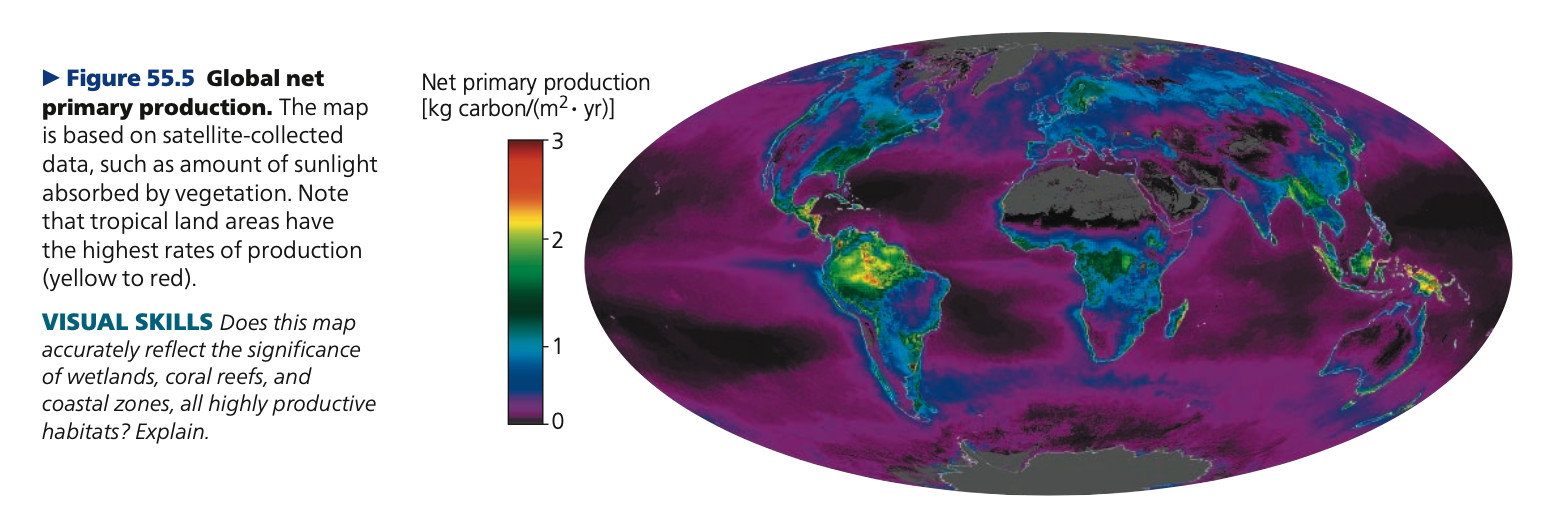
Net primary production (NPP)
➔ GPP minus the energy used by the primary producers (autotrophs) for
their _____________
➔ Expressed as:
◆ Energy per unit area per unit time(J/(m^2*yr)
◆ Biomass (mass of vegetation) added per unit area per unit time [g/(m^2 & yr)
➔ GPP minus the energy used by the primary producers (autotrophs) for
their _____________
➔ Expressed as:
◆ Energy per unit area per unit time(J/(m^2*yr)
◆ Biomass (mass of vegetation) added per unit area per unit time [g/(m^2 & yr)
32
New cards
NPP = GPP - Ra
(Ra = amount of energy used by atutotrophs for cellular respiration)
33
New cards
NPP, biomass, total
Gross and Net Production
● On average, NPP is ~1⁄2 GPP
● ____ is the key measurement in ecology
because it represents the storage of chemical energy that will be available to consumers in the ecosystem
● NPP is amount of new ________ added in a given period of time
○ Biomass is expressed in terms of dry mass of organic material
○ NPP is not the same as ___ biomass
○ Grasslands do not accumulate as
much biomass as forests
■ Grasses and herbs decompose faster than trees
● On average, NPP is ~1⁄2 GPP
● ____ is the key measurement in ecology
because it represents the storage of chemical energy that will be available to consumers in the ecosystem
● NPP is amount of new ________ added in a given period of time
○ Biomass is expressed in terms of dry mass of organic material
○ NPP is not the same as ___ biomass
○ Grasslands do not accumulate as
much biomass as forests
■ Grasses and herbs decompose faster than trees
34
New cards
Tropical, reefs, ocean
Gross and Net Production
● Satellite data can help us learn about different ecosystems’ NPP
○ ______ rain forests are one of the most productive ecosystems and contribute a lot of the earth’s NPP
○ Estuaries & coral ____ have very high NPP
■ lesser contribution because they cover 1/10th of the area of tropical rain forests
○ The _____ has relatively lower NPP
■ But great contribution because of the vast size
● Satellite data can help us learn about different ecosystems’ NPP
○ ______ rain forests are one of the most productive ecosystems and contribute a lot of the earth’s NPP
○ Estuaries & coral ____ have very high NPP
■ lesser contribution because they cover 1/10th of the area of tropical rain forests
○ The _____ has relatively lower NPP
■ But great contribution because of the vast size
35
New cards
GPP - RT
Net ecosystem production (NEP)
➔ GPP minus the total respiration of ALL organisms in the system
➔ _______
◆ RT- cellular respiration of ALL organisms
➔ GPP minus the total respiration of ALL organisms in the system
➔ _______
◆ RT- cellular respiration of ALL organisms
36
New cards
carbon, flux, storing, O2
Net ecosystem production (NEP)
➔ NEP is used by ecologists to determine whether an ecosystem is gaining or losing _____ over time
◆ Possible to have (+)NPP but lose carbon because of heterotrophs releasing CO2 quicker than production
➔ Measured by net ___ of CO2 or O2 entering or leaving the ecosystem (usually CO2 measured on land)
◆ More CO2 entering than leaving - system is _____ carbon
◆ A system that gives off __ is also storing carbon (because O2 release is coupled to respiration and photosynthesis)
➔ NEP is used by ecologists to determine whether an ecosystem is gaining or losing _____ over time
◆ Possible to have (+)NPP but lose carbon because of heterotrophs releasing CO2 quicker than production
➔ Measured by net ___ of CO2 or O2 entering or leaving the ecosystem (usually CO2 measured on land)
◆ More CO2 entering than leaving - system is _____ carbon
◆ A system that gives off __ is also storing carbon (because O2 release is coupled to respiration and photosynthesis)
37
New cards
Aquatic Ecosystems
a. Light Limitation
b. Nutrient Limitation
b. Nutrient Limitation
38
New cards
Depth, 15
Light Limitation
● ____ of light penetration majorly affects primary production throughout photic zone of ocean / lake
○ ~1⁄2 of solar radiation absorbed in first __m of water
○ Even in clear water, only 5-10% of radiation may reach a depth of 75m
● ____ of light penetration majorly affects primary production throughout photic zone of ocean / lake
○ ~1⁄2 of solar radiation absorbed in first __m of water
○ Even in clear water, only 5-10% of radiation may reach a depth of 75m
39
New cards
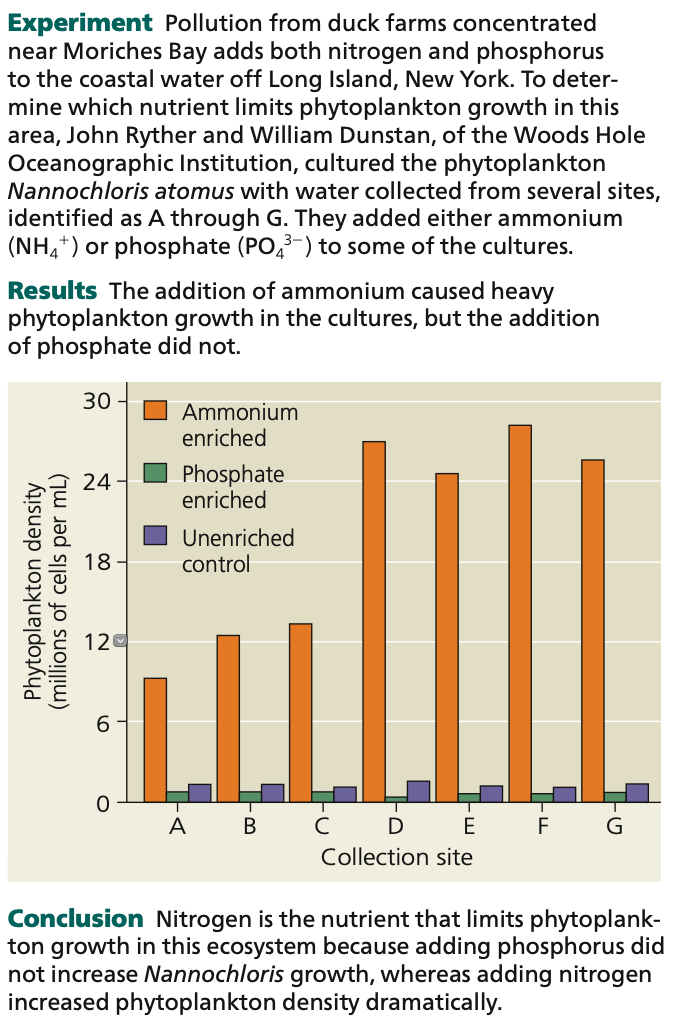
Nutrient Limitation
1. Eutrophication
2. Iron and the Sargasso Sea
3. Upwelling
2. Iron and the Sargasso Sea
3. Upwelling
40
New cards
Limiting nutrient
➔ element that must be added for production to increase
➔ Often nitrogen and phosphorus
◆ Low concentrations in photic zone because of uptake by phytoplankton and because detritus sinks
➔ Often nitrogen and phosphorus
◆ Low concentrations in photic zone because of uptake by phytoplankton and because detritus sinks
41
New cards
increasing, algal
Eutrophication
➔ Process where ecosystem changes from nutrient poor to nutrient-rich, dramatically _____ production
➔ prevention of ___ blooms caused by excess nitrogen runoff that fertilizes phytoplankton
◆ Algal blooms can lead to formation of dead zones
➔ Process where ecosystem changes from nutrient poor to nutrient-rich, dramatically _____ production
➔ prevention of ___ blooms caused by excess nitrogen runoff that fertilizes phytoplankton
◆ Algal blooms can lead to formation of dead zones
42
New cards
phosphorus, detergents
In freshwater lakes
○ sewage and fertilizer runoff from farms and lawns add nutrients
○ Usually ________ is the limiting nutrient for cyanobacterial growth
■ Overabundance leads to overgrowth, compromising water free quality
● Led to the use of phosphate-free _____
○ sewage and fertilizer runoff from farms and lawns add nutrients
○ Usually ________ is the limiting nutrient for cyanobacterial growth
■ Overabundance leads to overgrowth, compromising water free quality
● Led to the use of phosphate-free _____
43
New cards
Dead zones
- regions of low oxygen, dangerous to many
organisms
organisms
44
New cards
primary, nitrogen
Iron and the Sargasso Sea
○ Nitrogen and phosphorus aren’t the only limiting nutrients
○ Iron limits _____ production in the Sargasso Sea
○ Has some of the clearest water in the
world because of low phytoplankton density
■ Despite high _____, Sargasso Sea has low iron, limiting production
■ Iron is usually supplied to marine ecosystems from windblown dust from land supplies
○ Nitrogen and phosphorus aren’t the only limiting nutrients
○ Iron limits _____ production in the Sargasso Sea
○ Has some of the clearest water in the
world because of low phytoplankton density
■ Despite high _____, Sargasso Sea has low iron, limiting production
■ Iron is usually supplied to marine ecosystems from windblown dust from land supplies
45
New cards
Upwelling
➔ deep, nutrient-rich waters circulate to the ocean surface
46
New cards
high, phytoplankton, fishing
Upwelling
● Areas of upwelling have very ___ production
○ Due to high nutrient availability
○ Stimulate growth of ________ that form the base of marine food webs
○ Productive, diverse, prime ____ locations
○ Largest areas: in the Southern Ocean,
across the equator, coastal waters off Peru, California, and parts of Western Africa
● Areas of upwelling have very ___ production
○ Due to high nutrient availability
○ Stimulate growth of ________ that form the base of marine food webs
○ Productive, diverse, prime ____ locations
○ Largest areas: in the Southern Ocean,
across the equator, coastal waters off Peru, California, and parts of Western Africa
47
New cards
aerobic, nutrient
Nutrient limitation
● When primary producers die, their bodies are
broken down by _____ decomposers
○ Depletes water of a lot of oxygen, causing a lot of fish to die
■ To prevent this, it’s important to identify the limiting _____
● When primary producers die, their bodies are
broken down by _____ decomposers
○ Depletes water of a lot of oxygen, causing a lot of fish to die
■ To prevent this, it’s important to identify the limiting _____
48
New cards
Terrestrial ecosystems
a. Nutrient Limitations and Adaptations
49
New cards
Terrestrial ecosystems
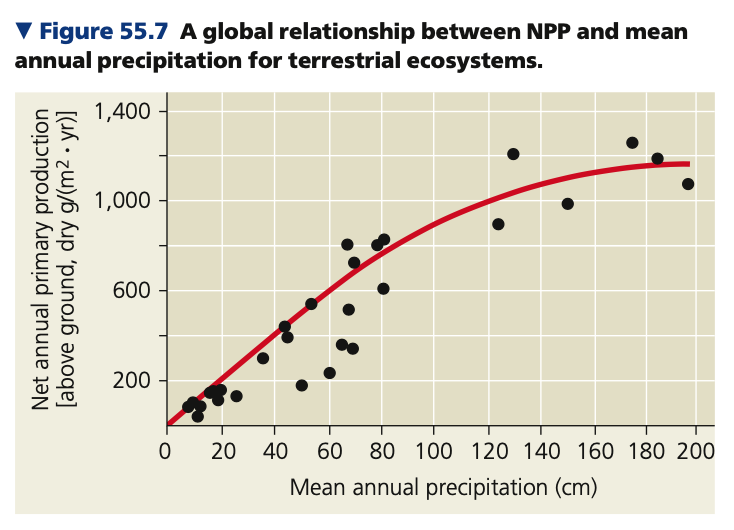
● Two main factors controlling primary production
1.Temperature
2. Moisture
1.Temperature
2. Moisture
50
New cards
Temperature
● Associated with higher amount of solar energy, drives higher evaporation and transpiration rates
● Higher = more productive
● Higher = more productive
51
New cards
Moisture
● Higher precipitation, wetter ecosystems = higher NPP, more productive
52
New cards
tropical, dry, moderate
Terrestrial ecosystems
● Because of these two factors, _____ rain forests are very productive (they are warm + wet)
● In contrast, ___ ecosystems are not very productive, including:
○ Cold + dry (ex. tundra)
○ Hot + dry (ex. desert)
● Ecosystems with _______ climates have
intermediate productivity (ex. grasslands)
● Because of these two factors, _____ rain forests are very productive (they are warm + wet)
● In contrast, ___ ecosystems are not very productive, including:
○ Cold + dry (ex. tundra)
○ Hot + dry (ex. desert)
● Ecosystems with _______ climates have
intermediate productivity (ex. grasslands)
53
New cards
NPP, fox, tundra, seabirds,
Terrestrial ecosystems
● Nutrients also affect __; Case Study - Arctic __ introduced to islands near Alaska
○ Presence of foxes converted grasslands to _____, lowering NPP
○ Foxes fed on the _____, decreasing their density -> less bird guano
○ Scarce nutrients -> reduced growth of nutrient-hungry grasses, favoring slower growing plants typical of tundra
■ When they added fertilizer to plots of tundra, the nutrients reverted it back to grassland within years
● Nutrients also affect __; Case Study - Arctic __ introduced to islands near Alaska
○ Presence of foxes converted grasslands to _____, lowering NPP
○ Foxes fed on the _____, decreasing their density -> less bird guano
○ Scarce nutrients -> reduced growth of nutrient-hungry grasses, favoring slower growing plants typical of tundra
■ When they added fertilizer to plots of tundra, the nutrients reverted it back to grassland within years
54
New cards
Guano
a manure with a lot of nutrients / fertilizer potential
55
New cards
Nutrient Limitations and Adaptations
1. Nitrogen
2. Phosphorus
2. Phosphorus
56
New cards
Nitrogen
➔ Limits terrestrial plant growth the most
57
New cards
Phosphorus
➔ Limitations are more common in older soils (phosphate molecules have been leached away by water)
ex. In tropical ecosystems
ex. In tropical ecosystems
58
New cards
non, increase
Nutrient Limitations and Adaptations
● If you add a __-limiting nutrient, it will not stimulate production
● If you add limiting nutrient, production will ______ until some other nutrient becomes limiting
● If you add a __-limiting nutrient, it will not stimulate production
● If you add limiting nutrient, production will ______ until some other nutrient becomes limiting
59
New cards
uptake, mutualism, mycorrhizal, hairs, enzymes, phosphatates, Chelating
Nutrient Limitations and Adaptations
● Adaptations that increase ____ of limiting nutrients
1. ______ between plant roots and nitrogen-fixing bacteria
2. ________ association between plant roots and fungi
■ supply phosphorus and other limiting elements to plants
3. Plant ____ and other anatomical features
■ Increase area of soil in contact with roots
4. release _____ and other substances into the soil that increase the availability of limiting nutrients
a. _________
● cleave a phosphate group from larger molecules
b. ______ agents
● make micronutrients such as iron more soluble in the soil
● Adaptations that increase ____ of limiting nutrients
1. ______ between plant roots and nitrogen-fixing bacteria
2. ________ association between plant roots and fungi
■ supply phosphorus and other limiting elements to plants
3. Plant ____ and other anatomical features
■ Increase area of soil in contact with roots
4. release _____ and other substances into the soil that increase the availability of limiting nutrients
a. _________
● cleave a phosphate group from larger molecules
b. ______ agents
● make micronutrients such as iron more soluble in the soil
60
New cards
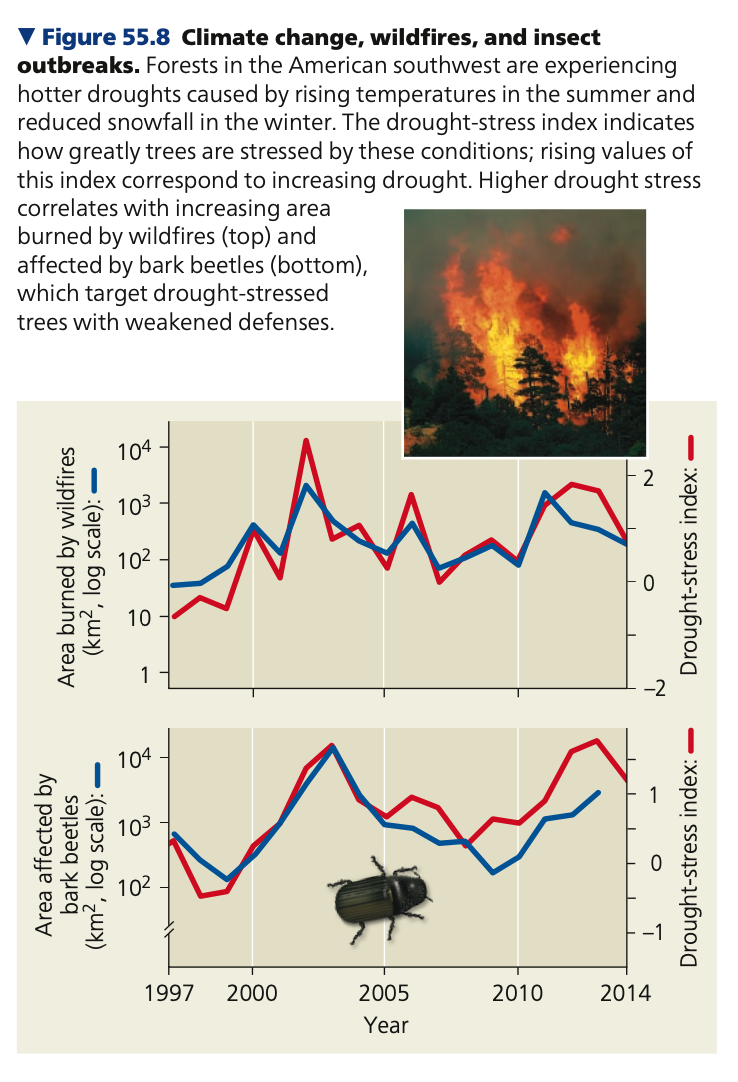
factors, Amazon, southern, wildfires, insect
Effects of Climate Change
● Climatic ______ like temperature and moisture affect terrestrial NPP -> climate change also affects productivity
○ NPP increased by 6% in terrestrial ecosystems from 1982-1999
■ ~1⁄2 of this change occurred in the _____ forest
■ Cloud cover decreased, increasing amount of solar energy
○ However, since 2000, NPP gains were erased
■ Major droughts in the _______ Hemisphere
■ Hotter droughts affect _______ and _____ outbreaks
● Climatic ______ like temperature and moisture affect terrestrial NPP -> climate change also affects productivity
○ NPP increased by 6% in terrestrial ecosystems from 1982-1999
■ ~1⁄2 of this change occurred in the _____ forest
■ Cloud cover decreased, increasing amount of solar energy
○ However, since 2000, NPP gains were erased
■ Major droughts in the _______ Hemisphere
■ Hotter droughts affect _______ and _____ outbreaks
61
New cards
decreased
Effects of Climate Change
○ Case study: forests in the American Southwest
■ Experiencing droughts driven by climate change + different precipitation patterns
■ More wildfires
■ More outbreaks of bark beetles ex. mountain pine beetle Dendroctonus ponderosae
■ Increased tree mortality -> _____NPP
○ Case study: forests in the American Southwest
■ Experiencing droughts driven by climate change + different precipitation patterns
■ More wildfires
■ More outbreaks of bark beetles ex. mountain pine beetle Dendroctonus ponderosae
■ Increased tree mortality -> _____NPP
62
New cards
10, decomposers
Trophic Level Energy Transfer
● Energy transfer between trophic levels is only __% efficient
● Secondary production
● Most of an ecosystem’s production is eventually consumed by _________
● Energy transfer between trophic levels is only __% efficient
● Secondary production
● Most of an ecosystem’s production is eventually consumed by _________
63
New cards
Secondary production
➔ Amount of chemical energy in consumers’ food that is
➔ Converted to their own new biomass during a given period of time
➔ Converted to their own new biomass during a given period of time
64
New cards
Trophic Level Energy Transfer
- Production Efficiency
- Trophic Efficiency
- Ecological Pyramids
- Trophic Efficiency
- Ecological Pyramids
65
New cards
Production Efficiency
● The percentage of energy stored in assimilated food that is used for growth and reproduction, not respiration

66
New cards
Herbivory
Production Efficiency
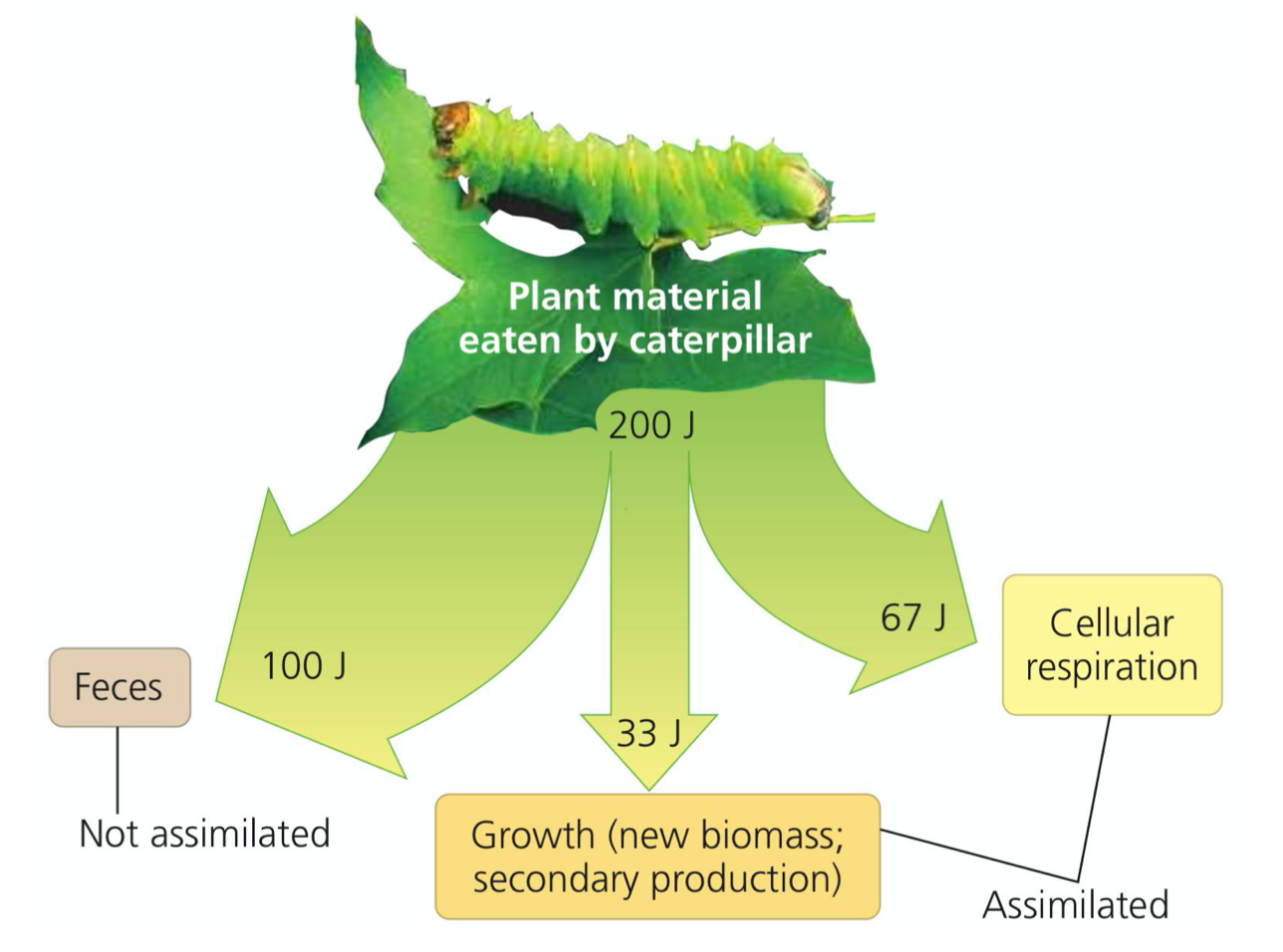
● _______ only acquires a small fraction of plant material in an ecosystem
○ 1⁄6 of the potential energy in the leaf is used for secondary production or growth
○ Remaining energy compounds will be used for cellular respiration and some pass as feces, which in turn, is lost as heat
○ Chemical energy stored in herbivores as biomass is available as food to secondary consumers
● _______ only acquires a small fraction of plant material in an ecosystem
○ 1⁄6 of the potential energy in the leaf is used for secondary production or growth
○ Remaining energy compounds will be used for cellular respiration and some pass as feces, which in turn, is lost as heat
○ Chemical energy stored in herbivores as biomass is available as food to secondary consumers
67
New cards
1-3, constant, 10, 40
Production Efficiency
○ The production efficiency of the caterpillar in the figure is 33%
■ 67J is used for respiration
■ 100 J is not assimilated due to defecation
○ Birds and mammals have lower production efficiencies, ___%
■ Use so much energy in maintaining _____, high temperature
■ Fishes are ectothermic, ~__% production efficiency
■ Insects and microorganisms are most efficient, > __%
○ The production efficiency of the caterpillar in the figure is 33%
■ 67J is used for respiration
■ 100 J is not assimilated due to defecation
○ Birds and mammals have lower production efficiencies, ___%
■ Use so much energy in maintaining _____, high temperature
■ Fishes are ectothermic, ~__% production efficiency
■ Insects and microorganisms are most efficient, > __%
68
New cards
Trophic Efficiency
● Percentage of production transferred from one trophic level to the next
69
New cards
lower, respiration, fecal, unconsumed, 10
Trophic Efficiency
○ Always ___ than production efficiency as it also accounts for ______, energy lost through fecal excretion, and ________ energy potential from the biomass of the previous trophic level, i.e. unutilized food
○ On average, only __% of energy in a trophic level is transferred to the succeeding trophic level
■ Limits the abundance of top-level carnivores that an ecosystem can support
■ Explains why most food chains and webs include only about four or five trophic levels
○ Always ___ than production efficiency as it also accounts for ______, energy lost through fecal excretion, and ________ energy potential from the biomass of the previous trophic level, i.e. unutilized food
○ On average, only __% of energy in a trophic level is transferred to the succeeding trophic level
■ Limits the abundance of top-level carnivores that an ecosystem can support
■ Explains why most food chains and webs include only about four or five trophic levels
70
New cards
Ecological Pyramids
1. Energy Pyramid
2. Biomass Pyramid
2. Biomass Pyramid
71
New cards
loss, width
Energy Pyramid
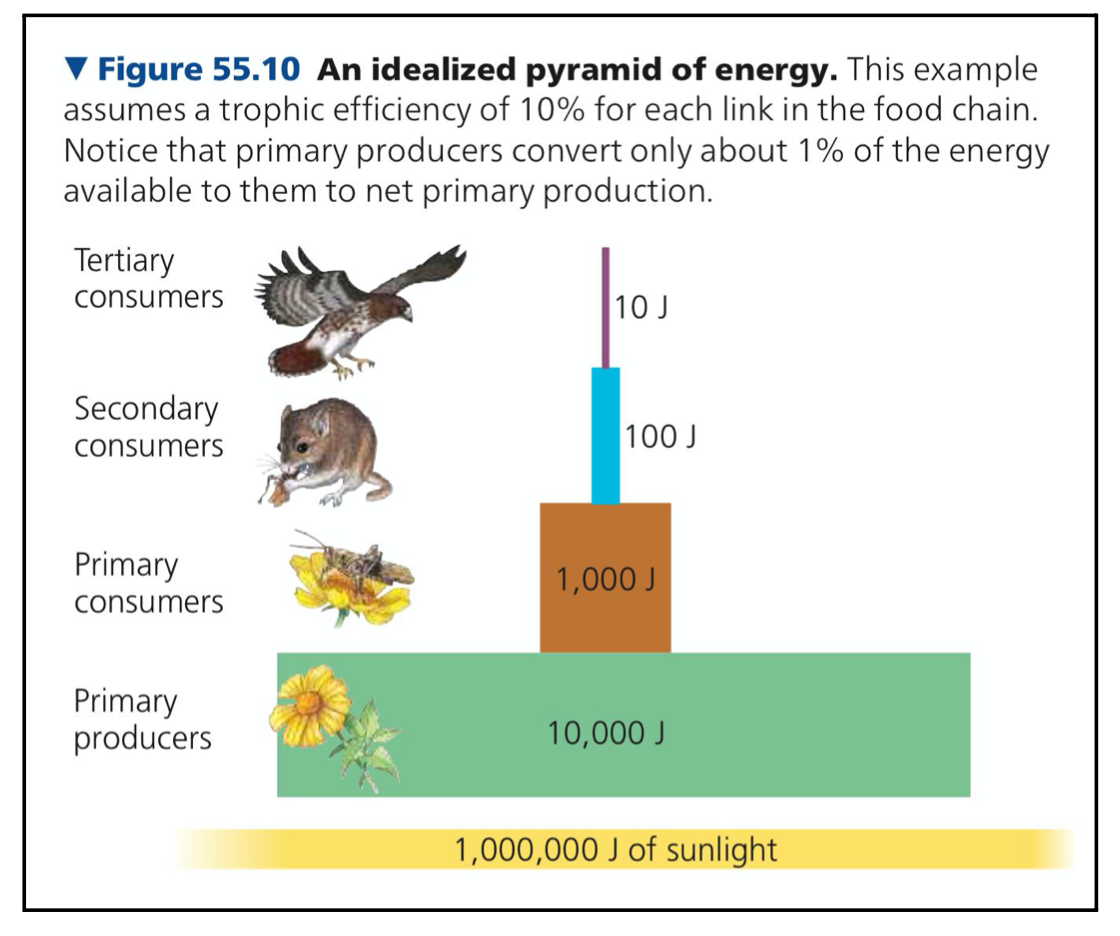
➔ Represents the ___ of energy with each transfer in a food chain
◆ Net productions of trophic levels arranged in tiers
◆ Tier ___ is proportional to net production (joules)
◆ Highest level contains few, vulnerable, top-level predators
➔ Represents the ___ of energy with each transfer in a food chain
◆ Net productions of trophic levels arranged in tiers
◆ Tier ___ is proportional to net production (joules)
◆ Highest level contains few, vulnerable, top-level predators
72
New cards
low, level, inverted
Biomass pyramid
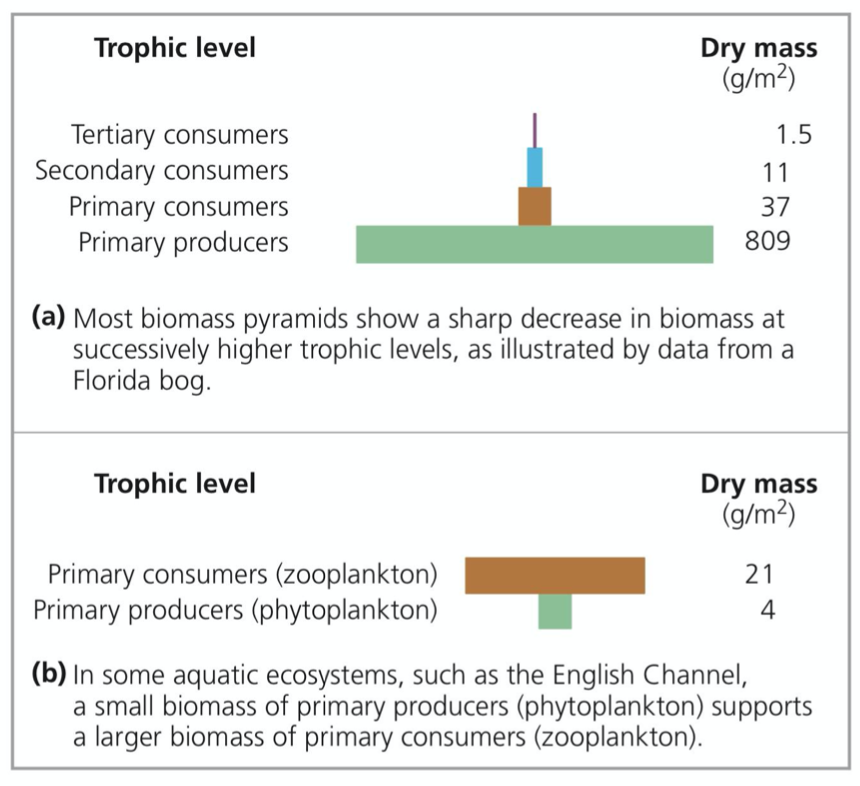
➔ Represents ecological consequences of ___ trophic efficiencies
◆ Each tier represent total dry mass of organisms in one trophic _____
◆ Most narrow sharply from primary producers to apex carnivores due to inefficient energy transfer
◆ Certain aquatic systems have ______ biomass pyramids as primary consumers outweigh the producers, i.e. phytoplankton are consumed quickly by zooplankton
● Rapid reproduction of phytoplankton results to higher production than zooplankton -> energy pyramid is still bottom- heavy
➔ Represents ecological consequences of ___ trophic efficiencies
◆ Each tier represent total dry mass of organisms in one trophic _____
◆ Most narrow sharply from primary producers to apex carnivores due to inefficient energy transfer
◆ Certain aquatic systems have ______ biomass pyramids as primary consumers outweigh the producers, i.e. phytoplankton are consumed quickly by zooplankton
● Rapid reproduction of phytoplankton results to higher production than zooplankton -> energy pyramid is still bottom- heavy
73
New cards
Biological and Geochemical Processes
- Decomposition and Nutrient Cycling
- Biogeochemical Cycles
a. Water cycle
b. Carbon cycle
c. Nitrogen cycle
d. Phosphorus cycle
- Cycle Analysis
- Biogeochemical Cycles
a. Water cycle
b. Carbon cycle
c. Nitrogen cycle
d. Phosphorus cycle
- Cycle Analysis
74
New cards
elements, recycling
Biological and Geochemical Processes
1. Most ecosystems receive abundant solar energy, but chemical ______ are limited
2. Life depends on _______ of essential chemical nutrients
1. Most ecosystems receive abundant solar energy, but chemical ______ are limited
2. Life depends on _______ of essential chemical nutrients
75
New cards
Decomposers
➔ Heterotrophs that get their energy from detritus
76
New cards
Decomposition rate
➔ Controlled by temperature, moisture, and nutrient availability
77
New cards
warmer, oxygen, peatlands
Decomposition and Nutrient Cycling
○ Decomposers thrive in ______ ecosystems that receive more precipitation
○ However, decomposition rate may slow if there is too much precipitation
■ Conditions would be too wet to supply decomposers with enough _____
■ Decomposer growth is especially poor in _______ (both cold and wet)
○ E.g. average decomposition rates in tropical rainforests faster than in temperate forests
○ Decomposers thrive in ______ ecosystems that receive more precipitation
○ However, decomposition rate may slow if there is too much precipitation
■ Conditions would be too wet to supply decomposers with enough _____
■ Decomposer growth is especially poor in _______ (both cold and wet)
○ E.g. average decomposition rates in tropical rainforests faster than in temperate forests
78
New cards
litter
Decomposition and Nutrient Cycling
● More rapid decomposition rate → less organic
material accumulating as leaf _____ → lower concentration of nutrients in the soil
○ In terms of the amount of nutrients stored in the soil: tropical rainforests > temperate forests > peatlands
● More rapid decomposition rate → less organic
material accumulating as leaf _____ → lower concentration of nutrients in the soil
○ In terms of the amount of nutrients stored in the soil: tropical rainforests > temperate forests > peatlands
79
New cards
Aquatic, detritus, directly
Decomposition and Nutrient Cycling
● ______ ecosystems
○ Decomposition can take ≥ 50 years
○ Are productive when bottom layers of water exchange nutrients with surface waters (e.g. in upwelling regions)
■ Bottom layers are comparable to ____ layer, but:
■ Aquatic plants absorb nutrients ____ from water
● ______ ecosystems
○ Decomposition can take ≥ 50 years
○ Are productive when bottom layers of water exchange nutrients with surface waters (e.g. in upwelling regions)
■ Bottom layers are comparable to ____ layer, but:
■ Aquatic plants absorb nutrients ____ from water
80
New cards
Biogeochemical Cycles
● Summarizes movements of a chemical elements between living and nonliving components of the biosphere
● Nutrient cycles involve biotic and abiotic components
● Two general scales
1. Global
2. Local
● Nutrient cycles involve biotic and abiotic components
● Two general scales
1. Global
2. Local
81
New cards
gases
Global biogeochemical cycles
■ Involving atmospheric _____
■ E.g. carbon, oxygen, sulfur, nitrogen cycles
■ Involving atmospheric _____
■ E.g. carbon, oxygen, sulfur, nitrogen cycles
82
New cards
dust
Local biogeochemical cycles
■ Involving elements too heavy to occur as gases, that are transported through ___
■ Elements are absorbed from the soil and eventually returned by decomposers
■ E.g. phosphorus potassium, calcium cycles
■ Involving elements too heavy to occur as gases, that are transported through ___
■ Elements are absorbed from the soil and eventually returned by decomposers
■ E.g. phosphorus potassium, calcium cycles
83
New cards
General Model of Nutrient Cycling
1. Reservoir A
2. Reservoir B
3. Reservoir C
4. Reservoir D
2. Reservoir B
3. Reservoir C
4. Reservoir D
84
New cards
Reservoir
➔ Where a chemical element is found
85
New cards
Peat
➔ Partially decomposed organic layer of soil
➔ Along with coal and oil, nutrients in peat cannot be accessed
➔ Along with coal and oil, nutrients in peat cannot be accessed
86
New cards
Reservoir A
● Material: Organic
● Nutrient availability: available
● Example: Living organisms, detritus
● Nutrient availability: available
● Example: Living organisms, detritus
87
New cards
Reservoir A
○ Can be accessed by other organisms
when consumers feed, or:
○ When decomposers consume nonliving organic matter
when consumers feed, or:
○ When decomposers consume nonliving organic matter
88
New cards
Reservoir B
● Material: Organic
● Nutrient availability: Unavailable
● Example: Peat, coil, oil
● Nutrient availability: Unavailable
● Example: Peat, coil, oil
89
New cards
Reservoir B
○ Transfers from Reservoir A when low pH and low oxygen levels inhibit decomposition, forming peat
○ Eventually, peat can be converted to fossil fuels (e.g. coal, oil)
○ Eventually, peat can be converted to fossil fuels (e.g. coal, oil)
90
New cards
Reservoir C
● Material: Inorganic
● Nutrient availability: Available
● Example: Inorganic materials (Ca2+, P) dissolved in water or present in soil/air
● Nutrient availability: Available
● Example: Inorganic materials (Ca2+, P) dissolved in water or present in soil/air
91
New cards
Reservoir D
● Material: Inorganic
● Nutrient availability: Unavailable
● Example: Minerals in rocks
● Nutrient availability: Unavailable
● Example: Minerals in rocks
92
New cards
Reservoir D
○ Cannot be directly tapped into, but:
○ May slowly become available through weathering and erosion
○ May slowly become available through weathering and erosion
93
New cards
Biogeochemical Cycles
a. Water cycle
b. Carbon cycle
c. Nitrogen cycle
d. Phosphorus cycle
b. Carbon cycle
c. Nitrogen cycle
d. Phosphorus cycle
94
New cards
rates, directly, vapor, freezing, Evaporation, Condensation, Precipitation, Transpiration, runoff, groundwater
Water cycle
1. Importance
● Influences ___ of ecosystem processes (e.g. primary production, decomposition
2. Forms
● All organisms can exchange water ____ with environment
● Primarily used as liquid, though some organisms can harvest water ____
● ______ can limit availability to terrestrial plants
3. Reservoirs
● 97%: ocean
● 2%: glaciers and polar ice caps
● 1%: lakes, rivers, groundwater
● Negligible amount in atmosphere
4. Processes
1. ________ of liquid water by solar energy
2. _______ of water vapor into clouds
3. _________; rain
4.________ by terrestrial plants moves water to atmosphere
5. Surface _____ and _______ flow return water to oceans
1. Importance
● Influences ___ of ecosystem processes (e.g. primary production, decomposition
2. Forms
● All organisms can exchange water ____ with environment
● Primarily used as liquid, though some organisms can harvest water ____
● ______ can limit availability to terrestrial plants
3. Reservoirs
● 97%: ocean
● 2%: glaciers and polar ice caps
● 1%: lakes, rivers, groundwater
● Negligible amount in atmosphere
4. Processes
1. ________ of liquid water by solar energy
2. _______ of water vapor into clouds
3. _________; rain
4.________ by terrestrial plants moves water to atmosphere
5. Surface _____ and _______ flow return water to oceans
95
New cards
organic, photosynthesis, organic, Sedimentary, fossil, soil, aquatic, ocean, mass, atmosphere, respiration, Photosynthesis, respiration, burning, volcanic
Carbon cycle
1. Importance
● Framework of all essential _____ molecules
2. Forms
● Photosynthetic organisms utilize CO2 during ________, and:
● Convert carbon to _____forms used by consumers
3. Reservoirs
● ______ rocks (e.g. limestone) are the largest reservoir but not easily accessible (Reservoir D)
● _____ fuels
● _____
● Sediments of ______ ecosystems
●______ (dissolved carbon compounds)
● Bio___
● _________ (CO2)
● All organisms can return CO2 to environment through ______
4. Processes
1. ________ by plants and phytoplankton converts atmospheric CO2
2. Producers and consumers add CO2, to environment through _______
3. CO2 is also added through fossil fuel, wood ______, and ______ eruptions
1. Importance
● Framework of all essential _____ molecules
2. Forms
● Photosynthetic organisms utilize CO2 during ________, and:
● Convert carbon to _____forms used by consumers
3. Reservoirs
● ______ rocks (e.g. limestone) are the largest reservoir but not easily accessible (Reservoir D)
● _____ fuels
● _____
● Sediments of ______ ecosystems
●______ (dissolved carbon compounds)
● Bio___
● _________ (CO2)
● All organisms can return CO2 to environment through ______
4. Processes
1. ________ by plants and phytoplankton converts atmospheric CO2
2. Producers and consumers add CO2, to environment through _______
3. CO2 is also added through fossil fuel, wood ______, and ______ eruptions
96
New cards
phospholipids, ATP, bones, teeth, phosphate, marine, soil, oceans, mass, soil, Weathering, leaches, Decomposition, excretion, dust, spray
Phosphorus cycle
1. Importance
● Part of nucleic acids, __________, and ____
● Mineral constituent of ____ and _____
2. Forms
● Absorbed by plants as _________ (PO43-), which is:
● Also used in organic compound synthesis
3. Reservoirs
● Sedimentary rocks of _____ origin
● ___
● ______ (dissolved)
● Bio____
● Recycling is localized because ___ binds to phosphate
4. Processes
1. _______ gradually adds phosphate to soil
2. Some phosphate ______ into groundwater or surface water, which may reach the sea
3. Phosphate taken up by plants may be ____ by consumers
4.________ or ______ returns phosphate to soil
5. Relatively small amounts of phosphate move through the atmosphere as ___ and sea ____
1. Importance
● Part of nucleic acids, __________, and ____
● Mineral constituent of ____ and _____
2. Forms
● Absorbed by plants as _________ (PO43-), which is:
● Also used in organic compound synthesis
3. Reservoirs
● Sedimentary rocks of _____ origin
● ___
● ______ (dissolved)
● Bio____
● Recycling is localized because ___ binds to phosphate
4. Processes
1. _______ gradually adds phosphate to soil
2. Some phosphate ______ into groundwater or surface water, which may reach the sea
3. Phosphate taken up by plants may be ____ by consumers
4.________ or ______ returns phosphate to soil
5. Relatively small amounts of phosphate move through the atmosphere as ___ and sea ____
97
New cards
amino, proteins, nucleic, plant, Ammonium, nitrite, amino, atmosphere, fixation, bacteria, fertilizers, Nitrification, Denitrification, Ammonification
Nitrogen cycle
1. Importance
● Part of ____ acids, _____, and ____ acids
● Limiting ____ nutrient
2. Forms
● Plants
○ Inorganic forms: _____ (NH4+) and ___ (NO -)
2 ○ Organic forms: _____ acids
● Animals can only use organic forms
3. Reservoirs
● 80%: free nitrogen gas in _______ (N2)
● Inorganic and organic compounds present in soils, water sediments, and biomass
4. Processes
N2 is converted to forms that can be used to synthesize organic nitrogen compounds through nitrogen ______
1. Certain ______, and lightning and volcanic activity, fix nitrogen naturally
2. Some human activities (e.g. industrial ______) input nitrogen, outpacing natural inputs
Other bacteria in soil convert nitrogen to different forms
1. ________: nitrifying bacteria convert ammonium → nitrate
2. ________: denitrifying bacteria convert nitrate → nitrogen gas
3. _______: saprobiotic bacteria convert organically bound nitrogen in biomass → ammonium
1. Importance
● Part of ____ acids, _____, and ____ acids
● Limiting ____ nutrient
2. Forms
● Plants
○ Inorganic forms: _____ (NH4+) and ___ (NO -)
2 ○ Organic forms: _____ acids
● Animals can only use organic forms
3. Reservoirs
● 80%: free nitrogen gas in _______ (N2)
● Inorganic and organic compounds present in soils, water sediments, and biomass
4. Processes
N2 is converted to forms that can be used to synthesize organic nitrogen compounds through nitrogen ______
1. Certain ______, and lightning and volcanic activity, fix nitrogen naturally
2. Some human activities (e.g. industrial ______) input nitrogen, outpacing natural inputs
Other bacteria in soil convert nitrogen to different forms
1. ________: nitrifying bacteria convert ammonium → nitrate
2. ________: denitrifying bacteria convert nitrate → nitrogen gas
3. _______: saprobiotic bacteria convert organically bound nitrogen in biomass → ammonium
98
New cards
isotopes, carbon, plants, Retaining
Cycle analysis
● Inflow and outflow of nonradioactive ________ is observed through the biotic and abiotic components of the ecosystem
○ E.g. Rainfall collection and dam construction are carried out to determine the amount of water and dissolved minerals present
● Tiny amounts of radioactive isotopes are added and their progress is traced (e.g. radioactive _____)
● The amount of nutrients leaving an intact ecosystem is controlled mainly by _____
○ ______ nutrients helps maintain productivity and avoid other problems such as algal blooms
● Inflow and outflow of nonradioactive ________ is observed through the biotic and abiotic components of the ecosystem
○ E.g. Rainfall collection and dam construction are carried out to determine the amount of water and dissolved minerals present
● Tiny amounts of radioactive isotopes are added and their progress is traced (e.g. radioactive _____)
● The amount of nutrients leaving an intact ecosystem is controlled mainly by _____
○ ______ nutrients helps maintain productivity and avoid other problems such as algal blooms
99
New cards
Restoration ecologists
- Bioremediation
- Biological Augmentation
- A Review on Ecosystems
- Biological Augmentation
- A Review on Ecosystems
100
New cards
farming, mining, Salt, oil
Restoration ecologists
● Ecosystems recover naturally from disturbances
○ May take centuries especially if humans have degraded the environment
■ Tropical areas cleared for ______ are unproductive because of nutrient loss
■ _____ activities abandon lands in a degraded state
■ ___ build up in soil from irrigation
■ Toxic chemicals or __ spills
● Ecosystems recover naturally from disturbances
○ May take centuries especially if humans have degraded the environment
■ Tropical areas cleared for ______ are unproductive because of nutrient loss
■ _____ activities abandon lands in a degraded state
■ ___ build up in soil from irrigation
■ Toxic chemicals or __ spills
 Note
Note  Flashcards (77)