Allen's Cognitive Disabilities Groups wk.6
 Studied by 0 people
 Call Kai
 Learn
Learn Practice Test
 Spaced Repetition
 Match
Match Flashcards
 Knowt Play
1/23

There's no tags or description
Looks like no tags are added yet.
Name | Mastery | Learn | Test | Matching | Spaced | Call with Kai |
|---|
No analytics yet
Send a link to your students to track their progress
24 Terms
Framework Focus
Used to measure and monitor client’s problem solving ability and safety while performing daily
activities in any occupations
Match and adapt individual’s functional cognitive capacities with activity demands and context
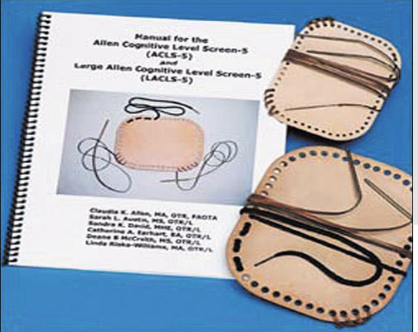
Assessment
Leather lacing tool to eval cognition
highly valid and reliable
use results as guidelines for planning initial activities or discharge
initial screening important before setting groups
Enabling best ability to function
Two aspects: environmental adaptation and providing assistance
Cognitive Disability
limitations in sensorimotor actions
originating in physical or chemical structures of brain and
producing limitations in routine task behavior
Task Analysis
Determine the complexity of the task by breaking it into steps
Look at physical and cognitive abilities needed
Allen’s functional Info processing system
Cues
Attention
Action/activity
Speed
Categories related to cognition that impact task performance
Attention
Motor Actions
Conscious Awareness
6 Cognitive Levels
Level 1 – Automatic actions
Level 2 – Postural actions
Level 3 – Manual actions
Level 4 – Goal directed actions
Level 5 – Exploratory actions
Level 6 – Planned actions
Cognitive Level 1
Automatic actions
often bed ridden
respond mainly to internal cues (ex. hunger)
behavior is largely reflexive or habitual
OT should provide sensory stim. to elicit motor response
Cognitive Level 2
Postural Actions
can respond to proprioceptive input via postural changes
can imitate gross motor actions
can assist caregiver with ADLs
can feed themselves but messy
24 hr nursing care needed
can benefit from exercise group NOT interactive groups
Lower Cognitive Level Test
Ask client to watch you clap your hands three time loudly – if they can wait and then imitate they may be level 3
Cognitive Level 3
Manual Actions
Perform manual actions in response to tactile cues
Actions based on interest in objects near by
Attention maintained up to 30 minutes
Basic grooming tasks may be done independently
Can walk to familiar places without getting lost
Need supervision for some ADLs such as meal prep, following schedule, using phone, etc
Supervise tool use; put dangerous objects out of reach
Steps in a task can be imitated one at a time
Cognitive Level 4
Directed Actions
Goal directed in this level; this makes activity more purposeful
Able to ask for assistance
Basic living skills intact (ie dressing, grooming, bathing, feeding)
Respond well to visual cues; verbal or written directions not
followed
Non visible properties in the environment may pose danger (ie.
heat, electricity, etc)
Need assistance with coping with new events, anticipating needs,
managing money
New routines must be reinforced with practice and repetition
Aware of goal and can ask for assistance – helps keep them safe
and functional
Cognitive Level 5
Exploratory Actions/Independent Learning
Use of trial and error learning in this level
Able to use inductive learning (learning from examples); capable of new learning
Imitate new procedures; remember several steps at a time
Novelty sought; variations explored
Choices may be given to client
Deficits in functions that require anticipation and planning
Concrete thinkers; trouble imagining long term consequences
Clients do not take preventative measures
Social relationships may be impaired
OT can focus on increasing social awareness, reciprocation in
relationships and accepting supervision to avoid negative
consequences
Cognitive Level 6
Planned Actions
No disability
Can use deductive reasoning
Can plan ahead
Organized behavior
Verbal and written directions followed
Can use symbols
Function and Dysfunction
Cognitive groups focus on learning the optimal environmental conditions necessary for safe purposeful activity participation
No cut off cognitive level defining competence
Competence is related to the activity the client intends to do
Change and Motivation
If change in cognitive process is irreversible OT can still make
changes in adaptive responses by manipulating the environment
Strategies include
Cultural considerations
Adding social
Providing choices
Placement and storage of items
Lighting
Seating
Facilitate available
Assistance
Change the task supplies, steps or instructions
Just right challenges
Reinforcers can include: Task success and Socially positive responses
Cognitive Disabilities Group Intervention
Homogenous groups
Level 2 and above
Some clients will move up the levels; some will plateau
Role of Leader
Directive
Often uses group to evaluate client
Chooses task or provides limited choices
Focus on the following:
Task analysis
Controlling and adapting Environment
Instructing members in task
No more than 8 members
Need to be able to observe task performance of each member for
ongoing assessment
Lower level groups may need more assistance
Higher level groups will need help with discussion
Structure and Goals: Level 2/3
movement activities; should be pleasurable
Ie touching toes or passing ball
Clients may be disruptive
Motor skills may be limited
Structure and Goals: Level 3
Manipulation and repetition
Ie simple wood working, tile use, bead stringing
Clients are not goal directed; process must interest them
Timing difficult; decreased ability to know where to begin and end
No longer than 30 minute groups
Structure and Goals: Level 4
Goal directed; better at problem solving in order to reach the goal
Attention limited; group should be no longer than 1 hour
Group should be no longer than one hour
Ie craft strategies such as 3 piece woodworking set
Have finished sample available as visual cue
Verbal and written cues not helpful
Demonstration is helpful
Probing questions are helpful if they get stuck
Remove unnecessary items to decrease distraction
Clearly mark supplies
Assistance needed with processes that are not visible (ie. drying paint, heating food, etc.)
Structure and Goals: Level 5
Focus on safety
Difficulty with impulsivity and lack of planning
Tasks can have more complex directions
Support needed for safe tool use
Ie cooking, grilling, multi-piece woodworking,etc
Leadership
Introduction
Activity
Sharing
Processing
Generalizing
Application
 Note
Note  Flashcards (117)