Immune System & Pathogen Avoidance

0.0(0)
Studied by 0 people
call kaiCall Kai
learnLearn
examPractice Test
spaced repetitionSpaced Repetition
heart puzzleMatch
flashcardsFlashcards
GameKnowt Play
Card Sorting

1/42

encourage image

There's no tags or description

Looks like no tags are added yet.

Last updated 4:21 AM on 4/4/26
Name
Mastery
Learn
Test
Matching
Spaced
Call with Kai

No analytics yet

Send a link to your students to track their progress

43 Terms

1
New cards

what are some of the first line defences

  • skin

  • enzymes

  • lysozymes

2
New cards

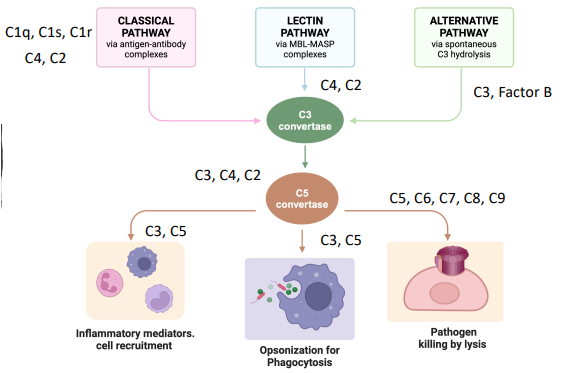
what are the 3 pathways for complement

  • classical pathway

  • lectin pathway

  • alternative pathway

<ul><li><p>classical pathway</p></li><li><p>lectin pathway</p></li><li><p>alternative pathway</p></li></ul><p></p>
3
New cards

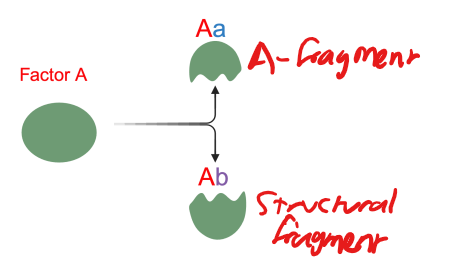
what are proenzymes

enzymes that must be cleaved to be activated, 2 fragments

  • structural - helps form other complexes

  • A-fragment - inflammatory mediators

<p>enzymes that must be cleaved to be activated, 2 fragments</p><ul><li><p><strong><u>structural</u></strong> - helps form other complexes</p></li><li><p><strong><u>A-fragment</u></strong> - inflammatory mediators</p></li></ul><p></p>
4
New cards

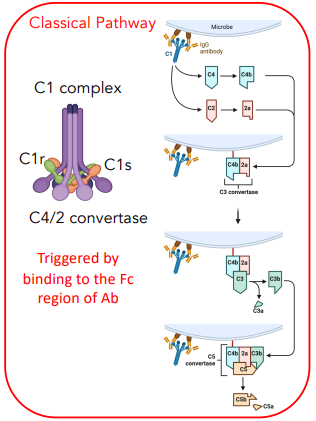
explain the classical pathway

consists of the C1 complex (C1q, C1r, C1s)

  • binds to microbe, converts C4 → C4b, C2 → 2a

  • C4b & 2a form C3 convertase

  • converts C3 → C3a + C3b

  • C3 convertase + C3b = C5 convertase

  • converts C5 → C5a + C5b

<p><strong><u>consists of the C1 complex (C1q, C1r, C1s)</u></strong></p><ul><li><p>binds to microbe, converts C4 → C4b, C2 → 2a</p></li><li><p>C4b &amp; 2a form <strong>C3 convertase</strong></p></li><li><p>converts C3 → C3a + C3b</p></li><li><p>C3 convertase + C3b = C5 convertase</p></li><li><p>converts C5 → C5a + C5b</p></li></ul><p></p>
5
New cards

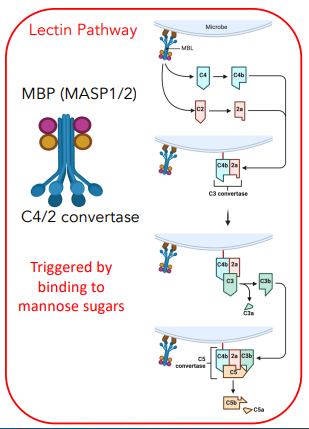
explain the lectin pathway

MBP complex (MASP1/2)

  • binds to microbe, converts C4 → C4b, C2 → 2a

  • C4b & 2a form C3 convertase

  • converts C3 → C3a + C3b

  • C3 convertase + C3b = C5 convertase

  • converts C5 → C5a + C5b

<p><strong><u>MBP complex (MASP1/2)</u></strong></p><ul><li><p>binds to microbe, converts C4 → C4b, C2 → 2a</p></li><li><p>C4b &amp; 2a form <strong>C3 convertase</strong></p></li><li><p>converts C3 → C3a + C3b</p></li><li><p>C3 convertase + C3b = C5 convertase</p></li><li><p>converts C5 → C5a + C5b</p></li></ul><p></p>
6
New cards

how are the classical & lectin pathway different in activation

classical = triggered by binding to Fc region of antibody

lectin = triggered by binding to mannose sugars

7
New cards

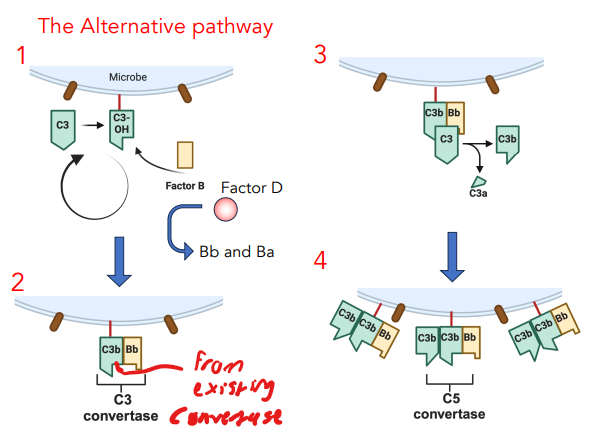
explain the alternative pathway

  • C3 spontaneously undergoes hydrolysis

  • binds factor B, cleaved by Factor D → Bb + Ba

  • C3b + Bb = C3 convertase

  • converts C3 → C3b + C3a

  • C3b + C3b + Bb = C5 convertase

<ul><li><p>C3 spontaneously undergoes hydrolysis</p></li><li><p>binds factor B, cleaved by Factor D → Bb + Ba</p></li><li><p>C3b + Bb = C3 convertase</p></li><li><p>converts C3 → C3b + C3a</p></li><li><p>C3b + C3b + Bb = C5 convertase</p></li></ul><p></p>
8
New cards

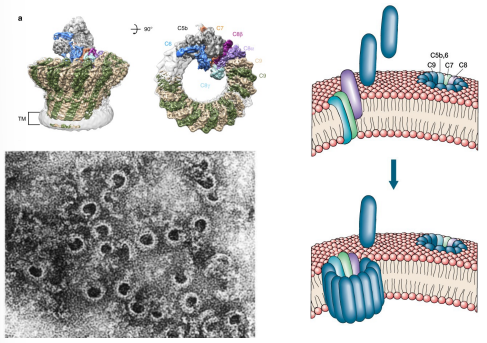
explain how the membrane attack complex works

C5 convertase recruits C5-C9

  • proteins are recruited in a “circular” fashion hence forming pores in the membrane of the microbe
<p><strong><u>C5 convertase recruits C5-C9</u></strong></p><ul><li><p>proteins are recruited in a “circular” fashion hence forming pores in the membrane of the microbe</p></li></ul><p></p>
9
New cards

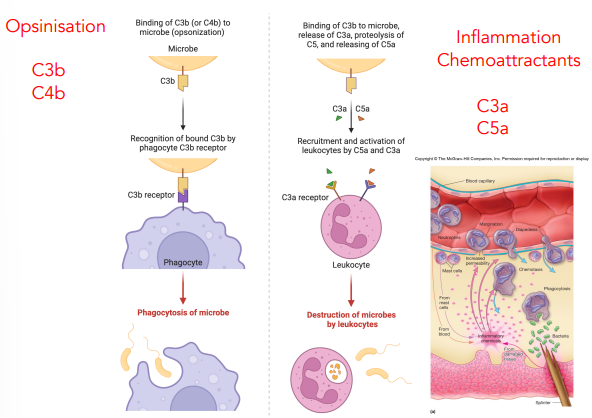
explain how opsonization works

C3b on microbes can bind to C3b receptors on phagocytes

  • induced endocytosis → phagocytosis

<p>C3b on microbes can bind to C3b receptors on phagocytes</p><ul><li><p>induced endocytosis → phagocytosis</p></li></ul><p></p>
10
New cards

explain chemoattractants

C3a & C5a recruit & activate leukocytes

  • both can bind to receptors on leukocytes

  • leukocytes can destroy microbes

<p><strong><u>C3a &amp; C5a recruit &amp; activate leukocytes</u></strong></p><ul><li><p>both can bind to receptors on leukocytes</p></li><li><p>leukocytes can destroy microbes</p></li></ul><p></p>
11
New cards

what are some ways that microbes can avoid complement

  • possessing a capsid, physically blocks complement

  • Fc binding proteins, binds to antibody Fc hence preventing complement action
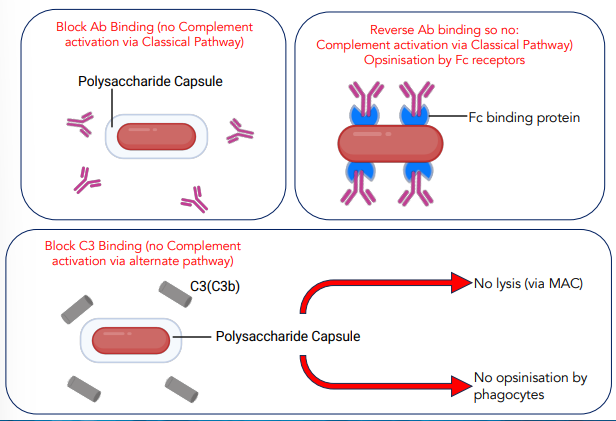
<ul><li><p>possessing a capsid, physically blocks complement</p></li><li><p>Fc binding proteins, binds to antibody Fc hence preventing complement action</p></li></ul><p></p>
12
New cards

how are pathogens detected by the immune system

pattern recognition receptors (e.g. toll-like receptors)

  • recognize different PAMPs

  • all drives NF-kB transcription factor

13
New cards

what is NF-kB

a transcription factor responsible for synthesis of pro-inflammatory mediators

  • TNF-α

  • IL-6

  • Pro-IL-1β

14
New cards

describe the process of interleukins synthesis

parts of pathogen are recognised by PRRs, downstream phosphorylation of NF-kB

  • translocate into nucleus

  • promotes gene expression for pro-interleukins

  • pro-form = inactive

<p>parts of pathogen are recognised by PRRs, downstream phosphorylation of NF-kB</p><ul><li><p>translocate into nucleus</p></li><li><p>promotes gene expression for pro-interleukins</p></li><li><p>pro-form = inactive</p></li></ul><p></p>
15
New cards

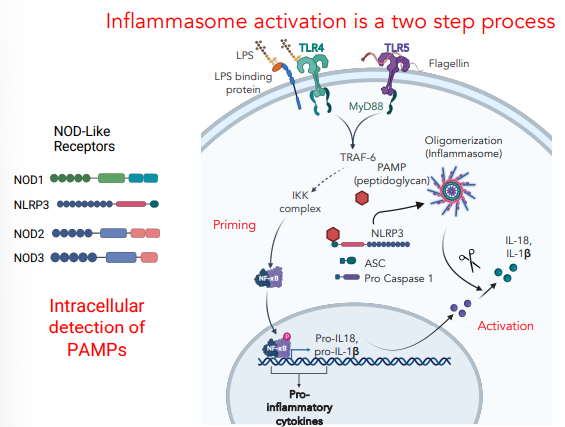
describe the process of inflammasome activation

PAMPs invade cell → recognised by nod-like receptors

  • causes oligomerization of nod-like receptors, ASC & pro caspase 1

  • this forms inflammasome (this activates pro caspase)

  • inflammasome cleaves & activates pro-interleukins

16
New cards

how can bacteria interfere with the inflammasome activation

  • intercept signaling events

  • degrade NF-kB subunits

17
New cards

what is some information on NK cells

contain granules with cytolytic molecules

  • perforin & granzyme B

can also produce inflammatory mediators

  • interferon-y

<p><strong><u>contain granules with cytolytic molecules</u></strong></p><ul><li><p>perforin &amp; granzyme B</p></li></ul><p><strong><u>can also produce inflammatory mediators</u></strong></p><ul><li><p>interferon-y</p></li></ul><p></p>
18
New cards

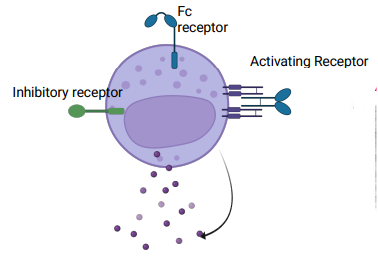
what is antibody dependent cellular cytotoxicity

when an antibody binds to a pathogen, the Fc receptor on NK cells can bind to the antibody

this triggers the degranulation of perforin & granzyme B
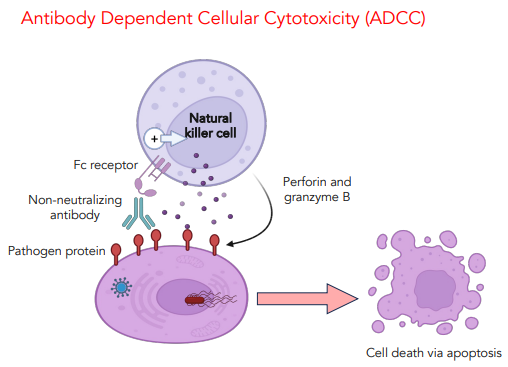
<p>when an antibody binds to a pathogen, the Fc receptor on NK cells can bind to the antibody</p><p></p><p>this triggers the degranulation of perforin &amp; granzyme B</p>
19
New cards

how do NK cells function normally

contain an inhibitory & activating receptor

  • inhibitory receptor bind MHC I receptors

  • this suppresses the activity of the NK cell
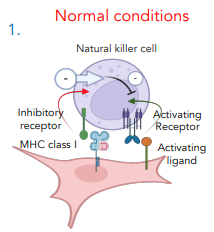
<p><strong><u>contain an inhibitory &amp; activating receptor</u></strong></p><ul><li><p>inhibitory receptor bind MHC I receptors</p></li><li><p>this suppresses the activity of the NK cell</p></li></ul><p></p>
20
New cards

how do NK cells function against non-self pathogens

pathogens DON’T expression MHC I, thus activating receptor is triggered

  • degranulation occurs, pathogen dies

  • pathogens downregulated MHC I expression by interfering with the biochemical pathway
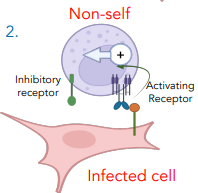
<p>pathogens DON’T expression MHC I, thus activating receptor is triggered</p><ul><li><p>degranulation occurs, pathogen dies</p></li><li><p>pathogens downregulated MHC I expression by interfering with the biochemical pathway</p></li></ul><p></p>
21
New cards

how can pathogens evade NK cells

  • express MHC I like molecules

  • block cell expression of activating ligands

22
New cards

what are the contents of granules in eosinophils, basophils, mast cells

vasodilators - prostaglandins, leukotrienes

degrading enzymes - proteases, lipases, etc.

23
New cards

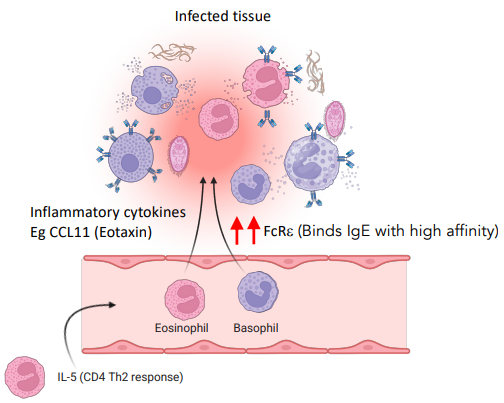
how do basophils & eosinophils function

circulate in the body, when moved to tissues via cytokines, they bind to pathogens via IgE receptors

  • release histamine, vasodilators.

<p>circulate in the body, when moved to tissues via cytokines, they bind to pathogens via IgE receptors</p><ul><li><p>release histamine, vasodilators.</p></li></ul><p></p>
24
New cards

what are some cells of the adaptive immune system

B cells - antibody production

CD4+ T cell - maturation of adaptive response

CD8+ T cell - recognition & removal of viral host cells

25
New cards

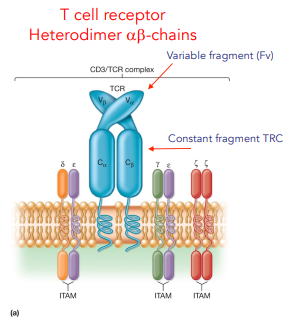
explain the design of the T cell receptor

2 chains α & β, each chain has 2 domains

  • proximal = constant

  • distal = variable (binding)

<p><strong><u>2 chains α &amp; β, each chain has 2 domains</u></strong></p><ul><li><p>proximal = constant</p></li><li><p>distal = variable (binding)</p></li></ul><p></p>
26
New cards

explain the design of the B cell receptor

pair of heterodimers (heavy + light chains)

  • constant Fc region

  • variable Fv region

  • associates with other protein for signaling clonal exp.

27
New cards

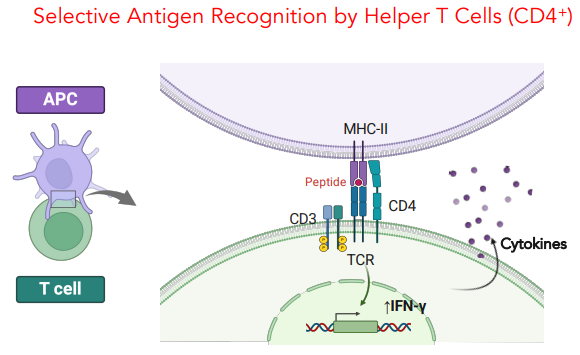
describe selective antigen recognition by Helper T cells (CD4+)

CD4+ binds to APC via MHC II (stabilized by CD28 ligand)

  • triggers CD3 phosphorylation

  • causes expression of IFN-y which is released
<p>CD4+ binds to APC via MHC II (stabilized by CD28 ligand)</p><ul><li><p>triggers CD3 phosphorylation</p></li><li><p>causes expression of IFN-y which is released</p></li></ul><p></p>
28
New cards

describe selective antigen recognition by cytotoxic T cells (CD8+)

T cell binds to antigen-MHC I complex on abnormal cells

  • stabilized by CD28 ligand

  • delivers granzymes & perforin to cell

29
New cards

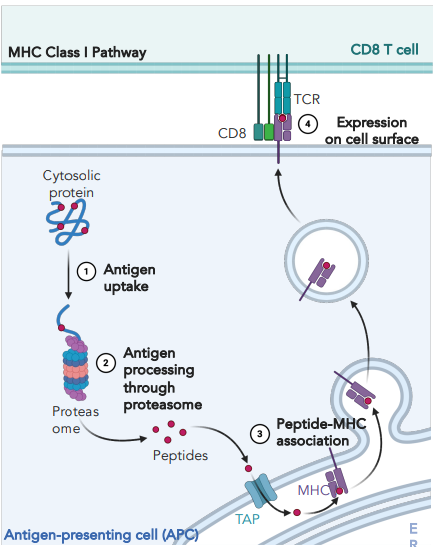
explain how antigen-MHC I complexes are formed

cytosolic protein is broken down by proteasome

  • peptides are transported to ER by TAP transporter

  • empty MHC I is loaded with peptide

  • complex is transported to surface via vesicle
<p><strong><u>cytosolic protein is broken down by proteasome</u></strong></p><ul><li><p>peptides are transported to ER by TAP transporter</p></li><li><p>empty MHC I is loaded with peptide</p></li><li><p>complex is transported to surface via vesicle</p></li></ul><p></p>
30
New cards

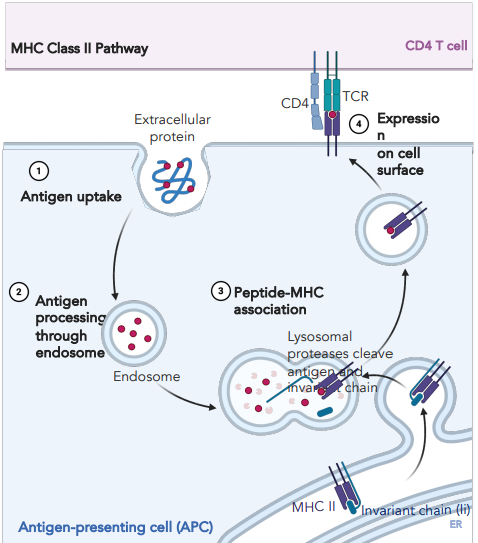
explain how antigen-MHC II complexes are formed

endocytosis of extracellular protein, processed through endosome

  • MHC II with pre-loaded invariant chain is dispatched

  • endosome and vesicle with MHC II combine

  • invariant chain is displaced by peptide

  • vesicle is transported to surface

<p>endocytosis of extracellular protein, processed through endosome</p><ul><li><p>MHC II with pre-loaded invariant chain is dispatched</p></li><li><p>endosome and vesicle with MHC II combine</p></li><li><p>invariant chain is displaced by peptide</p></li><li><p>vesicle is transported to surface</p></li></ul><p></p>
31
New cards

how can pathogens interfere with MHC I/II pathways

  • preventing processing (proteasome)

  • preventing transport of vesicle

32
New cards

describe co-stimulation in T cells

CD28 ligand is expression on naive T cells

  • contains an immune tyrosine activating motif (ITAM)

  • triggers phosphorylation of signaling kinases

  • induces signaling for cell survival

33
New cards

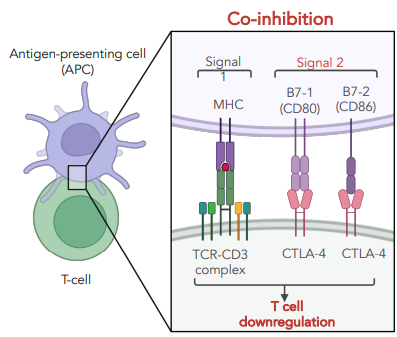
how do you stop T cell proliferation

CTLA-4, has higher affinity for CD80/CD86

  • contains an ITIM motif (inhibitory) competitor for CD28

  • upregulated after activations

  • dephosphorylates signaling tyrosine kinases
<p><strong><u>CTLA-4, has higher affinity for CD80/CD86</u></strong></p><ul><li><p>contains an ITIM motif (inhibitory) competitor for CD28</p></li><li><p>upregulated after activations</p></li><li><p>dephosphorylates signaling tyrosine kinases</p></li></ul><p></p>
34
New cards

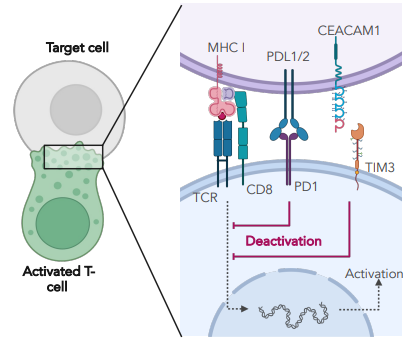
what are PD-1 & TIM3 checkpoints

receptors that act as phosphatases (dephosphorylates) activated kinases

  • limits effector function

<p>receptors that act as phosphatases (dephosphorylates) activated kinases</p><ul><li><p>limits effector function</p></li></ul><p></p>
35
New cards

how might chronic infection result in sustained expression of checkpoint molecules

if an infection cannot be cleaned up, the constant activation of T cells also drives the constant activation of inhibitory signals'

  • thus T cells cannot be restimulated

  • infection persists

36
New cards

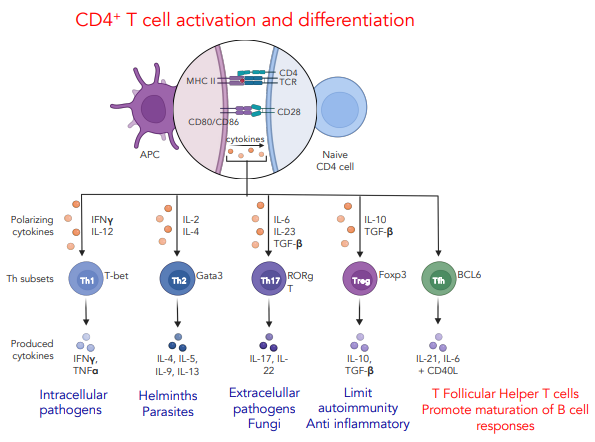
what is the role of cytokines in CD4+ T cell function

different cytokines stimulate different T cell responses
<p>different cytokines stimulate different T cell responses</p>
37
New cards

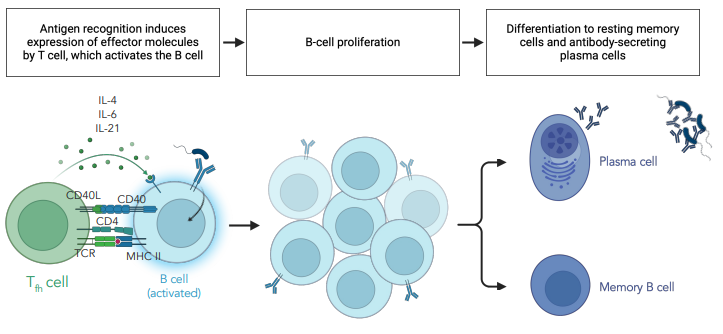
what are T follicular helper cells

specialised CD4+ T cells which help B cells produce antibodies

  • provide costimulation (CD4 & CD40L)

<p>specialised CD4+ T cells which help B cells produce antibodies</p><ul><li><p>provide costimulation (CD4 &amp; CD40L)</p></li></ul><p></p>
38
New cards

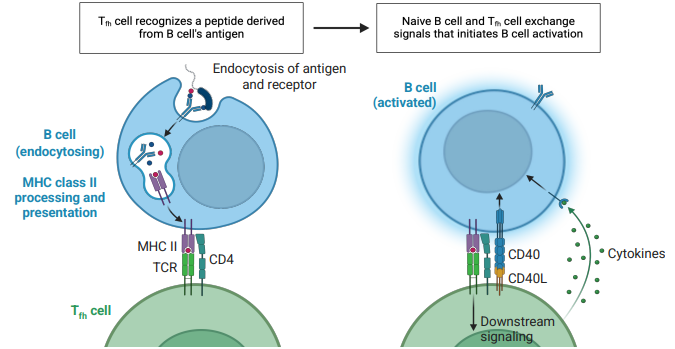
what is the general process of B cell activation via Tfh cells

B cell endocytosis of antigen & receptor

  • antigen is loaded on MHC II, transported to surface

  • Tfh cell binds via MHC II, CD4 & CD40L

  • releases cytokines allowing expansion

<p><strong><u>B cell endocytosis of antigen &amp; receptor</u></strong></p><ul><li><p>antigen is loaded on MHC II, transported to surface</p></li><li><p>Tfh cell binds via MHC II, CD4 &amp; CD40L</p></li><li><p>releases cytokines allowing expansion</p></li></ul><p></p>
39
New cards

explain B cell activation in the lymph node

lymph node is split into a B cell & T cell area

  • B cell expresses CCR7 chemokine attracting Tfh cells

  • Tfh cell expresses CXCR5 chemokine attracting B cell
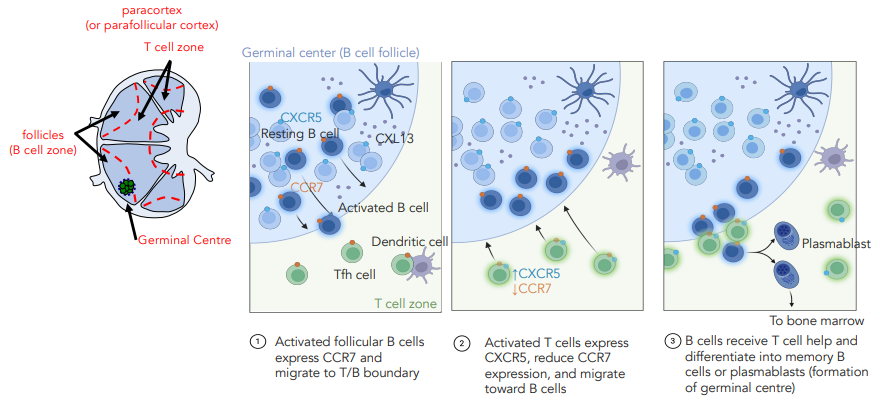
<p><strong><u>lymph node is split into a B cell &amp; T cell area</u></strong></p><ul><li><p>B cell expresses CCR7 chemokine attracting Tfh cells</p></li><li><p>Tfh cell expresses CXCR5 chemokine attracting B cell</p></li></ul><p></p>
40
New cards

what is affinity maturation

introduce mutations within Ig gene regions

  • if mutations increase affinity cell get selective survival

  • i.e. if B cell cannot bind antigens no survival signals

  • if B cell binds induces survival signals & proliferation
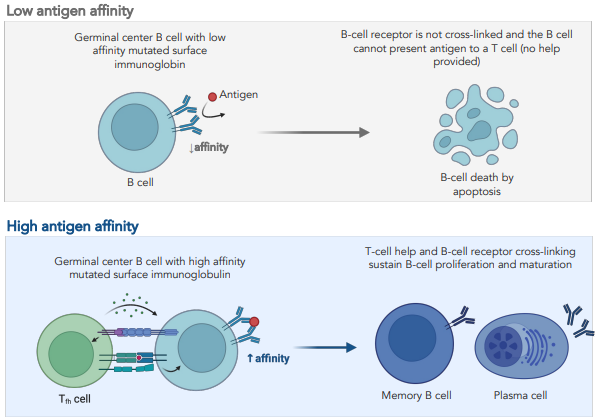
<p><strong><u>introduce mutations within Ig gene regions</u></strong></p><ul><li><p>if mutations increase affinity cell get selective survival</p></li><li><p>i.e. if B cell cannot bind antigens no survival signals</p></li><li><p>if B cell binds induces survival signals &amp; proliferation</p></li></ul><p></p>
41
New cards

what is isotype switching

after VDJ recombination for the Fv region, AID & cytokine induced factors can alter the Fc region of an antibody

  • based on presence of interferon/interleukin
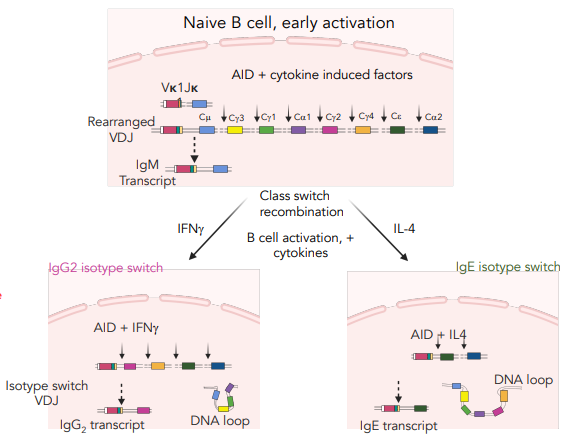
<p>after VDJ recombination for the Fv region, AID &amp; cytokine induced factors can alter the Fc region of an antibody</p><ul><li><p>based on presence of interferon/interleukin</p></li></ul><p></p>
42
New cards

what are some qualities of different antibodies
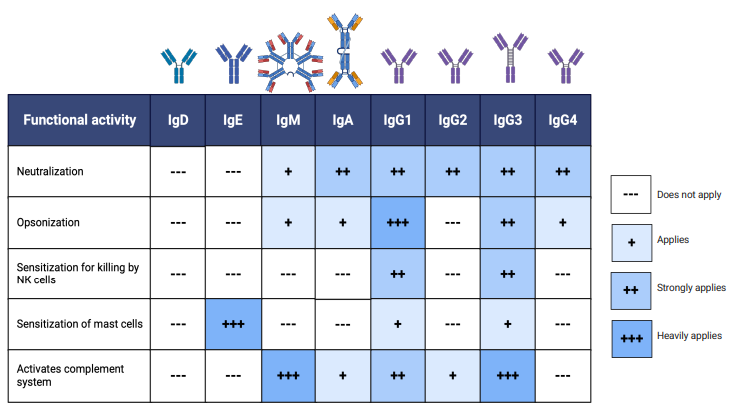
knowt flashcard image
43
New cards

how can pathogens evade antibody responses

  • blocking Ab binding (capsule)

  • reverse Ab binding (receptors for Fc region)

  • antigen variation (genetic mutations)

Explore top notes

note
Chapter 8: Magnetism and Its Uses
Updated 1037d ago
0.0(0)
note
Key Terms ITI Exam 2
Updated 783d ago
0.0(0)
note
14.7 Intro to Statistical Thinking
Updated 1285d ago
0.0(0)
note
Chapter 28: The Unraveling
Updated 1222d ago
0.0(0)
note
Chapter 8: Magnetism and Its Uses
Updated 1037d ago
0.0(0)
note
Key Terms ITI Exam 2
Updated 783d ago
0.0(0)
note
14.7 Intro to Statistical Thinking
Updated 1285d ago
0.0(0)
note
Chapter 28: The Unraveling
Updated 1222d ago
0.0(0)

Explore top flashcards

flashcards
Linked Review
34
Updated 941d ago
0.0(0)
flashcards
Civics - Ethics - Week 1
28
Updated 961d ago
0.0(0)
flashcards
House part 한국어7
28
Updated 307d ago
0.0(0)
flashcards
Chem 1LD Safety Practical
93
Updated 760d ago
0.0(0)
flashcards
psyc 211 - research methods
32
Updated 86d ago
0.0(0)
flashcards
ISS final
63
Updated 1203d ago
0.0(0)
flashcards
Linked Review
34
Updated 941d ago
0.0(0)
flashcards
Civics - Ethics - Week 1
28
Updated 961d ago
0.0(0)
flashcards
House part 한국어7
28
Updated 307d ago
0.0(0)
flashcards
Chem 1LD Safety Practical
93
Updated 760d ago
0.0(0)
flashcards
psyc 211 - research methods
32
Updated 86d ago
0.0(0)
flashcards
ISS final
63
Updated 1203d ago
0.0(0)