Cognitive Psychology open questions
 Call Kai
 Learn
Learn Practice Test
 Spaced Repetition
 Match
Match Flashcards
 Knowt Play
1/254

Earn XP
Description and Tags
Name | Mastery | Learn | Test | Matching | Spaced | Call with Kai |
|---|
No analytics yet
Send a link to your students to track their progress
255 Terms
Name two key ideas which accompanied the cognitive revolution.
psychology must investigate the mental world to understand behaviour
we cannot study the inner mental world directly
Why does research in many subfields of psychology (and most of cognitive psychology) rely on inferential methods?
unobservable processes are crucial for understanding observable capacities and behaviours
hypotheses about processes that cannot be observed directly (are unobservable) are needed -> can only be inferred
State the main goal of the original behaviourists:
discover a set of principles of how behaviour changes in response to different configurations of stimuli and observable behavioural outcomes
focus on directly measurable and observable variables
dismiss internal mental processes
Describe the criticism of earlier psychological methods that led to the behaviourist movement.
Introspection (tool to investigate conscious mental events) had several limitations:
limited to inspecting conscious events (mental processes are also, at least party, unconscious)
data gathered is not objectively testable -> not comparable
Describe the perspective of Wundt and Titchener to psychology.
assumed that the only possibility to study conscious mental events is personal observation, because feelings, thoughts, perceptions and recollections are subjective events -> should be studied with introspection
introspection = to observe and record content of our own mental lives/experiences
Discuss the limitations of behaviourism in explaining human behaviour
focuses on overt behaviour -> mental events are not investigated (not directly measurable)
but mental processes influence people's behaviour -> to understand people's behavior, also non-overt, mental processes need to be investigated.
Explain why an activity such as normal breathing is outside the scope of cognitive psychology.
cognitive psychology = investigates activities that focus on the “processing of information” and activities that depend on these intellectual achievements
normal breathing is an automatic biological process -> not directly depending on cognitive skills.
State which of the following statements about introspection is not true and explain why.
A) It is based on opinions, not facts.
B) It is subjective.
C) It provides a testable hypothesis.
D) It was a form of evidence in the early days of experimental psychology.
the outcome of introspection relies on self-report -> not objective
reports of different people cannot be compared or checked for accuracy (due to subjective point of view and descriptive style)
What is the main claim of Gestalt psychology? And how can its ideas be used to explain the human experience?
behaviours, ideas, and perceptions are organized in a way that could not be understood through a part-by-part analysis -> claimed, the elements take on meaning only as part of the whole
emphasized on the role of the perceiver in organizing his/her experience in a meaningful context (prior knowledge and experience is important)
What was F. Bartlett’s crucial contribution to psychology?
how people shape, organize and interpret their experiences
“schema” = mental framework in which people fit their experiences to aid interpretation of an experience at present and the creation of memories at a later stage
Describe the historical development that led to the Cognitive Revolution.
focus on internal mental states such as thoughts, feelings, beliefs and memories -> introspection (observing and noting mental experiences)
lack of objectivity and testability -> Behaviourism,
behaviourism = a psychological movement that excluded all mental entities and focused only on directly observable and measurable behaviour
couldn’t explain all psychological phenomena and studying mental processes proved to be essential
criticised by Tolman, Chomsky, Gestalt psychologists and Bartlett
rise of computer science -> inspiration to attempt to explain the human mind as an information processor (computer) - used technical terminology
How did computational advancements aid our view of cognitive psychology?
inspired by the way computers worked
explored the similarities between artificial and human intelligence
a wide variety of computer programs try to emulate intelligent behaviour and problem solve similarly to how humans would
Computational modelling has gained much attention and has become a prominent way to test various theories and predict performance
A friend tells you a story. To make sense of it, you need to use both bottom-up and top-down processing: Describe both types of processing.
Bottom-up processing = hearing the story at that moment - passively processing the incoming sensory information
Top-down processing = prior knowledge that I bring to the situation, allows me to formulate the necessary inferences to make sense of the story
actively reconstructing the incoming information based on previous experiences
Which sense is dominant in humans? Provide two arguments supporting this view and give an example.
Vision:
largest percentage of brain area that is devoted to vision compared to brain area used for the other senses
significance of vision is evident in human behaviour -> when information from different senses is conflicting, the visual input is dominant
McGurk effect = the visual input influences the perception of an auditory stimulus
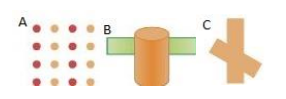
Which three Gestalt principles are associated with these figures, and describe how we perceive the figures, and how we would perceive them if the Gestalt principles wouldn’t hold/exist.
A) Priniciple of similarity - group the dots into columns rather than rows (using the dots' colours as a grouping characteristic based on their similarity)
If this principle would not hold, we might see 16 individual dots or 4 horizontal lines, each containing alternating red and beige dots
B) Principle of good continuation - tend to see a continuous green bar, that is hidden behind the orange pillar
would perceive two smaller rectangles next to the pillar
C) Principle of simplicity = interpret a form in the simplest way possible -> see two intersecting
rectangles
would see a 12-sided polygon
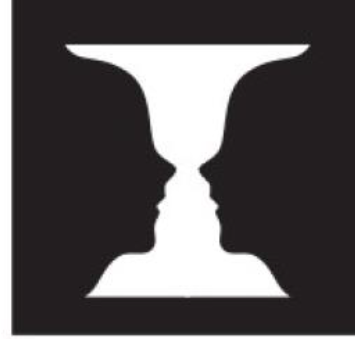
Using one of the two images, explain the statement "perception is not neutral". (the other is the necker cube)
not neutral because the perceiver adds an interpretation to the input
both images displayed are ambiguous figures(reversible) -> provide for two prominent and stable interpretations
A) the Necker Cube can either be perceived and interpreted to have the lower-left or the upper-right square as its front side
B) The face-vase figure can either be seen as a vase or two faces looking toward each other
people see one interpretation or the other but can flip between them
cannot see both at the same time
perception is an active process that requires some interpretation of the visual input from the perceiver -> is not "neutral"
Describe an example that demonstrates that the detection of features, an early phase in visual perception, is influenced by higher level interpretation.
example: words of which one can only "see" the shadows of the letters (as on the photo above)
visual features = low-level visual information such as colour, shape (corners, angles, curves), size, texture
higher level interpretation -> can only "see" the shadows of the letters
features of the letters are not present -> "perceive" them by filling in the blanks based on a global analysis of the presented stimulus
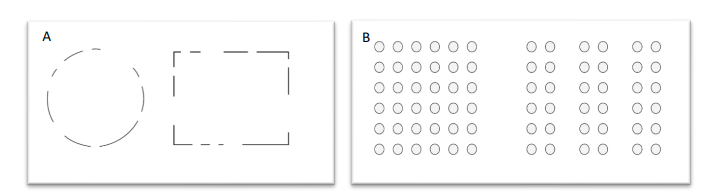
Which two Gestalt principles of organization are depicted below? Describe how we perceive the figures, and how the Gestalt princple influences this process.
A) illustrates the principle of closure -> perceive a circle and a square -> bias toward perceiving closed figures rather than incomplete ones
B) Illustrates the principle of proximity -> tend to perceive groups -> linking dots that are
close together
Why is the statement that “perception can be divided into an information gathering step followed by an interpretation step” plausible, but nonetheless wrong?
plausible:
assume that the first step in perception consists of collecting information about the stimulus -> second step is the interpreting of the "raw data" (serial processing)
wrong:
interpretation can proceed basic information collection
the brain’s functioning relies on parallel processing (simultaneously analysing basic features and large-scale configuration) - neither is prioritized -> interaction of both processes
In the figure below, the edges of each stripe seem to be more prominent, either brighter or
darker than their surroundings. Do the edges’ contrast objectively differ from the rest or not? How is this phenomenon called and how can you explain it?
optical illusion called Mach bands
caused by a phenomenon called lateral inhibition:
retinal cells of the eye that receive greater stimulation inhibit surrounding cells to a greater degree than cells receiving less intense stimulation
light receptors receiving input from the lighter side of the edges produce a stronger visual response than receptors receiving input from the darker side -> create a greater inhibition -> enhances contrast at the borders making the edges more pronounced
What is a receptive field? Describe an example of specialized neurons that work with receptive fields.
region of visual space in which an appropriate stimulus can drive an electrical response in a sensory neuron (the region we are able to see)
example:
centre-surround cells whose firing rate increases when a stimulus is presented in the middle of their receptive field
the cell’s firing rate decreases if a stimulus is presented at the edge of the cell’s receptive field
if a stimulus is presented both to the centre of the receptive field and to the edge, the cell’s firing rate does not change from its baseline level
Describe the “What” pathway & the “Where” pathway and what they are associated with.
“What” pathway = information processing stream
occipital cortex to the temporal cortex
specializes in object recognition
closely related to the hippocampus -> role in associative learning
“Where” pathway = crucial for spatial information, guides actions
occipital lobe to the parietal lobe
closely related to the motor cortex and eye movement system
Explain what perceptual constancy is, and what are the different ways that we achieve this.
perceptual constancy = the tendency to see objects’ properties such as size, shape and brightness as steady or constant in the world regardless of changes in the reception of sensory information such as changes in angle of perspective, distance, or lighting
can be achieved by focusing on the relationships between the different objects in the visual field that remain unchanged instead of the images themselves (do not always have the relationships)
Helmholtz: we manage to achieve constancy by unconscious inference
unconscious inference = a calculation process
example: size constancy = multiplying the image size reflected on the retina by the distance the perceiver has from the actual object
Depth perception is not inherent to humans. Instead, they need to infer it from visual cues.
A) How do humans achieve this?
B) You friend unfortunately had an accident and needs to where a band-aid on the left eye for a week. How does she/he manage to perceive depth?
A) binocular disparity = the two eyes receive a somewhat different view of an object and the difference between these views
binocular vision is needed
can also be depending only on monocular distance cues
B) cannot see from one eye -> will have to depend only on monocular distance cues
will have to calculate the adjustment the muscles of the eye do depending on the distance of the viewed object, rely on basic principles of physics
can use different cues:
cue of interposition = when an object blocks vision to another object
can also use cues from different textures
cue of linear perspective = when parallel lines begin to converge the farther away, they go from her/his position
cues related to movement:
motion parallax = when moving, the projected images of objects at different distances move at slightly different speed -> with the ones closer to move more than the more distant ones
optic flow = providing information on how the entire visual field changes as she/he moves through the world
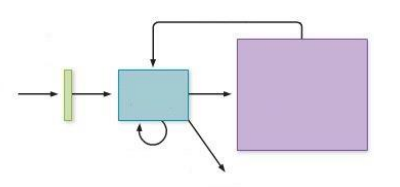
6.1.Using the figure, describe the modal model of memory, focusing on how incoming information is processed.
Incoming information is first briefly stored in a "raw" sensory form in sensory memory (green, leftmost box).
Visual input is stored in iconic memory and auditory input is stored in echoic memory.
Through an attentional process of selection and interpretation, the information passes on to short-term memory (STM; blue, middle box), where it is maintained via rehearsal (arrow pointing back to the same box).
Some of the information from STM is lost, while other moves into long-term memory (LTM; purple, rightmost box).
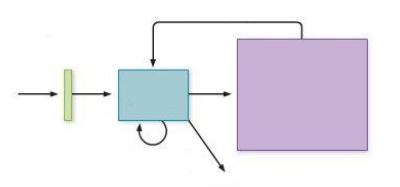
Using the figure, describe the modal model of memory, focusing on the storage duration and capacity of the different stages.
sensory memory:
store (left, light green) is large
only available for a very short period of time - only available for a number of seconds
Information that is processed is then passed on to STM (blue box)
capacity is limited
information needs to be rehearsed to remain in STM
From there, information that has not been lost will move into LTM (purple box)
much greater capacity than STM
final storage of information
information can be retrieved into STM again.
State 4 differences between working memory and long-term memory.
The capacity of working memory (WM) is limited, but the capacity of long-term memory (LTM) is not.
It is easy to get information into WM, but is effortful to store information in LTM.
Getting information out of WM is also easy, while it is effortful and sometimes impossible to get information out of LTM.
The contents of WM are quite fragile, but the contents of LTM are more durable and can last a life time.
What are the typical effects observed in free recall of a list of memorized items, and what are the associated terms?
a typical pattern: accuracy of recall is dependent on an item’s serial position
the relation between percentage of recalled items and serial position is U-shaped
primacy effect = first items within a series are typically most accurately recalled
recency effect. = last items of a series are also recalled fairly well
Describe how the recency effect observed in free recall of a list of memorized items can be eliminated by giving an example and explain how this process works and why it doesn’t for the primacy effect.
can be eliminated by introducing an additional task between memorizing and recall
example counting backward by threes
constitutes new material and activation of different knowledge that requires WM -> due to WM’s limited capacity, the last items that were memorized, can no longer be held in WM but are replaced by elements of the new task
no such impact on items earlier on the list (primacy effect) because they are assumed to be recalled by the LTM, which does not depend on current activity
Assume that in a list-learning experiment, the rate of presentation of to-be-remembered items is decreased, so the items are presented at a slower rate. What effect is observed on the percentage of words recalled as a function of the serial position? Explain what is driving this effect.
improves LTM-based retention -> all items as items have a higher chance of being encoded in LTM
does not enhance the recency effect
overall increase is caused by the additional rehearsals that can be performed due to the additional time provided by the slower presentation rate
Describe the digit (or word) span procedure, and what are the main outcomes of this test?
measures an individual's working memory capacity
presented a short list of items (e.g., 3 - 6 - 4) and is asked to recall these items
then a list one element longer is presented, and the participant is again asked to recall the items.
list length is increased until the individual starts making errors
the longest list that the individual could recall correctly is assumed to reflect that individual's working memory span
main outcome: people can recall about 7 items when chunking is not prevented, but also that there is quite some variability
Assume that in a list-learning experiment, the rate of presentation of to-be-remembered items is decreased, so the items are presented at a slower rate. What effect is observed on the percentage of words recalled as a function of the serial position? Explain what is driving this effect.
improves LTM-based retention -> all items as items have a higher chance of being encoded in LTM
does not enhance the recency effect
overall increase is caused by the additional rehearsals that can be performed due to the additional time provided by the slower presentation rate
Explain what "7 plus or minus 2" means in relation to working memory.
the number of chucks people can recall (assuming relatively short retention periods)
WM span/capacity tasks have shown that people can typically hold between 5 and 9 elements of information in WM
the number is assumed to be influenced by chunking, as when chunking is prohibited, the WM span/capacity is lower (~ 4 items).
Explain the meaning of a chunk by explaining how a learner will store the following two letter sequences in memory: (a) W R S C X P, or (b) T R A N L O
sequence (a): one most likely has to memorize each letter individually, that is, each letter
will be stored as one chunk
sequence (b): however, the letters can be combined into two syllables: TRAN and LO. In this sequence, the syllables comprise one chunk each.
sequence (a) would therefore be memorized as six chunks and sequence (b) as two chunks, although both sequences consist of six letters.
chunk = a package of connected information, that can be memorized together
Describe what has and hasn’t changed if the digit span of a person has increased through practice.
acquires more efficient chunking strategies -> help to store more information into one chunk
WM capacity does not change
Describe the differences between an operation span task and a digit span task.
operation span tasks require active processing of information, whereas a digit span tasks only requires a more static storage of information
operation span tasks correlate better with measures of intellectual performance, such as test of reasoning or reading comprehension and standardized academic tests than digit span tasks
operation span task also aligns better with the theoretical concept of working memory as a status of activation (the “most memory chunk that is currently most active, i.e., the one that we’re currently working on”), while the digit span task fits better with the earlier theoretical concept of working memory as a storage place
State the names of the helper systems of working memory as proposed by Baddeley and explain briefly what they do.
visuospatial sketchpad and the articulatory rehearsal loop are the helper systems of working memory
sketchpad storing visual and spatial information, the loop storing auditory information (or information that can be stored in auditory form, such as visually presented words)
episodic buffer dedicated to linking information across domains to form integrated units of visual, spatial, and verbal information with time sequencing
Explain which of the following statements is true about establishing information in memory, and why?
(a) Relational rehearsal is superior to maintenance rehearsal
(b) Maintenance rehearsal is superior to relational rehearsal
(a) is correct
to create lasting memories of detailed aspects of the presented stimuli, one needs to engage in relational, or elaborative, rehearsal
attend to the new information and to think about it, how it relates to already known information
simply repeating information over and over might result in shallow memorization, but it is unlikely that all details of the presented information will be retained
State an example for shallow and for deep processing and explain which process leads to better memory retention.
reading the textbook by merely looking at the words to “get through” the study material is an example of shallow processing
no attention is paid to the actual meaning of it
superficial way of engaging with the new information
only allows for a small number of connections to previous knowledge
creating a mental image and trying to relate prior knowledge to the new information consists of deep processing
thinking about the meaning and engaging with the material
leads to better memory than shallow processing, because deep processing makes people relate to the material, thus creating connections that serve as retrieval paths
the more paths, the easier to recall the target information, i.e., enhancing the creation of retrieval cues
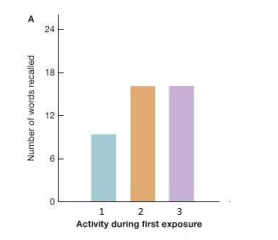
In a study, memory performance recalling a list of words was compared after different methods of engagement with the material. In one group, participants were asked to find the 'e' in each word, in a second group participants had to decide how pleasant the word seemed, and a third group was instructed to learn the words for later testing. The figure depicts the observed results. Label the shortest bar, and explain what these results tell us.
the group that was asked to find the 'e' in each word (bar 1) remembered the least words
the other two groups remembered about the same number of words
experiment indicates that intention to learn does not necessarily make a difference
the participants who thought about the words' pleasantness without the intention to learn, performed just as well as participants who were instructed to memorize the words
the level of processing influences memory:
shallow processing, like finding the 'e', encodes the material less well than deep processing, such as rating the material's pleasantness
Explain the role of intention in learning and give an example
intention to learn leads people to approach the material in a certain fashion
it is this approach, not the intention itself, that influences memory of the material
example: people who genuinely want to learn something are paying attention to the material they want to memorize. In addition, they are thinking more deeply about it, for example they ask questions, connect it to existing knowledge and organize the material, which all leads to better understanding of the material
shallow processing, which usually happens in the absence of the intention to learn
intention induces the application of mechanisms that promote encoding and hence better later recall of new material
Explain the significance of deep processing of new material, compared to shallow processing, using the analogy of categorizing new books arriving at a library.
Deep processing:
connects the new material to existing knowledge, and is therefore creating many retrieval cues
processing of the material is like carefully cataloguing new books at a library and categorise them according to different aspects, for example by genre
thoughtful processing of new input is done at the arrival of the input
crucial for easy retrieval and use of information at a later point in time
shallow processing:
not many retrieval cues -> impedes later retrieval
lack of attention to the input
compared to incomplete or indistinct cataloguing of new books, for example by only organizing books according to colour or by not categorizing them at all.
deep processing means carefully and attentively processing the incoming information in order to facilitate later retrieval
What is the basis underlying mnemonic memory strategies?
principle of organization
well-organized structure aids recall
if organization is found within the materials itself, this organization is used to aid later retrieval.
if no organization can be found, e.g., a list of random items, then we can impose external organization (mnemonic strategies)
Are mnemonic strategies always useful to remember information? Explain why or why not and give an example.
helpful to learn information, because they organize material and establish connections
usually set the focus on just one aspect of the material, leaving out many others
general understanding and learning the broader meaning of the material might be disregarded, because the attention to one or two connections leaves less attention to the many other possible connections of the material
can be very helpful but come with a trade-off
for some material, for example remembering the colours a rainbow, where the order of colours is the main information one wants to know, mnemonics promote exactly the right characteristics
What kind of process or strategy can participants use to increase their scores obtained in a digit span task? Give an example.
when they can "chunk" the presented information in bigger units ("chunks"), the participants can recall more information
example: when the number presented to a participant have a certain meaning (e.g., a telephone number), the participant needs only one "entry" in working memory to store those 7 or 8 numbers.
Explain whether the following statement is correct or not: "Memory is attention in the past tense" and elaborate on the relationship between memory and attention. Give an example to support your view.
the most part the statement is true
people remember what they have paid attention to and generally do not remember aspects that they have not paid attention to
memory has a limited capacity -> attention determines what will be encoded
attention -and specifically, selective attention- is a prerequisite for -explicit episodic- memory
attention alone is not always enough for forming long-lasting memories
creating retrieval paths between new and already-known information by engaging in deep processing might be required
but memories from past experience can guide attention in the present
example: effortfully searching for your desk at a new job as of the second day, won’t be necessary as your attention will immediately be directed to the place you were introduced the first day
a bi-directional relationship between memory and attention
What do attention and WM have in common? And how do they relate to each other? Is there another way to view WM?
both capacity-limited systems, crucial for learning new information
attention is important for selecting the new information to-be-learned
WM is responsible for making sense of this incoming material
the executive control processes related to attention are equivalent to WM’s central executive.
recent view criticizes the subdivision of WM and propose that instead of a unique component the state of temporary memorization and manipulation of information is generated by activating existing representations from long-term memory through an attentional mechanism
activation can be viewed as internal attentional process
Rinck (1999) conducted experiments in order to elucidate whether memory for numerical layouts encountered in everyday life (see figure below), is as poor as for other everyday objects. Rinck found that people’s memory for the layout of numbers on keypads is indeed poor. Why do we remember these layouts so poorly despite encountering them frequently?
long-lasting memories of the layouts are not formed by repeated exposures to them.
to remember a certain piece of information in the long-term, one has to be attentive to it and rehearse it elaborately
the use of keypads of telephones and calculators does not involve paying a great deal of attention to their layout -> no elaborative rehearsal -> the arrangement is remembered quite poorly.
you remember the shopping list shown below in the following way: You imagine a carrot stuck into a bun, the elegant shoes of an Italian lady making pasta, a tree with croissants hanging from it instead of fruit and a door with a sign on it saying: “Welcome to my soap opera.”. What is the name of this mnemonic strategy and how does it work?
peg-word system-> constitutes a mnemonic strategy
allows you to impose an organization
an object or image is mentally visualized which holds or 'pegs' the information that needs to be recalled and thus makes it easier to remember
What factors determine a person’s success in memorizing new information?
effort to organize and understand the new information as well as connect it with prior knowledge-> determines the success in memorizing
deep processing of the new information, elaborative rehearsal and a rich framework in which the new material can be incorporated.
Explain why the conceptual separation of the memory process into the distinct steps of acquisition, storage and retrieval may be misleading.
to memorize new information, having a rich framework of prior knowledge (i.e., storage) in order to make connections (i.e., acquisition & retrieval) with the new information is important-> acquisition of new information is contingent on information in storage and on the creation of retrieval paths
the acquisition stage is intertwined with the retrieval of already stored
Which type of errors are more common: misreading uncommon letter combinations as common ones, or misreading common letter combinations as uncommon ones, and why?
it is a typical error to misread uncommon letter combinations as common ones
based on the top-down influences in perception
if the uncommon letter representation activates a word (i.e., a common letter combination) sufficiently, it is this word that will be perceived instead of the uncommon letter representation
What model applies the feature network idea to the recognition of complex three dimensional objects? What does this model assume is the lowest level feature that is specific for recognizing complex three-dimensional objects., and what is this feature’s analogue in the models of word-recognition?
recognition by components (RBC) model
lowest level feature are geons - simple geometric shapes
comparable to letters more than to the line segments:
composed of simple visual components
form the building blocks of larger conceptual meaningful objects (like letters do words)
What is repetition priming, how does it affect performance, and what is the explanation of this effect?
a priming effect- an earlier stimulus influences a later stimulus
describes the phenomenon that participants are faster to react to the second presentation of a stimulus that was recently presented
the influence of recency (and frequency) on recognition
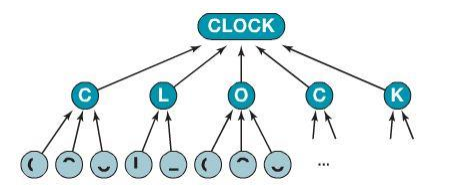
Using the provided figure, explain the different levels of a feature net and their functions and explain a particularity in the flow of information in this model.
feature net = a hierarchical network of detectors, which are organized in layers
when a detector (the nodes in the scheme) receives input its activation level increases
if the node’s response threshold is reached, the detector will fire, which means that it activates the other detectors to which it is connected
the lowest level in the net is comprised by feature detectors that respond to simple features
when these detectors are activated, they trigger the next level of detectors, the letter detectors. These can trigger the next level of detectors, for example word detectors
activation can flow in both directions
Name two factors that are influencing the recognition of briefly visible stimuli.
familiarity with the stimulus (i.e., frequency; how often was the stimulus seen before)
recency of last presentation influence the recognition of a stimulus
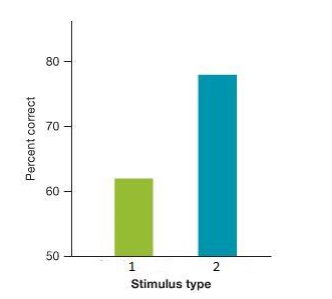
Label the two bars in the figure, which display recognition rates of letters presented in isolation, and letters presented as part of a word. What do the results in this figure demonstrate, and how is this explained?
first bar (1) indicates the percentage of correctly recognized single letters
the second bar (2) indicates the percentage of correctly recognized letters presented in words.
letters in words are recognized more often than single letters - word-superiority effect
explained by assuming that the recognition of the whole word facilitates the recognition of individual letters by means of feedforward and feedback activation between word and letter recognition processes
How can the response threshold of detectors be reached? Describe two manners.
the response threshold of detectors depends on the starting point of activation level of each detector
for a detector that has been recently activated (like a “warm-up” effect) has a higher activation level and can therefore be activated by weaker input
if the detector is frequently activated, it can again reach the threshold much easier
if a detector has a starting point of low activation level, then it needs a strong impulse
Explain why, on the basis of the multiple views proposal, perspective either does / does not matter in object recognition.
contrary to the RBC model view
perspective is crucial for object recognition
the speed of recognition is viewpoint-dependent, because objects will be recognized more easily when the perspective is familiar
.if the perspective on the object is unfamiliar, mental rotation is necessary in order to recognize the object nevertheless, but this additional process delays recognition
perspective (viewpoint) influences the speed of recognition
Explain why, according to the recognition by components (RBC) model, the viewpoint (perspective) on an object, either does / does not matter in object recognition.
geon detectors, which are thought to be viewpoint-independent
respond to certain shapes, independent of the perspective
evidence comes from a famous study in which they showed patients different photos of Jennifer Aniston and single neuron strongly responded to the photos regardless of the differences
Explain why object recognition is essential to human behaviour.
crucial to apply knowledge of the world to the environment
for example, in order to be able to enter a building you not only need to know what a door looks like and how to use it, but you also need to recognize it
relevant to learning
need to be able to link new information to previous knowledge and experiences in order to build up knowledge of a certain object
example: you need to be able to recognize a person again, in order to get to know him/her
Explain why frequent words of a language are recognized better/faster than less frequent words.
frequent are also likely to have occurred recently.
the detector for a frequent word has fired frequently and recently. -> high baseline level of activation level of this detector -> a weak signal can bring the detector to its response threshold and cause it to fire -> the word is more easily detected even when the signal is degraded
Explain which statement is true by describing an example to support your answer:
(A) Context allows us to see more
(B) Context allows us to make better use of what we see
(B) is true
the context helps to decide which stimulus is more likely to be present
example, when the input is the same for CQRN and CORN, then the higher baseline activation level for the bigram CO, based on higher frequency and recency, will lead to the activation of the word CORN
the surrounding letters helped to decide which letter is more plausible at higher levels of recognition, but it did not add extra activation at a basic level that would have helped to detect all simple features
Explain what happens in perception when visual input is degraded or ambiguous.
when visual input is degraded, not all the original features (e.g., letters) of the non-degraded input will be detected
the detected features will send activation to a higher-level unit (e.g., a word)
the activated higher-level unit will in turn send activation downwards, "filling in" the perception of the original features that were not detected due to the degraded stimulus.
Explain the composite effect.
appears in face recognition
shows that recognition of faces relies on holistic perception, including the perception of relationships and contingents
evident in an experiment where participants had to recognize the faces of famous people, when two halves of different people were combined. When the combinations were properly aligned, participants faced more difficulty in recognizing the celebrities, which implies that holistic processing takes place in face recognition
face recognition seems to be like pattern recognition, rather than recognition of individual features.
Describe the elements of the recognition by components (RBC) model.
uses hierarchy of detectors
lowest level: feature detectors -> activate geons -> activate geon assemblies -> activate object models
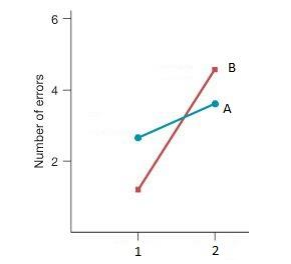
Describe the effect of inversion on the recognition of houses and faces based on the presented figure. Label the graphs and the x-axis accordingly.
blue graph (A) shows errors made in the recognition of houses and the red one (B) shows errors made in the recognition of faces
first point on the x-axis (1) shows the number of errors with upright images and the (2) one errors made with inverted images
with upright images, people's recognition of faces is better than for houses
with inverted images, more errors are made in both categories, but the impact of inversion (inversion effect) is a lot stronger for the recognition of faces
Some websites offer quizzes in which close-up pictures of everyday objects are shown and users are required to identify the objects. Most people take quite some time to recognize the depicted object. How would an RBC theorist explain the failure of not immediately recognizing the object?
RBC model is a network of detectors, which is hierarchically organized
the lowest-level consists of feature detectors, which are followed by geon detectors. The next level of detectors responds to geon assemblies, which in turn activate the object model
few features/subset of geons in the close-up pictures of objects -> a combination of geons cannot be readily assembled -> object model inactivated
the missing geons need to be inferred, thereby delaying or even preventing object recognition.
Which factor determines the extent of a letter string’s context benefit? Explain by giving an example.
Well-formedness, i.e. how much a letter string conforms to the usual spelling patterns of a specific language
example, the more English-like the letter string
the more frequently it occurs in the language, the easier it is to identify the letters in the context, thus the greater the context benefit, rather than the letters alone
Discuss whether a network’s recognition errors lend support to the notion that perception “goes beyond the information given”.
a network’s recognition errors reveal that the network is biased towards frequent inputs and letter combinations than infrequent ones
the bias depends not on locally represented bigrams, but on the network’s distributed knowledge, meaning that knowledge is represented by a pattern of activation that’s distributed across the network and it’s only identifiable when the entire network is activated
this enables us to make inferences, giving up accuracy in order to gain efficiency -> recognition errors indeed support the notion that perception “goes beyond the information given”.
example: , for instance misperceiving the briefly presented letter string “CQRN” as “CORN” -> shows the network is biased towards frequent inputs
Do you agree with the term Fusiform Face Area? Yes or no, and why?
No, because several experiments have shown that this brain area becomes active when recognizing something familiar or something that a person has been trained to recognize
this area seems to reflect expertise in distinguishing between similar, well-known objects
For his exams, a student always studies in a quiet study cabinet that has a calming impact on him. The exam takes place in a large exam hall with many students sitting close to each other. The student notices the uneasy atmosphere in the exam hall and also the construction work that takes place in front of the windows. Explain a possible negative effect that this difference in context might have on the student's performance, and how she might counter it.
context-dependent learning: context reinstatement improves recall performance on a test -> if the context during study and recall is the same, recall is improved
differences in context -> recall might suffer in this example
when the psychological context of the learning situation can be re-created, the negative effect is attenuated as this might also provide recall cues that facilitate the retrieval of the learned material
Explain which of the following is a more effective method of context reinstatement, in order to facilitate recall in a testing situation, and describe the evidence supporting your answer
A) re-creating the physical context of the study environment only, or
B) re-creating the psychological state during studying only.
reinstatement of both would be ideal
psychological context of the learning situation matters more than the physical context
the best results were produced when learning and testing were done in the same room
participants, for whom learning and testing took place in different rooms, that had to think about the context of the learning, led to the same performance level
re-creating the psychological context is enough of an effective method of context reinstatement for better recall on a test.
For her exams, a student always studies in a quiet study cabinet that has a calming impact on her. Right before the exam, while waiting outside the exam hall, the student listens to the latest album of her favourite band. She had seen this band on a rock festival the weekend before and now remembers the excitement she had felt; energized she enters the exam hall. Explain the effect that this context of the exam probably has on the student's performance.
context-dependent learning: context reinstatement improves recall performance on a test -> if the context during study and recall is the same, recall is improved
psychological and physiological context - create recall cues
psychological context the student puts herself into differs from the psychological context she was when studying for the exam -> problems optimally recalling the learned material
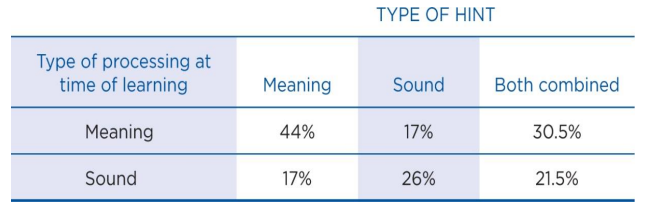
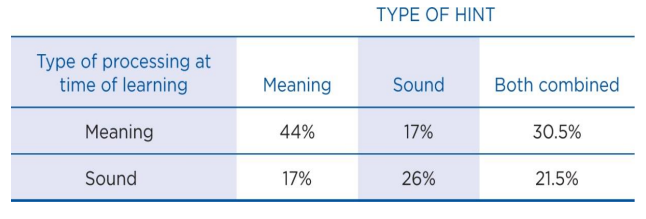
A study compared the recall of words that were processed differently and for which different hints were given in the testing phase. The results are listed in the table below (to avoid confusion, note that the rightmost column “Both combined” simply lists the average across the two types of hint). Explain how the results illustrate both the effects of deep processing and the operation of the transfer-appropriate-processing (TAP) principle.
processed with a focus on meaning: better recalled when the hint for recall was aimed at the meaning rather than at the sound
opposite relation for words that were processed with a focus on sound during study
TAP principle: memory performance benefits when mental operations used during study and those used during retrieval overlap
performance was better when words were processed with a focus on meaning during study -> beneficial effects of deep processing
focus on meaning during study resulted in worse performance when the recall hint was aimed at sound -> beneficial effects of deep processing can be strongly modulated and even overpowered by the TAP principle
Explain the impact that context has on the encoding of a stimulus.
stimulus is encoded together with the context as an integrated whole
mechanism is called encoding specificity
example: a stimulus depicting “a piano that is lifted” is encoded in the context of it being a large and heavy item
a hint aimed at the musical characteristics of the piano is less likely to be an effective retrieval cue here as compared to a cue aimed at the piano's size or weight.
the context of a stimulus influences the connections made with other knowledge and, therefore, the connected retrieval cues
Explain the function of hints in recall with regard to the memory network (i.e., the finding that recall for question-plus-hint is generally better than for the question by itself).
hints activate some nodes in the memory network, from where activation spreads
raises the activation of connected nodes or associative links
if the hint is useful and relevant, it will facilitate recall or reactivation of the relevant nodes -> activated by spreading activation from both the hint and the retrieval cues provided by the question
Explain why people react faster in a lexical decision task to the word pair 'bread - butter', than to the word pair 'shoe - lake', and give the term of this phenomenon.
first word pair: the word bread causes spreading activation of related concepts -> word 'butter' already receives subthreshold activation from 'bread' via associative links
semantic priming facilitates the correct recognition as a word "butter"
second word pair: 'shoe' and 'lake' are semantically unrelated
recognition of 'shoe' will not facilitate the subsequent recognition of 'lake' as a word, because 'lake' has not been pre-activated or primed by ‘shoe’
Does a double dissociation exist between familiarity and source memory? Explain why or why not by giving examples and delineating the terms.
familiarity and source memory seem to be completely independent types of memory
example for familiarity: the feeling that one has met a certain person before, but cannot recall the situation in which the encounter took place
absence of source memory, meaning the absence of any recollection regarding the exact source of the current knowledge
an implicit feeling of familiarity suggests recognizing that current knowledge has been encountered before
example for source memory only: people with the Capgras syndrome have concrete memory of some people, without a feeling of familiarity
source memory is intact, but the stimulus does not feel familiar
Describe what the false fame effect illustrates in relation to memory.
false fame effect = misinterpretation or misattribution of the feeling of familiarity with regard to a certain person in the absence of explicit memory about specific earlier encounters
due to the feeling of familiarity together with a lack of any explicit recollection of earlier encounters (no source memory), people assume or infer that this person must be famous
State the effect familiarity has when judging the credibility of a statement and describe what happens when adding a warning about the falsity of the statement. Give some examples of the effect in everyday life.
sentences, which have been encountered in a previous and unrelated situation, are subsequently more likely to be accepted as true -> familiarity influences and promotes judgments of credibility
true even when explicit warnings are given not to believe the statements during the previous encounter
misattribution of the feeling of familiarity -> the illusion of truth
exploited more and more often in modern politics and in advertising
Describe what source confusion is and give an example.
source confusion: memory error that is based on misattribution (remembering information as being obtained from one source, while in fact was obtained from another)
e.g. believing someone told you something personally when you really read it on their social media page
Explain the mechanism underlying implicit memory effects.
previous encounters with a stimulus will leave this stimulus more highly activated and strengthen the connections and pathways that were involved in processing it
next time this stimulus is encountered and processed, the processing fluency will be higher than for new stimuli, and people are assumed to be sensitive to the degree of processing fluency
higher than expected processing fluency may make a stimulus seem special, and people will often interpret that specialness as familiarity
when that interpretation is incorrect -> illusion of familiarity.
How may an illusion of familiarity be elicited, and explain the consequences of this illusion.
can occur when presentation of a specific stimulus is manipulated to make perception easier (more fluent) than for other stimuli
e. g. by presenting it for a few milliseconds longer or at a slightly higher intensity
people are sensitive to the degree of processing fluency
higher than expected processing fluency may make a stimulus seem special -> people will often interpret that specialness as familiarity
when enhanced processing fluency is actually caused by manipulation of the quality of stimulus presentation -> illusion of familiarity
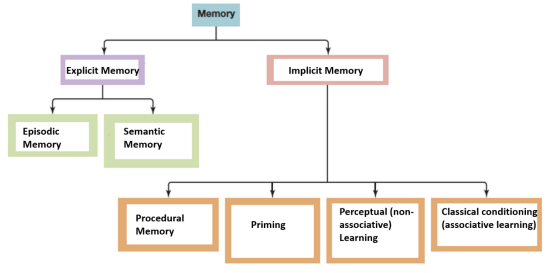
Name all subcategories of memory in the schema bellow.
on the photo
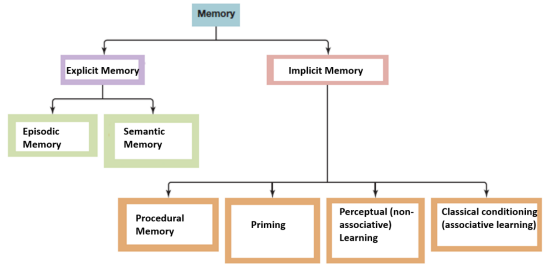
What types of evidence support the division of memory into different types and systems? Give some examples.
Behavioural, functional and biological evidence
anterograde amnesia: problems with explicit memory but implicit memory remains intact
damage to amygdala (crucial for fear learning): classical conditioning experiment -> neutral stimulus was paired to a “scary” one -> the patients exhibited explicit memory of the event with no fear response accompanying it -> implicit memory was impaired, explicit memory was intact.
Does a double dissociation between semantic and episodic memory exist? Explain how this is/isn’t evident.
is a double dissociation between semantic and episodic memory
evidence from clinical observations and studies:
some patients show disrupted semantic memory and entirely intact episodic memory, some reversed -> independent from each other
Explain the functioning of implicit and explicit memory in patients with anterograde amnesia and provide an example.
anterograde amnesia: cannot form new episodic memories
implicit memory is intact, can learn implicitly
example: one patient with anterograde amnesia did not remember having met her psychologist before, but she implicitly remembered that he had hidden a pin in his hand when shaking her hand the day before
evident in her pulling her hand away just before the hand shake, with the explanation that some people hide pins in their hands, but she did not directly link this experience to her psychologist
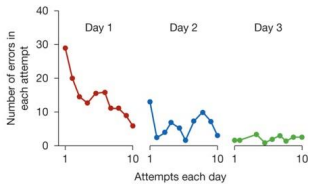
Amnesic patients engaged in a mirror-drawing task and the results are displayed below. On neither Day 2 and 3 did they recall already having performed the task. Using the results, answer the following questions:
a. Which type of memory is disrupted in amnesic patients and which type is intact?
b. What do the results tell us about the conceptualization of memory in general?
amnesic patients’ explicit memory is disrupted while their implicit memory remains intact.
amnesic patients improved on the mirror-drawing task gradually, resembling the pattern of results from healthy participants, even though they had no recollection of practicing
indicate an unimpaired implicit memory
suggest that one must consider different types of memory and that explicit and implicit memory are dissociable
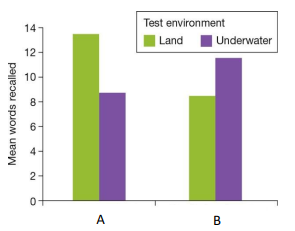
Below the results of Godden and Baddeley’s (1975) study are shown. Label the two conditions (A & B) and explain what the results reveal about memory.
Condition A represents materials studied on land, whereas condition B represents materials studied underwater
materials studied and tested on land and materials studied and tested underwater were remembered best by the scuba diver -> retrieval advantage when learning and testing circumstances match -> respective circumstance is triggering certain thoughts which act as retrieval pathways for the target material
not only the target material is stored in memory, but also connections established during learning
Using the concept of a memory network, explain the context reinstatement effect by giving examples.
sought information is probably tied to a provided retrieval cue (e.g., “What word was on the list?”), but it might be that the desired information receives insufficient activation from this source
the sought information is tied in memory to thoughts that had been triggered by the learning context (e.g., thoughts about what the room looked like etc.)
back in that context at the time of recall (or re-creates it) -> target nodes can receive a double input -> helps activate them
On which key assumption does context reinstatement rest? And how do we know about it?
rests on the assumption of summation of subthreshold activation
= the activation received from two different sources, each of which is by itself too weak to activate target nodes above threshold, when combined or summed may well suffice to activate the target nodes sufficiently strongly
context reinstatement, even if it would contribute only a modest amount of activation to retrieval, this contribution can make a lot of difference with respect to overall retrieval success as attested by often surprisingly strong contextual effects on memory reported in the literature
Participants are exposed to a list of words. Four days later, they are tested in one of two ways: A first test consisting of a second word list of which they have to indicate which words were also on the initial list, and a second test consisting of a lexical-decision task, occasionally involving words from the initial list. At testing, participants showed a random performance on the first test, apparently not able to remembering the words on the initial list. However, a clear priming effect for words from the initial
list was found in the lexical-decision task.
a. What is the name of the first type of memory testing?
b. What is the second type of memory testing called?
c. Which phenomenon did the researchers observe when participants came back to the
laboratory after four days?
direct memory testing
indirect memory testing.
called “memory without awareness”/implicit memory -> not able to remember the words consciously, they are still influenced by them
You are not sure how to spell a specific word. After having written the word down on a piece of paper in two versions, you ask yourself: “Which one does look right?”. On what are you relying when employing this strategy?
relying on processing fluency
having encountered the correctly spelled version very often, the processing of the correct version will be fluent -> correct spelling “looks or feels right”
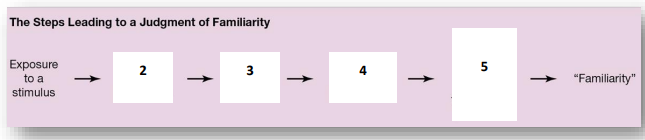
Using the figure below, fill in the missing steps leading to a judgment of familiarity and explain
why “familiarity” is more like a conclusion one draws rather than a feeling triggered by a stimulus.
step 2 (practice and perceiving): prior exposure to a stimulus leads to a higher processing fluency on subsequent encounters
step 3: heightened processing fluency is detected
step 4: step 3 results in registering the stimulus as somehow “special”
step 5: attribution of fluency
possible outcomes:
attributing it to a specific prior event -> experience of familiarity
they described steps can be viewed as a list of requirements which need to be fulfilled in order to elicit the sensation of familiarity -> can be regarded as an inference or conclusion
none of these steps are executed consciously, only the “conclusion” manifests itself as a feeling of familiarity
concluding familiarity will only happen when information/circumstances support it
eep processing may lead to improved memory performance because it facilitates retrieval.
How exactly does this happen?
deeper and more elaborate encoding gives rise to richer and more richly connected representations -> more retrieval paths (connections to retrieval cues) that can be used to re-activate (recollect) the memory representation by means of spreading activation
Describe the technique of dichotic listening and which questions it attempts to answer about selective attention.
dichotic listening experiment: special headphones used to present different auditory messages to the left and the right ear
participants are instructed to pay attention only to the message coming in on one ear (the attended channel), and ignore the other one (unattended channel)
asked to shadow the message in the relevant ear to make sure they follow the instructions correctly
concerns when selection of the information to proceed to further processing takes place and the extent to which this information will be processed.
Discuss the similarities between empirical findings in the dichotic listening task and the invisible gorilla experiment with the ball players
participants instructed to selectively process a certain part of the input they are receiving -> must be selectively attending the information presented
concentrating on the relevant information -> miss even quite striking or peculiar events when these are formally irrelevant.
dichotic listening: people do not notice what is the content of the unattended channel
invisible gorilla experiment: people do not see a gorilla walking in the midst of the ball game
in both participants are selectively attending some part of the input while they are ignoring the rest -> causes inattentional deafness and inattentional blindness.
Describe an example of change blindness.
a video in which some supposedly obvious part in a simple set-up was changed with every shift of the camera
e.g. colour of the table cloth/person's t-shirt
the changes not noticed by the watchers of the video
Can priming be done actively, when one anticipates a certain stimulus? Explain why or why not.
Yes
priming can be done actively -> to prepare for a certain input that one expects to encounter (expectation-based priming)
presented with a valid/informative cue or a prime, i.e., reliably predicts the occurrence of a certain stimulus -> actively expects it -> speeds up its processing.
top-down priming is effortful and can produce both benefits (valid cue) and costs (invalid cue).

