Intro to Psychology Study Guide: Test #1
 Studied by 0 people
 Call Kai
 Learn
Learn Practice Test
 Spaced Repetition
 Match
Match Flashcards
 Knowt Play
1/74

There's no tags or description
Looks like no tags are added yet.
Name | Mastery | Learn | Test | Matching | Spaced |
|---|
No study sessions yet.
75 Terms
1. What Psychology Is and Is Not
Psychology: The scientific study of behavior and mental processes.
Not psychology: Common myths, pseudoscience, or untested "folk psychology."
Roots in Philosophy and Physiology
Philosophy: Asked big questions like "What is consciousness?" and "How do we know reality?"
Physiology: Studied the brain and nervous system; linked physical processes to behavior.
Psychology emerged by combining philosophical questions with scientific methods.
What is facilitated communication?
A method used with children with autism that often led to false messages but people belived it because they wanted too.
What is confirmation bias?
The tendency to interpret ambiguous behavior as supporting pre-existing beliefs.
How does confirmation bias contribute to harm?
It leads individuals to reinforce their existing beliefs, potentially ignoring evidence to the contrary.
Scientific Approach
Psychology relies on systematic observation, experimentation, and evidence.
Avoids assumptions, guesswork, and intuition alone.
What is pseudopsychology?
Unscientific claims (e.g., astrology).
What is critical thinking?
Evaluating evidence before accepting claims.
What is belief perseverance?
Clinging to beliefs despite evidence to the contrary.
Scientific Method Steps
Ask a question
Conduct background research
Form a hypothesis
Test with experiments
Analyze results
Draw conclusions & report
What are the hree primary types of research that psychologists do?
Descriptive, Correlation, Experimental
What is Descriptive research
Observes and records behavior. Includes:
(Case studies, Surveys,Naturalistic observation)
What is Correlational research
Measures relationship between variables (correlation coefficient r ranges from -1 to +1). Cannot infer causation. Beware of illusory correlations or third-variable problems.
What is Experimental research
Manipulates variables to determine causation
Independent variable (IV): Manipulated factor
Dependent variable (DV): Measured outcome
Random assignment: Minimizes bias
Control & experimental groups
Placebo effect and double-blind studies reduce bias
What do neurons do?
Process and transmit information.
What do Glial Cells do?
Support neurons (nourish, remove waste, form myelin)
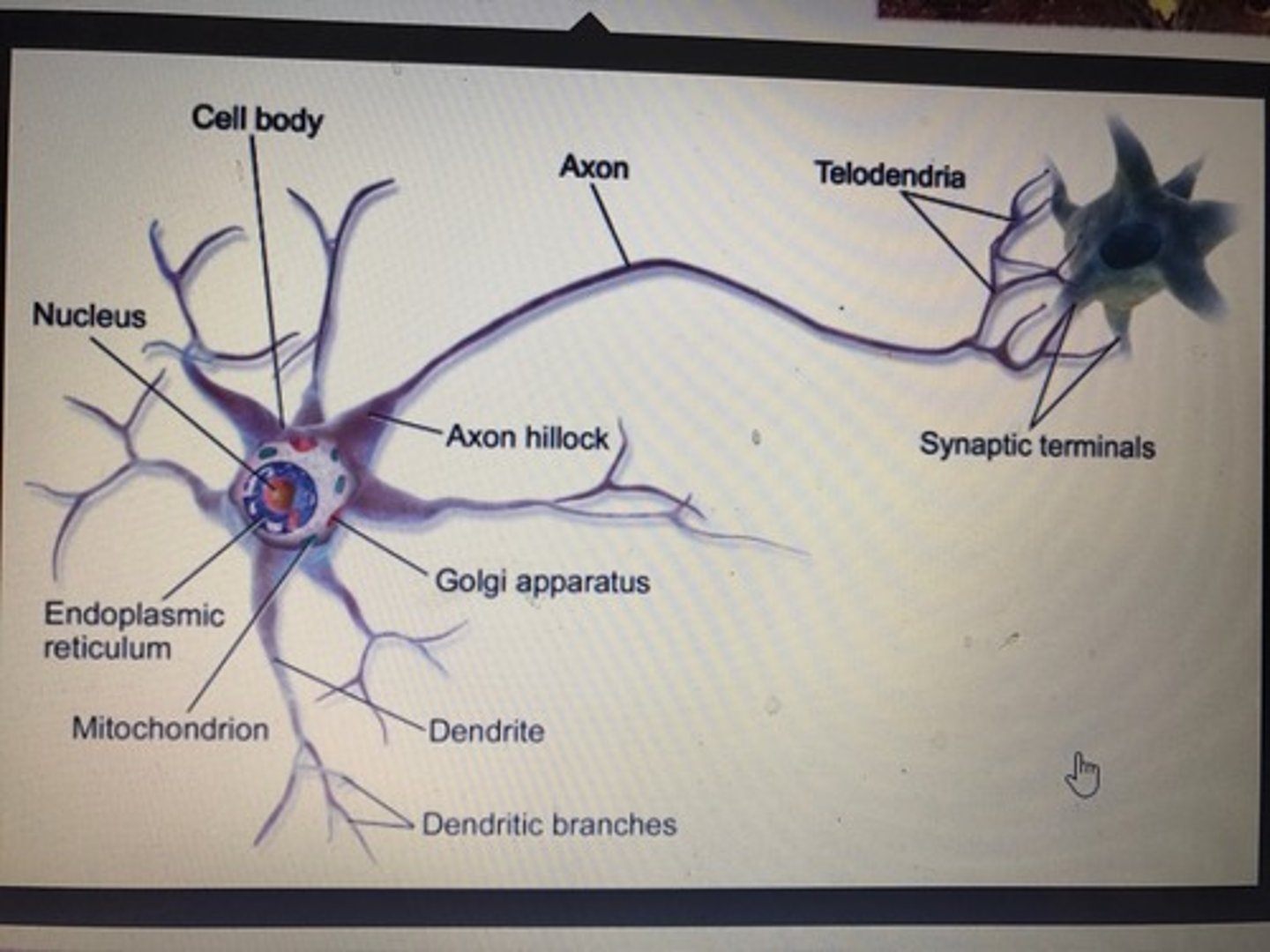
Neuron Stucture
Dendrites: Receive signals
Cell body (soma): Maintains cell
Axon: Sends signals
Myelin sheath: Insulates axon; MS destroys it
Axon terminals / terminal buttons: Release neurotransmitters
Synapse: Gap between neurons
Neurotransmitters & enzymes: Chemicals transmitting messages
All-or-None Response
A neuron either fires completely or does not fire at all.
There's no partial firing—once the electrical signal reaches the threshold, an action potential travels down the axon at full strength.
Example: Flipping a light switch—you either turn the light on fully, or it stays off; there's no half-on.
Threshold
The minimum level of stimulation needed to trigger an action potential in a neuron.
If the stimulus does not reach the threshold, the neuron does not fire.
Example: You need a strong enough tap on your knee to trigger the reflex; a light touch won't cause it.
Refractory Period
The recovery time after a neuron fires when it cannot fire again immediately.
During this period, the neuron resets its electrical charge.
Example: After snapping a rubber band, you have to reset it before snapping again.
2 parts of Nervous System
central and peripheral(CNS and PNS)
Central Nervous System (CNS)
Brain & spinal cord
Peripheral Nervous System (PNS)
Connects the CNS to the body
What are the two main divisions of the PNS
Somatic Nervous System (SNS) and Autonomic Nervous System (ANS)
Somatic Nervous System (SNS)
Controls voluntary movements (skeletal muscles).
Carries sensory information to the CNS and motor commands from the CNS.
Autonomic Nervous System (ANS)
Controls involuntary functions (organs, glands, heart rate, digestion).
Subdivisions:
Sympathetic: "Fight or flight" — prepares the body for stress or danger.
Parasympathetic: "Rest and digest" — calms the body and conserves energy.
Afferent vs. Efferent Neurons
Afferent neurons (sensory)
Carry information from the body to the CNS.
Example: Feeling heat on your hand sends signals to your brain.
Efferent neurons (motor)
Carry commands from the CNS to the body.
Example: Brain tells your hand to pull away from a hot stove.
The main function of the thalamus and how synesthesia is related to it
The thalamus is a structure in the limbic system that acts as the brain's "sensory relay station."
Main function: It receives sensory information (except smell) and routes it to the appropriate part of the cerebral cortex for processing.
Synesthesia is a condition where stimulation of one sense automatically triggers another sense.
Example: Seeing a color when hearing a sound, or tasting a flavor when reading a word.
Limbic System
Regulates emotions, survival behaviors (like eating and fighting), and memory formation.
Amygdala → emotion
Hippocampus → memory
Hypothalamus → drives & homeostasis
Cingulate gyrus → emotion regulation
Amygdla
Responsible for anxiety, emotion and fear.
Hippocampus
memory
Hypothlamus
Fear, thirst, sexual drive, and aggression we feel
Cingulate gyrus
Emotion regulation
Cerebrum
entire upper brain; handles higher-level functions
Cerebral Cortex
outer layer; allows complex thought, perception, and conscious behavior
Contralateral Wiring
brain controls opposite side of the body
Corpus Callosum
"bridge" between hemispheres, allowing them to share information
Split-Brain Research
Split-brain research shows that the two hemispheres specialize in different tasks.
The corpus callosum is the key structure that was destroyed in these patients.
The Four Lobes of the Cerebral Cortex
Frontal: decision-making, reasoning, planning
Parietal: spatial awareness, coordination
Temporal: object and sound recognition
Occipital: visual perception, interpretation
Broca's Area
Frontal lobe → speech production
Wernicke's Area
Temporal lobe → language comprehension
Plasticity
The brain's ability to adapt and rewire
Strongest in young brains, but still present in adults for learning and recovery from injury
Sensation vs. Perception
Sensation is the process of detecting physical stimuli from the environment through the senses (eyes, ears, skin, etc.) while perception
is the process of interpreting and organizing sensory information to make it meaningful.
How Evolution Influences Sensation and Perception
Our sensory systems evolved to help us survive: detect threats, find food, navigate environments, and communicate.
Examples:
Color vision helps identify ripe fruits or danger signals.
Auditory perception helps detect predators or other humans.
Depth perception allows accurate movement and navigation.
Evolution favors senses and perceptual systems that increase survival and reproductive success.
Sensory Adaptation
ignore constant stimuli
Perception of Changing Stimuli
attend to new or moving stimuli
Multisensory Input: Competition vs. Integration
Competition: Sometimes, input from different senses conflicts, creating confusion.
Example: In the McGurk effect, seeing lips say "ga" while hearing "ba" can make you perceive "da."
Integration: Other times, senses work together, enhancing perception.
Example: Eating involves taste, smell, texture, and sight, all combining to create flavor perception.
Role of Expectations and Experience
Past experiences and expectations shape perception:
Perceptual set: A mental predisposition to perceive one thing and ignore others.
Example: Expecting a friend to be in a crowd makes you notice them faster.
Experience: Expertise or familiarity influences perception.
Example: A musician can detect subtle changes in pitch that others might miss.
Selective Attention
Definition: The process of focusing on one specific stimulus while ignoring others in the environment.
Example: Listening to a friend talk at a noisy party, tuning out background conversations.
Purpose: Helps the brain filter important information from irrelevant distractions.
Sensory Interaction
Definition: The principle that different senses can influence each other in perception.
Example:
Flavor perception: Taste is influenced by smell.
McGurk effect: Seeing a mouth say "ga" while hearing "ba" can make you perceive "da."
Purpose: Allows the brain to integrate multiple sources of information for more accurate perception.
Cocktail Party Effect
(Selective Attention)
selective auditory attention
McGurk Effect
(Sensory Interaction)
sensory interaction between vision and hearing
Bottom-Up Processing
Definition: Perception starts with sensory input; the brain builds understanding from the raw data.
Example: Seeing a shape, lines, and colors, then recognizing it as a tree.
Top-Down Processing
Definition: Perception is influenced by expectations, prior knowledge, and experience.
Example: Reading messy handwriting—you use context and prior knowledge to understand the words.
Perceptual Set
A mental predisposition to perceive things in a certain way, guided by expectations.
Example: Expecting a stop sign at an intersection may make you notice it faster.
(Top-down processing)
Change Blindness
Failing to notice large changes in a visual scene when attention is elsewhere.
(Top-down processing)
Inattentional Blindness
Failing to see an unexpected object because attention is focused elsewhere.
Demonstrates limits of selective attention and top-down focus.
Cornea
The clear, curved outer layer at the front of the eye.
Function: Focuses incoming light onto the lens; provides most of the eye's focusing power.
Iris
The colored part of the eye (muscle tissue).
Function: Controls the size of the pupil, regulating how much light enters.
Lens
Transparent, flexible structure behind the pupil.
Function: Focuses light onto the retina by changing shape (accommodation) to see objects at different distances.
Retina
Light-sensitive layer of tissue lining the back of the eye.
Function: Converts light into neural signals sent to the brain via the optic nerve.
Rods
Photoreceptor cells in the retina.
Function: Detect light and dark (black-and-white vision); essential for night vision and peripheral vision.
Cones
Photoreceptor cells concentrated in the retina.
Function: Detect color (red, green, blue) and fine detail; work best in bright light.
Fovea
Small central area in the retina.
Function: Point of sharpest vision; contains the highest concentration of cones.
Blind Spot
The area of the retina where the optic nerve leaves the eye.
Function: No photoreceptors here—creates a "blind" area in vision (normally unnoticeable because the brain fills it in).
Saccadic Movements
Definition: Quick, jerky eye movements from one fixation point to another.
Function: Allow the eyes to scan the environment and bring new objects of interest onto the fovea for sharp vision.
Example: Reading a sentence—your eyes jump from word to word in small bursts.
Compensatory Movements
Definition: Small, automatic eye adjustments that stabilize images on the retina when the head or body moves.
Function: Prevents the world from looking blurry when you move.
Example: Turning your head but still being able to keep your eyes fixed on a stationary object.
Vergence Movements
Definition: Coordinated inward or outward movement of both eyes.
Function: Helps maintain binocular vision by adjusting eye position for objects at different distances.
Example: Eyes move inward (convergence) to focus on something close, and outward (divergence) for something far away.
Monocular Depth Cues (work with one eye)
Linear Perspective - Parallel lines appear to converge in the distance (e.g., railroad tracks).
Relative Size - Smaller objects are perceived as farther away if we assume objects are similar in size.
Interposition (Occlusion) - If one object blocks another, the blocked object looks farther away.
Texture Gradient - Textures look finer and less detailed as they recede into the distance.
Relative Height - Objects higher in the visual field are usually perceived as farther away.
Relative Motion (Motion Parallax) - As you move, closer objects appear to move faster than distant ones.
Light and Shadow - Shading and shadows create the illusion of depth.
Depth Perception
The brain's ability to judge distance and three-dimensional space.
Gestalt principles
PSCCFC(PurpleSnakesClimbCliffs, FrighteningCats.)proximity, similarity, continuity, closure, figure-ground, connectedness
Somatosenses
"Body senses" that provide information about touch, pain, temperature, and body position
Kinesthetic Sense
Awareness of body position and movement of muscles, joints, and tendons.
Vestibular Sense
Sense of balance and spatial orientation, located in the inner ear
Which Do Researchers Study Most?
Researchers are most likely to study the somatosenses, especially pain perception.
 Note
Note  Flashcards (69)