ROCKET AERODYNAMICS FIN STABILITY - Part 2
 Call Kai
 Learn
Learn Practice Test
 Spaced Repetition
 Match
Match Flashcards
 Knowt Play
1/8

There's no tags or description
Looks like no tags are added yet.
Name | Mastery | Learn | Test | Matching | Spaced | Call with Kai |
|---|
No analytics yet
Send a link to your students to track their progress
9 Terms
Finertia
maximum acceleration
Fdrag
maximum angle-of-attack
Falpha
fin restoring force
non-zero angle-of-attack
Fhandling
out-of-plane
FIN STRUCTURAL STRENGTH
Rocket fins and their mounting to the rocket body (or tube or other support structure, if fin can is utilized) must be capable of handling the following loads:
1) _________ : In-plane fin mass inertia load due to ________ of the rocket
2) _______ In-plane aerodynamic drag load at Max-Q or ___________
3)_________ : Out-of-plane loading due to_____________ due to ____________
4) _________: Handling load, typically ______
force resultant.
subsonic flow,
1⁄4 Chord line
fin leading edge
mean aerodynamic chord
FIN STRUCTURAL STRENGTH
Location of the C.P. of an individual fin, as this is the location of the _______
For _______< the C.P. of a fin is located at the intersection of the _______ relative to the ______ X̅ ) and the _________ (Y̅ )
fin attachment:
FInertia × Ycg
Fdrag × Y̅
fin bending.
FAlpha × Y̅
FHandling × YH
shear loading,
EX rocket
FIN STRUCTURAL STRENGTH
The maximum (fin root) bending moment (M) for the four cases are:
The first two cases are considered to be critical solely for the _________:
1) M = ________
2) M = _________
the third and fourth cases are critical for ______
3) M = ______
4) M = _______
The fin and its attachments are also subject to ______ however, this loading is not critical for most ________ and may be neglected.
force-couple
top fastener in tension
linear distribution
FIN STRUCTURAL STRENGTH
he applied moment (M) is reacted as a _______ (R) by the ________ (T) and the lowest part of the fin in bearing against the rocket body.
It may be conservatively assumed that solely the top fastener reacts the applied moment (if additional fasteners are to be considered effective in reacting the moment,
a __________ reactions over the remaining fasteners may be assumed).
Bending stress
2 or higher.
__________ is then compared to the material strength and the resulting Safety Factor determined. Safety Factor should be _________
Gyroscopic stabilization
thin atmospheres
low speeds
Reduced trajectory dispersion
wind disturbances or fin misalignment
spin
pitch–roll coupling,
FINS TO INDUCE ROLL
Inducing roll (spin) about the rocket’s longitudinal axis can improve flight performance in two main ways:
____________ – Spin adds stability, especially for rockets flying in __________ (e.g., upper stages) or rockets with ______ where fin restoring forces are weak.
_____________ – A rolling rocket is less affected by ___________ or __________, because the spin distributes aerodynamic disturbances evenly around the rocket.
Disadvantages of roll:
● Parachute line tangling during recovery due to the ____.
● Dynamic instability, particularly __________ which can negatively affect flight stability.
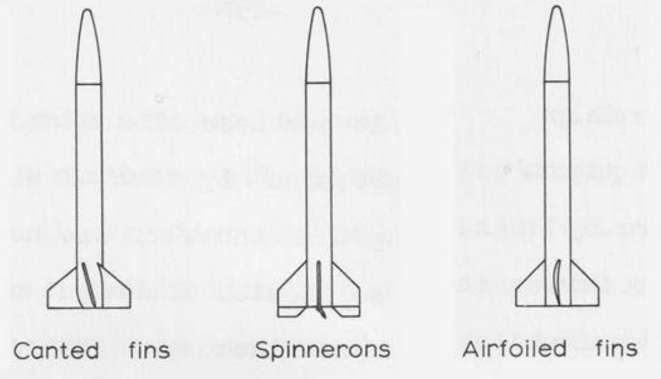
Canted Fins
Fins with spinneron
Asymmetrically airfoiled fins
FINS TO INDUCE ROLL
The three most common methods of inducing roll are:
1)____________
2)___________(or tabs)
3) ____________ fins
Planar fins
EX rocket
maximum restoring (stabilizing) moment
ALTERNATIVE TO FINS
_________ are nearly always the best option as the stabilizing device for an _____, providing ____________ combined with minimum weight and minimum drag, and of course, are simple to fabricate and mount.
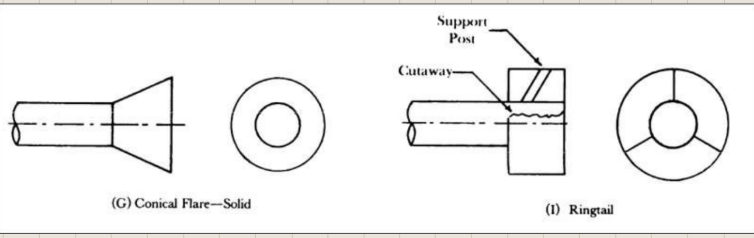
Ringtail fins
restoring moment
higher drag
base drag
ringtail and the exhaust plume
Conical flares
hypersonic speeds
tube-launched rockets,
weathercocking and trajectory dispersion.
less than 8°
flow separation
ALTERNATIVE TO FINS
TWO Alternative Stabilizing Devices:
_________ produce about twice the _________ of planar fins with the same span and chord at both subsonic and supersonic speeds.
Their disadvantage is _______ at subsonic speeds, but
at supersonic speeds ______ can decrease due to favorable interaction between the ________ and the _________, especially for long-burn motors (e.g., end-burners).
_________ can generate more than twice the normal force of planar fins at_________, but they usually produce much higher drag.
They may be useful for _________ where exhaust gases pressurize the tube and provide an initial boost in launch velocity, helping reduce _____________ and ____________
For effective operation, the flare angle should be _________ to avoid _______, which would reduce stability effectiveness.

