Endo-Intro- Intro Slides
 Call Kai
 Learn
Learn Practice Test
 Spaced Repetition
 Match
Match Flashcards
 Knowt Play
1/53

There's no tags or description
Looks like no tags are added yet.
Name | Mastery | Learn | Test | Matching | Spaced | Call with Kai |
|---|
No analytics yet
Send a link to your students to track their progress
54 Terms
What is endocrinology?
study of hormones and their actions
the endocrine system consists of hormones that travel through what?
blood
What is an organic chemical which is released by living cells that travels through the blood to trigger physiological changes?
a hormone
T/F: cells are only affected by a specific hormone if they have the correct receptor that corresponds to that hormone
true
What two things can change how effective a hormone is?
1. Concentration of hormone in blood
2. how receptive the target cell is (lot or a little receptors on cell)
What are the two types of hormone receptors?
Which hormones, either lipid-soluble or water-soluble, are associated with each?
1. transmembrane proteins- water soluble
2. Intracellular receptors - lipid-soluble
What does "up-regulation" mean in relation to hormone adaptation?
# of receptors on a cell is increased, causing higher sensitivity even when hormone levels are low in the bloodstream
What does "down-regulation" mean is relation to hormone adaptation?
# of receptors on a cell is DECREASED, causing cells to be LESS sensitive to the hormone (even if the hormone is in excess in the blood stream)
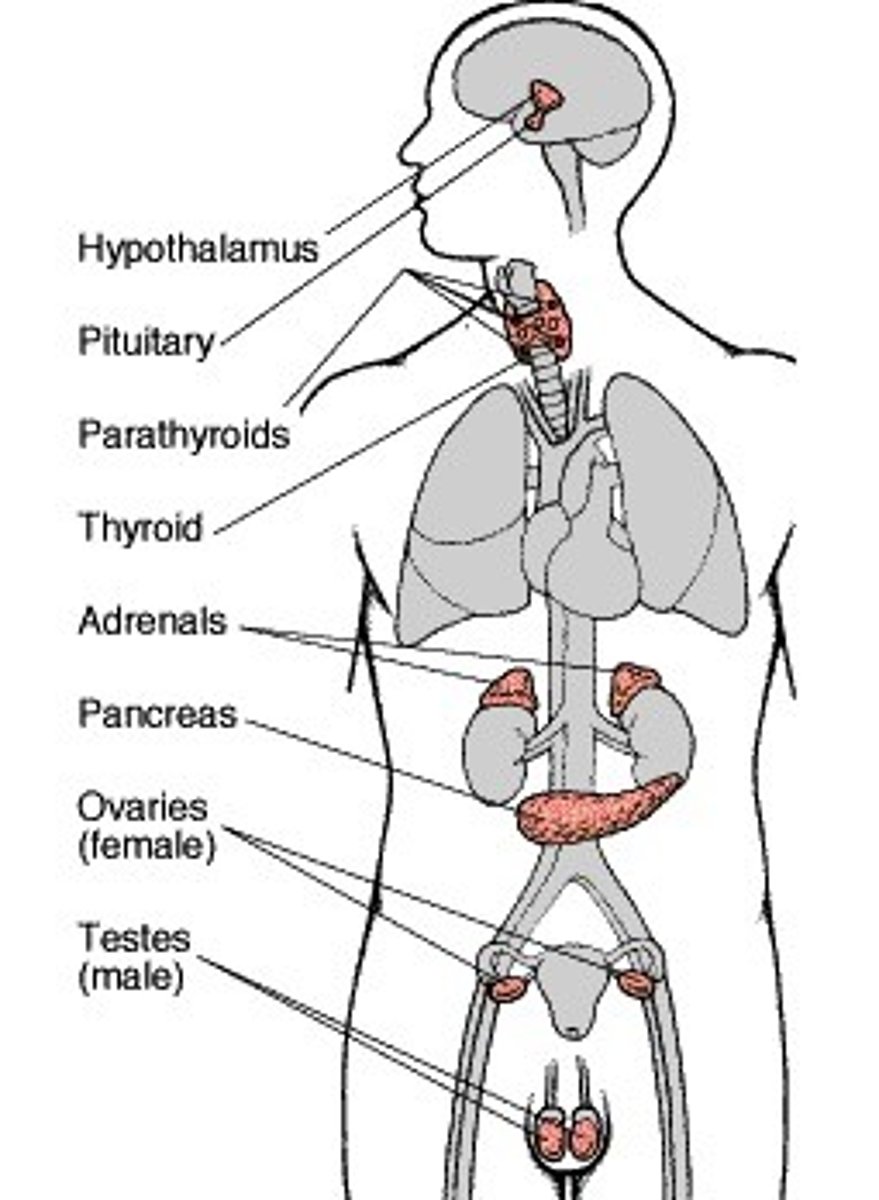
What are the main endocrine glands of the body? (9)
1. Hypothalamus
2. Pituitary gland
3. Pineal gland
4. Thyroid gland
5. Parathyroid gland
6. Thymus
7. Pancreas
8. Adrenal glands
9. Gonads (ovaries/testes)
What are the three molecular types of hormones?
1. Peptide/Protein Hormones
2. Steroid hormones
3. Amines
Which type of hormone is water-soluble?
Are these fast or slow acting?
Peptide/Protein Hormones
Fast-Acting (can travel through blood easily)
Which type of hormone is lipid-soluble?
Are these fast or slow acting?
Steroid hormones
slow acting (require a transport protein to get through bloodstream. )
Most peptide/protein hormones use what type of cell receptors?
transmembrane receptors
Steroid hormones utilize which type of cell receptor?
intracellular receptors
Which hormones are released via diffusion?
Which are released via vescicles and exocytosis?
Steroid hormones
Peptide/Protein Hormones
Steroid hormones are derived from __________________.
cholesterol
T/F: Amines are only lipid-soluble hormones.
FALSE- they can be water or lipid-soluble depending on the hormone!
T/F: the endocrine system is ductless (closed system).
TRUE (doesn't leave the body)
Steroid hormones are fat lovers. What are two other terms for "fat lovers"?
lipophilic
hydrophobic
Most peptide/protein hormones are water lovers. What are two other terms for "water lovers"?
Hydrophilic
lipophobic
What do autocrine hormones act on?
the same cell that secreted them (act on itself)
What do paracrine hormones act on?
neighboring cells
what do endocrine hormones act on?
How do they achieve this?
-act on a cell far from the secreting cell (original cell)
-hormone travels through lymph or the blood stream to achieve this
What are the circulating hormone/s?
What are the local hormone/s?
circulating: Endocrine hormones
local: autocrine and paracrine hormones
What are the three ways that cells are stimulated to secrete hormones? TQ
1. Hormonal (chemical in nature)
2. Humoral (sensor associated with the gland itself)
3. Neural (generates rapid release of hormone)
T/F: Hormone secreting cells wait until they receive a stimulus to start building hormones.
FALSE: they do NOT wait, and hormone is typically made and stored already in cell.
Which type of hormone utilizes exocytosis (storage compartment moving to the cell's plasma membrane) to be released from the cell?
Protein/Peptide Hormones
Which type of hormone utilizes diffusion to be released from a cell?
Steroid hormones
Lipophilic (hydrophobic) hormones utilizes what to move through the bloodstream to their target tissue?
Transport proteins
What is the "half-life" of a hormone?
time required for half the concentration of the hormone to be degraded
What are direct transport routes and what are 2 major examples of these routes?
-Routes that are developed to ensure important hormones reach their targets without being degraded.
- Btw the Hypothalamus and anterior pituitary
-Btw hepatic portal circulation (portal vein between GI/Spleen and the liver directly for insulin and glucagon regulation)
The removal of hormones from circulation is called what?
metabolic clearance
What are the different fates of a hormone after being released into circulation? (3)
1) bind to specific receptor in target organ
2) Undergo metabolic transformation by the liver
3) undergo urinary excretion
Hormones are divided into 2 types of messengers.
What is the difference between primary and secondary messengers?
Primary messengers: hormone itself travels to create a cell response.
Secondary messenger: hormone causes the cell to release proteins, and these proteins act as a second messenger to create a response.
Which hormones can act as primary messengers and why?
Steroid hormones- they can bring intracellularly and do not require additional proteins to DIRECTLY influence transcription/translation within a cell.
Which hormones typically require secondary messengers and why?
Protein/Peptide hormones- they bind on the outer cell membrane, triggering a cascade inside the cell and rely on proteins within the cell.
What are the 3 potential effects/physiologic actions that hormones can have?
1. Kinetic effects (ex: muscle movement)
2. Metabolic effects (ex: change of speed of cellular process)
3. Morphogenetic effect (ex: increased or decreased cell growth in embryo development)
T/F: The adenylyl cyclase mechanism utilizes a second messenger.
TRUE (uses Cyclic AMP)
What is the second messenger found in the Adenylyl Cyclase mechanism?
cAMP
What are the second messengers of the Phospholipase C mechanism?
-IP3
-DAG
-Ca2+
What are the steps of a steroid hormone mechanism? (kinda long card)
1. lipid soluble hormone diffuses through cell membrane
2. Hormone binds with intracellular receptor, forming a hormone-receptor complex
3. Complex enters the nucleus and triggers gene transcription
4. Transcribed mRNA is translated into proteins that alter cell activity
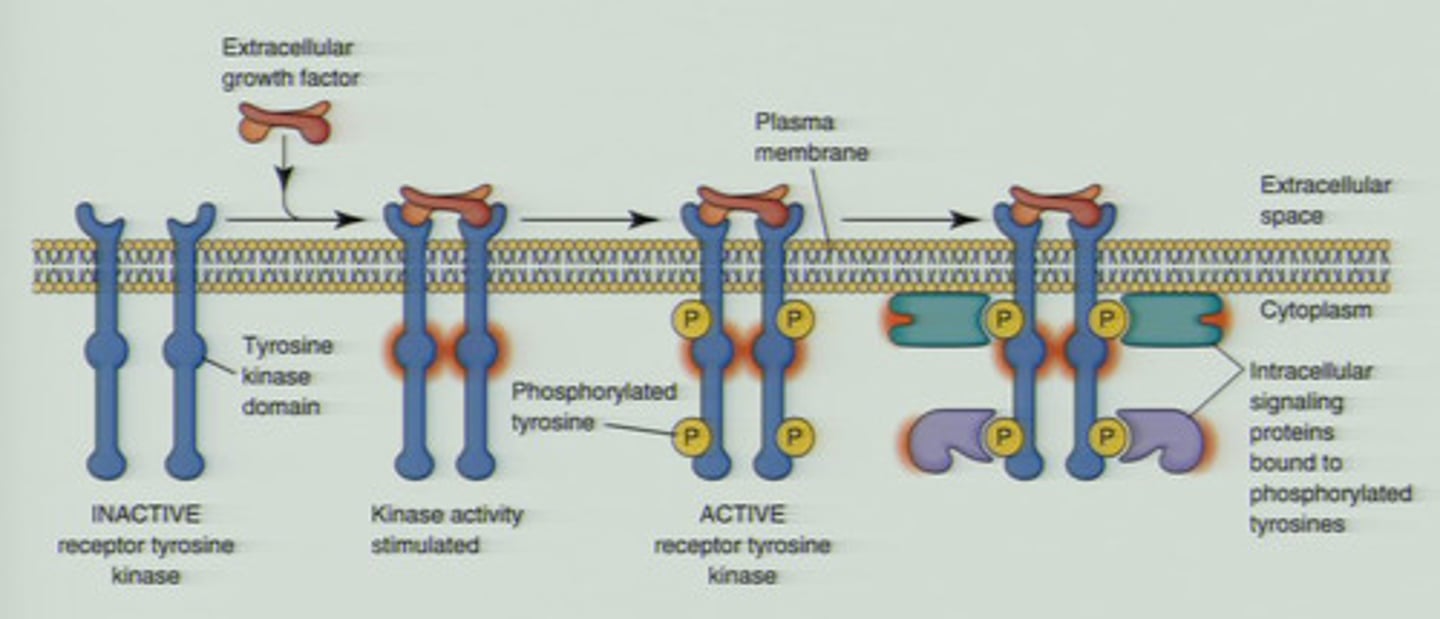
What are the steps of a Tyrosine Kinase Mechanism?
(image with card)
1. extracellular binding occurs with ligane (hormone) on transmembrane protein containing tyrosine kinase
2. Intracellular tyrosine kinase self-phosphorylates and also phosphorylates other proteins inside the cell
3. phosphorylated (activated) proteins lead to a cascade of events, altering cell activity
What is the second messenger in the Guanylate cyclase mechanism?
cGMP
In what two ways are the secretions of hormones regulated?
1. negative feedback loops (hormone secretion inhibits its own production)
2. positive feedback loops (secretion of hormone stimulates more production of a hormone)
NOTE: some hormones are not regulated by feedback loops, but rather sudden bursts of secretion that only lasts a few seconds-minutes
What is the most common form of regulation of hormones?
negative feedback loops
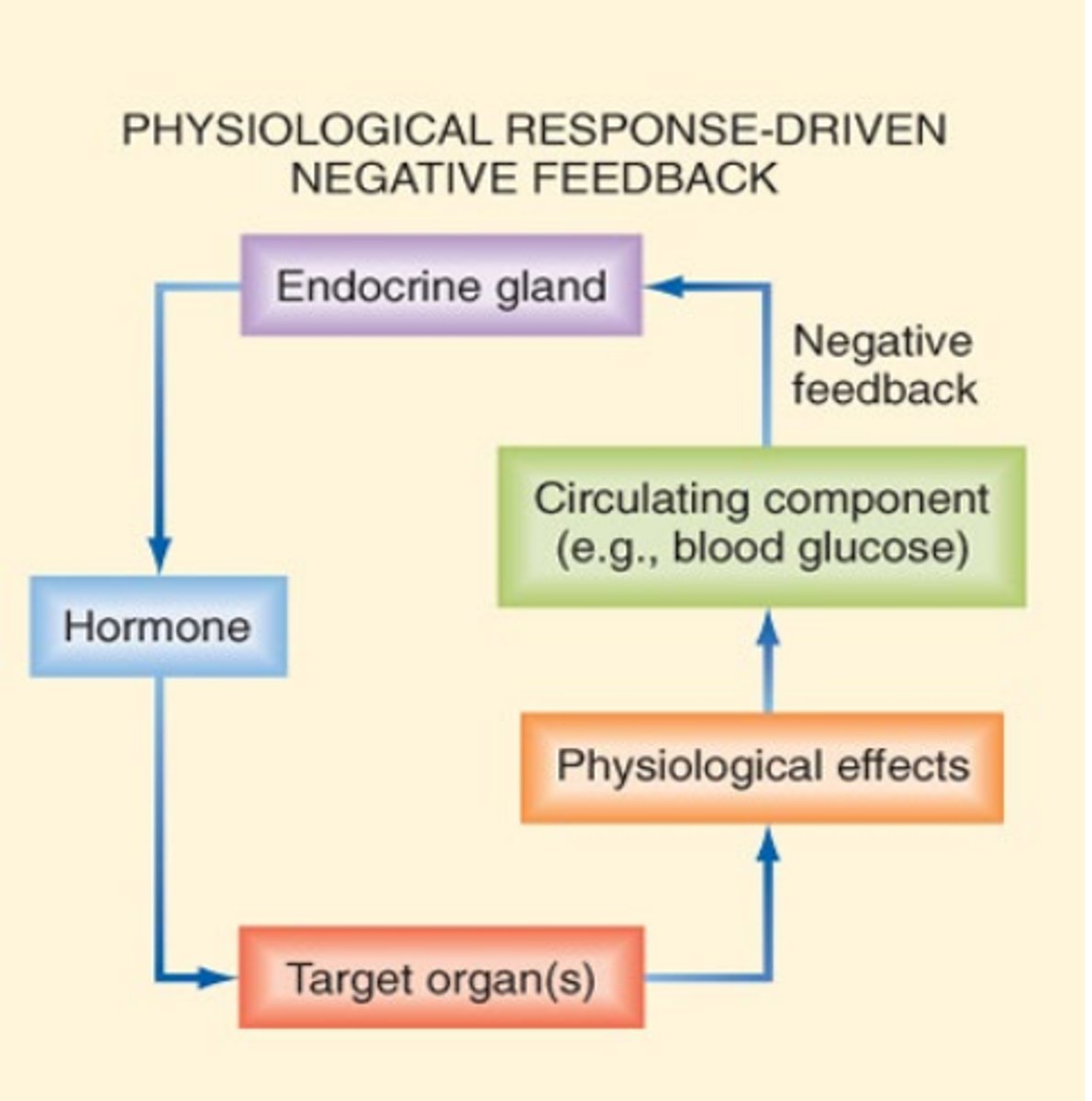
Describe the physiological response-driven negative feedback loop
Circulating component-->endocrine gland--> hormone--> target tissue--> phsiologic effect
Describe the endocrine axis-driven feedback loop
Hypothalamic neuroendocrine neurons--> releasing hormone-->Pituitary gland-->trophic hormone--> peripheral endocrine gland--> Hormone--> target organ--> physiologic effects
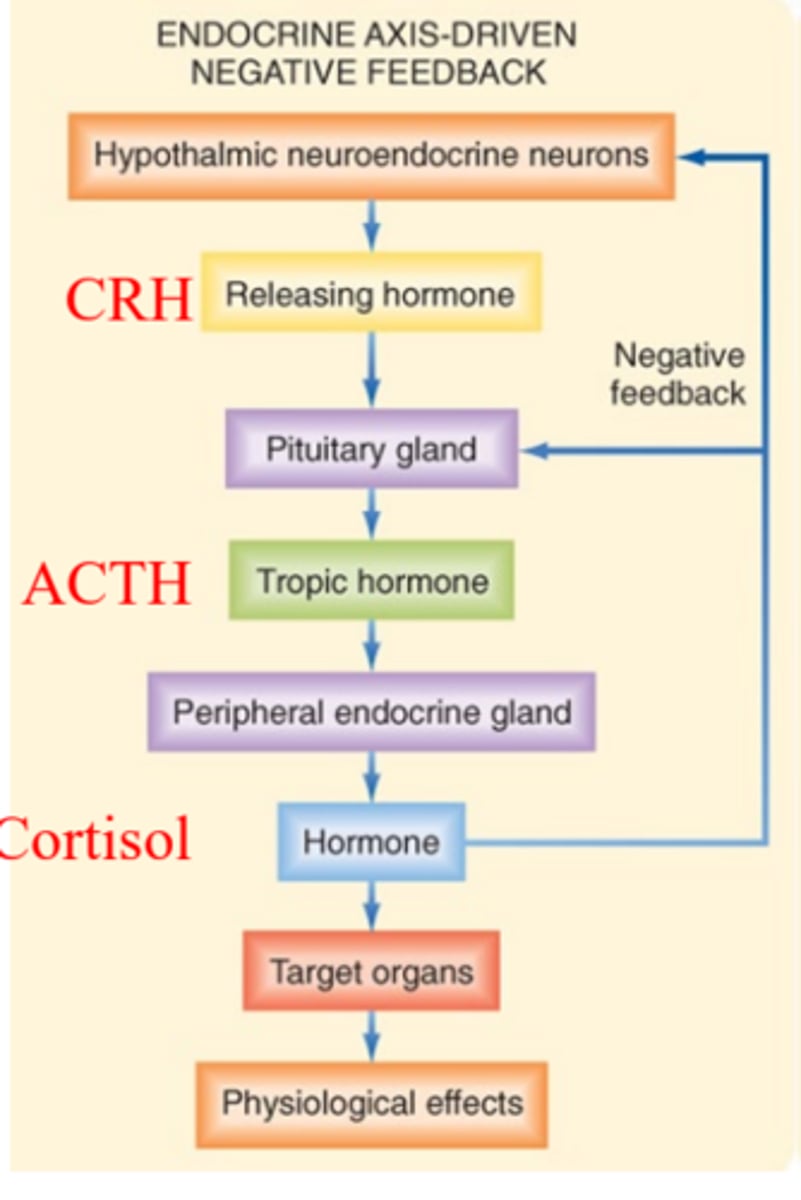
In the endocrine axis driven feedback loop, what are the primary, secondary and tertiary parts when referencing the parathyroid hormone.
Primary- Endocrine Gland (thyroid gland)
secondary- pituitary gland
tertiary- hypothalamus
What is an agonist?
molecule binds to a receptor and causes biologic response in the cell
What is an antagonist?
molecule binds to a receptor and blocks the binding of an agonist=no action caused
What is primary hyposecretion?
What is secondary hyposecretion
primary- too little hormone secretion by the endocrine gland
secondary-endocrine gland receiving too little of its tropic hormone (pituitary)
What is primary hypersecretion?
What is secondary hypersecretion?
primary- too much hormone secretion by the endocrine gland
secondary- endocrine gland receiving too much of its tropic hormone
What is hyporesponsiveness?
target cell does not respond normally to hormone (under responds)
What is hyperresponsiveness?
target cell has excessive response to the hormone

