Lecture 13: Cardiac Pathologies; The Breath Cycle
 Call Kai
 Learn
Learn Practice Test
 Spaced Repetition
 Match
Match Flashcards
 Knowt Play
1/13

There's no tags or description
Looks like no tags are added yet.
Name | Mastery | Learn | Test | Matching | Spaced | Call with Kai |
|---|
No analytics yet
Send a link to your students to track their progress
14 Terms
Clinical Application
In _______: insufficient blood flow (____) to the heart
coronary artery disease (CAD); ischemia
What is CAD?
insufficient blood flow (ischemia) to the heart
What is the result of CAD?
result may be myocardial damage in the affected region, or even death of that portion of the heart — a myocardial infarction, or heart attack
Site of gas exchange
Alveoli
Types of Alveoli
Type I alveolar cells: gas exchange
Type II alveolar cells: produce (detergent-like substance) surfactant
The total alveolar-capillary surface area is very large —→
permits the rapid exchange of large quantities of O2 & CO2 by diffusion
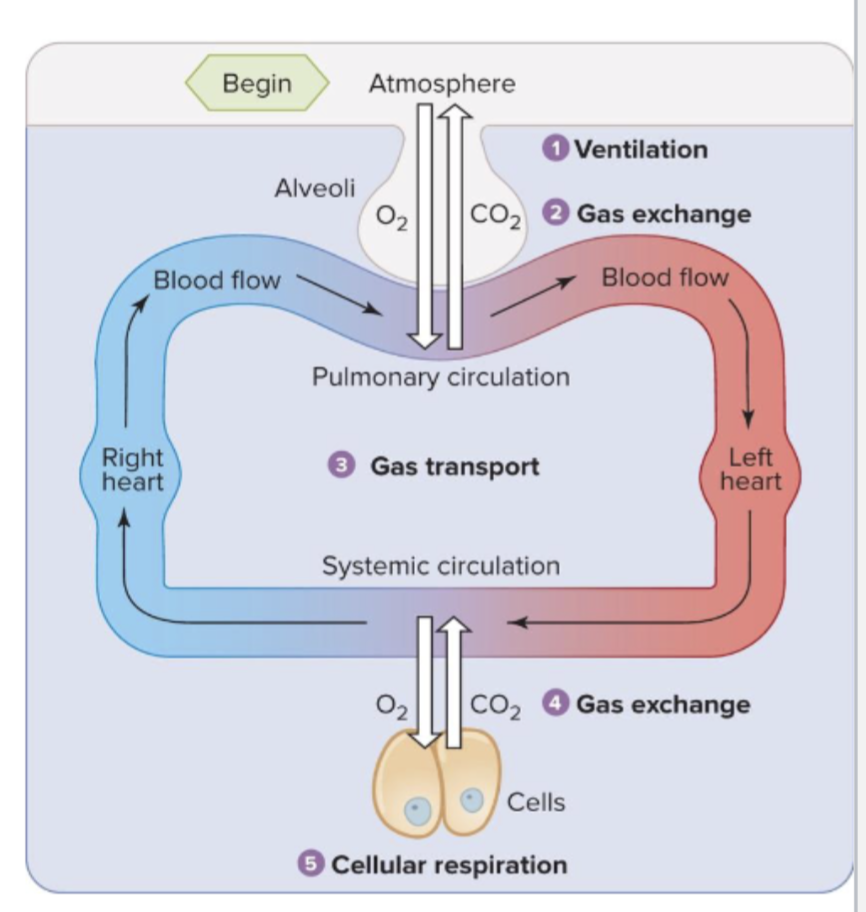
Steps of Respiration
Ventilation: exchange of air b/w atmosphere and alveoli
exchange of O2 & CO2 b/w alveolar air & blood in lung capillaries by diffusion
transport of O2 and CO2 thru pulmonary and systemic circulation
exchange of O2 and CO2 b/w blood in tissue capillaries and cells in tissues by diffusion
Cellular utilization of O2 and production of CO2
Ventilation
exchange of air b/w atmosphere and alveoli
F = ΔP/R
Flow (F) is proportional to the pressure difference (ΔP) b/w 2 points and inversely proportional to the resistance (R)
Steps of respiration
ventilation
gas exchange
gas transport
gas exchange
cellular respiration
Mechanics of Breathing
Pulmonary ventilation: 2 Phases
Inspiration: gases flow into lungs
Expiration: gases exit lungs
Atmospheric Pressure (Patm)
pressure exerted by air surrounding the body
Respiratory pressures described relative to Patm
negative respiratory pressure: less than Patm
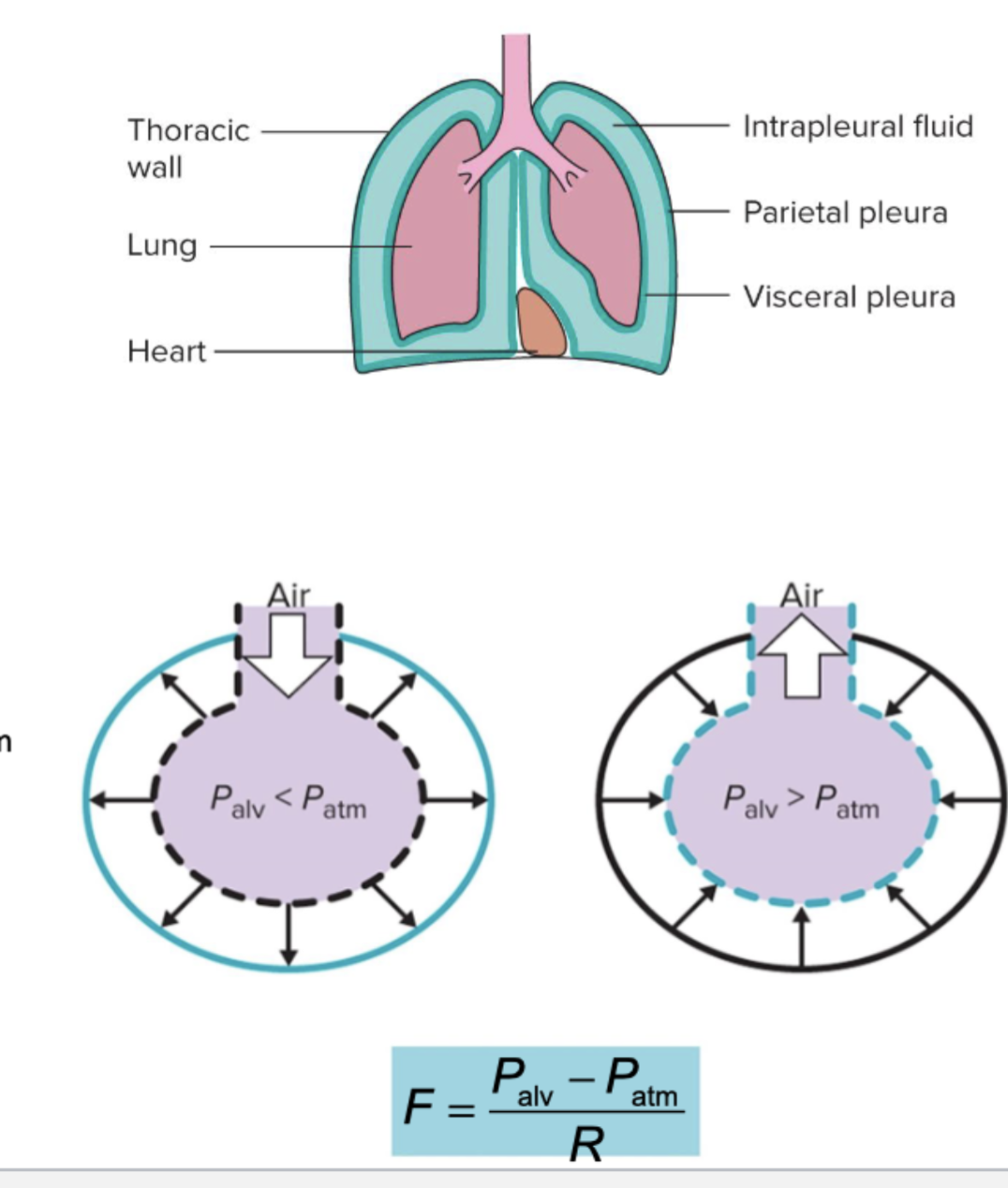
positive respiratory pressure: greater than Patm
zero respiratory pressure: equal to Patm

