3 Daniel Raymer book
 Call Kai
 Learn
Learn Practice Test
 Spaced Repetition
 Match
Match Flashcards
1/19

There's no tags or description
Looks like no tags are added yet.
Name | Mastery | Learn | Test | Matching | Spaced | Call with Kai |
|---|
No analytics yet
Send a link to your students to track their progress
20 Terms
950 fps
At sea level the helical tip speed of a metal propeller should not exceed
850 fps.
A wooden propeller, which must be thicker, should be kept below
decrease.
As forward velocity increases, the angle of attack seen by the blades of a fixed-pitch propeller will
spinner
Most aircraft propellers have a "______," a cone- or bullet-shaped fairing at the hub.
very little to the thrust.
The inner part of the propeller contributes
spinner
A _____ pushes the air out to where the propeller is more efficient. Also, a ______ streamlines the nacelle. Ideally, the _____ should cover the propeller out to about 25% of the radius, although most _____ are not that large.
unstable
taildragger landing gear is inherently ____
16-25 deg back from vertical measured from the main wheel location. If the c.g. is too far forward the aircraft will tend to nose over, and if it is too far back it will tend to groundloop.
With a tricycle landing gear, the c.g. is ahead of the main wheels so the aircraft is stable on the ground and can be landed at a fairly large crab angle (i.e., nose not aligned with the runway) The c.g. (most forward and most aft) should fall between
10-15 deg with the gear in the static position (i.e., tires and shock absorbers compressed the amount seen when the aircraft is stationary on the ground at takeoff gross weight).
The taildown angle should be about
8-15%
The optimum range for the percent of the aircraft's weight which is carried by the nose wheel is about
tipback angle
The "_____" is the maximum aircraft nose-up attitude with the tail touching the ground and the strut fully extended.
should be greater than the tipback angle or 15 deg, whichever is larger
To prevent the aircraft from tipping back on its tail, the angle off the vertical from the main wheel position to the c.g.
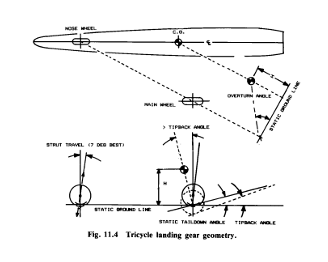
overturn angle
The "______" is a measure of the aircraft's tendency to overturn when taxied around a sharp corner. This is measured as the angle from the c.g. to the main wheel, seen from the rear at a location where the main wheel is aligned with the nose wheel.
63 deg (54 deg for carrier-based aircraft).
For most aircraft the overturn angle should be no greater than
7 deg.
the desired strut-travel angle as about __. This optimal angle allows the tire to move upwards and backwards when a large bump is encountered, thus tending to smooth out the ride.
acceptable.
However, any strut-travel angle from purely vertical to about 10 deg aft of vertical is
undesirable
Strut geometry in which the tire must move forward as it moves up is ___
wing strake, or "Leading Edge Extension (LEX)
The _____, is similar to the dorsal fin used on vertical tails. Like dorsal fins, the ____ at high angle of attack produces a vortex that delays separation and stall. Unfortunately, a _____ tends to promote pitch-up tendencies and so must be used with care.
specific strength
The "________" of a material is defined as the ultimate stress divided by the material density.
specific stiffness
The "_______" is defined as the modulus of elasticity E divided by the material density

