fingerprints
 Studied by 0 people
 Call with Kai
 Learn
Learn Practice Test
 Spaced Repetition
 Match
Match Flashcards
 Knowt Play
1/33

There's no tags or description
Looks like no tags are added yet.
Name | Mastery | Learn | Test | Matching | Spaced | Call with Kai |
|---|
No study sessions yet.
34 Terms
when do fingerprints develop?
Fingerprints develop in womb at ~20 weeks
Formed by interactions between epidermis, dermis and environmental factors (movement, pressure, fluid flow)
Once formed, ridge patterns do not change, but enlarge with growth
Sir William Herschel 1833-1917
Oversaw pension payments signed by fingerprints
Observed fingerprints were unique
Introduced fingerprint signing for identity verification
Studied prints, helping establish principle of persistence - idea that fingerprints remain unchanged throughout life
Principle of Persistency
Fingerprints form in womb ~20 weeks
Stay same throughout life
Even after death, patterns remain identifiable
Fingerprints grow in size but pattern never changes
Dr Henry Faulds 1843-1936
Medical missionary and early fingerprint researcher
First to describe ridges, furrows and their forensic potential
Argued that they could:
Show individual identity
Be left on surfaces
Be used to identify suspects or exclude the innocent
Published rigorous work supporting fingerprints as evidence
Belper Committee 1900
A home office led by Lord Belper
Evaluated fingerprint and anthropometric identification methods
Approved fingerprinting for police use in UK
Led to creation of Met Police Fingerprint Branch
Other UK forces soon adopted system
Automated Fingerprint Recognition
identifies landmarks in print
where do they come from?
Early computerisation
1984- New Scotland Yard installed first UK computerised fingerprint system
Before 1990s each force kept its own fingerprint records, so searching beyond local files was slow and required manual transfer
National Rollout
1992- UK forces gained shared access to a single national database
Fingerprints digitalised and entered into a unifies system
NAFIS
National automated fingerprint identification system
Developed in 1995 operational by 1999
All UK forces uploaded
Fingerprints of arrested persons
Crime scene fingerprint marks
2001 - NAFIS went live across England & Wales
Scotland has separate system
Provided nationwide comparison and rapid suspect identification
IDENT1- modern system
Introduced in 2004 upgrade to NAFIS
Enhanced:
Search accuracy
Data entry
Workflow efficiency
Supports Livescan devices: digital, inkless fingerprint capture
Allows improved data quality and faster results
livescan and portable identification
Livescan (Custody Suites)
Captures fingerprints digitally
Provides immediate feedback on print quality
Allows instant retake
Faster and cleaner than ink methods
Portable fingerprint devices
Used by officer in field
Confirms identity if individual is already on database
Cannot identify people with no prior record
papillary ridges and their functions
Ridges run parallel lines across finger, palm, toes, sole
Furrows appear as white lines in inked or scanned image
Functions include:
Friction - grip
Enhanced touch sensitivity
Channels for sweat pores - help develop latent prints at scenes
fingerprint recovery at scenes
Latent prints may require:
Powdering
Chemical enhancement
Lighting and photography
Choice of technique depends on surface type and environment
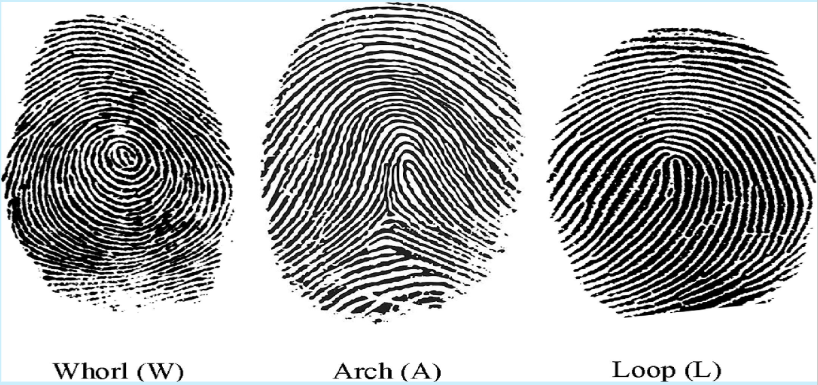
basic patterns
delta
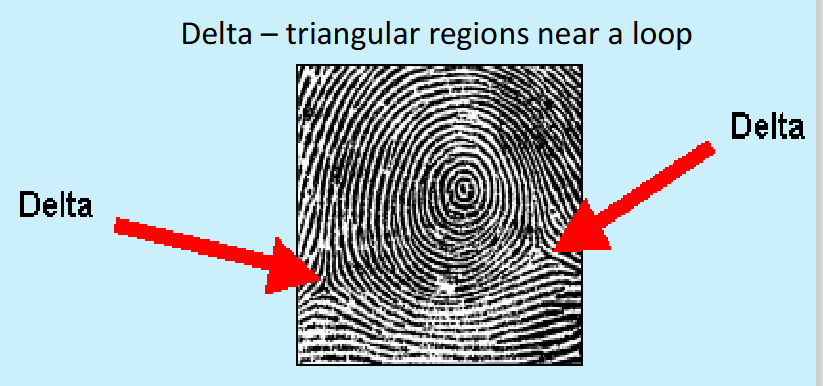
core

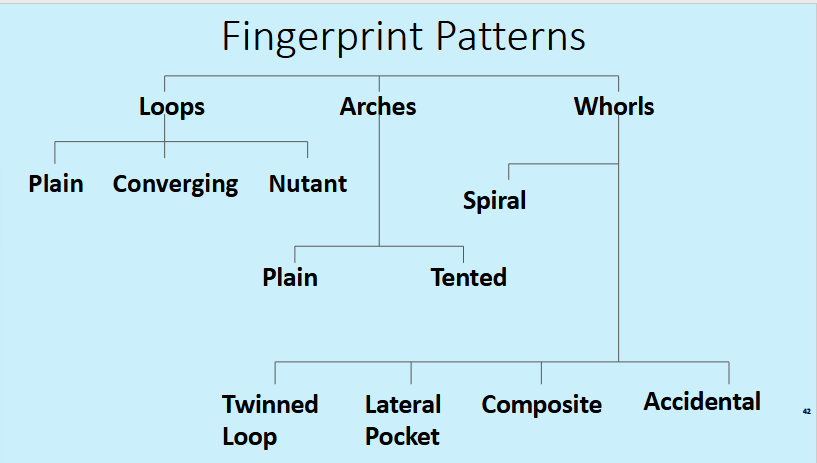
fingerprint patterns
Plain arch
Tented arch
Plain loop
Converging loop
Nutant loop
Spiral whorl
Twinned loops
Lateral pocket
Composite
Accidental
plain arch
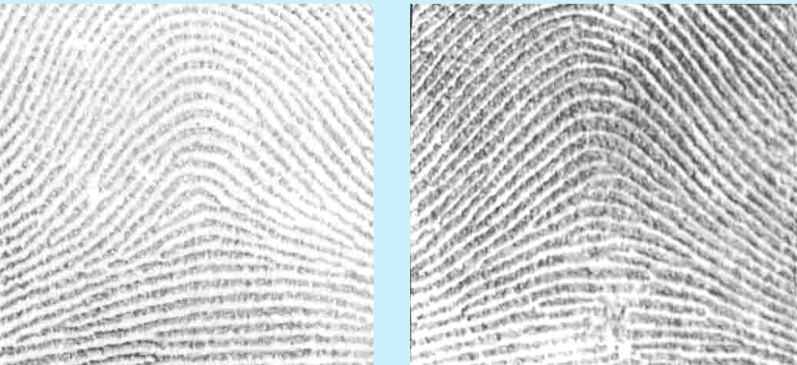
tented arch
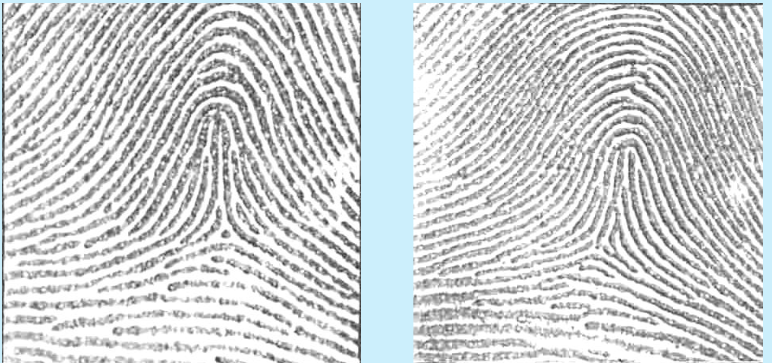
plain loop

converging loop

nutant loop
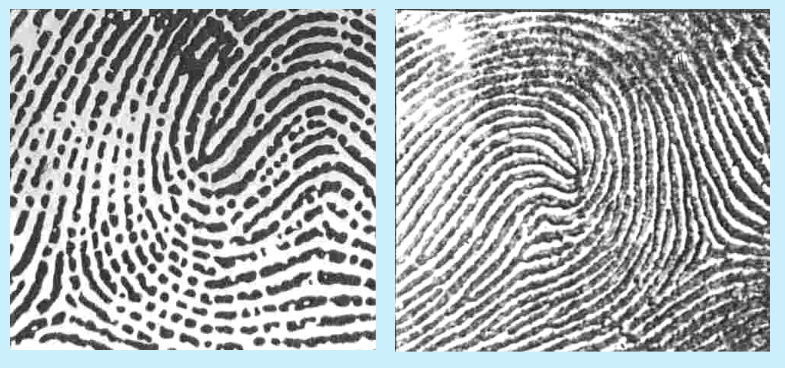
spiral whorl

twinned loops

composite
an arch with any other pattern
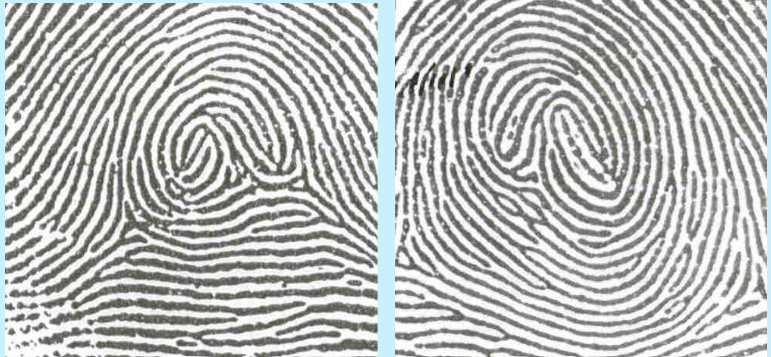
accidental
totally random - don’t fit into any other category
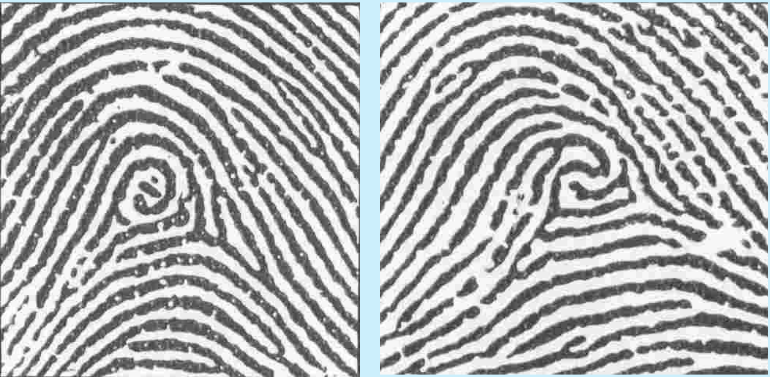
Galton details/characteristics
Ridge ending
Bifurcation
Lake
Independent ridge
Spur
Crossover
ridge ending
when ridge comes to an abrupt ending
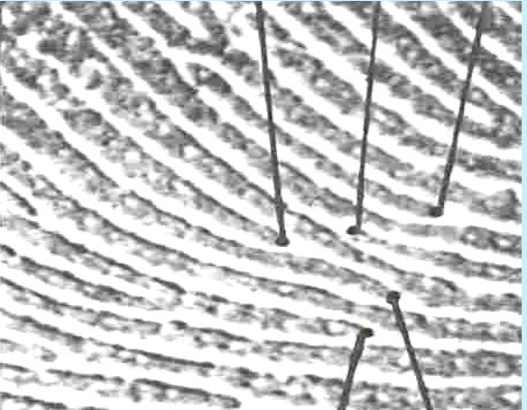
bifurcation
when ridge splits in two
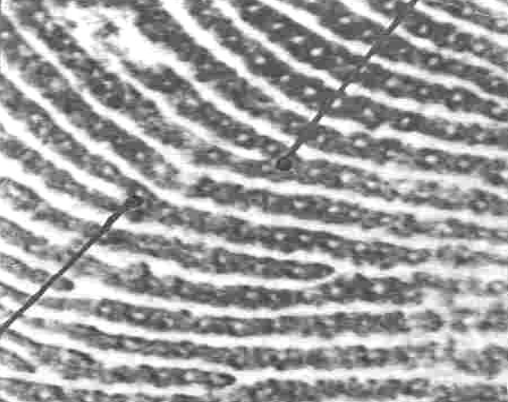
lake
ridge into bifurcation and then rejoins - leaves a kind of hole

independent ridge
little section of ridge on its own
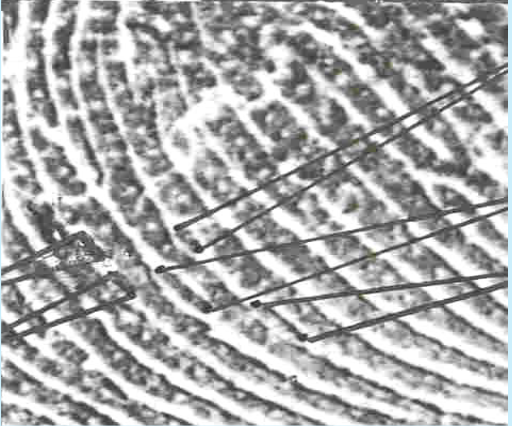
spur
ridge splits into bifurcation - one stops and one carries on
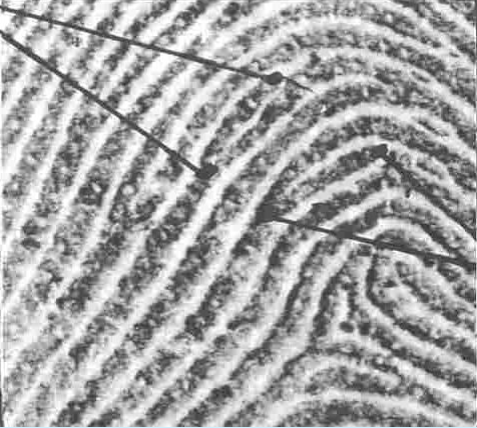
crossover
ridge splits and crosses over another one
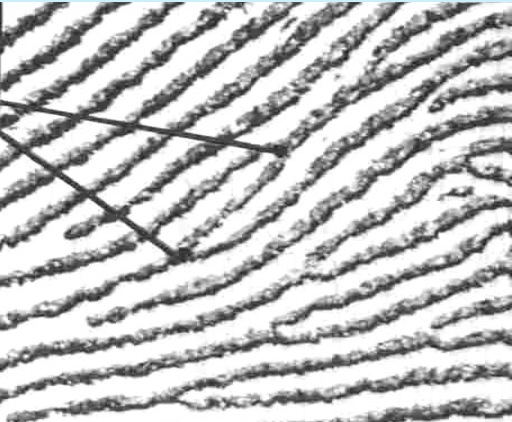
fingerprint patterns
Fingerprints are same (from scene vs suspect) if the ridge characteristics are…
Same in both impressions
In same order and relationship to each other in both impressions
All In agreement with none in disagreement
 Note
Note  Flashcards (40)