VISUAL ART
 View linked note
 Call Kai
 Learn
Learn Practice Test
 Spaced Repetition
 Match
Match Flashcards
 Knowt Play
1/43

There's no tags or description
Looks like no tags are added yet.
Name | Mastery | Learn | Test | Matching | Spaced | Call with Kai | Chat |
|---|
No analytics yet
Send a link to your students to track their progress
44 Terms
Background of fauvism
This is the art movement where three young French artists were involved, Matisse, Derain and Vlaminck. This was the first revolutionary movement of the 20th century.
Background/influence of German Expressionism
Expressionism is a permanent tendency in art. The artist portrays his emotional reaction in a highly individual style where a free distortion of shape and colour take place.
Artists in German Expressionism: Die Brücke include?
Ernst kirchner, Karl Schmidt-Rottluff, Emil Nolde, Erich Heckel, Max Pechstein, Otto Mueller.
Influences on expressionism
Van Gogh- he worked according to his subjective feelings aswell as his strong use of colour and linear brushworks.
Non Western-cultures - African masks.
The Germanic character
Edvard Munch- because of his violent distortions of colour and shape to give form tone to emotional states.
German Expressionism can be divided into 2 groups
Die Brücke (The bridge) and Der Blaue Reiter (The blue rider)
Die Brücke characteristics: Themes
Criticised their social conditions. The message o f their work was important. Art was personal art, portraying strong individual feelings. Angst-ridden art with underlying themes such as hate, jealousy and love.
Die Brücke characteristics: Colour
Used strong primary and secondary colors but colors became increasingly more somber and dark. Strong colour contrast portrayed conflicts in life and harsh strong colours were used unnaturalistically.
Die Brücke characteristics : Shape
Simplified and distorted shapes. Work seems to be unfinished because of distortion. Shapes are often outlined with a strong dark colour. Many figures are crowed claustrophobic into the picture space. Space is unrealistic and diagonal lines often stretch from the foreground to the background.
Die Brücke characteristics: Brushwork
Broad , free brushstrokes. Creates a new “barbaric” beauty. Linear and paint is applied freely and roughly often very thickly.
Der Blaue Reiter Background
An association of artists founded by Kandinsky and Marc. Their aim was the expression of inner spirituality through the variety of shapes. This was more international and the most important manifestation of modernism in Germany.
Der Blaue rider artists
Wassily Kandinsky, Franz Marc and August Macke.
Der Blaue Rieter, themes
Lyrical, romantic, spiritual and sometimes abstract. Wanted to express inner necessities. No real social commentary.
Deer Blaue Rieter Colours
Experimented with the emotional use of colour and excluded somber colors.
Der Blaue Rieter shapes
Experimented with shapes and distorted shapes to express emotion.
Der blaue reiter Brushwork
Variety of brushstrokes were used and an emphasis on the process of painting. Lines created by brushstrokes were important as an expression of the artist’s personality.
Cubism
Was developed by pablo Picasso and Georges Brauke. It was an important and radical art revolution in the 20th century.
Background on Fauvism 2
Viewers were shocked with the extremely strong colours of the works. Fauvism was not a particularly coherent group with specific rules and regulations. They wanted to avoid naturalism. The liberation of colour was their biggest contribution to modernism.
Influences on Fauvism, Vincent Van Gogh
Vincent Van Gogh for his non-descriptive and emotive colour.
Influences on Fauvism, Paul Gauguin
Paul Gauguin was the inspiration for their large flat colour areas and the ‘primitive’ character of shapes.
Influences on Fauvism, Non-western cultures
Non-western cultures influenced the Fauvists with their non-representative and decorative qualities.
Influences on fauvism, Synthetic colours
Synthetic colours helped the Fauvists to achieve their unusually bright colours.
Characteristics of fauvism, Subject matter
Everyday scenes like landscapes, figures, interiors and portraits. They worked from reality but believed artists should portray their emotional reaction to the subject. Pure colours portray this emotion and colour was arbitrary meaning free of choice.
Charateristics of fauvism, Colour
Colour was the chief characteristic of their work. Their colour is stronger than the colour of previous movements. Colour was free of choice and not naturalistic. It was normally a vibrant and intense colour often used in a large flat area of one colour. Bright, dashing colours in foregrounds and backgrounds are equally bright.
Characteristics of fauvism, Form/shape
Forms are distorted and often combined with incorrect perspectives. Drawing is simplified. Shapes are often outlined and very decorative.
Characteristics of fauvism, application of paint
Energetic, quick brushstrokes. The technique changes between broken divisionism and pure flat areas.
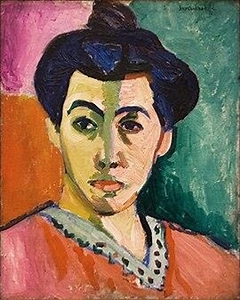
The green stripe by Henri Mattise, Fauvism
Bright turquoise, pink and red are placed next to each other in flat areas without tonal modelling. Green stripe in the middle of the face. Colour is freely applied without any reference to reality.
An orange area in the background can be seen moving forward while the green recedes creating an ambiguous space.
Background on cubism
Cubism was developed by Pablo Picasso and Georges Braque between 1907 and 1914.
Background on Cubism 2
Cubism was an important and radical art revolution in the 20th century. Since the Renaissance artists worked perceptually where the eye rules and artwork is naturalistic.
Background on cubism 3
Kadinsky created abstract paintings unrelated to the natural world, by expressing his spiritual side. Fauvism liberated colour from its descriptive use. Cubism however presented a real change by working conceptually
Influences on cubism
African art. Cezanne was one of the major influences on cubism with his ideas on numerous viewpoints and the underlying structure. The flatness of the painting and the emphasis on the two-dimensional were also influential.
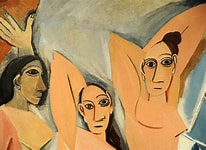
LES DEMOISELLES D’AVIGON: Cubism
The figure on the left is in profile and is painted in Egyptian style. The two figures in the middle show an influence of ancient Iberian sculpture with their face’s frontal but their noses in profile. However, the two figures on the right show an influence of African art. Pablo Picasso used simultaneous viewpoints which is seen from the back, front and side positions. The figures remain flat. The background is integrated and create an ambiguous flat space. This is conceptual rather than perceptual.
Cubism: Cezanne phase
Different viewpoints and a break-up of forms into sharp, angular shapes. Forms have been drastically simplified. Atmospheric and tonal recession. Colours are used in a monochromatic way. Still a link with naturalism. Houses are formed in a basic rectangular shape.
Cubism: Analytical phase
Analytical means to break up. Themes were still lifes and portraits. Simultaneity was used from a multiplicity of viewpoints. Space was flattened. The distinction between background and foreground virtually disappears. The space around them were broken up into small geometrically shaped areas or facets. The colours consisted of restricted palette of ochres, browns and greens. At the end of analytic cubism, the facets become smaller and the painting becomes a complex grid. Oval shaped canvasses. Analytical cubism was always based on reality.
Cubism: Synthetic phase
This is the discovery of collage. The first cubist collage was Picassos Still life with Chair Caning. The work consisted of being framed with real rope. They first glued the pieces of paper to the canvas creating a free composition. Then reality was introduced. A very flat space. Subject matter is virtually exclusively still lifes.
Characteristics of dada
Dada was a state of mind. They wanted to mock and shock. It was a protest movement. Dada was a revolt against logic and reason. They started to explore the subconcious.
Influences of Dada
Hans Arp- The use of chance. Kurt Schwitters - the use of junk/recycling. John Heartfield and Hannah Hoch - Photomontage. Marcel Duchamps - Ready-made.
Surrealism: Automatism
New form of abstract art was developed. Organic, biomorphic and amoeba-like shapes. Creativity was automatic and the use of chance was more important.
Joan Miro: Carnival of harlequin
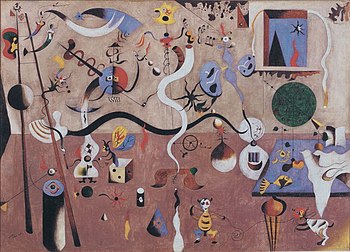
The dream world: Surrealism
Dream images were made by painting recognisable scenes in a detailed realistic way and the placing them in completely illogical situations
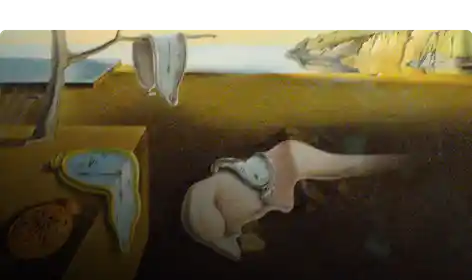
Salavador Dali: The persistence of memory
Three soft watches represent time. The orange watch does not melt. It echoes the passing of time as it is runed over and covered by ants. The ants symbolise decomposition and death. The fly represents time flying and passing. A strange being is lying on the ground which could represent the painter or the inner world’s dream-like nature. The mirror embodies inconsistenc as it reflects reality. The olive tree is dry and dead which is a sign of the past. Dali symbolises the sea with memory and reality. He also symbolises his emotional emptiness by the empty shoreline. The mountains are rooted in the ground like it is in the painters memory.
Characteristics of the dream world, Surrealism
Illogical Juxtaposition. Extended depth. Acidic colours. Elongated Characters.
Artists in The dream world, surrealism
Salvador Dali, René Magritte.
Surrealism Background
The name surrealism means beyond reality. It’s art born from the subconscious.
Characteristics of surrealism
It’s illogic. It’s the exploration of the subconscious.