ECO 119 Exam 2
 Call Kai
 Learn
Learn Practice Test
 Spaced Repetition
 Match
Match Flashcards
 Knowt Play
1/69

There's no tags or description
Looks like no tags are added yet.
Name | Mastery | Learn | Test | Matching | Spaced | Call with Kai |
|---|
No analytics yet
Send a link to your students to track their progress
70 Terms
In a small open economy, if exports equal $20 billion, imports equal $30 billion, and domestic national saving equals $25 billion, then net capital outflow equals:
1) -$25 billion
2) $10 billion
3) $25 billion
4) -$10 billion
4) -$10 billion
When exports exceed imports, all of the following are true except:
1) Domestic output exceeds domestic spending
2) Domestic investment exceeds domestic saving
3) Net capital outflows are positive
4) Net exports are positive
2) Domestic investment exceeds domestic saving
In a small open economy, if exports equal $5 billion and imports equal $7 billion, then there is a trade ____ and ____ net capital outflow.
1) Surplus; negative
2) Surplus; positive
3) Deficit; positive
4) Deficit; negative
4) Deficit; negative
In a small open economy, if the world interest rate is r3, then the economy has:
1) A trade surplus
2) A trade deficit
3) Balanced trade
4) Positive capital outflows
2) A trade deficit
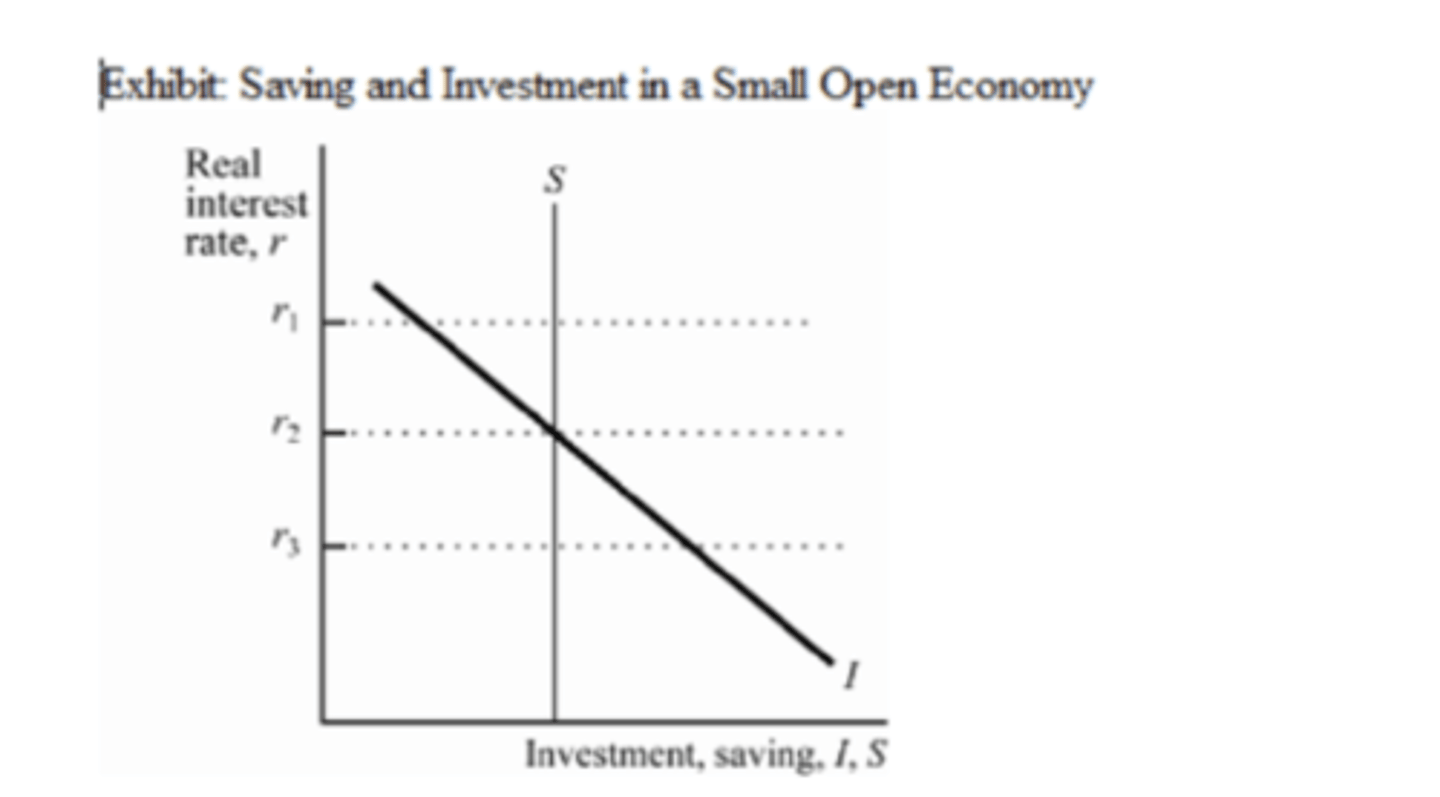
In a small open economy, starting from a position of balanced trade, if the government increases domestic government purchases, this produces a tendency toward a trade ____ and ____ net capital outflow.
1) Deficit; negative
2) Surplus; positive
3) Surplus; negative
4) Deficit; positive
1) Deficit; negative
Assume that some large foreign countries decided to subsidize investment by instituting an investment tax credit. Then a small country's real exchange rate:
1) Will rise, and its net exports will fall
2) And net exports will both fall
3) And net exports will both rise
4) Will fall, and its net exports will rise
4) Will fall, and its net exports will rise
In a small open economy, starting from a position of balanced trade, if the government increases the income tax, this produces a tendency toward a trade ____ and ____ net capital outflow.
1) Deficit; negative
2) Surplus; negative
3) Surplus; positive
4) Deficit positive
3) Surplus; positive
The percentage change in the nominal exchange rate equals the percentage change in the real exchange rate plus the:
1) Domestic interest rate minus the foreign interest rate
2) Foreign exchange rate minus the domestic exchange rate
3) Domestic inflation rate minus the foreign inflation rate
4) Foreign inflation rate minus the domestic inflation rate
4) Foreign inflation rate minus the domestic inflation rate
In a small open economy, if consumers shift their preference toward Japanese cars, then net exports:
1) Increase, and the real exchange rate remains unchanged
2) Fall, and the real exchange rate falls
3) Fall, but the real exchange rate remains unchanged
4) Remain unchanged, but the real exchange rate falls
4) Remain unchanged, but the real exchange rate falls
Which of the panels illustrates the impact of an increase in household saving on the real exchange rate?
1) B
2) D
3) A
4) C
3) A
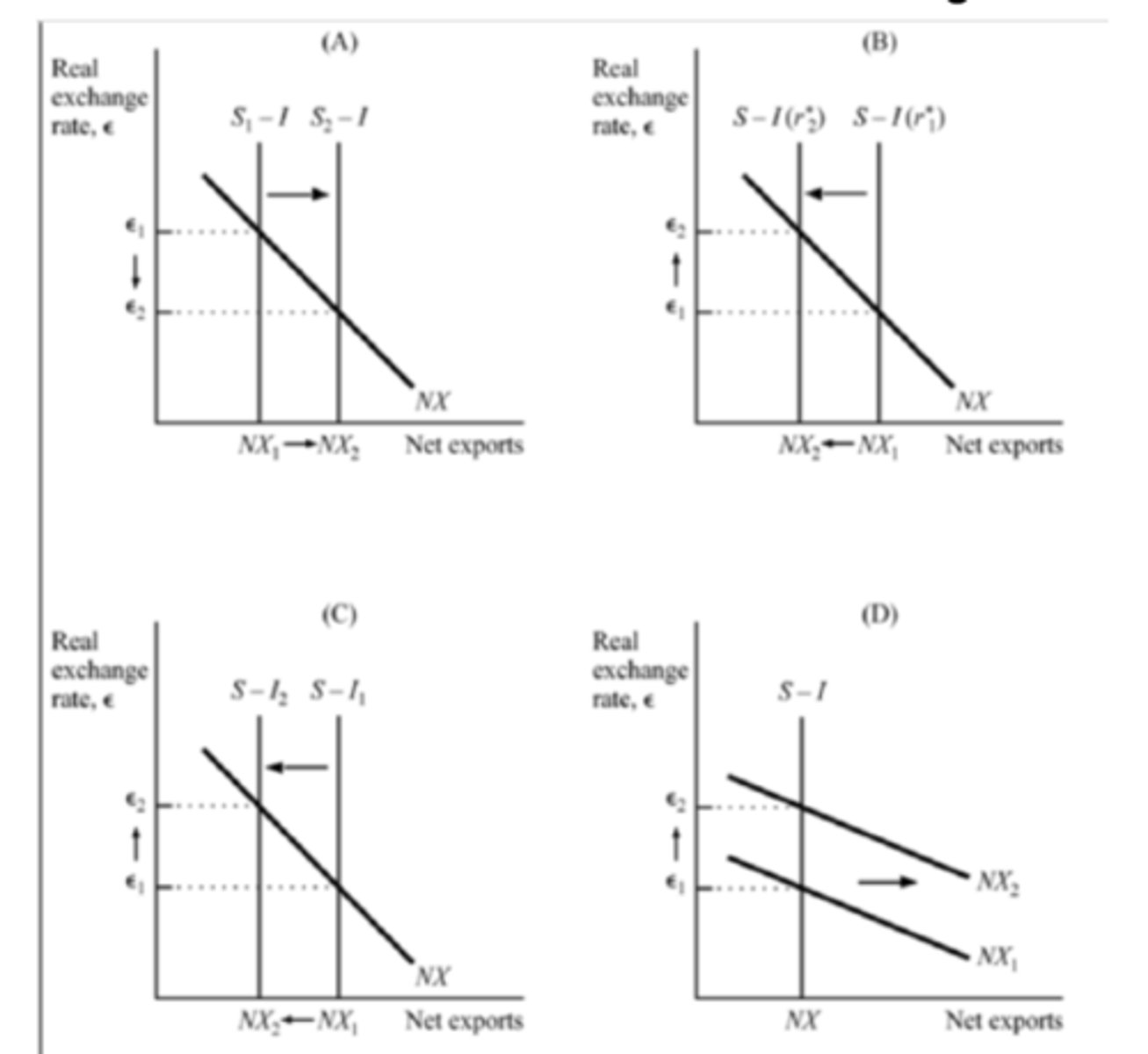
In a small open economy, if the government adopts a policy that lowers imports, then that policy:
1) Lowers the real exchange rate
2) Raises the real exchange rate and increases net exports
3) Raises the real exchange rate and does not change net exports
4) Raises the real exchange rate and decreases net exports
3) Raises the real exchange rate and does not change net exports
If the information technology boom increases investment demand in a small open economy, then net exports ____ and the real exchange rate ____.
1) Increase; appreciates
2) Increase; depreciates
3) Decrease; depreciates
4) Decrease; appreciates
4) Decrease; appreciates
In a small open economy, if the world interest rate falls, then domestic investment will ____< and the real exchange rate will ____, holding all else constant.
1) Increase; decrease
2) Decrease; decrease
3) Increase; increase
4) Decrease; increase
3) Increase; increase
Which of the panels illustrates the impact of an increase in investment demand on the real exchange rate?
1) C
2) B
3) D
4) A
1) C
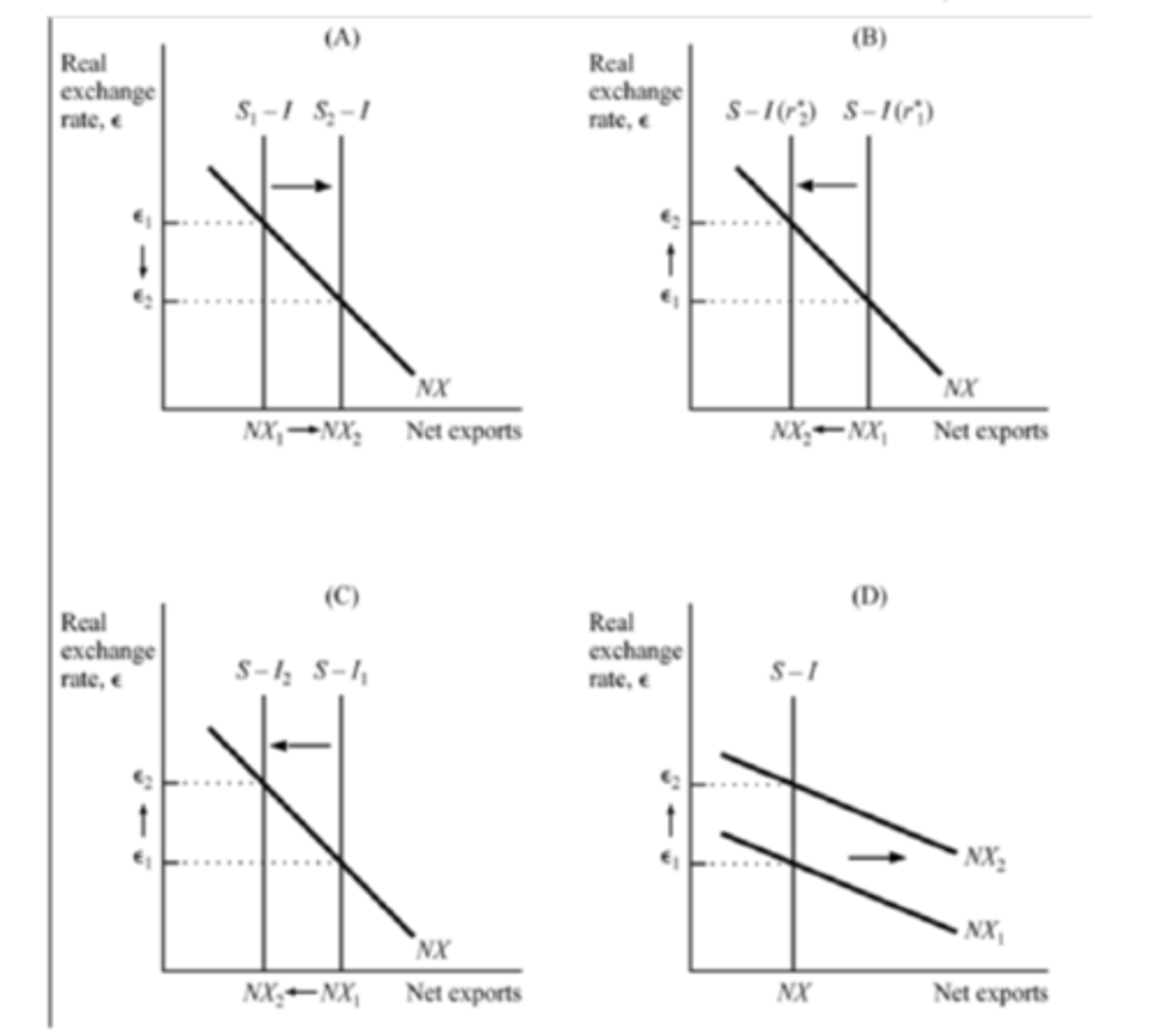
An effective policy to reduce a trade deficit in a small open economy would be to:
1) Increase government spending
2) Increase taxes
3) Impose stricter quotas on imported goods
4) Increase tariffs on imports
2) Increase taxes
If the real exchange rate depreciates from 1 Japanese good per U.S. good to 0.5 Japanese good per U.S. good, then U.S. exports ____, and U.S. imports ____.
1) Decrease; decrease
2) Increase; decrease
3) Decrease; increase
4) Increase; increase
2) Increase; decrease
Which of the panels illustrates the impact of contractionary fiscal policies abroad on the real exchange rate?
1) B
2) D
3) A
4) C
1) B
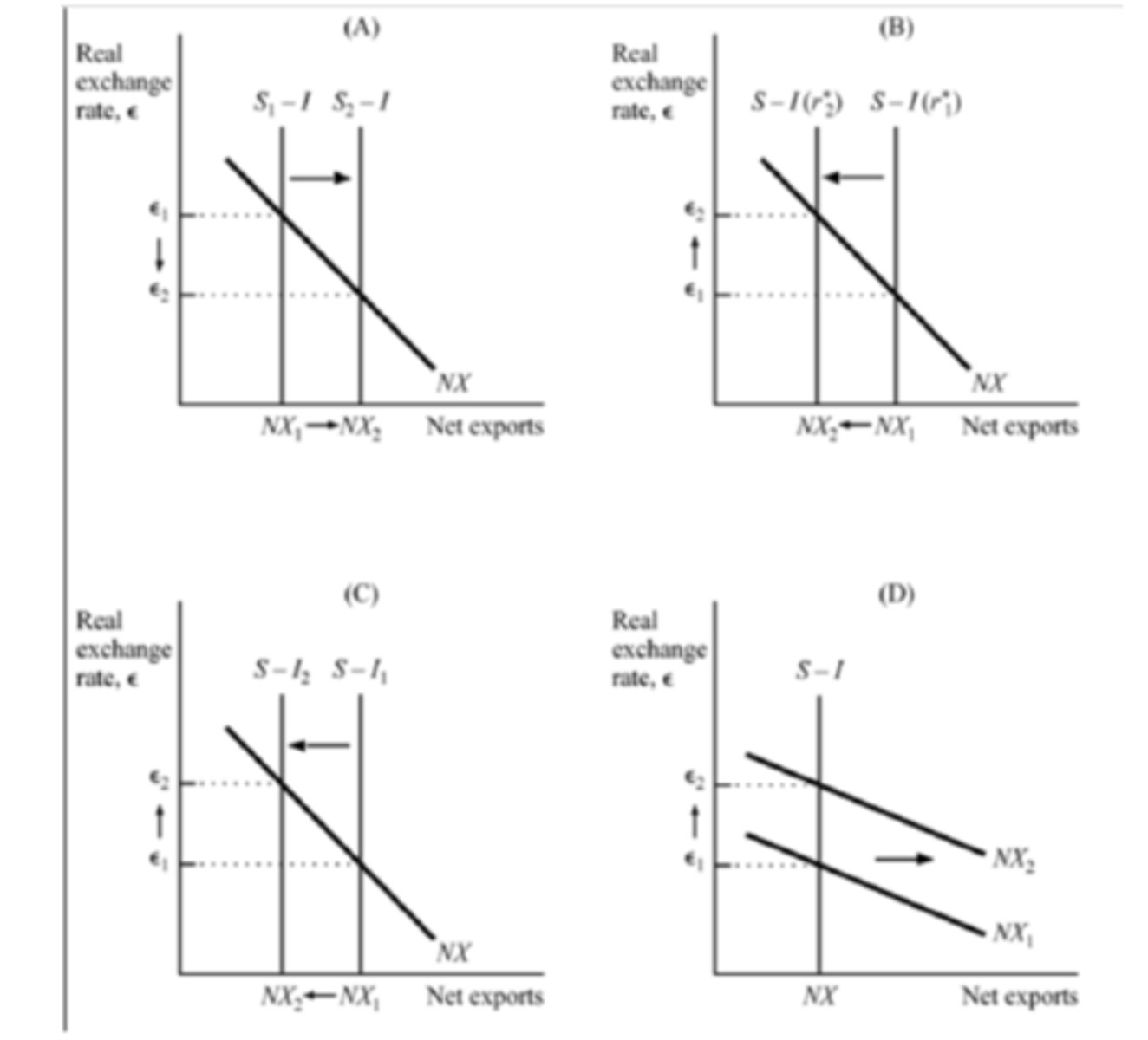
Use the model of the small open economy to predict what would happen to the trade balance, the real exchange rate, and the nominal exchange rate in response to a tax reform that increases incentives for businesses to build new factories.
1) The trade balance would increase/decrease
2) The real exchange rate would rise/fall
3) The nominal exchange rate would rise/fall
1) decrease
2) rise
3) rise
Oceania is a small open economy. Suppose that a large number of foreign countries began to subsidize investment by instituting an investment tax credit (while adjusting other taxes to hold their tax revenue constant), but Oceania does not institute such an investment subsidy. Based on this information, answer all parts of the following two questions.
1) World investment demand as a function of the world will increase/decrease
2) As a result, the world interest rate will rise/fall
3) This will cause domestic investment in Oceania to increase/decrease
4) Oceania's trade balance will move toward surplus/deficit
5) Ultimately, the real exchange rate for Oceania currency will increase/decrease
1) increase
2) rise
3) decrease
4) surplus
5) decrease
The president is considering placing a tariff on the import of Japanese luxury cars. Using the model presented in this chapter, consider the economics and politics of such a policy. Answer each question.
1) How would this policy affect the U.S. trade deficit? This policy proposal would ultimately decrease/not affect the trade deficit.
2) How would it affect the exchange rate? The exchange rate would increase/decrease.
3) Who would benefit and who would be hurt by such a policy? The foreign buyers of U.S. exports and the domestic buyers of automobiles would benefit/be hurt economically, whereas the domestic manufacturers of automobiles would benefit/be hurt.
1) not affect
2) increase
3) be hurt; benefit
The country of Leverett is a small open economy. Suddenly, a change in world fashions makes the exports of Leverett unpopular.
Use the information provided below to answer questions about national savings (S), domestic investment (I), net exports (NX), the domestic interest rate (r), and the exchange rate (E).
1) The impact of this sudden ________________.
2) These changes will then ________________.
3) Now assume that the fiscal policymakers of Leverett want to adjust taxes to maintain the exchange rate at its previous level. Leverett policymakers should _________________.
1) change leaves both S and I unchanged, which leaves NX unchanged
2) change leaves both S and I unchanged, which leaves NX unchanged
3) change leaves both S and I unchanged, which leaves NX unchanged.
Which event would cause a currency to depreciate?
1) An increase in the price level
2) An investment boom
3) An increase in tax abroad
4) A tax cut
1) An increase in the price level
Any policy aimed at lowering the natural rate of unemployment must either ____ the rate of job separation or ____ the rate of job finding.
1) Increase; reduce
2) Increase; increase
3) Reduce; reduce
4) Reduce; increase
4) Reduce; increase
In the model of the steady-state unemployment rate with a fixed labor force, the rate of job finding equals the percentage of the ____ who find a job each month, while the rate of job separation equals the percentage of the ____ who lose their job each month.
1) Labor force; unemployed
2) Employed; labor force
3) Labor force; labor force
4) Unemployed; employed
4) Unemployed; employed
Sectoral shifts:
1) Explain the payment of efficiency wages
2) Lead to wage rigidity
3) Make frictional unemployment inevitable
4) Depend on the level of the minimum wage
3) Make frictional unemployment inevitable
Unemployment insurance increases the amount of frictional unemployment by:
1) Making workers more frantic in their search for new jobs
2) Making employers more reluctant to lay off workers
3) Softening the economic hardship of unemployment
4) Inducing workers to accept the first job offer that they receive
3) Softening the economic hardship of unemployment
All of the following are reasons for frictional unemployment except:
1) The flow of information is imperfect
2) Unemployed workers accept the first job offer that they receive
3) Geographic mobility takes time
4) Workers have different preferences and abilities
2) Unemployed workers accept the first job offer that they receive
Economists call the changes in the composition of demand among industries and regions:
1) Sectoral shifts
2) Adverse selection
3) Moral hazard
4) Insider-outsider conflicts
1) Sectoral shifts
According to efficiency-wage theories, firms benefit by paying higher-than-equilibrium wages because worker ____ increases.
1) Shirking
2) Unionization
3) Turnover
4) Productivity
4) Productivity
When insiders have a much greater impact on the wage-bargaining process than do outsiders, the negotiated wage is likely to be ____ the equilibrium wage.
1) Much less than
2) Much greater than
3) About one-half of
4) Almost equal to
2) Much greater than
Assume that a country experiences a reduction in productivity that shifts the labor demand curve downward and to the left. If the labor market were always in equilibrium, this would lead to:
1) A lower real wage and no change in unemployment
2) A lower real wage and less unemployment
3) A lower real wage and a rise in unemployment
4) No change in real wage or in unemployment
1) A lower real wage and no change in unemployment
By paying efficiency wages, firms contribute to higher unemployment because they:
1) Increase the wage bill
2) Keep the wage above the equilibrium level
3) Make workers more productive
4) Keep the wage below the equilibrium level
2) Keep the wage above the equilibrium level
Paying efficiency wages helps firms reduce the problem of moral hazard by:
1) Matching the wages each worker is paid to the number of units of output each worker produces
2) Generating additional profits that can be used to improve working conditions
3) Providing an incentive for the best-qualified workers to remain with the firm
4) Encouraging unsupervised workers to maintain a high level of productivity
4) Encouraging unsupervised workers to maintain a high level of productivity
Which of the following is the best example of structural unemployment?
1) Tim is looking for a job with flexible hours but has not been offered one yet
2) Vickie lost her job as a graphic artist at a movie studio because she did not have training in computer-generated animation
3) Kirby is seeking a job as an airline pilot, but the high union wages in the industry have limited the number of jobs available
4) Fatime lost her job at a packing plant but has not looked very intensively for a new job because she still has two months of unemployment insurance benefits left
3) Kirby is seeking a job as an airline pilot, but the high union wages in the industry have limited the number of jobs available
The unemployment resulting when real wages are held above equilibrium is called ____ unemployment, while the unemployment that occurs as workers search for a job that best suits their skills is called ____ unemployment.
1) Efficiency; structural
2) Efficiency; inefficiency
3) Frictional; efficiency
4) Structural; frictional
4) Structural; frictional
Spells of unemployment end when the unemployed person finds a job or:
1) Refuses to answer unemployment survey questions
2) Runs out of unemployment insurance compensation
3) Withdrawals from the labor force
4) Ends the labor force
3) Withdrawals from the labor force
Discouraged workers are counted as:
1) Employed
2) Unemployed
3) Part of the labor force
4) Out of the labor force
4) Out of the labor force
As the relative demand for unskilled workers falls, wages for unskilled workers ____, and unemployment compensation becomes a ____ attractive option.
1) Rise; more
2) Fall; less
3) Rise; less
4) Fall; more
4) Fall; more
If the underground economy is larger in Europe than in the United States, then the difference in the ____ number of hours worked between Europe and the United States may be smaller than the difference in the ____ number of hours worked.
1) Monthly; annual
2) Actual; measured
3) Annual; monthly
4) Measured; actual
2) Actual; measured
If an economy has many discouraged workers, the unemployment rate will remain unaffected/be low, and the employment-population ratio will be high/be low.
remain unaffected; be low
Although not a goal of the unemployment insurance system, one effect is that the system reduces
1) Frictional unemployment
2) The rate of job separation
3) Workers' uncertainty about their incomes
4) The search of those who are unemployed
4) The search of those who are unemployed
Monetary neutrality, the irrelevance of the money supply in determining values of ____ variables, is generally thought to be a property of the economy in the long run.
1) Real
2) Nominal
3) Neither real nor nominal
4) Real and nominal
1) Real
Most economists believe that prices are:
1) Flexible in the long run but many are sticky in the short run
2) Flexible in both the short and long runs
3) Flexible in the short run but many are sticky in the long run
4) Sticky in both the short and long runs
1) Flexible in the long run but many are sticky in the short run
For a fixed money supply, the aggregate demand curve slopes downward because at a lower price level, real money balances are ____, generating a ____ quantity of output demanded.
1) Lower; smaller
2) Higher; greater
3) Lower; greater
4) Higher; smaller
2) Higher; greater
Along an aggregate demand curve, which of the following are held constant?
1) The money supply and real output
2) Nominal output and velocity
3) Real output and prices
4) The money supply and velocity
4) The money supply and velocity
When an aggregate demand curve is drawn with real GDP (Y) along the horizontal axis and the price level (P) along the vertical axis, if the money supply is decreased, then the aggregate demand curve will shift:
1) Upward and to the left
2) Downward and to the right
3) Upward and to the right
4) Downward and to the left
4) Downward and to the left
If the long-run aggregate supply curve is vertical, then changes in aggregate demand affect:
1) Prices but not level of output
2) Neither prices nor level of output
3) Level of output but not prices
4) Both prices and level of output
1) Prices but not level of output
The short run refers to a period:
1) Of several days
2) During which prices are sticky and cyclical unemployment may occur
3) During which capital and labor are fully employed
4) During which there are no fluctuations
2) During which prices are sticky and cyclical unemployment may occur
Monetary neutrality is a characteristic of the aggregate demand-aggregate supply model in:
1) The short run but not in the long run
2) The long run but not in the short run
3) Both the short run and the long run
4) Neither the short run nor the long run
2) The long run but not in the short run
If the short-run aggregate supply curve is horizontal and the long-run aggregate supply curve is vertical, then a change in the money supply will change ____ in the short run and change ____ in the long run.
1) Only output; only prices
2) Both prices and output; both prices and output
3) Both prices and output; only prices
4) Only prices; only output
1) Only output; only prices
Assume that the economy starts from long-run equilibrium. If the Federal Reserve increases the money supply, then ____ increase(s) in the short run, and ____ increase(s) in the long run.
1) Prices; output
2) Prices; prices
3) Output; prices
4) Output; output
3) Output; prices
In this graph, initially the economy is at point E, with price P0 and output Y aggregate demand is given by curve AD0, and SRAS and LRAS represent, respectively, short-run and long-run aggregate supply. Now assume that the aggregate demand curve shifts so that it is represented by AD1. The economy moves first to point ____ and then, in the long run, to point ____.
1) B; C
2) A; D
3) D; A
4) C; B
4) C; B
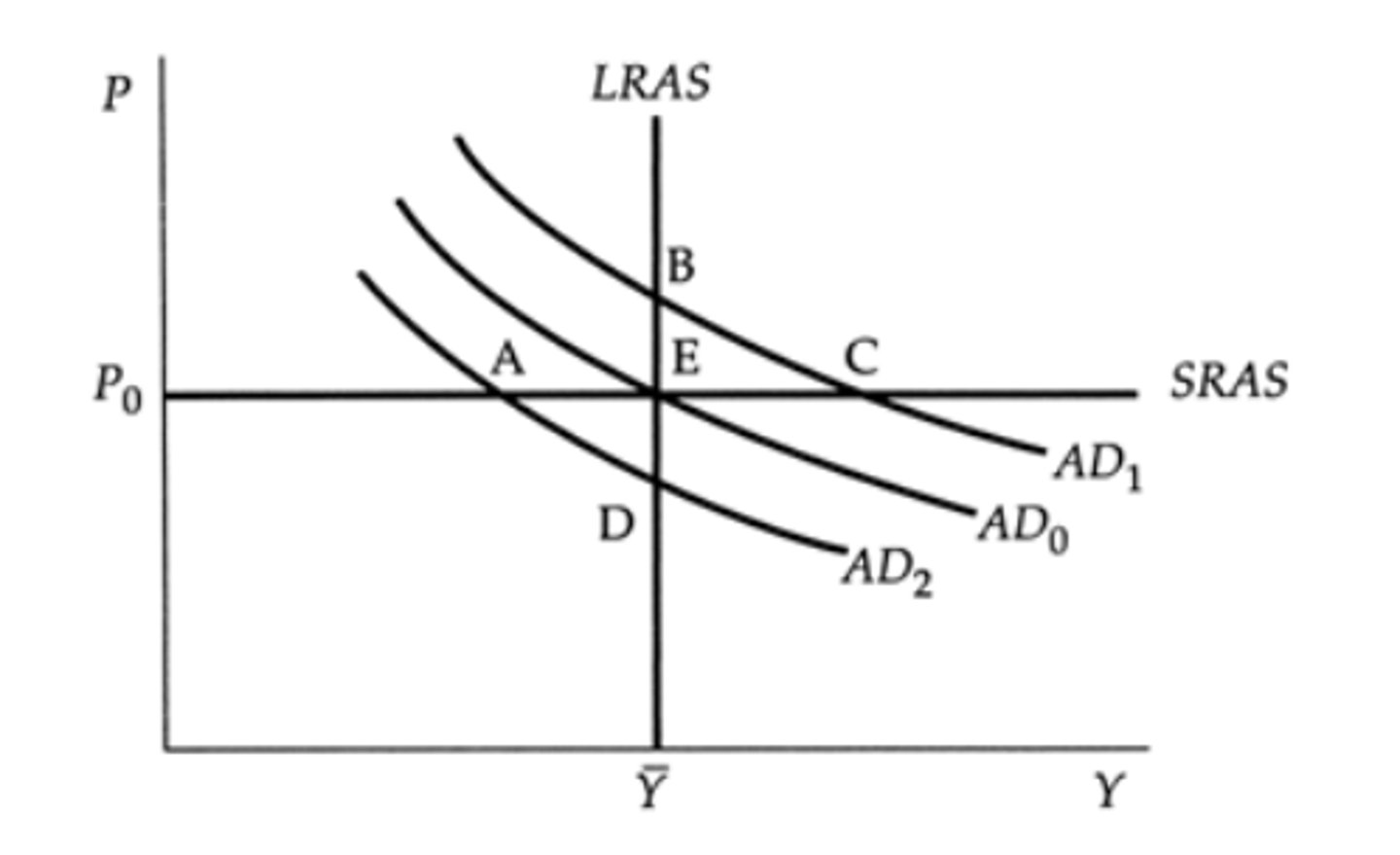
Assume that the economy is at point E. With no further shocks or policy moves, the economy in the long run will be at point:
1) D
2) C
3) B
4) A
4) A
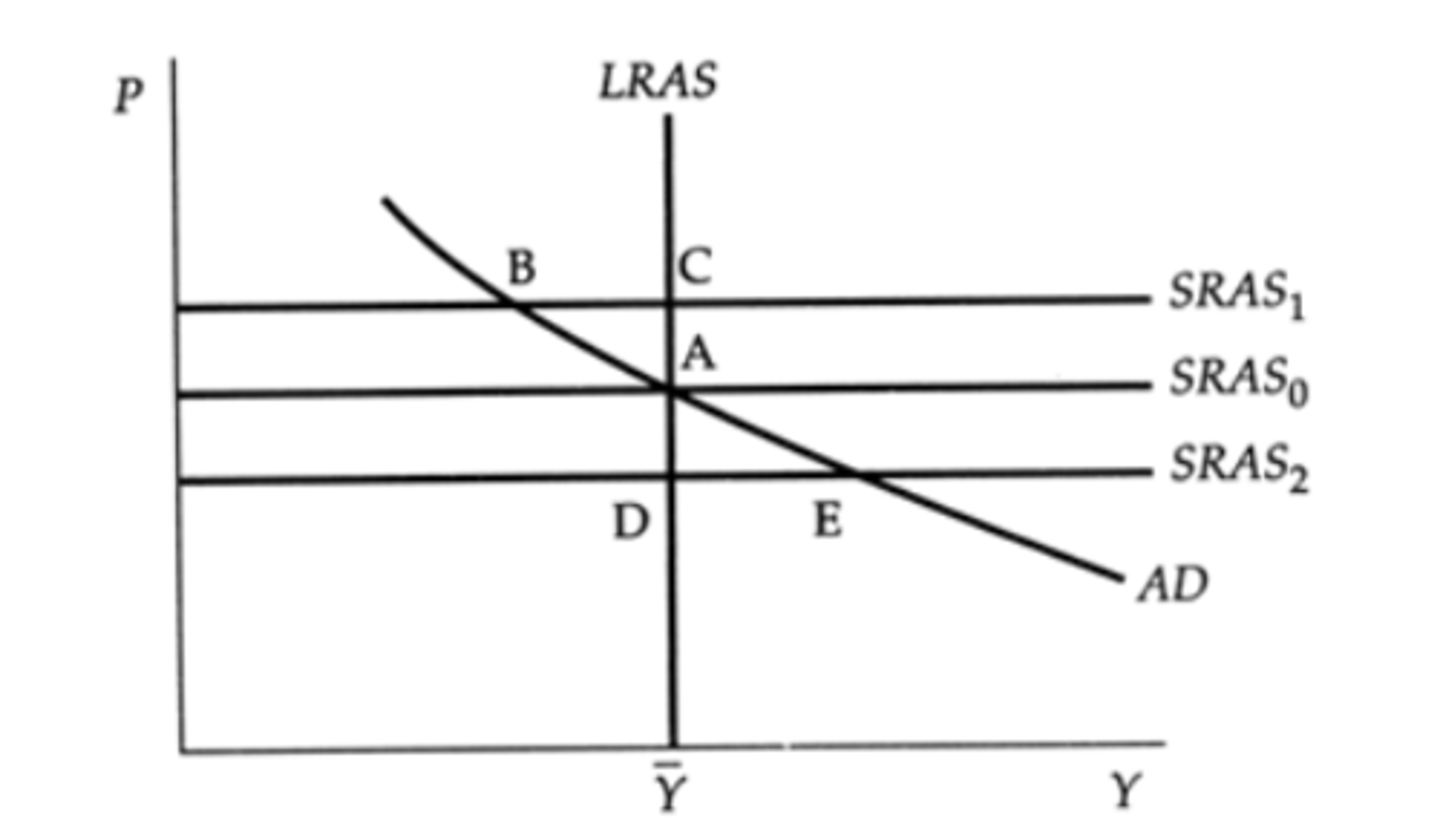
If the Fed accommodates an adverse supply shock, output falls ____, and prices rise ____.
1) More; more
2) Less; more
3) Less; less
4) More; less
2) Less; more
Starting from long-run equilibrium, if a drought pushes up food prices throughout the economy, the Fed could move the economy more rapidly back to full employment output by:
1) Increasing the money supply, but at the cost of permanently higher prices
2) Decreasing the money supply, which would restore the original price level
3) Increasing the money supply, which would restore the original price level
4) Decreasing the money supply, but at the cost of permanently lower prices
1) Increasing the money supply, but at the cost of permanently higher prices
Over the business cycle, investment spending ____ consumption spending.
1) Is inversely correlated with
2) Is less volatile than
3) Has about the same volatility as
4) Is more volatile than
4) Is more volatile than
When GDP growth declines, investment spending typically ____ and consumption spending typically ____.
1) Decreases; increases
2) Decreases; decreases
3) Increases; decreases
4) Increases; increases
2) Decreases; decreases
An increase in taxes shifts the IS curve:
1) Downward and to the right
2) Upward and to the right
3) Upward and to the left
4) Downward and to the left
4) Downward and to the left
In this graph, if firms are producing at level Y3, then inventories will ____, inducing firms to ____ production.
1) Fall; increase
2) Fall; decrease
3) Rise; increase
4) Rise; decrease
4) Rise; decrease
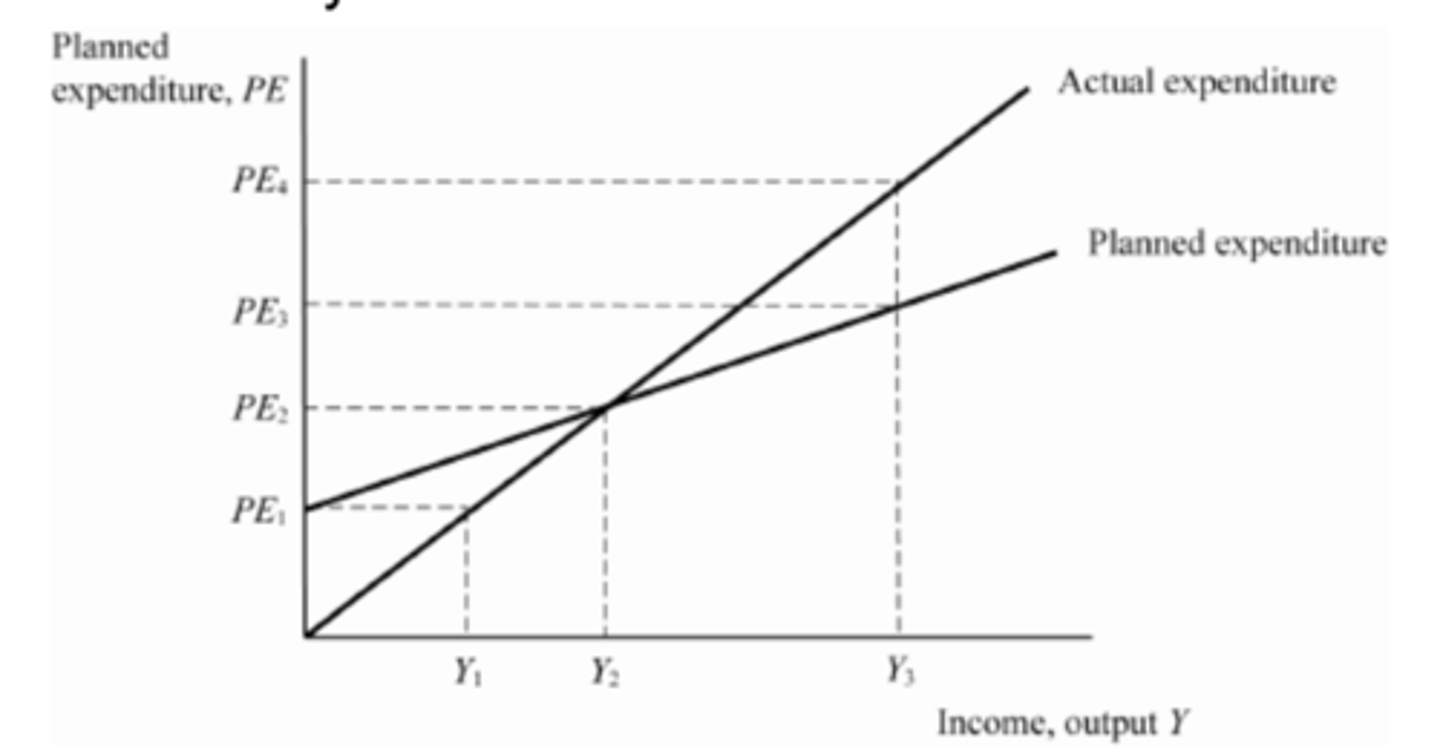
In the Keynesian-cross model with a given MPC>0, the government-expenditure multiplier ____ the tax multiplier.
1) Is smaller than
2) Is the inverse of the
3) Is larger than
4) Equals
3) Is larger than
An explanation for the slope of the IS curve is that as the interest rate increases, the quantity of investment ____, and this shifts the expenditure function ____, thereby decreasing income.
1) Decreases; downward
2) Increases; upward
3) Decreases; upward
4) Increases; downward
1) Decreases; downward
The IS curve plots the relationship between the interest rate and ____ that arises in the market for ____.
1) The price level; goods and services
2) National income; goods and services
3) National income; money
4) The price level; money
2) National income; goods and services
In the Keynesian-cross model, if taxes are reduced by 100, then planned expenditures ____ for any given level of income.
1) Decrease by 100
2) Increase by more than 100
3) Increase by 100
4) Increase but by less than 100
4) Increase but by less than 100
Based on the Keynesian model, one reason to support government spending increases over tax cuts as measures to increase output is that:
1) Government-spending increases do not lead to unplanned changes in inventories, but tax cuts do
2) Government spending increases the MPC more than tax cuts
3) The government-spending multiplier is larger than the tax multiplier
4) Increases in government spending increase planned spending, but tax cuts reduce planned spending
3) The government-spending multiplier is larger than the tax multiplier
The liquidity preference model, what adjusts to move the money market to equilibrium following a change in the money supply?
1) Production
2) The interest rate
3) Planned spending
4) The price level
2) The interest rate
The theory of liquidity preference states that the quantity of real money balances demanded is:
1) Negatively related to the interest rate and positively related to income
2) Positively related to both the interest rate and income
3) Positively related to the interest rate and negatively related to income
4) Negatively related to both the interest rate and income
1) Negatively related to the interest rate and positively related to income
If the interest rate is above the equilibrium value, the:
1) Market for real balances clears
2) Supply of real balances exceeds the demand
3) Demand for real balances increases
4) Demand for real balances exceeds the supply
2) Supply of real balances exceeds the demand
Based on the graph, if the interest rate is r3, then people will ____ bonds, and the interest rate will ____.
1) Buy; rise
2) Sell; rise
3) Sell; fall
4) Buy; fall
2) Sell; rise
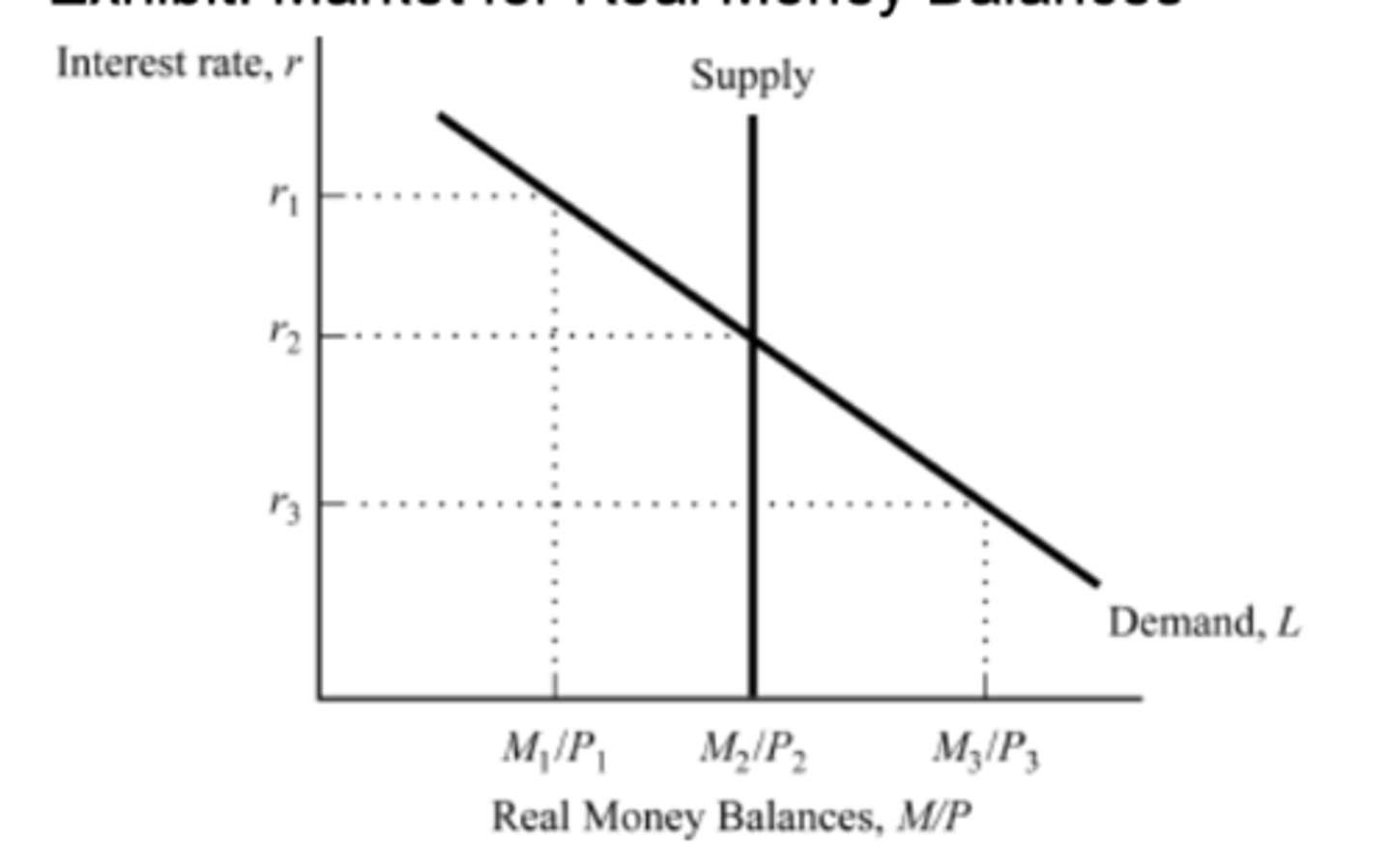
A decrease in the real money supply, other things being equal, will shift the LM curve:
1) Upward and to the left
2) Upward and to the right
3) Downward and to the right
4) Downward and to the left
1) Upward and to the left
The interest rate determines ____ in the goods market and money ____ in the money market.
1) Investment spending; supply
2) Government spending; supply
3) Government spending; demand
4) Investment spending; demand
4) Investment spending; demand
Explore top notes

