3.4.5 Monopoly
 Call Kai
 Learn
Learn Practice Test
 Spaced Repetition
 Match
Match Flashcards
 Knowt Play
1/24

There's no tags or description
Looks like no tags are added yet.
Name | Mastery | Learn | Test | Matching | Spaced | Call with Kai |
|---|
No analytics yet
Send a link to your students to track their progress
25 Terms
PURE MONOPOLY- DEFINITION
one firm is sole seller of a product in a market
MONOPOLY- CHARACTERISTICS
high barriers to entry- incumbent firms less likely to face new competition as barriers are high (e.g. loyalty, high start up costs, high sunk costs, EoS, limit pricing, ads)- allows them to increase prices as no substitutes
MONOPOLY POWER
a firm can be legally considered to have monopoly power if it has >25% of market share
firm has price making power for their product
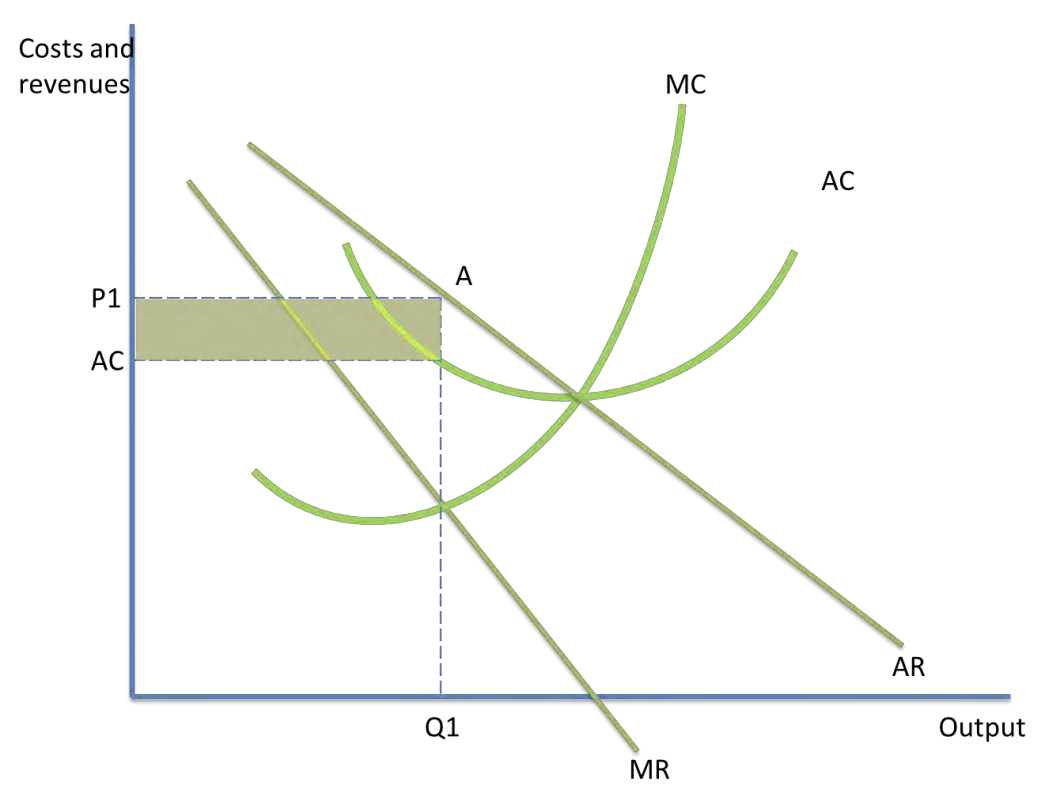
MONOPOLY- PROFIT MAX EQUILIBRIUM
monopolist earns SNP in both SR and LR (bc high barriers)
since firm is sole supplier in market, firm’s cost and revenue curve is the same as the industry’s cost and revenue curve
firms are price makers in a monopoly
P>MC in diagram, due to profit max, so there is allocative inefficiency
THIRD DEGREE PRICE DISCRIMINATION- DEFINITION
charge diff prices to diff people for the same good or service, in diff markets
THIRD DEGREE PRICE DISCRIMINATION- CONDITIONS
separate market into groups of buyers- must have diff elasticities of demand (low price for elastic, high price for inelastic)
be able to control supply and prevent buyers from expensive market from buying from cheaper market
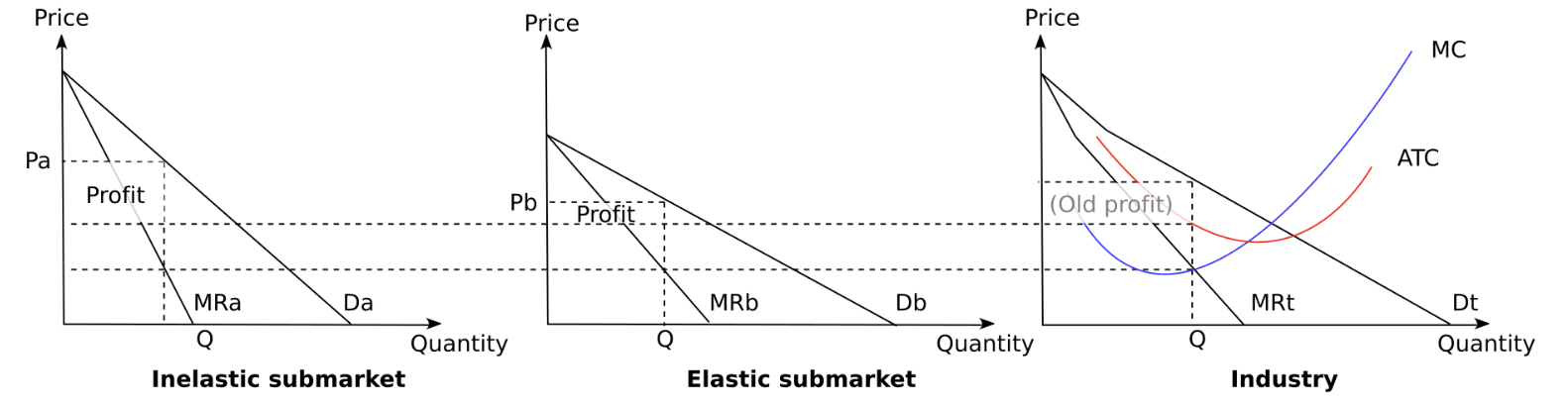
THIRD-DEGREE PRICE DISCRIMINATION DIAGRAM
same costs for industry as whole (so AC equal)
total SNP higher with price discrimination compared to original profit (right diagram)
IMPACTS OF PRICE DISCRIMINATION- GROUPS OF PEOPLE
consumers
producers
BENEFITS OF PRICE DISCRIMINATION ON CONSUMERS
net welfare gain as a result of cross subsidisation, if they receive lower prices for having price elastic demand
those previously excluded by high prices, may now be able to benefit from g or s - increase equality
COSTS OF PRICE DISCRIMINATION ON CONSUMERS
usually results in loss of consumer surplus
since P>MC theres a loss of allocative efficiency
strengthens monopoly power → increases barriers → may result in higher prices in LR
BENEFITS OF PRICE DISCRIMINATION ON PRODUCERS
make better use of spare capacities
higher SNP → stimulate investment (dynamic efficient)
if more profits are made in one market, a diff market which makes a loss could be cross-subsidised → limit job losses
COSTS OF PRICE DISCRIMINATION ON PRODUCERS
if used as a predatory pricing method- firm could face investigation by CMA
might cost firm to divide market, which limits benefits they could gain
COSTS AND BENEFITS OF MONOPOLY ON…
firms
consumers
employees
suppliers
BENEFITS OF MONOPOLY ON FIRMS
high SNP through profit max- can set high prices which will benefit owners (shareholders) as they can gain high return on investment, can increase investment (innovation and R&D) to maintain monopoly power and improve dynamic efficiency and overcome short term difficulties
gain economies of scale- lower LRAC → increase profits + can limit price to increase barriers to entry
can compete internationally- can lower price and achieve non-price competitiveness
COSTS OF MONOPOLY ON FIRMS
greater regulation- as they gain greater monopoly power, regulators (CMA) may intervene to protect consumers
diseconomies of scale- explain yourself
LR lack of competition- may mean that firms become complacent and so they may not make maximum profits
BENEFITS OF MONOPOLIES ON CONSUMERS
benefit from innovation and R&D- improved g and s through product innovation or maybe lower prices due to more efficient production methods
lower prices through EoS- particularly seen in natural monopolies, where having monopoly prevents duplication of effort and max EoS
consumers benefit from cross-subsidisation- firms funds loss from one product by raising price of another → widening range of products (increase choice) available for consumers and increase consumer welfare
COSTS OF MONOPOLIES ON CONSUMERS
higher prices- no competition → high price and low output → allocative inefficiency → decrease consumer surplus (low costs of EoS may not be passed to consumers)
lack of choice and poor quality- SNP may not be invested into R&D → less innovation → less choice + lack of incentive to improve quality due to no competiiton
BENEFITS OF MONOPOLIES ON EMPLOYEES
high levels of employment and job security- firm has high profits and lack of competition to remain in business in LR + may expand operations which allow increase employment
higher wages- more SNP → can reward successful employees as there is increase in demand for workers
COSTS OF MONOPOLIES ON EMPLOYEES
few employment opportunities- lower overall output in that industry due to lack of competition→ less derived demand for labour
BENEFITS OF MONOPOLIES ON SUPPLIERS
higher sales and profit- can have a reliable buyer → LT relationship → also provide security for employees in supplier company
COSTS OF MONOPOLIES ON SUPPLIERS
exploitation- may have monopsony power → suffer from lower prices → lower profits (maybe even loss)
EFFICIENCY OF MONOPOLY
allocative inefficient- as P>MC so they will be profit max → deadweight loss
productively inefficient- not minimising costs (AC not = MC)
dynamically efficient- invest into R&D due to high SNP
X-inefficient- lack of competitive pressure → increase AC
NATURAL MONOPOLY
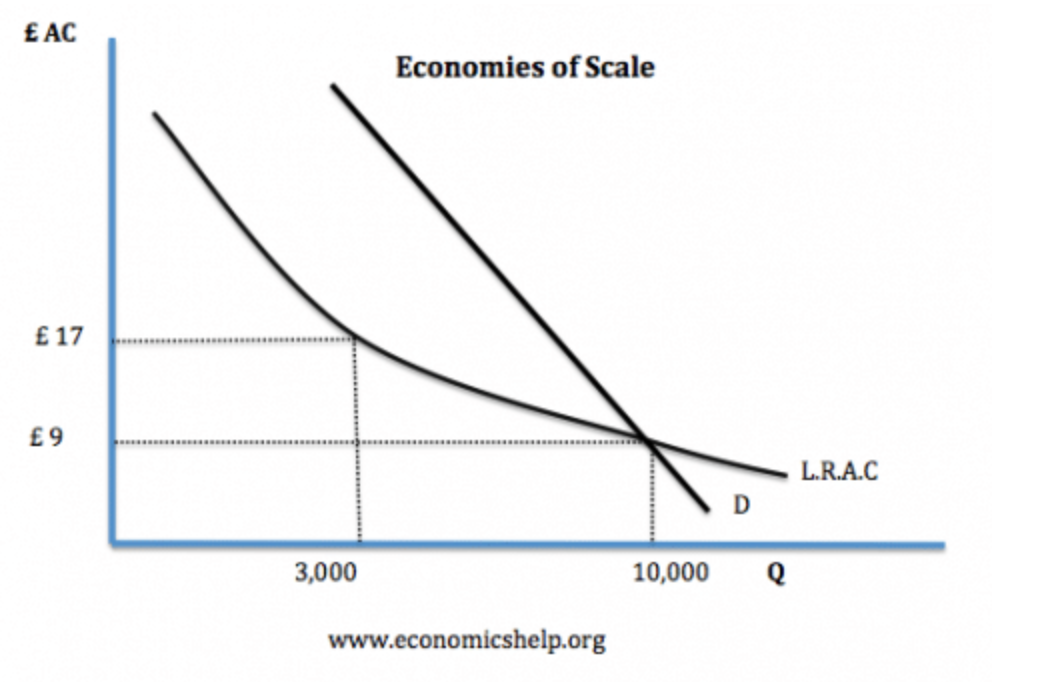
situation where, due to EoS of a particular industry, industry is best served by single supplier
NATURAL MONOPOLY DIAGRAM
occurs in an industry where LRAC falls over a wide range of output levels such that there may be only room for one supplier to exploit all internal EoS, so achieve productive efficiency
e.g. gas network, electricity grid, railway infrastructure