Roman Rhetoric
 Studied by 0 people
 Call Kai
 Learn
Learn Practice Test
 Spaced Repetition
 Match
Match Flashcards
 Knowt Play
1/16

There's no tags or description
Looks like no tags are added yet.
Name | Mastery | Learn | Test | Matching | Spaced | Call with Kai |
|---|
No study sessions yet.
17 Terms
Rhetoric in Roman society
Rhetoric is a Greek invention & well received because its practical
Romans saw it useful to speak well + convince others
What is Atticism & Asianism
2 diff public speaking styles that were not known to the Greeks
Asianism
ornate
used big words
large sentences
more flamboyant
Atticism
pure & simple
Demosthenes is the example for Rhetoric
followed greek conventions
more measured
Cicero used both Quintilian did not care
they are nuances in both styles
Death of political rhetoric
after Athens were conquered, the deliberative type disappeared completely
speeches and rhetoric
Same thing happens in Rome when in 31 BC the empire starts.
happened in Rome end of 1st century bc → Augustus becomes emperor , senate, ppl assembly : talked about stuff but a façade
Epideictic fell off, mostly for school teachings, with exception of praise speeches
Greek judicial system
civil court, no state department of justice, people had to defend themselves.
The roman build their system based on this
This was mostly taken over by the Romans and later on towards a certain extent
Roman judicial system
epidetic remained important, before and after the Empire
justice was heavily state organised
Civil procedures: praetor
organiser of court and judicial procedures
mostly civil procedures
Criminal cases: Centumviral Court
more state-organised,
impossible for a layman to represent himself due to the complexities of the law
important for a layman to be able to represent himself
need to be trained in it
People had to hire lawyers, who will represent you.
Genres
Epideictic
judicial → jiudiciale
deliberative → deliberativum
demonstrative → demonstrativum
Tasks of the judicial system
Teach → Docere
have to teach: in a court, need to teach the defendent/prosecutor whats going on
Delight → Delectare
please the audience, speak to the jury, speak beautifully
Please and move → Movere
need to move the audience, pathetic = pathos, make the jury laugh or cry
doesn’t need to be done in order, but usually like this
Phases of the judicial system
Discovery, disposition, elocution, memory, activity
Find arguments and counters, organise, write the actual speech, memorise it, declaiming
invention
action: standing there and doing it
inventio, dispositio, elocutio, memoria, actio
Parts of the judicial system
beginning, story, argumentation, refutation, peroration
the proem
introduction
the narration: your version of the events
the argumentation: counter arguments of opponents
conclusion
exordium, narratio, argumentatio, refutatio, peroratio
4 stylistic demands
free of errors, clear, beautiful, fitting
what you say has to be apt: v important
linked to lit immediately & need to explain it clearly
The system gets more complex can be further subdivided
What is statis?
Status
for prosecution and defence, pick a strategy for your cases
part of the invention phase, pick a particular strategy or point your case will circle
Status coniecturalis → state of the conjecture
did person commit the crime?
strongest possible defence done here
Status definitionis → Status definition
not exactly this crime, tweaking the legal definitons of the crime
Status qualitatis → quality
less strong defence, is the crime morally justified?
Status translativus
argues that court is not allowed to judge the case → weakest leg to stand on
prosecutor; have to prove case on all this status
prosecutor; have to prove case on all this status
Cicero
the greatest rhetorician
writing speeches & analysing → All kinds of philosophical and technical treatises
106BC - 43BC
works through the cursus honorum: order of holding public offices at the minimum age
curse of honours, there is a certain honour of achieving in office
his death = death of public & political rhetoric in Rome
Speeches: the greatest hits & made a lot
80: Pro Roscio Amerino
defend the a guy of patricide, won speech at 20 yrs
70: In Verrem
Trial started by the people of Sicily against Verres for an oppressive regime.
Cicero was a “defender of the people”.
Verses was already out of favour for the higher class so there weren’t any real enemies made
63: In Catilinam (4):
attacking Catiline post-conspiracy.
Considered to be his best work
62: Pro Archia Poeta
In defence of the poet archias, defends his status of citizen.
Throughout the speech transforms about the defence of poetry and literature
44: Philippicae (14
aganist Mark Anthony
mimic Demosthenes
De Oratore (55)
incl the belief that the perfect orator must know all the rules about rhetoric but he must also be a morally immaculate person (philosopher as well
Law practices in ancient rome
lawyers weren’t allowed to get paid for their services
made the patterns of mutual dependency stronger
weaker party is clients, stronger one is patrons.
If you get accused by a stronger party: senator, the weaker party will have to find someone of equal standing to their attacker to defend them: another rich person with time and education to do so
Gratia/political power is payment
Strengths of Cicero
Adapted to circumstances easily
Praises the senators but backtalks them to the ppl & portrayed them as traitors
Very good at histrionics
acting and altering the surroundings to support your message.
when defending a supporter of Catiline: place the blame on C., not on him.
Changes the tone, defends that he had some virtue to say well he deceived him.
Belief in the people and senate
a strong chosen elected consul + laws of the republic = can defend itself against inside and outside threats (toga as a weapon)
Anything can be solved through senatorial deliberation.#
Addresses the deepest fears & passion of his roman audience.
Wise speaker that could combine practical wisdom of Rome & specialist knowledge and philosophy of the Greeks.
Appeal to the non-rational audience: needed their mobilization
decision was made based on fear instead of passion
Twists civil & political affairs into cosmic-godly affairs
paints himself as priest that sacrifices Catiline at the altar of roman union& stability
Character assassination (movere)
Theatrical performance: histrionics + prosopopoiia play a role to dramatize
could have been perceived as overtly dramatical, humour at the expense of others
all happening in the courts
Quintilian
Trained in Rome & practice law in Spain
Published the Institutio Oratoria.
a textbook on the theory & practice of rhetoric
The Institutio is not exactly literary style
followed the rhetorical training in Rome then went back to Spain to practice law
a Textual tradition
Content Institutio
very logical structure
Expresses the same belief as Cicero of the rhetorician having to be knowledgeable in many areas and ethically blameless.
Uses anecdotes and examples because it was also thought for the interested layman
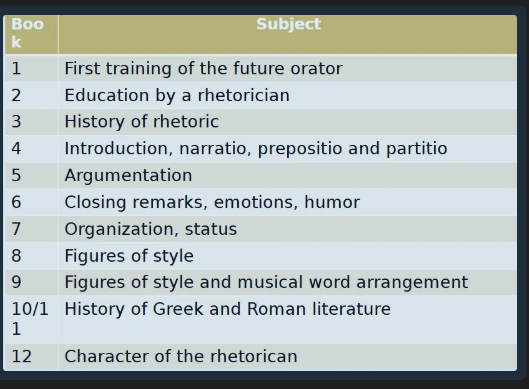
Charm of the Institutio
Composed for the interested layman
Theory tested in practice
Thousands of examples
Epideictic genre
Panegyrics for the emperor
Pliny’s Panegyricus
praise poem written in verse praising a person
Declamations (training in rhetoric): in rhetorical schools practiced this to train public speaking
fictitious
historical
mythological
Demonstrativum genre
more prominent after the establishment of the empire by virtue of the others being less used.
Used for rhetorical training in schools.
Panegyrics for the emperor
Pliny’s Panegyricus
Declamations (training in rhetoric)
fictitious
historical
mythological
 Note
Note  Flashcards (57)