[P2] Electricity
 Call Kai
 Learn
Learn Practice Test
 Spaced Repetition
 Match
Match Flashcards
 Knowt Play
1/94

There's no tags or description
Looks like no tags are added yet.
Name | Mastery | Learn | Test | Matching | Spaced | Call with Kai |
|---|
No analytics yet
Send a link to your students to track their progress
95 Terms
What is the circuit symbol for a bulb?
Circle with a cross
What is the circuit symbol for a cell?
Two lines, one shorter than the other
What is the circuit symbol for a battery?
Two lines, one shorter than the other, repeated at least twice
What is the circuit symbol for an ammeter?
Circle with an A
What is the circuit symbol for a voltmeter?
Circle with a V
What is the circuit symbol for a switch?
A break in the wire line
What is the circuit symbol for a fuse?
Rectangle with a line through
What is the circuit symbol for a diode?
Circle with an arrow and line inside
What is the circuit symbol for a LED?
Circle with an arrow and line inside and two arrows pointing out
What is the circuit symbol for a resistor?
Rectangle
What is the circuit symbol for a variable resistor?
Rectangle with an arrow through
What is the circuit symbol for a thermistor?
Rectangle with a bent line through
What is the circuit symbol for an LDR?
Rectangle with a circle around and two arrows pointing in
What is the function of an electrical cell?
Provides energy to the electrons, or provides potential difference
What is the function of a battery?
Provides energy to the electrons, or provides potential difference
What is the function of a fuse?
Breaks and stops the circuit if the current is too high
What is the function of a switch?
Breaks or completes the circuit
What charge do electrons have?
Negative
What equation links current, charge flow & time?
charge flow = current × time
What is the unit for charge flow?
Coulombs, or C
What is the unit for current?
Amps, or A
What is the unit for time?
Seconds, or s
What happens to current flow if the resistance increases?
Decreases
What equation links current, resistance & potential difference?
potential difference = current × resistance
What is the unit for potential difference?
Volts, or V
What is the unit for resistance?
Ohms, or Ω
What is the function of an ammeter?
Measures the current in a circuit
What is the function of a voltmeter?
Measures the potential difference through a component
Where should an ammeter be placed in a circuit?
In series with the components
Where should a voltmeter be placed in a circuit?
On a parallel bridge around the component of interest
What is the function of a resistor?
Increases the resistance of a circuit
What is the function of a variable resistor?
Increases the resistance of a circuit, and can be changed
What is an ohmic conductor? (2)
The current through an ohmic conductor (at a constant temperature) is directly proportional to the potential difference across it
This means that the resistance remains constant as the current changes
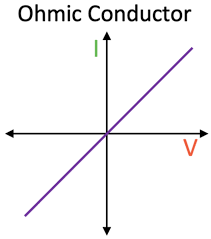
What does the current-potential difference graph for an ohmic conductor (like a resistor) look like?
A straight line through 0,0
What does the current-potential difference graph for a filament bulb look like?
A curved line through 0,0
What is the function of a bulb?
Produces light radiation
What does the current-potential difference graph for a diode look like?
A curved line that increases significantly after a certain potential difference
What is the function of a diode?
Allows current to only flow in one direction
What is the function of an LED?
Allows current to only flow in one direction, and produces light radiation
What happens to the resistance of a thermistor when the temperature changes?
The resistance of a thermistor decreases as the temperature increases.
What is the function of a thermistor?
Increases the resistance of a circuit depending on the temperature of the surroundings
What happens to the resistance of an LDR when the light intensity changes?
The resistance of an LDR decreases as light intensity increases.
What is the function of an LDR?
Increases the resistance of a circuit depending on the brightness of the surroundings
How are thermistors used?
in circuits as thermostats
How are LDRs used?
in circuits to switch on lights on when it gets dark
Give four examples of non-ohmic conductors
Diodes, filament bulbs, LDRs, thermistors
What does 'components in series' mean?
The same electrons flow through each component
What does 'components in parallel' mean?
The same electrons doesn’t flow through the components because they are on different branches of a circuit
What happens to current through components connected in series?
there is the same current through each component
What happens to the total resistance of components connected in series? (2)
the total resistance of the components is the sum of the resistance of each component
adding more components increases the resistance
What happens to the potential difference across components connected in series?
the total potential difference of the power supply is shared between the components
What happens to current through components connected in parallel? (2)
the current splits across the components
the total current through the whole circuit is the sum of the currents through the separate components
What happens to the total resistance of components connected in parallel? (3)
the total resistance is less than the resistance of the smallest individual resistor
the total resistance decreases as more components are added
this is because each new branch provides an additional path for charge to flow
What happens to the potential difference across components connected in parallel?
the potential difference across each component is the same
What is the unit for power?
Watts, or W
What equation links current, resistance & power?
power = current² × resistance
What equation links potential difference, current & power?
power = potential difference × current
What does the amount of energy an appliance transfers depend on?
how long the appliance is switched on for and the power of the appliance
What equation links power, energy transferred, and time?
energy transferred = power × time
What equation links power, charge flow, and potential difference?
energy transferred = charge flow × potential difference
What is the unit for energy transferred?
Joules, or J
What is the unit for work done?
Joules, or J
[𝗛𝗶𝗴𝗵𝗲𝗿 𝗧𝗶𝗲𝗿] How is the equation 𝙥𝙤𝙩𝙚𝙣𝙩𝙞𝙖𝙡 𝙙𝙞𝙛𝙛𝙚𝙧𝙚𝙣𝙘𝙚 𝙖𝙘𝙧𝙤𝙨𝙨 𝙥𝙧𝙞𝙢𝙖𝙧𝙮 𝙘𝙤𝙞𝙡 𝙭 𝙘𝙪𝙧𝙧𝙚𝙣𝙩 𝙞𝙣 𝙥𝙧𝙞𝙢𝙖𝙧𝙮 𝙘𝙤𝙞𝙡 = 𝙥𝙤𝙩𝙚𝙣𝙩𝙞𝙖𝙡 𝙙𝙞𝙛𝙛𝙚𝙧𝙚𝙣𝙘𝙚 𝙖𝙘𝙧𝙤𝙨𝙨 𝙨𝙚𝙘𝙤𝙣𝙙𝙖𝙧𝙮 𝙘𝙤𝙞𝙡 𝙭 𝙘𝙪𝙧𝙧𝙚𝙣𝙩 𝙞𝙣 𝙨𝙚𝙘𝙤𝙣𝙙𝙖𝙧𝙮 𝙘𝙤𝙞𝙡 used?
To relate the input and output quantities for a transformer
[𝗛𝗶𝗴𝗵𝗲𝗿 𝗧𝗶𝗲𝗿] In a transformer, which coil is the primary coil?
The coil with an alternating power supply connected to it
[𝗛𝗶𝗴𝗵𝗲𝗿 𝗧𝗶𝗲𝗿] In a transformer, which coil is the secondary coil?
The coil without an alternating power supply connected to it
What colour is the neutral wire?
Blue
What is name of the blue wire in a plug?
Neutral
What colour is the earth wire?
Green and yellow stripes
What is name of the green and yellow striped wire in a plug?
Earth
What colour is the live wire?
Brown
What is name of the brown wire in a plug?
Live
What is the purpose of the neutral wire?
Completes the circuit
What is the purpose of the live wire?
Provides the alternating potential difference
What is the purpose of the earth wire? (2)
Protects the circuit and stops the appliance casing from becoming live
It only carries current if there is a fault
What is the pd of the neutral wire?
0 V
What is the pd of the live wire?
230 V
What is the pd of the earth wire?
0 V (unless there is a fault)
What is the national grid?
a system of cables and transformers linking power stations to consumers
What is the potential difference of mains electricity?
230 V
What is the frequency of mains electricity?
50 Hz
What type of current is mains electricity?
Alternating current (caused by an alternating potential difference)
What is direct current (d.c.)? (2)
Current flows in one direction around the circuit, due to a direct potential difference
It is supplied by cells and batteries
What is alternating current (a.c.)? (2)
Current changes (alternates) direction, due to a potential difference where the positive and negative ends alternate
It is supplied by mains electricity
Why does the national grid transmit electricity at very high potential differences?
Less energy is lost, which makes it more efficient
What happens at step-up transformers?
potential difference increased (current lowered)
What happens at step-down transformers?
potential difference lowered (current increased)
Why do we need step-down transformers?
Electricity has to be reduced to mains potential difference (230V) to be safe for use in homes
How do like charges react to one another?
They repel
How do opposite charges react to one another?
They attract
What contact force is able to move electrons from the surface of one material to another?
Friction
Why is charge able to build up on insulating materials?
They do not conduct charge well
What happens to the charge of a material that loses electrons?
It becomes positively charged
What happens to the charge of a material that gains electrons?
It becomes negatively charged
In what direction do field lines point around a negative charge?
They point towards the source
In what direction do field lines point around a positive charge?
They point away from the source

