Behaviourist - Aversion Therapy
 Call Kai
 Learn
Learn Practice Test
 Spaced Repetition
 Match
Match Flashcards
 Knowt Play
1/48

There's no tags or description
Looks like no tags are added yet.
Name | Mastery | Learn | Test | Matching | Spaced | Call with Kai |
|---|
No analytics yet
Send a link to your students to track their progress
49 Terms
What is aversion therapy?
A therapy derived from the behaviorist approach designed to create an aversion to a particular stimulus.
What types of addictions can aversion therapy treat?
Drug and alcohol abuse, deviant sexual behavior, compulsive nail biting, gambling, and smoking.
What is the main goal of aversion therapy?
To make individuals associate an unwanted behavior with an unpleasant or uncomfortable sensation.
What is classical conditioning in the context of aversion therapy?
Pairing an unwanted behavior with an aversive stimulus to reduce that behavior.
What does UCS stand for in classical conditioning?
Unconditioned Stimulus.
What does UCR stand for in classical conditioning?
Unconditioned Response.
What does NS stand for in classical conditioning?
Neutral Stimulus.
What does CS stand for in classical conditioning?
Conditioned Stimulus.
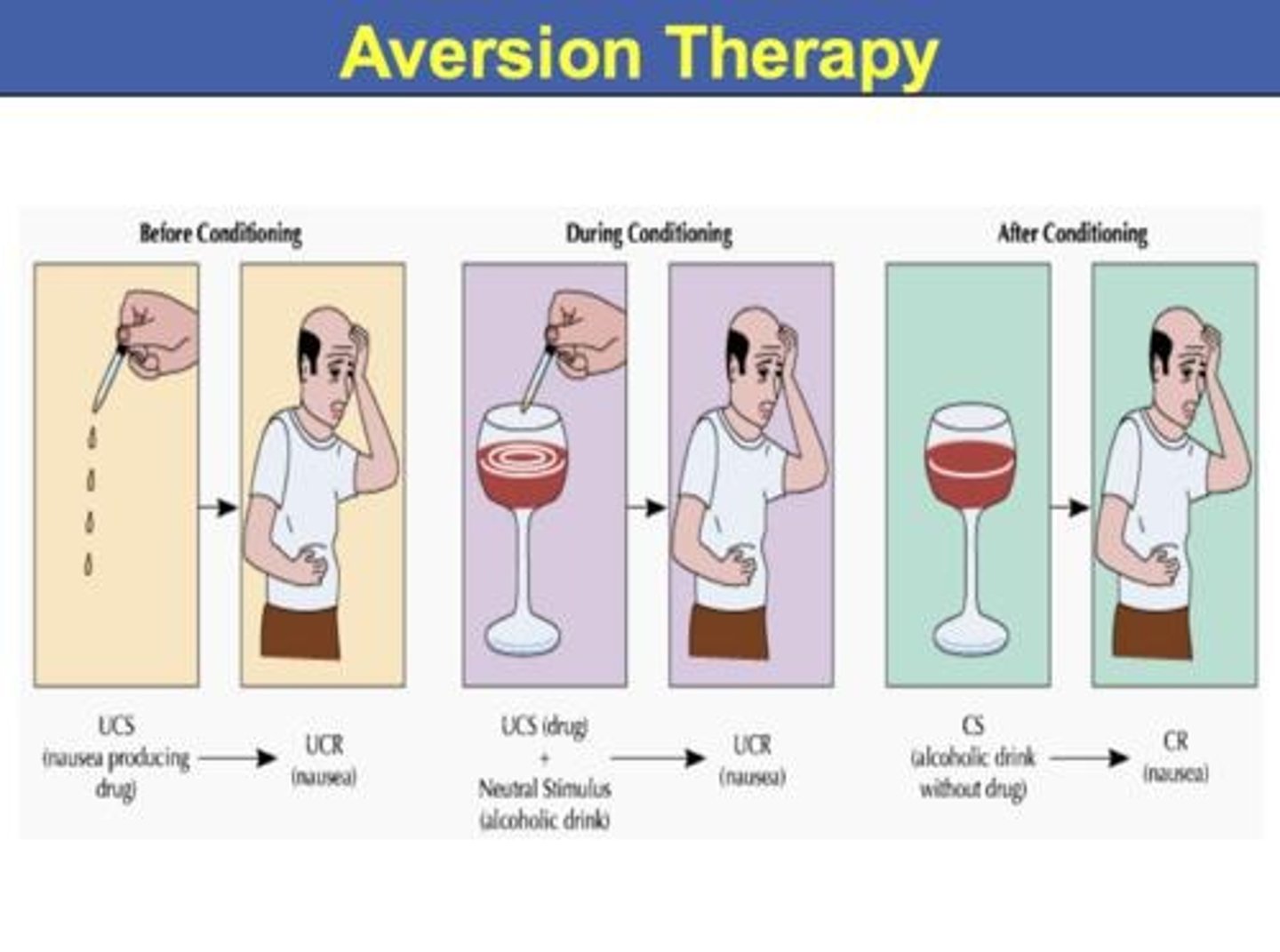
How does aversion therapy use classical conditioning to treat alcohol addiction?
By giving nausea-inducing drugs (UCS) and pairing them with alcohol (NS) to create an aversion (CS).
What is covert sensitization?
A technique that encourages patients to imagine progressively worse scenarios related to their unwanted behavior.
How does operant conditioning relate to aversion therapy?
It reinforces avoidance of the stimulus through negative reinforcement after the aversion is established.
What are new developments in aversion therapy?
Drugs that induce nausea when mixed with alcohol, creating an aversive effect while promoting tranquility when avoided.
What is the first assumption of the behaviorist approach?
Humans are born a 'blank slate.'
What is the second assumption of the behaviorist approach?
Behavior is learned through conditioning.
What is the third assumption of the behaviorist approach?
Humans and animals learn in similar ways.
How does the assumption that 'humans are born a blank slate' apply to aversion therapy?
It suggests that behaviors can be unlearned through conditioning, such as pairing aversive stimuli with unwanted behaviors.
What is the role of negative reinforcement in aversion therapy?
It motivates individuals to avoid situations that trigger unwanted behaviors.
What is the purpose of using aversive stimuli in aversion therapy?
To create a negative association with the unwanted behavior, leading to its reduction.
What is an example of an aversive stimulus used in aversion therapy?
Electric shock or nausea-inducing drugs.
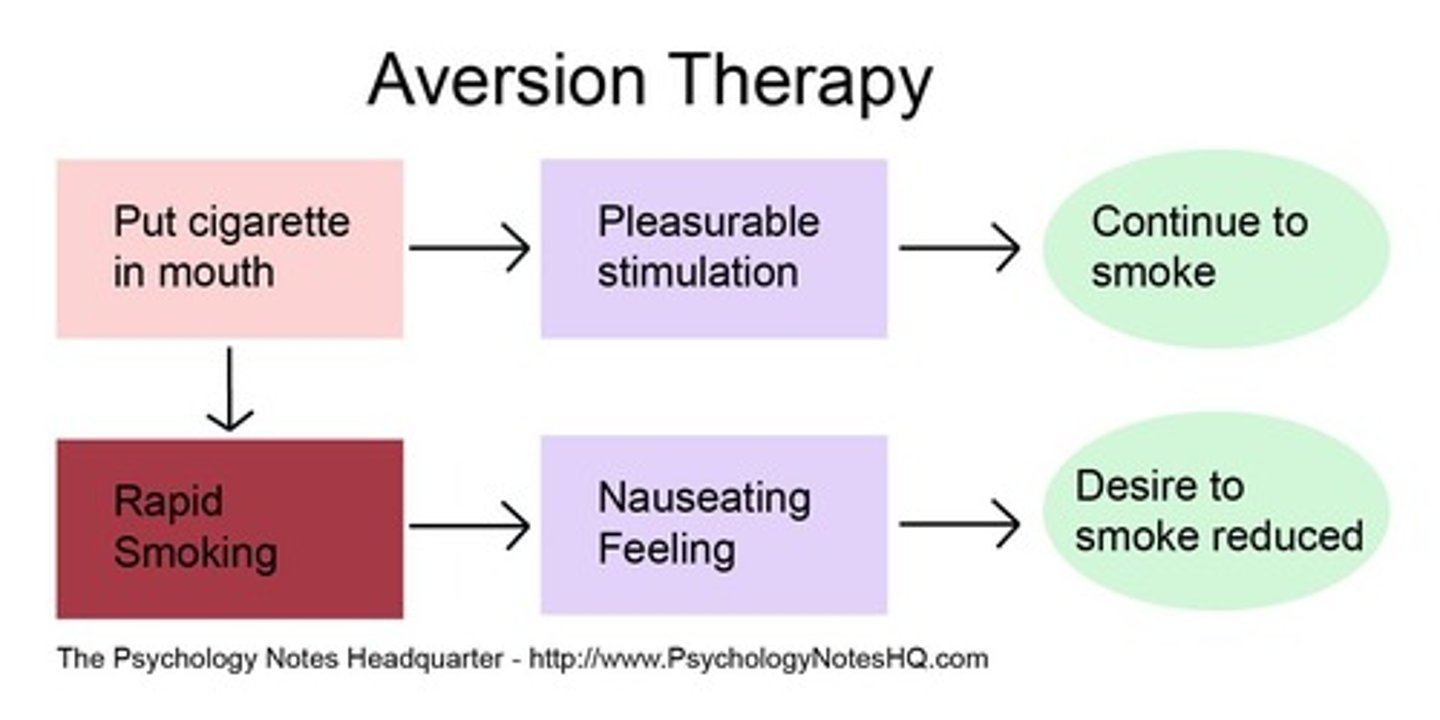
What is the outcome of repeatedly pairing an aversive stimulus with an unwanted behavior?
The unwanted behavior becomes associated with the aversive stimulus, leading to reduced engagement in that behavior.
What is the aim of using covert sensitization for someone trying to quit drinking?
To help them imagine increasingly distressing scenarios related to their drinking to create aversion.
How can aversion therapy be applied to online shopping addiction?
By associating the act of shopping with negative feelings or consequences to reduce the behavior.
What is the significance of the term 'counter-conditioning' in aversion therapy?
It refers to the process of replacing a positive response to a stimulus with a negative one.
What is the expected result of aversion therapy?
The individual learns to avoid the undesired behavior through negative associations.
How can the effectiveness of aversion therapy be evaluated?
By assessing the reduction in engagement with the unwanted behavior and any ethical considerations involved.
What is classical conditioning?
A process of learning where an unconditioned stimulus becomes associated with a neutral stimulus, leading to a learned response.
What is operant conditioning?
A learning process where behavior is modified through reinforcement or punishment.
What does Dr. Singh believe causes abnormal behavior?
Maladaptive faulty learning, such as addiction formed through classical conditioning.
How does classical conditioning relate to addiction?
Pleasurable effects of drug use become associated with environmental cues, reinforcing the behavior.
What is the aim of aversion therapy?
To break down maladaptive learning and help individuals re-learn a more functional response.
What is counter-conditioning?
A process in aversion therapy where a pleasurable response is replaced with an aversive response.
How does operant conditioning apply to aversion therapy?
Clients experience unpleasant consequences that discourage them from repeating the addictive behavior.
What is a strength of aversion therapy according to research?
Research shows that patients treated with aversion therapy have higher abstinence rates compared to those treated with counseling alone.
What is a weakness of aversion therapy related to patient dropout?
Up to 50% of patients may refuse or drop out of treatment, leading to a biased evaluation of its effectiveness.
Why is aversion therapy criticized for treating symptoms rather than causes?
It focuses on changing behavior without addressing underlying psychological issues, which may lead to replacement behaviors.
What question arises regarding the long-term effects of aversion therapy?
There is uncertainty about whether the positive effects of aversion therapy are sustainable outside the therapy environment.
What ethical issue is associated with the control therapists have in aversion therapy?
Therapists may use unpleasant methods, such as electric shocks, which can cause trauma to patients.
What historical ethical issue is associated with aversion therapy?
It was used to treat homosexuality until 2006 in the US and UK, raising significant ethical concerns.
What structure is recommended for evaluating therapies?
The SEEW structure: Statement, Evidence, Explanation, and Weakness.
What is the purpose of the SEEW paragraph structure?
To analyze, interpret, and evaluate scientific information and evidence effectively.
What is one potential consequence of aversion therapy?
Patients may appear to recover in therapy but may not maintain changes outside of it.
What is a common criticism of aversion therapy's effectiveness?
It may treat the behavior rather than the underlying cause of addiction.
What is the significance of the research by Smith et al. (1997) regarding aversion therapy?
It found that alcoholics treated with aversion therapy had higher abstinence rates than those treated with counseling alone.
What is one reason why aversion therapy may not be effective for all patients?
Many patients who engage in aversion therapy are already willing participants, which may skew effectiveness results.
What is the implication of the 'blank slate' assumption in behaviorism?
It suggests that all behaviors are learned and can be unlearned through conditioning.
How does aversion therapy aim to create an aversion to addictive behaviors?
By associating the addictive behavior with negative stimuli to develop a dislike for it.
What is a potential risk of focusing solely on behavior in therapy?
It may lead to clients substituting one addiction for another without addressing the root cause.
What is the role of reinforcement in operant conditioning?
Reinforcement increases the likelihood of a behavior being repeated.
What is a key factor in the effectiveness of aversion therapy?
The ability to create a strong negative association with the addictive behavior.

