Somatosensory system (central processing)
 Studied by 0 people
 Call Kai
 Learn
Learn Practice Test
 Spaced Repetition
 Match
Match Flashcards
 Knowt Play
1/35

There's no tags or description
Looks like no tags are added yet.
Name | Mastery | Learn | Test | Matching | Spaced | Call with Kai |
|---|
No analytics yet
Send a link to your students to track their progress
36 Terms
What are the two main ascending tracts?
dorsal column - medial lemniscal system
anterolateral system
What sensations use the dorsal column system?
mechanosensation
used for tactile discrimination and interaction with objects
What sensations use the anterolateral system?
temperature
pain
What is steps of transduction in the anterolateral system like?
peripheral axon
through dorsal root ganglion cells
cross the contralateral side in spine
ascend through different tracts
to thalamus
to somatosensory cortex
What are any differences for dorsal column system?
doesn’t cross at the spinal cord
ascends in the ipsilateral spinal cord to dorsal column nuclei
instead crosses at the medial lemniscus (in brainstem) to contralateral ventral posterior nucleus in thalamus
Which system is newer and what does this mean?
Dorsal
more direct
fewer synapses
faster and less chance of modulation
What are the 3 pathways of the anterolateral system?
spino-reticular
spino-mesencephalic
spino-thalamic
What does the spino-reticular tract project neurons to?
medial laminae
What does the spino-reticular tract influence? (2)
‘reticular activating system’
releases neuromodulators into CNS
raphe nuclei and more
reticulospinal tracts
project down spinal cord to end on interneurons
increases stretch relex activity and flexor withdrawal activity
for posture, gait and muscle tone
Where does the spino-mesencephalic tract input to?
midbrain, originates from laminae 1 and 5
What does the spino-mesencephalic system influence?
periaqueductal grey (PAG)
pain control centre
superior colliculus
unconscious oritentation in response to tactile, visual and auditory stimuli
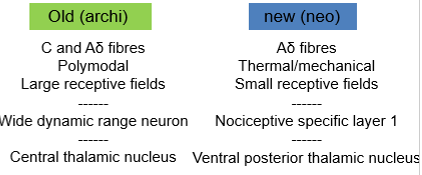
What does the old spino thalamic tracts diffuse to?
‘emotional’ areas of cortex
What does the new spinothalamic tract do?
sensory S1 cortex for location of painful stimuli
Properties of old and new spino-thalamic tract? (picture)
What are anterolateral sensory transmission influenced by?
descending cortical fibres
Do mechanoreceptors get activated separately or together?
simultaneously out of difference channels
can very amplitude of a stimulus and record from afferent nerve then split recording by differnt type to see
What is somatotopic organisation?
mechanoreceptors innervating adjacent spots send axons into the adjacent regions of the dorsal column
preserves neighborhood relations
As you ascend the dorsal column are there more or less fibres?
more
What does the dorsal column project to?
the ipsilateral nucleus
Does receptor field size increase or decrease with a weaker stimuli?
decrease
Does the anterolateral system have surround inhibition and why?
no becasue transmission is then broadened and amplified as for nociception location is not important
Why does the dorsal column system have lateral surround inhibition?
for fine tactile discrimination
inihibition silences neuron so that second stimulus more noticebale
can notice two events occured
improves spatial ingenuity
Ipsilateral dorsal column nucleus projects to ipsilateral thalamus, true or false?
false - contralateral thalamus
Where do ventral posterior medial thalamic nuceli receive input from?
face
Where do ventral posterior lateral thalamic nuceli receive input from?
body
How is the contralateral body mapped within the somatosensory cortex?
somatotopically
Which areas of the body occupy larger areas of the corte and more cortical neurons?
most densely innervated areas
What led to the ‘homunculus’
Penfield and Boldrey (1937)
micro stimulation of the brain syrface alloiwing functional mapping
Fun fact about mouse whiskers?
used to discriminate objects in an environment and each is stereotyped and matches one to one with somatosensory cortex
As you move further from the fingertips, RF size … and overlap …?
increases, decreases (so ability to discriminate decreases)
What are the areas within the somatosensory cortex - S1, S2, S3?
1,2,3a,3b,5+7
What are the roles of these areas?
1 - touch with wide receptive fields
2 - combines position and touch
3a - position sense
3b - local touch, detailed
5 + 7 - sensory guidance of movement, memory of an object
What does 3D perception rely on?
proprioceptive feedback
What is the descending contribution of the somatosensory cortex?
corticospinal tract provides descending control of ascending sensory systems in addition to motor control
What percentage of fibres from somatosensory cortex provide modulatory feedback onto ascending sensory feedback?
50%
Where does further processing beyond S1 take place?
S2, S3, motor, posterior parietal cortex, secondary thalamus
 Note
Note  Flashcards (96)