Romanticism
 Studied by 1 person
 Call Kai
 Learn
Learn Practice Test
 Spaced Repetition
 Match
Match Flashcards
 Knowt Play
1/6

There's no tags or description
Looks like no tags are added yet.
Name | Mastery | Learn | Test | Matching | Spaced | Call with Kai |
|---|
No analytics yet
Send a link to your students to track their progress
7 Terms
Romanticism
an artistic and intellectual movement (late 18th–mid-19th century) that rejects reason and order in favor of emotion, imagination, and individual experience, reacting against the Enlightenment and Neoclassicism.
Themes
Nature & the Sublime
Imagination, Dreams & Nightmares
Heroism & Revolution
The Dark Side of Humanity
Key Characteristics
Dramatic light and color
Emphasis on atmosphere and mood
Expressive brushwork
Rejection of classical balance and idealization
Art as emotional and moral expression
The Sublime
In Romanticism
Nature is shown as greater than humans
Humans appear small or isolated
Used to express emotion, imagination, and spiritual experience
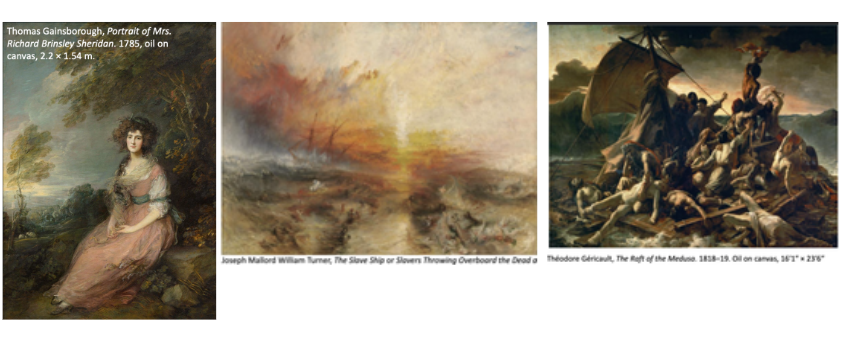
Nature & the Sublime - Theme #1
Thomas Gainsborough – Portrait of Mrs. Richard Brinsley Sheridan
Gainsborough’s portrait emphasizes emotional immediacy and a natural setting
loose brushwork
atmospheric landscape
emotional presence
nature as expressive
J. M. W. Turner – The Slave Ship
Inspired by the historical atrocity of enslaved people thrown overboard, Turner uses nature to express moral outrage.
Violent, overwhelming nature
Moral condemnation of slavery
Expressive color and light
Sublime terror and chaos
Théodore Géricault – The Raft of the Medusa
Based on a contemporary political scandal, the painting depicts shipwreck survivors abandoned by the state.
Real, recent history
Extreme human suffering
Emotional realism
Political critique
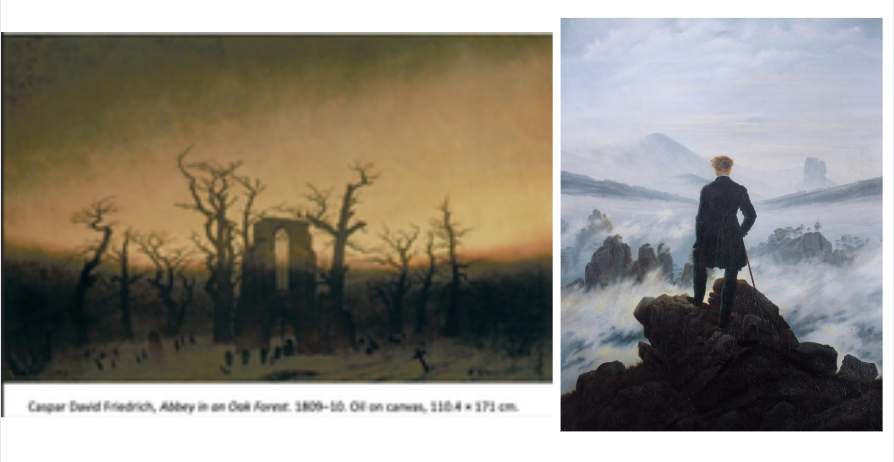
Caspar David Friedrich - Nature & the Sublime - Theme #1
A German Romantic painter known for contemplative landscapes
Abbey in an Oak Forest
A ruined Gothic monastery surrounded by winter trees evokes death, time, and spiritual transcendence.
Ruins and medieval past
Melancholy and silence
Nature as spiritual and eternal
Human figures diminished by scale
Sublime atmosphere
Wanderer above the Sea of Fog
A solitary figure looks out over a fog-covered landscape, representing inner reflection and the Romantic self.
Sublime landscape
Nature as emotional mirror
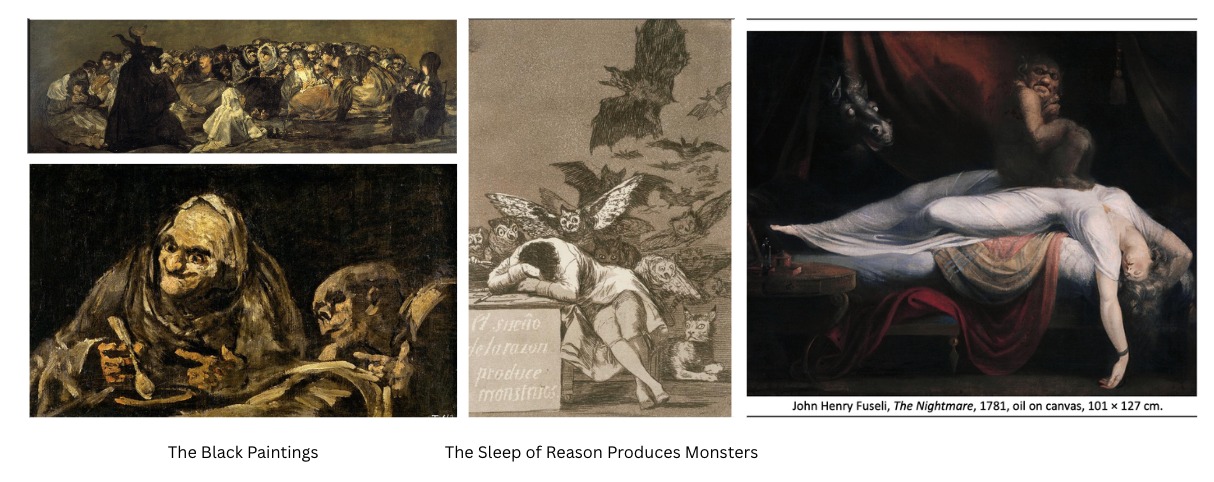
Subjectivity, Dreams & the Imagination - Theme #2
Henry Fuseli – The Nightmare
A visual exploration of unconscious fears, dreams, and sexuality.
Dreams and irrationality
Psychological terror
Dark imagination
Rejection of Enlightenment reason
Francisco Goya – The Sleep of Reason Produces Monsters
A print from Los Caprichos warning that unchecked irrationality leads to moral chaos.
Critique of Enlightenment reason
Satire and darkness
Francisco Goya – Black Paintings
Painted privately on the walls of Goya’s home, reflecting despair, madness, and violence.
Dark, muted palette
Psychological horror
Raw emotional expression
The dark side of humanity
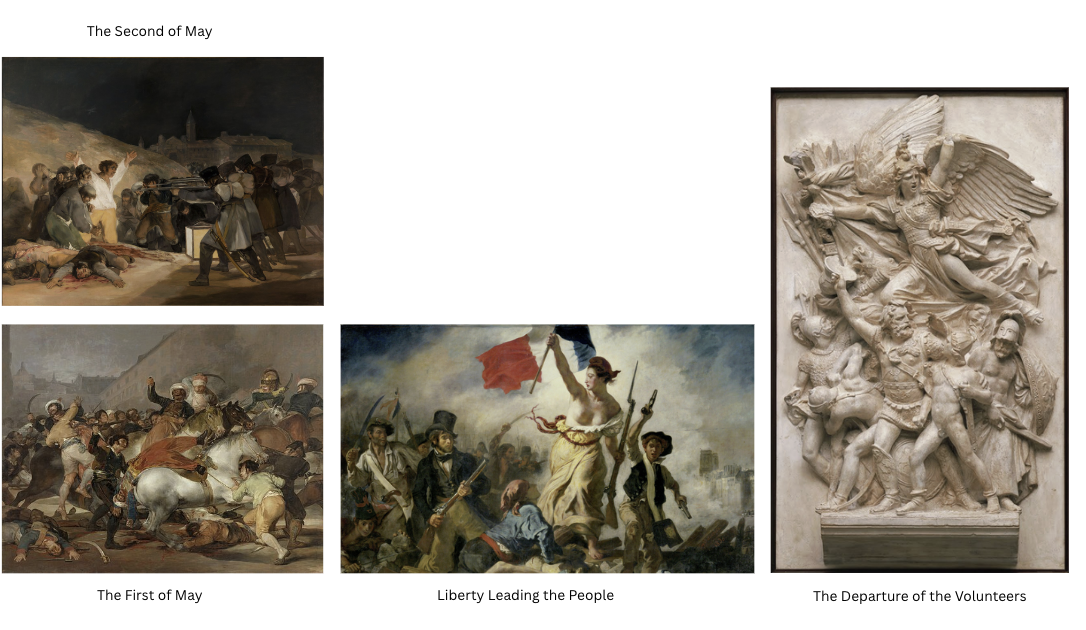
Heroism, Democracy & Nationalism - Theme #3
Francisco Goya – The Second of May, 1808
Depicts the spontaneous uprising of Madrid’s citizens against Napoleon’s troops.
Chaos and violence
Ordinary people as heroes
Emotional immediacy
Francisco Goya – The Third of May, 1808
Shows the execution of Spanish civilians, focusing on innocence and brutality.
Strong emotional contrast
Dramatic lighting
Moral outrage
Eugène Delacroix – Liberty Leading the People
An allegory of the 1830 Revolution, blending real figures with symbolic Liberty.
Political Romanticism
Allegory mixed with realism
François Rude – The Departure of the Volunteers of 1792
A sculptural celebration of revolutionary energy on the Arc de Triomphe.
Collective heroism
Dramatic movement
Passion and sacrifice
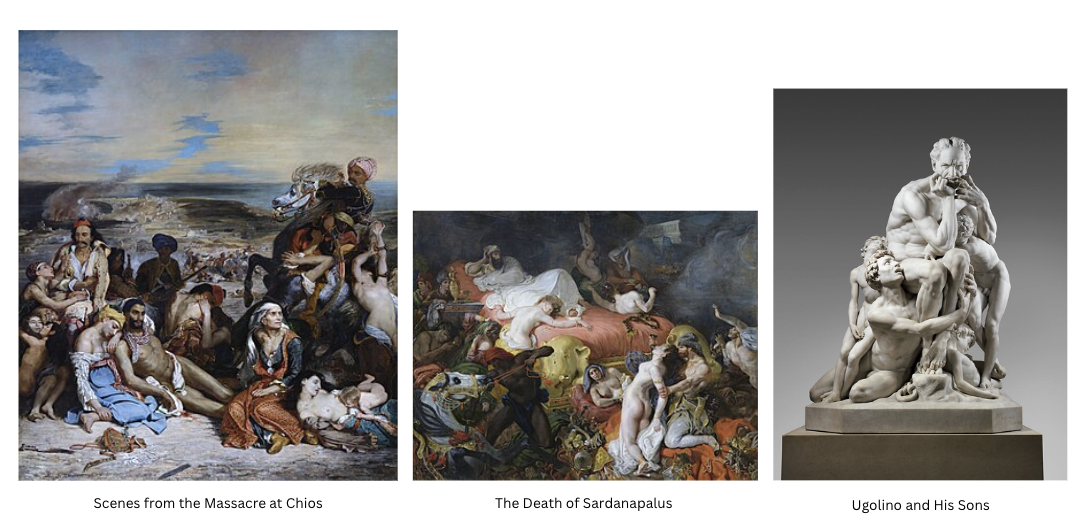
The Dark Side of Humanity & Exoticism - Theme #4
Eugène Delacroix – Scenes from the Massacre at Chios
Depicts the suffering of Greek civilians under Ottoman rule.
Human suffering without heroism
Political empathy
Emotional intensity
Eugène Delacroix – The Death of Sardanapalus
A chaotic vision of violence, excess, and destruction inspired by ancient legend.
Violence and sensuality
Rejection of classical order
Emotional excess
Jean-Baptiste Carpeaux – Ugolino and His Sons
Based on Dante’s Inferno, showing a father driven to madness by starvation.
Extreme emotional suffering
Psychological realism
Twisted bodies and tension
Horror and despair
 Note
Note  Flashcards (161)