science topic test t4 geography
 Studied by 0 people
 Call Kai
 Learn
Learn Practice Test
 Spaced Repetition
 Match
Match Flashcards
 Knowt Play
1/108

Earn XP
Description and Tags
all obj
Name | Mastery | Learn | Test | Matching | Spaced | Call with Kai |
|---|
No analytics yet
Send a link to your students to track their progress
109 Terms
4 sections of earths structure?
crust, mantle, outer core, inner core
2 types of crust?
continental, oceanic
what does the upper part of the mantle + crust consist of?
asthenosphere, lithosphere, continental crust and oceanic crust
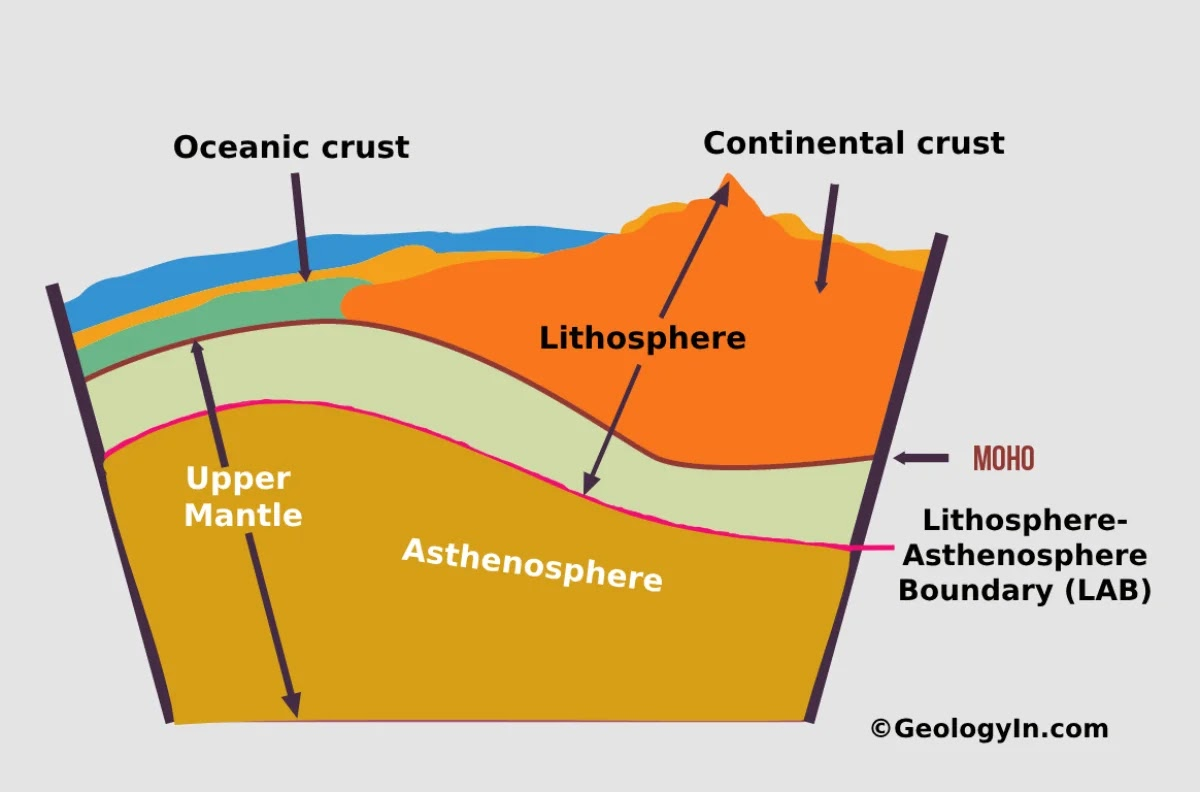
thickness of crust? (oceanic and continental)
oceanic crust – around 8km thick
continental crust – around 32km
temp of crust?
varies greatly depending on the depth. the upper crust withstands the temperature of the atmosphere/ocean (i.e. hot in deserts and freezing in the ocean). nearer to the mantle, it ranges from 200-400 degrees celsius,
composition of crust? (oceanic and continental)
oceanic – mostly basalt
continental – mostly granite
density of crust? (oceanic and continental)
oceanic – almost 3g/cm³. it is denser than the continental crust as basalt is much denser than granite, which is why the continental crust/continents sit on top of the oceanic plates.
continental – 2.7g/cm³.
thickness of mantle?
about 2,900 kilometers
temp of mantle
varies from 1000°C near its boundary with the crust - 3700°C near boundary with core
composition of mantle
hot, dense rock – mostly silicates
density of mantle
average density of about 3.3–5.7 g/cm³. As depth increases, pressure compresses minerals, raising density.
thickness of outer core
about 2,200 kilometers
temp of outer core
~4,000–6,000 °C. it is so hot that the metals in it are all in the liquid state.
composition of outer core
melted metals of nickel and iron.
density of outer core
~9.9–12.2 g/cm³
thickness of inner core
radius of about 1,220 kilometers
temp of inner core
about 5,200° Celsius
composition of inner core
iron–nickel alloy. temperatures and pressures so great that the metals are squeezed together and are not able to move about like a liquid, but are forced to vibrate in place like a solid.
density of inner core
~12.6–13.0 g/cm³
Explain why different layers have different compositions?
when earth was molten, dense materials like iron and nickel sank to form the core, while lighter silicates rose to form the mantle and crust.
explain why different layers have different consistencies?
As depth increases, so do pressure and temperature, which affect how materials behave: the crust is solid and brittle, the mantle is hot enough to slowly flow, the outer core is liquid metal, and the inner core is solid due to extreme pressure.
theory of plate tectonics?
proposes that Earth's outer layer (lithosphere) is divided into large, moving slabs called tectonic plates that float on the semi-molten asthenosphere
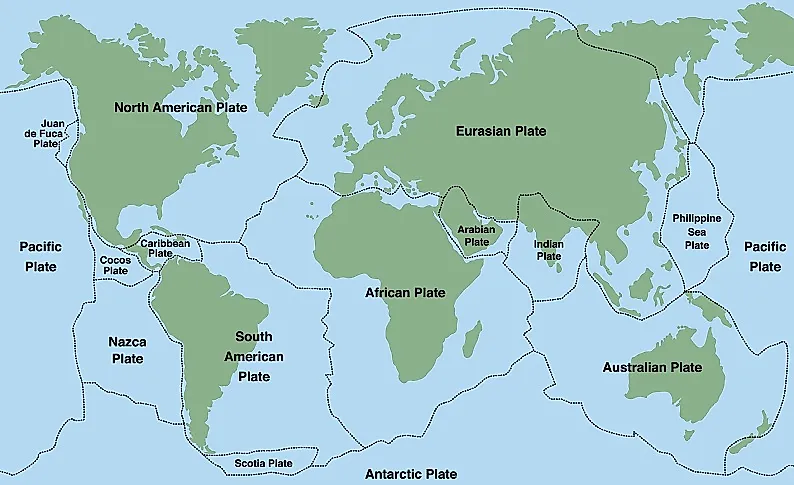
role of heat energy and convection currents that drive the movement of the plates?
Deep within the Earth, heat from the core and lower mantle causes hot, less dense rock to rise toward the surface and causes a convection current in the asthenosphere.
currents exert force on the rigid tectonic plates above, causing them to collide, move away from each other, or slide past each other.
when do folds occur and what do they form?
when stress is applied to both ends of layers/sections of rock, and the rocks bends.
forms mountains with anticline (rainbow) syncline (smile). anticline forms ridegs and syncline forms valleys within the mountain.
what is a fault and when and where does it occur?
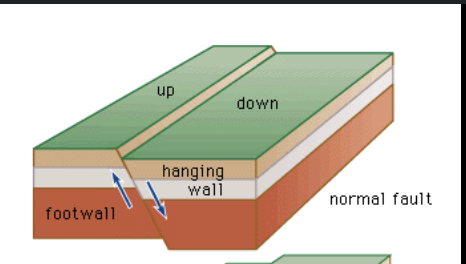
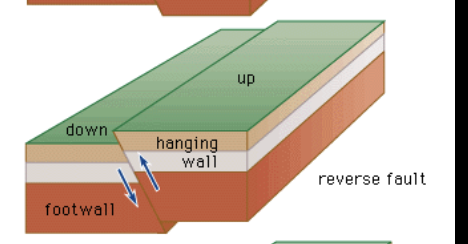
a fault is a fracture (or series of fractures) in the crust, occurs when various types of stress applied too quickly or too great and the rock fractures. many along plate boundaries. have hanging walls and foot walls
faulting landforms?
fault-block mountains (rift valley, block mountain), fault scarps
types of faults?
normal, reverse, transform
normal faults?
occurs when tensional stress pulls faults apart and the hanging wall drops.
reverse faults?
occurs when compressional stress pushes the 2 parts of the fault together and the hanging wall moves up
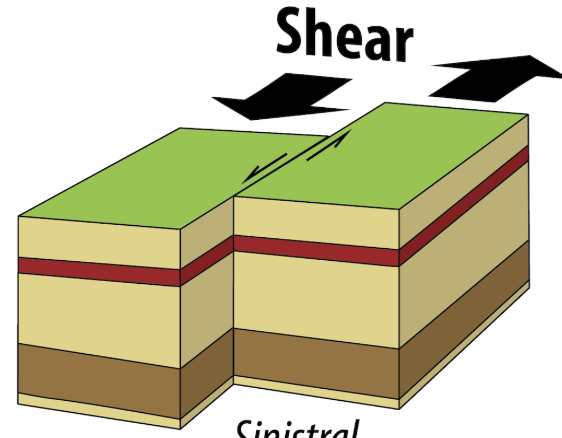
transform fault?
occurs when shear stress causes the parts of the fault to slide past one another.
intrusions?
forms when magma cools and solidifies underground, pushing into and deforming surrounding rocks. cooling is slow, allowing large crystals to form. erosion then exposes these rocks at the surface, shaping landforms.
constructive plate boundaries for volcanoes and earthquakes?
(divergent)
two plates move apart, creating tension. Magma rises from the mantle to fill the gap, solidifying into new crust.
volcanoes - Shield volcanoes occur along the edges of these boundaries.
earthquakes - As plates pull apart, the crust can fracture, causing small, frequent earthquakes.
destructive plate boundaries for volcanoes and earthquakes?
(converging)
Two plates collide. The denser oceanic plate is forced beneath the lighter continental plate (subduction).
The melting creates magma that rises to form explosive volcanoes.
The plates grinding and getting stuck builds pressure, which is released as powerful earthquakes.
diverging plate boundary?
where plates move away from each other. ocean to ocean and continent to continent.
When plates move away from each other, magma rises up into the resulting rift, cools and forms new crust. i.e. mid ocean ridge, iceland
transform plate boundary + what it forms + example?
•Where plates are sliding past each other in opposite directions
•Creates earthquakes
•Forms mountains and fault lines
i.e. san andreas fault
converging plate boundary?
collide. sites of subduction. volcanoes + earthquakes common. ocean - ocean, continent - continent, ocean - continent
ocean - continent convergent?
•Denser oceanic crust sinks under the lighter continental plate (subduction)
•Forms mountains and volcanoes
•Example – The Andes Mountains
ocean - ocean convergent?
•One plate subducts under the other
•Forms a chain of volcanic islands as the magma rises up to the surface
•
•Example – Japan
continent - continent converging?
•Continents float on the mantle so can’t be subducted (they are too light)
•Both are pushed upwards
•Forms high mountains
•Example – The Himalayas
major earthquake + volcanic regions related to plate tectonics?
Earthquakes and volcanoes cluster along plate boundaries.
Subduction zones (Ring of Fire) → explosive volcanoes + strong earthquakes.
Divergent boundaries (Mid-Atlantic Ridge) → volcanic ridges + shallow earthquakes.
Collision zones (Himalayas) → powerful earthquakes, mountain building, few volcanoes.
transform boundaries (san andreas fault) → frequent shallow earthquakes, no volcanoes
evidence for the theory of plate tetconics?
seafloor spreading - At mid-ocean ridges, magma rises and solidifies, forming new oceanic crust. This process pushes older crust outward, showing that plates are moving apart
magnetic striping - rocks on the seafloor contain a magnetic mineral called magnetite. when rocks cool, magnetite aligns itself with earths magnetic field in the same way a compass needle does. the magnetic field has changed direction throughout history
relate the age and stability of a large part of the australian continent to its plate tectonic history
australia is on the centre of the indo-australian plate so it has rarely changed over time and the stability is increased due to the lack of faults nearby
australias location in the future?
Australia is gradually moving northward as part of the tectonic plate it sits on. In the distant future, this drift will bring it closer to Asia, where it may eventually collide with nearby landmasses (Indonesia) and form new mountain ranges.
technology in the asia-pacific for earthquake predicition?
The Asia-Pacific is one of the most seismically active regions in the world, with the Ring of Fire running through it.
GPS networks measure ground movement and track how the Earth’s surface shifts over time. Scientists can then identify strain building along faults before it is released as an earthquake.
what are the three types of rock and how are they classified?
the three types are igneous, sedimentary and metamorphic and they are classified based on how and where they formed
formation of igneous rocks?
rocks formed from molten magma that has cooled slowly under the earth's surface or lava that cools quickly above the earth's surface
plutonic (intrsuive) v volcanic (extrusive)?
intrusive igneous rocks formed deep inside the earth and had much more time to form leading to them having large crystals whilst extrusive igneous rocks cooled quickly above the earth's surface leading to them having less time to form and thus having smaller crystals
formation of metamorphic rocks?
rocks formed after intense heat or pressure and recrystallise.
types of metamorphism?
contact, regional, or dynamic
contact metamorphism?
high heat low pressure
dynamic metamorphism?
high pressure, low heat
regional metamorphism?
high pressure, high heat
(detailed) formstion of sedimentary rocks?
Sedimentary rocks form through the breakdown of existing rocks into small particles by weathering. These sediments are transported by wind, rivers, or glaciers into lakes, seas, or oceans (erosion), where they settle (deposition) and build up in layers. Over time, the weight of accumulating layers compresses the sediments, while dissolved minerals in the water crystallise and act as a natural cement. (compaction/cementation) This combination of pressure and cementation binds the particles together, creating solid layers of sedimentary rock.
types of sedimentery rocks?
clastic, biogenic/organic and chemical
what is an organic sedimentary rock?
rock that is made up of things that were once living
what is a chemical sedimentary rock?
formed from minerals once dissolved in water
what is a clastic sedimentary rock?
made from sediments that come from pre-existing rocks that have been weathered and eroded then "glued" together (lithified)
properties of clastic sed?
shale
have layers because the sediments build up one on top of the other as they are deposited
grains do not interlock because they did not crystallise and grow together in the rock
may contain fossils
properties of chemical sed?
have crystals
are quite soft
rarely any layering
some contain fossils but not many
gypsum
properties of organic sed?
can be layered
usually soft but some are hard (flint)
properties of igneous?
hard and strong, have crystals, never have fossils, porous (holes formed from trapped gas during cooling) or glassy texture (smooth and glassy from fast cooling)
properties of metamorphic?
has crystals, banded texture (foliation) from pressure, usually harder and denser than their parent rocks due to recrystallisation under pressure.
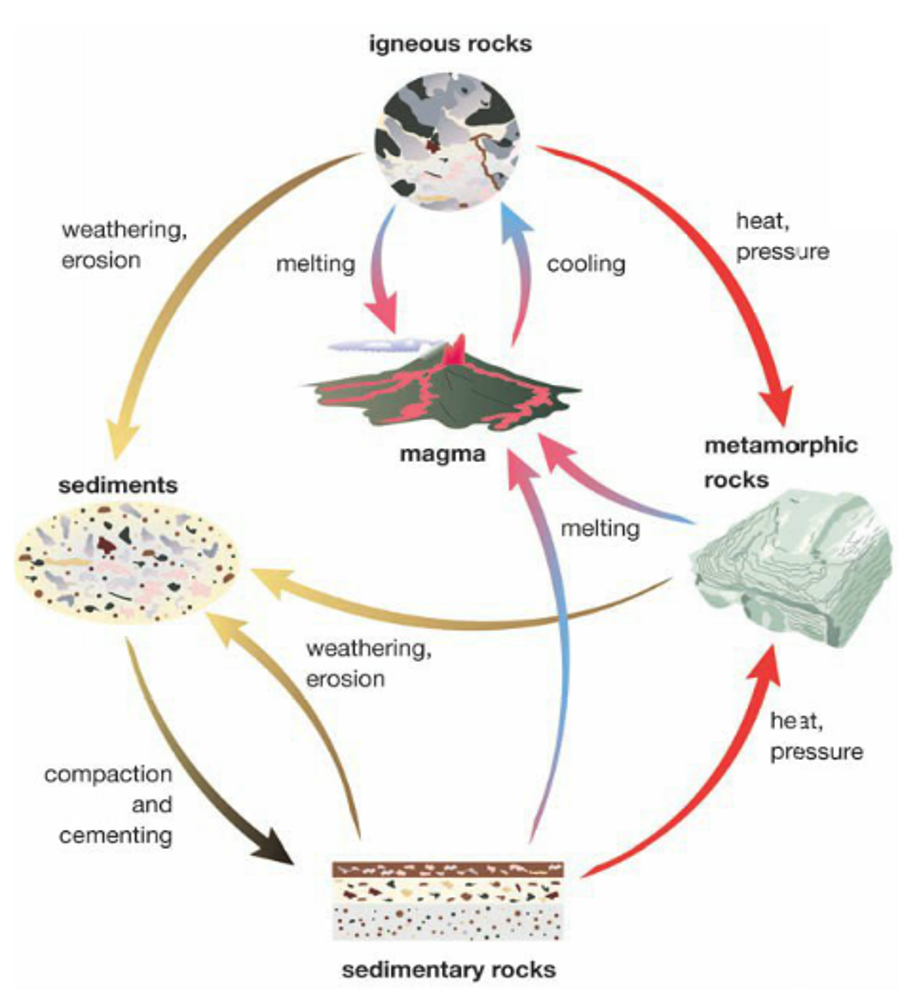
what is the rock cycle (w diagram)
The rock cycle is a model that describes and explains the endless cycle of change that rocks undergo
what type of rock is limestone and what metamorphic rock does it become?
sedimentary, under heat and pressure it becomes marble
what type of rock is sandstone and what metamorphic rock does it become?
sedimentary, recrystallises into quartzite
what type of rock is shale and what metamorphic rock does it become?
sedimentary, transforms into slate, but can become schist or gneiss with further metamorphism
what type of rock is granite and what metamorphic rock does it become?
igneous, gneiss
define mineral?
A naturally occurring inorganic solid with a specific chemical composition and crystalline structure
streak?
the colour of a minerals powder.
lustre?
how the surface of a mineral reflects light.
crystal?
A solid substance where atoms are arranged in an orderly repeating pattern.
cleavage?
the tendency of a mineral to break along flat planes due to bonds in its crystal structure.
hardness?
The resistance of a mineral to being scratched, measured by Moh’s hardness scale.
moh’s hardness scale?
scale of 1 to 10 that ranks the scratch resistance of minerals, with 1 being the softest (Talc) and 10 being the hardest (Diamond)
define ore.
A rock containing valuable minerals that can be mined for profit.
how are ores found?
remote/ satellite imaging, infra-red
remote / satellite imaging?
Satellites detect surface colours, patterns, and mineral signatures that help identify areas likely to contain ore deposits.
infra-red?
Infra-red sensors detect how rocks absorb and reflect heat, revealing altered minerals that commonly form around ore bodies.
how are ores refined / separated?
smelting, electrolysis
smelting?
Ore is heated at very high temperatures to separate metal from impurities. This chemical process is widely used for metals like iron,
electrolysis?
Electric current is used to extract pure metal from dissolved ore. It produces very high-purity metals like aluminium
types of mining?
open-pit, underground, dredging, leach mining
open-pit
Open-pit mining removes large amounts of surface rock and soil to expose shallow ore deposits. The ore is blasted and transported for processing, making this method suitable for wide, near-surface resources.
underground mining
Underground mining uses tunnels and shafts to reach deep ore bodies that cannot be mined from the surface. Miners drill, blast, and haul the ore to the surface while keeping the tunnels stable and supported.
dredging
Dredging uses floating machines to scoop or suction sediment from rivers, lakes, or coastal areas to extract minerals like gold, tin, or sand. It is used for underwater deposits and often separates minerals using water-based techniques.
leach mining
Leach mining involves pumping water or chemical solutions into the ground to dissolve minerals such as copper, salt, or uranium. The mineral-rich solution is then pumped back to the surface and processed to recover the metal.
3 rocks or minerals in wa that provide valuable resources and their uses?
iron ore (steel production)
lithium (batteries)
gold (major export, holds ongoing wealth)
Evaluate the methods used to extract iron ore, lithium, and gold
iron ore - Extracted mainly by open‑pit mining,
lithium - Taken from hard‑rock deposits via open‑pit mining
gold - Mined through open‑pit and underground methods
what does mya mean?
million years ago
how long is an epoch?
millions of years
how long is a period?
ten millions of years
how long is an eon?
hundred millions of years
how long is an era?
billions of years
 Note
Note  Flashcards (77)