Science Exam
 Studied by 0 people
 Call Kai
 Learn
Learn Practice Test
 Spaced Repetition
 Match
Match Flashcards
 Knowt Play
1/55

Earn XP
Name | Mastery | Learn | Test | Matching | Spaced | Call with Kai |
|---|
No analytics yet
Send a link to your students to track their progress
56 Terms
(Lesson 1) Name three fluids that are essential to life and justify your answer.
Water → all organisms need water to survive → producers need water for photosynthesis
Oxygen → animals need to breathe oxygen in order for cells to survive
Carbon Dioxide → plants need carbon dioxide to produce sugar and oxygen (photosynthesis)
Which phases of matter have a definite shape? Which have a definite volume?
Definite shape → solid
Definite volume → solid, liquid
(Lesson 2) Use the particle theory to explain why fluids can flow and solids cannot.
The particles in solids are closely packed which creates a definite shape and resists flowing.
What is one advantage and one disadvantage of each type of flow?
Laminar → Advantage = cheaper on gas
Laminar → Disadvantage = does not mix things well
Turbulent → Advantage = mixes things better
Turbulent → Disadvantage = more expensive on gas
(Lesson 3) Calculate the flow rate in the following situations.
a. The average shower is 8 minutes long and uses 62 L of water.
Flow rate = volume/length of time
62L/8min = 7.75 L/min
b. The average bath takes 5 minutes to fill and uses 80 L of water.
Flow rate = volume/length of time
80L/5min = 16 L/min
Calculate how much water is used in each situation.
a. Your tap flows at 2 L/min and you leave it running for the 2.5 minutes it takes you to brush your teeth.
Flow rate = volume/length of time
Volume = Flow Rate x length of time
2L/min x 2.5min = Volume
5L = Volume
b. Your garden hose flows at 140 L/min and it takes you 1.5 hours to water your lawn.
Flow rate = volume/length of time
Volume = Flow Rate x Length of time
1.5 hours = 1.5 x 60 = 90 mins
140 L/min x 90 min = 12600 L
Choose three common fluids and list them in order of viscosity, cohesion and adhesion.
Choice: Water, oil, alcohol
Viscosity → Oil, water, alcohol (1, 2, 3)
Cohesion → Water, alcohol, oil
Adhesion → Oil, water, alcohol
Why do fluids travel faster in the center of pipes and streams than at the edges?
Adhesion causes fluids to flow faster in the middle of pipes rather than at the edges because the fluids stick to the pipes as they pass. Fluids also flow faster in the center of a stream than at the edges because the fluids stick (adhesion) to the sides (banks) and bottom of the stream.
Complete the following statements using the words ‘increases’ or ‘decreases’.
a. As viscosity increases, the flow rate decreases.
b. As cohesion increases, the flow rate decreases.
c. As adhesion increases, the flow rate decreases.
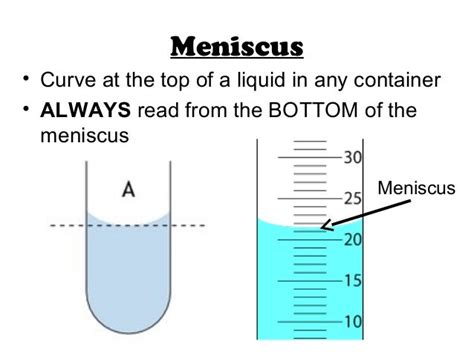
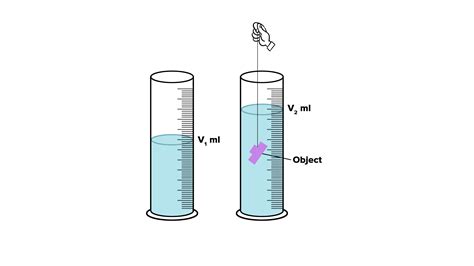
(Lesson 4) Describe each method for determining the volume of an object. Explain when you would use each one (meniscus picture is here).
A. We can find the volume through displacement. We use this technique when finding the volume of an irregular shaped solid object.
B. We can find the volume by reading. We can use this technique for measuring liquids. The curved line is called the meniscus. Read the bottom of the meniscus. Bring the eye down so it is level with the bottom of the meniscus and read.
C. When dealing with regular shaped solids (e.g cube) we can use a formula e.g. V = l x w x h
Explain the mathematical relationship between mass, volume and density.
Density = Mass/Volume
or,
D = M/V
Recall the particle theory and use it to explain the difference between the densities of solids, liquids and gases.
The tighter the particles are packed together in a substance, the greater the density. The particles in solids are tightly packed. The particles of gases are spread apart and have the least density.
What units can be used to measure density?
Mass (grams) per unit volume (Liters/cm³)
A characteristic property is one that is specific to a particular substance and can be used to identify it. Why is density considered a characteristic property?
Each pure substance has a specific density.
(Lesson 5) A student measures the mass of an 8 cm 3 block of brown sugar to be 12.9 g. What is the density of the brown sugar? (1.6 g/cm 3)
D=m/V
=12.9/8
=1.6 g/cm³
A chef fills a 50 mL container with 43.5 g of cooking oil. What is the density of the oil? (0.87 g/mL)
D = m/V
= 43.5/50
= 0.87 g/mL
Calculate the mass of a liquid with a density of 2.5 g/mL and a volume of 15 mL. (37.5 g)
m = DxV
= 2.5x15
m = 37.5g
Calculate the volume of a liquid with a density of 5.45 g/mL and a mass of 65 g. (11.93 mL)
V = m/D
= 65/5.45
V = 11.93 mL
A machine shop worker records the mass of an aluminum cube as 176 g. If one side of the cube measures 4 cm, what is the density of the aluminum? (2.75 g/cm3)
V = LxWxH
V = 4×4×4
V = 64 cm³
D = m/V
D = 176/64
D = 2.75 g/cm³
A teacher performing a demonstration finds that a piece of cork displaces 23.5 mL of water. The piece of cork has a mass of 5.7 g. What is the density of the cork? (0.24 g/mL)
D = m/V
= 5.7/23.5
= 0.24 g/mL
A piece of PVC plumbing pipe displaces 60 mL when placed into a container of water. If the pipe has a mass of 78 g, what is the density of PVC? (1.3 g/mL)
D = m/V
= 78/60
=1.3 g/mL
A solid magnesium flare has a mass of 1300 g and a volume of 743 cm 3 . What is the density of the magnesium? (1.75 g/cm 3 )
D = m/V
= 1,300/743
=1.75 g/cm³
A graduated cylinder has a mass of 50 g when empty. When 30 mL of water is added, the graduated cylinder has a mass of 80 g. If a rock is added to the graduated cylinder, the water level rises to 75 mL and the total mass is now 250 g. What is the density of the rock?
(Mass of Rock = 250 g–80(from cylinder and water) m = 170 g
Volume of Rock = 75 mL – 30 mL (already there) = 45 mL
D = m/V
= 170/45
= 3.78 g/mL
A student performs an experiment with three unknown fluids and obtains the following measurements:
Fluid A: m = 2060 g, V = 2000 mL (D = 1.03 g/mL)
Fluid B: m = 672 g, V = 850 mL (D = 0.79 g/mL)
Fluid C: m = 990 g, V = 1100 mL (D = 0.9 g/mL)
Draw how the fluids are layered if they were combined in a beaker.
Bottom to Top: A, C, B
Top to Bottom: B, C, A
Use your density skills to find the identity of the following mystery objects.
Marble → 2.56 g/cm³
Quartz → 2.64 g/cm³
Diamond → 3.52 g/cm³
Copper → 8.92 g/cm³
Gold → 19.32 g/cm³
Platinum → 21.4 g/cm³
While digging in the backyard, you find an old coin. Its mass is 26.76 g and its volume is 3 cm 3 . What is the coin made of?
(D = 8.92 g/cm³, copper)
D = m/V
= 26.76/3
= 8.92 g/cm³
You think you have found a diamond. Its mass is 5.28 g and its volume is 2 cm 3 . What did you find?
(2.64 g/cm³, quartz)
D = m/V
= 5.28/2
= 2.64 g/cm³
You find a ring with a mass of 107 g. You fill a graduated cylinder up with 10 mL of water and put the ring into the cylinder. The water rises up to the 15 mL mark. What is the ring made of?
(D = 21.4 g/mL, platinum)
Volume = 15-10 = 5 mL
D = m/V
= 107/5
= 21.4 g/mL
There is a block on your desk that acts as a paperweight. Its measurements are 3 cm by 4 cm by 6 cm. The block has a mass of 184.32 g. What is the block made of?
(D = 2.56 g/cm³, marble)
Volume = LxWxH
= 3x4x6
= 72cm³
D = m/V
= 184.32/72
= 2.56 g/cm³
(Lesson 6)
Buoyancy Basics
What are the two forces that act on a ship in the ocean?
Gravity (downward force) and buoyancy (upward force).
State Archimedes Principle in your own words.
Buoyant Force = Weight of the displaced fluid. In other words, if the object weighs less than the amount of water displaced, the object will float.
How does the size of a boat’s hull impact its ability to float?
The wider and longer the hull (bottom of boat), the greater the ability to float (buoyancy).
Oil and Water
What is an oil boom?
A floating barrier placed over a stretch of water to prevent the passage of oil, especially following an oil spill.
What are the four types of booms?
Foam-Filled Booms, Inflatable and Self-Inflating Booms(air), Fire Booms(heat resistant), and Trash and Debris Booms (PVP and metal)
How does the difference in density between oil and water play a role?
The density of oil is less than the density of water. Therefore, the oil floats to the top of the water.
Airships, Balloons, and Blimps
Why do helium balloons float?
Helium is less dense than the air around the balloon.
What is the force acting on the balloon?
The force of buoyancy is acting on the balloon.
Why does the hanging balloon appear to move backward?
The balloon stays in place while the box moves, giving the illusion of the balloon moving backwards.
Why does the pressure change in the box when it is moved?
The air particles are moved to the back of the box creating greater pressure at the back of the box.
Why does the floating balloon appear to move forward?
How does this relate to a balloon rising into the sky?
The pressure at the back of the box pushes the helium balloon forward.
The balloon moves from a higher pressure near the surface of the earth to the lower pressures further from the earth.
Submarines
What are the tanks on the side of a submarine called?
They are called ballast tanks.
Describe the tanks when the submarine is floating on the surface (positively buoyant).
The external ballast tanks are full of air.
Describe the tanks when the submarine is sinking (negatively buoyant).
Water is allowed into the external ballast tanks and water pressure ejects the air in the external ballast tanks.
Describe the tanks when the submarine is submerged (neutrally buoyant).
The external tanks are empty but the internal ballast tanks are filled with air.
Swim Bladders
What is a swim bladder?
A swim bladder is an organ in fish that can expand and contract.
How does a fish float closer to the surface?
A fish increases gas to the swim bladder.
How does a fish float closer to the bottom?
A fish decreases gas from the swim bladder.
How can eating affect a fish’s ability to swim down?
Fish can swallow air when eating from the surface of the water.
What is swim bladder disorder?
Swim bladder disorder is when fish are not able to swim down. When ingesting air, the fish will turn upside down. The air in its intestines cause this issue. The other form is when there is a problem with the swim bladder itself. This usually leads to the death of the fish.
(Lesson 7) How does the video demonstrate the idea that pressure applied to a fluid is distributed equally in all directions?
When the piston of a syringe is pushed down, water squirts out uniformly in all directions from the holes in the flask.
Identify two applications of hydraulics. Explain how Pascal’s Law is demonstrated in each one.
A spreader can open a car door by using hydraulic pressure. The pressure from the origin point (beginning) is spread equally to the 2 ends of the spreader. The cutter (Jaws of Life) can cut open a car door. The pressure from the origin point (beginning) is spread equally to the 2 ends of the cutter.
Identify two applications of pneumatics. Explain how Pascal’s Law is demonstrated in each one.
In a jack hammer (pneumatic drill) the force of the compressed air drives down the piston. The piston hits the chisel like tool. That chisel hits the cement/pavement. A dentist’s drill uses pneumatics. Air flows into an air inlet tube. This air turns the turbine blades. This cause the drill bit to turn very quickly.
(Lesson 8) What is meant by pressure in the scientific sense? What units are used to measure pressure?
Pressure is the force applied to unit of surface area. It is measured in Pascals (PA) (N/m²).
In your own words, describe atmospheric pressure and water pressure.
Atmospheric pressure is the force the atmosphere (gas) exerts on a unit of surface area. Water pressure is the force the water (liquid) exerts on a unit of surface area.
Describe Pascal’s Law in your own words. Draw a diagram to illustrate the law.
Pascal’s Law states that a force applied to a fluid is distributed equally to all parts of the fluid. The formula for this law is the following; Force = Pressure x Area.
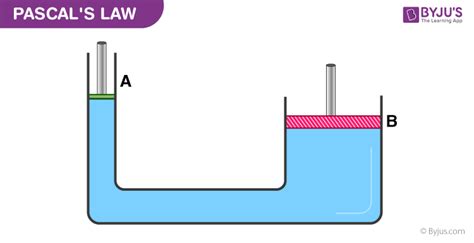
How is Pascal’s Law applied in hydraulic lifts, which are able to lift a heavy car with minimal input force?
We push Piston A: - farther
And Piston B rises: - with more force (not as far a)
You can increase the force by increasing the surface area (force multiplier).
 Note
Note  Flashcards (169)