Ch. 7 Products and Brands
 Call Kai
 Learn
Learn Practice Test
 Spaced Repetition
 Match
Match Flashcards
 Knowt Play
1/37

There's no tags or description
Looks like no tags are added yet.
Name | Mastery | Learn | Test | Matching | Spaced | Call with Kai |
|---|
No analytics yet
Send a link to your students to track their progress
38 Terms
Three Main Categories of Products
Durable
Non-durable
Services
Primary services.
Supplementary services.
Virtual.
Non-durable Goods
An item that does not last and that is consumed only once, or for a limited number of times.
Examples of non-durable goods are food products and fuel.
Durable Goods
A product that lasts for an extended period of time and encompasses items such as appliances, automobiles, and tablets.
Services
An intangible activity, benefit, or satisfaction, such as banking, conducting an online search, using cloud-based software to create websites or vlogs, visiting a doctor, taking a vacation, going to a concert, or taking a course.
This includes primary and supplementary services.
Primary Services
Main service being offered by the company.
Supplementary Services
Often allow products to differentiate their offerings from the competition while also adding value to consumers.
This can include product updates, free delivery, and payment terms as well as complimentary consultations, order-taking, and sales assistance.
Virtual Services
Only online and have no form of physical person-to-person interaction or tangible component.
Travel sites, online gaming sites, and online analytics are examples of virtual services.
Service Continuum
A range from tangible goods to intangible services.
Online analytics, nursing, and going to the theatre are examples of intangible, service-dominated offerings, while salt, neckties, and dog food are goods-dominated offerings.
Four Unique Elements to Service
4 I’s
Intangibility: Cannot see, feel or touch the service. It is an experience.
Inconsistency: Different people may deliver the service resulting in different experiences.
Inseparability: Consumer cannot (and does not) separate the deliverer of the service from the service itself.
Inventory: Services cannot necessarily be stored and accessed when in demand.
Intangibility
Services are intangible; that is, for the most part, they cannot be held, touched, or seen before a purchase.
Services tend to be more performance oriented and, as experiences, cannot generally be tried before purchase.
Free trials are often provided to overcome this drawback.
To help consumers assess and compare services, it is important for marketers to demonstrate the benefits of using the service.
Inconsistency
Delivering services is challenging because the quality of a service is dependent on the people who provide it, and it can therefore differ in consistency.
Quality can vary with each person’s capabilities, experience, motivation, and even personality.
Companies try to overcome the inconsistent delivery of services by training employees in how to deliver a consistent quality experience.
Inseparability
Related to problems of consistency, is inseparability.
In most cases, the consumer cannot (and does not) separate the deliverer of the service from the service itself.
Inventory
More complex than that of goods due to the nature of services.
Problems exist because services cannot necessarily be stored and accessed when in demand.
In the service industry, issues arise due to fluctuating demand throughout the day and the difficulty in assessing the requirements needed to service customers at peak times.
Include Idle Production Capacity.
Idle Production Capacity
When the supply of a service exceeds its demand, arises when a service is available when there is little demand.
To deal with this issue, the service industry often uses part-time employees who are paid an hourly wage and are scheduled to work shifts.
Example: Demonstrated in a grocery store setting where the number of cashiers varies depending on the time of day and day of the week (e.g. more cashiers on Saturday, than on Monday).
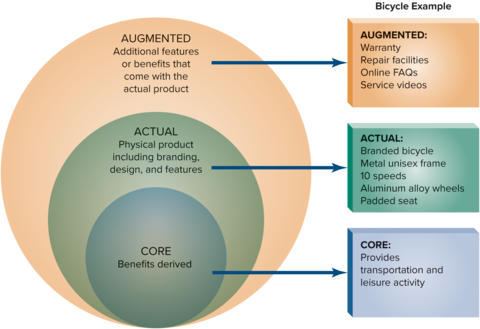
Three Layers of Product
Product Elements (CAA)
Core product: Fundamental benefit that a consumer derives from having the product.
Actual product: The physical good or the service that a customer purchases when buying a product. It includes the product’s branding, design, and features.
Augmented product: The additional features and attributes that accompany a product. Exist for more expensive purchases such as cars, computers, or TVs.
The more complex and expensive the product, the more intricate the layers used to differentiate the product from the competition
Packaging
Can communicate information about the product and reinforce the brand image. When there is no ______________, the website will communicate the brand.
Key source of competitive advantage.
Elements of Packaging (FCB)
Function: Allows products to be stored, protection of fragile objects, improves product quality, provides a safety function, makes a product easier to use, and makes a product more efficient to transport.
Communication: Explain detailed product information. Highlights the product and the purpose.
Brand Image: Packaging can be used to tell the brand story, communicate key messaging and build a deeper connection with ideal customers. Online packaging has to carry more weight due to the lack of a storefront experience.
Product Line
A group of similar products that are closely related because they satisfy a similar need and are directed at the same general target market.
Examples of a product line can be seen by examining Coca-Cola’s product offerings. Coca-Cola Canada offers five product lines: sparkling, hydration, coffee/tea, juices/dairy, and alcohol.
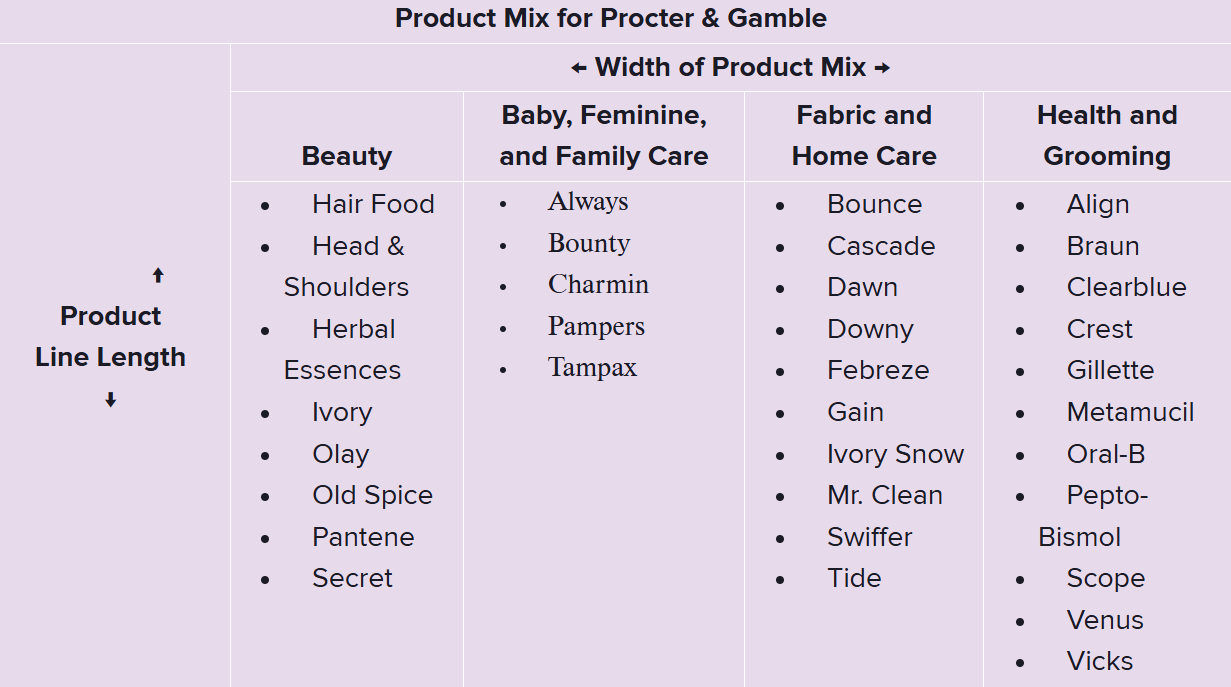
Product Mix (3 Ps in the Mix)
Consists of all the product lines marketed by a company. This includes the product width, the product line length, and the product line depth.
Product width: Number of different product lines offered by the company.
Apple offers many product lines (MacBook, Phones, AirPods, Apple Watch, iPad)
Product line length: Number of product or brands in the product line.
The iPhone line length has numerous different types of phones and years.
Product line depth: Number of different versions of each product sold within its product lines.
The one iPhone Pro offers different colours and GBs which is the depth of one singular product.
Consumer Products (4 Categories)
CSSU
Purchased by the ultimate consumer for their personal use. Consists of four different categories of products:
Convenience
Shopping
Specialty
Unsought
People in varying stages of life will classify products differently.
Business Products
Also called industrial goods or organizational products, are purchased either to run a business or to be used as a component in another product or service.
Some products, however, are both consumer and business products, depending on their usage.
A Canon printer can be classified as a consumer product when purchased as a final product for personal use, or it can be classified as a business product when purchased by an organization to help run a business.
Consumer Products 4 Ps (CSSU)
Convenience products: Inexpensive items that a consumer purchases frequently with minimal shopping effort. Examples include bread, gum, chips, coffee.
Shopping products: Items for which the consumer comparison shops, assessing the attributes and prices of different products and brands. Examples are jeans, airline tickets, and electronic items such as smartphones or televisions.
Speciality products: Items that require considerable time and effort to purchase. Examples of specialty products include a Rolex watch or taking a cruise with Norwegian Cruise Lines.
Unsought products: Items that the consumer either does not know about or is not interested in purchasing. An example of this is home insurance for people who do not own a home.
Business Product Elements (PS)
Product goods and services: Items used in the manufacturing process that become part of the final product are production goods and services. These can include raw materials, like parts, ingredients, or clothing materials.
Support goods and services: Items used to assist in producing other goods and services. This includes installations, accessory equipment, supplies and services. Can include transportation services, maintenance and repair, or advisory services.
Result of demand from consumer products.
Brand
A name, phrase, symbol, or design uniquely given by a company to identify its product(s) and to distinguish the product(s) from the competition.
Often created in tandem, designed to visually represent the brand to consumers and to build brand recognition.
Over the long term, the support that goes into marketing a brand results in strong brand associations and a certain degree of consumer loyalty.
Key Dimensions of a Brand (6 - TELCPC)
Key Dimensions of a Brand:
Trustworthiness: More important element. Dependable image that consumers have for a brand and fosters their ongoing confidence in recommending it to others.
Honda, Toyota (reliable vehicles), IKEA (for cheap prices).
Engagement: Creating interactions, so consumers can learn more about a brand and ultimately share it with others.
Lululemon, Nike.
Leading edge: Brands that stand out are often unique, innovative, and forward-thinking.
Apple, Tesla, Meta, Chat GPT.
Corporate citizenship: Brands with a caring image have the ability to connect with consumers by instilling pride.
Ben and Jerry’s, TOMS Shoes.
Presence: Have a high profile with consumers and stand out from the crowd. Often these brands have many advocates that support them.
Beats by Dre, Disney.
COVID-19: Brands that adapted to the pandemic and supported customers through it.
Zoom, Amazon, Walmart (curbside).
Brand Equity
Formally described as the value of a brand that results from the favourable exposure, interactions, associations, and experiences that consumers have with a brand over time.
The result of considerable marketing investment and needs to be protected.
Beats By Dre undertook this. They infused the headphones right into the culture of people. Had much notoriety, praise and usage from high profile people, and was created by Dr. Dre himself. A music prodigy.
Product was selling lifestyle, culture, sense of identity, and a feeling of being present with pop culture.
Global Brands
Brands that are sold in a variety of international markets and that enjoy wide recognition in these markets. Tend to enjoy strong brand equity due to their hefty marketing budgets and well-recognized trademarks.
This includes brands such as Apple, Amazon, Google, Samsung, and Microsoft.
Brand Strategy Types (IF - BS)
Individual brands: When a company uses a brand name solely for a specific product category. Tide = Laundry Detergent (only).
Family brands: When a company uses a brand name to cover a number of different product categories. Apple = iPhone, iPad, MacBook, Apple Watch, AirPods.
Brand extension: When new goods or services are introduced under an existing flagship brand name. Same brand / new product Starbucks: From cafés → bottled drinks → creamers → K-cups
Sub-brand: A brand that uses the family brand name as well as its own brand name and identity so that it can take on the strengths of the parent brand but also differentiate itself. Used in the car industry. Parent brand + specific product name.
Honda → Civic, Accord, CR-V
Patents
Used to legally protect new technologies, or improvements on products or processes.
Provide a time-limited, legally protected, exclusive right to make, use, and sell an invention.
20-year protection period, then the patent becomes available to the market.
Examples include: Dyson: Cyclone vacuum technology, Bagless suction system protected by patents.
Trademarks
Used by people or organizations to protect brand images, names, slogans, and designs from usage by others.
Limited to a period of ten years from the date of registration but can be renewed by their owners to maintain their investment.
Legally protects a brand name and its related logo, colours, fonts, and various combinations that exist for use in a particular category and in a part of the world.
Example: Nike trade marking the Check mark logo.
Copyrights
Used to legally protect original written works, sound recordings, or forms of communication from being copied by others. It covers music, literature, and performances.
Others cannot use the specific things from that work, unless they get adequate permission and meet the requirements (e.g. pay a fee to the owner).
A copyright protection exists for the creator’s lifetime plus 50 years.
Examples: Copyright on Harry Potter for the characters, story and theme.
Brand Loyalty
Favourable attitude toward and consistent purchase of a single brand over time; the degree of target market commitment toward a brand over time that results in varying levels of purchase commitment.
Varies by product and from person to person.
Marketers strive to have highly committed, brand-loyal consumers as this helps insulate their brand from competitive marketing practices.
Brand Personality
A set of human characteristics associated with a brand. Marketers work to associate brands with specific personality traits and to help consumers make emotional connections with their brands.
Cyber Squatting
When someone registers, uses, or sells a domain name that is the same as, or very similar to, a well-known brand, company, or person’s name, without permission, usually to profit from it.
Infringes on trademark names to be able to profit.
Types of Brands (3) MPG
Manfuacturer’s Brand
Private-label Brand
Generic Brand
Manufacturer’s Brand
One that is owned and produced by the manufacturer. Owned by the producer; heavily branded, advertised, and differentiated to build brand loyalty and trust.
Example: Gravol (dimenhydrinate is the name of the drug) is the manufacturer’s brand created by Church & Dwight and sold to drugstores throughout Canada.
Can be more expensive due to brand equity.
Includes advertising, packaging, brand story, trust, emotional connection.
Private-label Brand (Store Brand)
Otherwise known as a store brand, is owned by a retailer that contracts its manufacturing out to major suppliers and then sells the product at its own retail stores, under its own store-brand name.
Examples: Life Brand, Kirkland Signature, President’s Choice.
Price and quality are comparable.
Shelf placement and retailer do most of the selling.
Less advertisement then manufacturing brands.
Generic Brand
No branding at all and is sometimes produced as a cheap alternative to a manufacturer’s brand and to a private-label branded product.
Typically named using the main product ingredient, with its main point of difference being price. Most found in the pharmaceutical industry.
Competes almost entirely on cheap cost.
Minimal packaging, and no emotional branding.

