5. Agglomeration economies in production & consumption
 Call Kai
 Learn
Learn Practice Test
 Spaced Repetition
 Match
Match Flashcards
 Knowt Play
1/26

There's no tags or description
Looks like no tags are added yet.
Name | Mastery | Learn | Test | Matching | Spaced | Call with Kai |
|---|
No analytics yet
Send a link to your students to track their progress
27 Terms
Three sources of economies of scale:
- Knowledge spillovers
- Local non-traded inputs → costs for certain specialist inputs that are very expensively can be shared
- Local skilled labour pool → lower labour acquisition costs
Three types of agglomeration economies:
- Internal returns to scale, some firms achieve economies of scale simply by their large size
- Localization economies, A group of firms within the same industrial sector located at the same place
- Urbanization economies, when the economy of a city is centred around a single plant or company
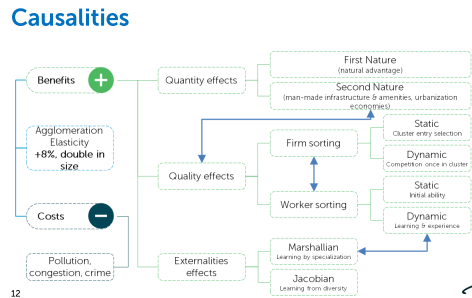
There is a productivity and wage markup in cities double in size of +5 to +10%
Matching, sharing, learning + Localization (industry specific) + Specialization → same industry
Urbanization (all industries) + Diversification→ cross-industry interaction
Why do firms want to be in cities?
Productivity increased
Competitive advantage (Porter)
Functionally defined cities and urban regions
Productivity (wages) and employment growth
transport cost
Why do people want to be in cities?
Work matching opportunities
Education
Amenities and culture (see second hour lecture)
Belonging (happiness)
Creativity
Entrepreneurs: market access
Functionally defined cities and urban regions.
Housing market and service provision, accessibility
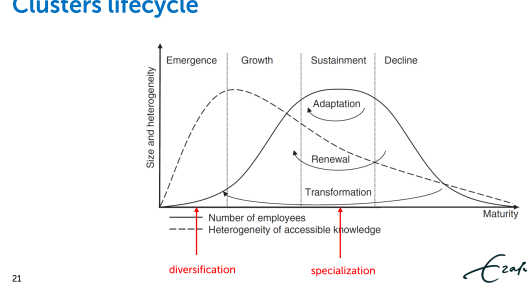
Explain how localisation and urbanisation advantages
interact with the life-cycle of clusters.
Early stage: urbanisationand diversity with employment growth, later stage: mature specialisation and productivity
Theories on agglomeration:
just read through
Neo-classical theory –dispersion, regional convergence
Endogenous growth theory –concentration, learning process, regional divergence
But not indefinitely (dependent on the life cycle of technologies, market opportunities, agglomeration diseconomies, institutions), e.g. Detroit, Manchester, Dortmund. Now: Beijing, Hong Kong, San Francisco, Amsterdam
Economists measure prices in markets: bid-rent curves of housing (prices) and firm (wages) location
Agglomeration economies are the essential part in explaining national and urban growth, innovation, resilience
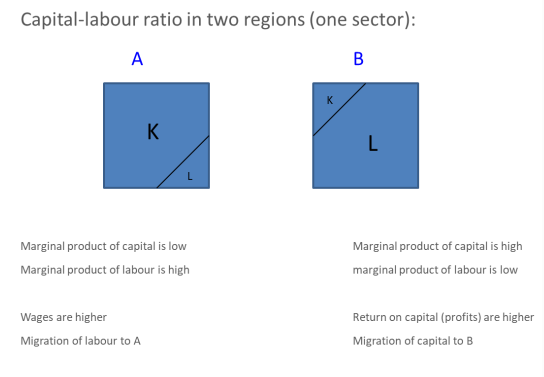
quick description
aggregate national efficiency + welfare gain from one-sector neoclassical model of factor allocation & migration
k/l equalised → no pareto efficiency gain → increase output convergence
Negative agglomeration externalities:
- Competition - Pollution - Congestion - Noise - Taxes to cover social costs
Production functions
Cobb -Douglas: Qt=A * e^(φt) * K^α * L^β (innovation ; technology)
Endogenous growth: increasing specializationincreases output based on specialized capital goods (divergence).
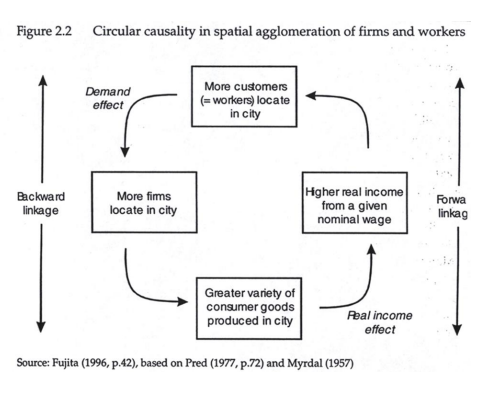
EU relate
Diversity and density related to employment growth, especially in non-objective regions of the EU
- Specialization and density related to productivity growth, especially in objective regions of the EU
- Convergence in productivity, divergence in employment
- Diseconomies of scale and more mature life-phases of economies gives disadvantages in western regions
- Educational level and openness of economies are conditional!
- Spatial heterogeneity matters
Do you think internet and ICT will make agglomeration advantages redundant? Motivate your answer.
Choose between: Yes –unlimited opportunities and speed. No –still spikes of agglomeration visible
How can you measure agglomeration advantages related to economic diversity (urbanisation economies) of cities and regions
New combinations of diverse economies, cross-sectional cooperation, innovation, use of in cities concentrated services, related variety, relatedness in skills
Dominant view among economists: “cities are good for production and bad for consumption”
- Firms and workers earn more
- Workers pay higher rents, commute longer, and face more crime
Life expectancy rural higher
ppl want to live
Future cities: car cities with decentralized employment and population and/or bicycle, pedestrian and public transport cities
Traditional cities will only survive providing amenities that are attractive to high human capital residents
(1) the presence of a rich variety of goods and services (2) aesthetics and physical setting, (3) good public services, and (4) speed. rank amenities importance
(1): endogenous engine of growth → (4): key urban dev → (3): necessary but not sufficient → (2) not sufficient
What are the 4 characteristics of the Consumer City according to Glaeser et al. (2001)
Variety of goods and services; aesthetics and physical setting; good public services; speed
Which two trends fuel the Consumer City hypothesis according to Glaeser et al. (2001)?
Growing disposable income, improved communication and transportation technology.
Can the Consumer City exist without the Producer City? Motivate your answer.
More answers possible:
Yes (like Las Vegas but seems exception), No (added value has to be created/produced first before spending)
How is the analysis of Glaeser (2001) of the Consumer City different from traditional theories of urban economics?
Traditional theory: cities better for producers. Glaeser: can also benefit consumer
What are the welfare implications of the outcome of the Hotelling model of spatial competition?
Welfare of ppl living in the center is the highest
Glaeser et al. (2001) mention reverse commuting, gasoline prices and mobility taxes as indicators of the success of consumer cities.
b) Explain what these concepts mean, how they are related to consumer cities and how they relate to the economic success of cities
check lại
Hedonic modeling
Estimate implicit prices of house and location attributes
Local effect of consumer amenities
Capitalization of non -tradable good/service
Utility bearing as → house prices
centers of direct consumption • part of a larger ecosystem/cluster of amenities. • facilitate knowledge exchange • Identity creation
Urban amenity premium Availability (H1):
Consumption • Experience (liveliness) • Image & identity
Urban amenity premium • Quality (H2):
Quality bears utility • Decreasing marginal utility • Quality <-> price • Quality <-> transportation tolerance
Urban amenity premium • Diversity (H3):
• Love of variety

