Short Term Memory
 Studied by 0 people
 Call with Kai
 Learn
Learn Practice Test
 Spaced Repetition
 Match
Match Flashcards
 Knowt Play
1/33

There's no tags or description
Looks like no tags are added yet.
Name | Mastery | Learn | Test | Matching | Spaced | Call with Kai |
|---|
No analytics yet
Send a link to your students to track their progress
34 Terms
T/F: The Modal Model, "series" is accurate
False
Describe the stages of Modal Model
Memory works in 3 stages. Sensory Register -> Short-term store -(rehearsal)-> Long-term store
- sensory register: <1 sec of just leaving the impression
- short-term store: decays in <30 sec, but can be infinitely held with rehearsal
STM is also called ...
Primary, Immediate, Working Memory
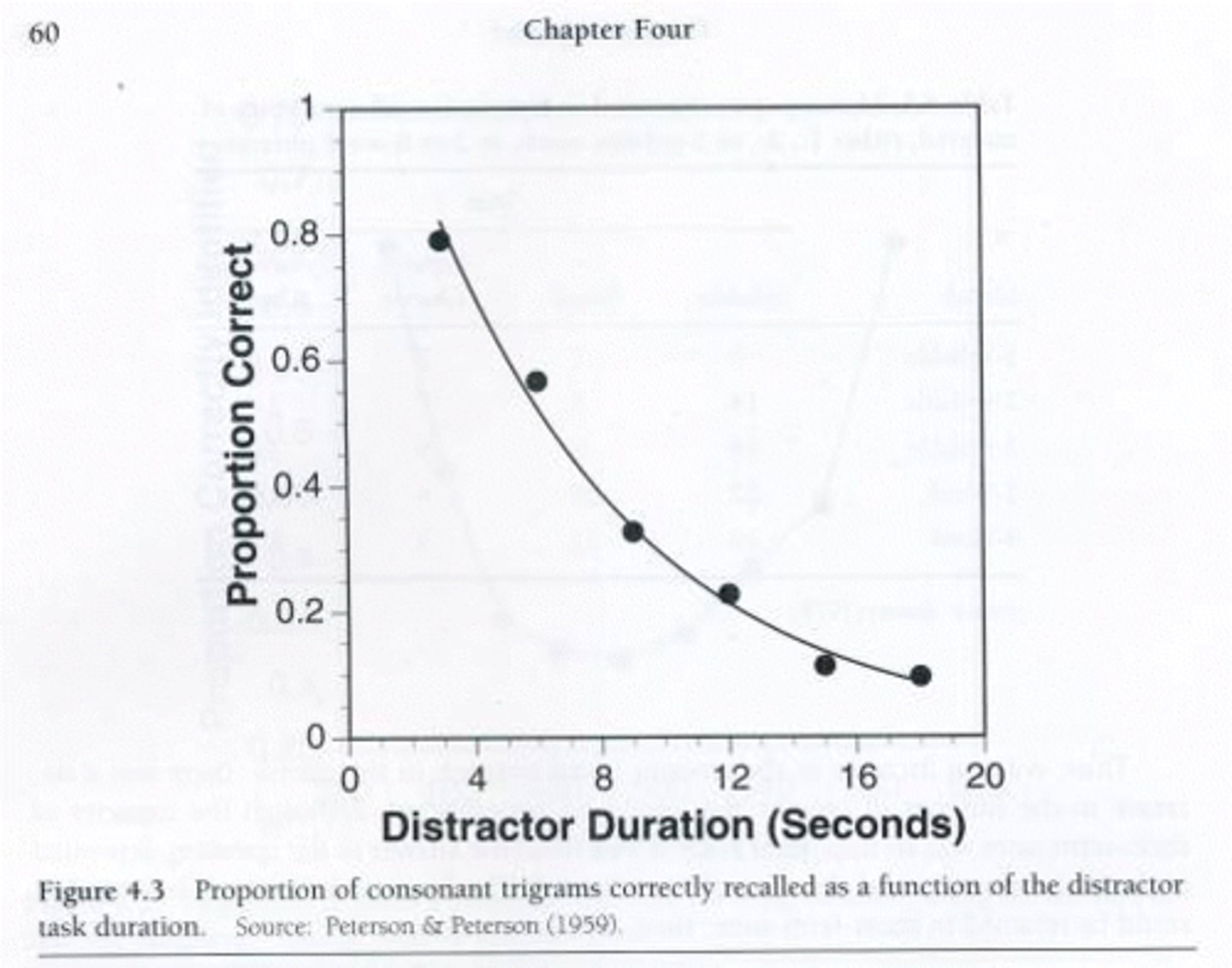
How did Brown-Peterson Paradigm interfere rehearsal to measure the rate of forgetting?
They were asked to memorize a consonant trigram (ex. DGM) and then a 3-digit number (ex. 243). They were then asked to count backwards by 3's to prevent rehearsal and finally asked to recall the original 3 letter consonants in order.
- STM showed "passive decay" over time after rehearsal prevention. (dec. proportion of words correct)
Usual limit in short term memory capacity (#)
7, +/- 3 from that
STM is usually ______, while LTM is usually ______.
phonological (briefly memorizing the words spoken out loud); semantic (deeper meaning)
Warrington & shallice's patient KF had very short digit span and this patient definitely had STM deficit and not due to impairments in these two categories:
1) speech perception (correct category detection)
2) speech impairment (impaired when pointing, not just talking)
STM patients show abnormally ______ forgetting.
rapid.
(normal person forgetting: Brown-Peterson paradigm vs. Patient PV showing 50% decay after only 3 seconds)
Phonological Similarity Effect
- memorization span is influenced by phonological similarity, and this affects controls as well as STM patients but in a smaller scale (list).
- They both showed 40% decrease in performance with phonologically similar words, even though controls had to memorize 6 items, but STM with 2 items.
Long-Term memory is still intact despite impaired Short Term Memory. How does this disprove the stage model?
- Because STM is not required to store LTM. This also shows difference in representation needed to store memories ST vs. LT.
- It's not just about duration of memory, but more so the fact that the two kinds of memories are used to store different kinds of events. (ex. LT-semantic)
primacy effect and recency effect and reasoning for each
primacy effect: people tend to remember the word presented at the very beginning better
- longer time to consolidate
recency effect: people tend to remember the word last shown better.
- well stored in short term memory
STM patients show weakened _______ effect; LTM patients show weakened _______ effect.
recency; primacy
conditions for better LTM consolidation
slower presentation! (this does not affect STM)
- recency is not affected in slow vs. fast presentation, but overall more percentage of words were recalled in slow presentation control.
Why should we use STM patients, not healthy controls, to test the effect of slower presentation in LTM? (Patient LS)
Because STM patients have impaired STM but intact LTM, so they're using LTM system to recall words. Healthy controls would use STM so this effect would not show.
So STM patient LS were presented with a pair of words, one word with .5 sec rate, and another with 2 sec rate. She got more % correct in 2 sec rate trial.
why did Patient KF (STM patient) show more % correct with greater presentation rate in words compared to letters?
First, STM patients use LTM to perform STM tasks. Presentation rate had greater effect on words than letters in STM patients because words are more semantically meaningful than letters. This means patients can benefit more from LTM since LTM has to do with semantic stuff.
T/F: Health individuals also need LTM to perform STM tasks.
False - they also aren't affected by rate of presentation
T/F: Increased STM rehearsal Time improves LTM in controls. (describe the experiment)
False.
Presented a 21 word list, one at a time, told the person to report the last word that starts with g. Rehearsal Time was equal to the gap between one g word to another g word to control how many times a g word is being rehearsed. But even with increasing rehearsal time, the percentage recall did not increase! So no.
Serial Dependency is proven to be (correct/incorrect). Describe another model!
Incorrect!! There's another loop that goes from phonemic analysis -> semantic analysis -> Long-term store so that short term store can be bypassed. This allows STM patients to rely on intact LTM to perform STM task under right circumstances.
Under what circumstances can STM patients rely on LTM to perform STM tasks?
slow rate of presentation, meaningful stimuli
2 different encoding pathways in the new model
phonemic analysis -> short term store
semantic analysis -> long term store
but can be connected in a "square"
How did they test whether STM works as working memory? Does it work as working memory?
If STM works as working memory, they they should have difficulty on reasoning tasks that require working memory when STS is overloaded. They were asked to perform T/F reasoning tasks, while repeatedly saying 6-digit number (loaded up STM) out loud as well. But subjects didn't make errors in either test, even though there was some slowing. So no, STS is involved in working memory but it's not the whole explanation.
Slow performance in working memory when STM is full but degree is much less than expected:
STS did play a role in working memory, but not enough to be a critical player.
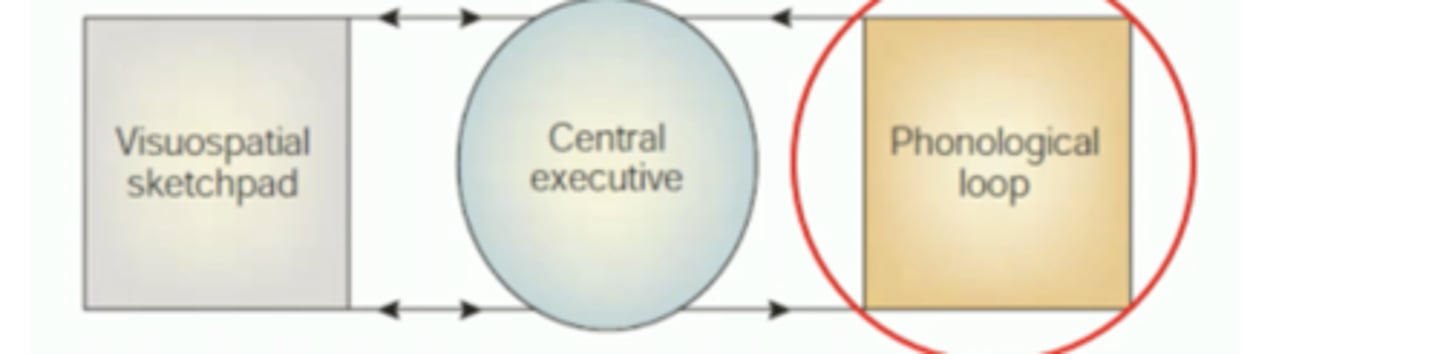
3-component model of working memory
Central Executive: primary working memory component with limited attentional capacity.
Visuospatial Sketchpad & Phonological Loop: temporary "buffer" systems that the central executive can fetch the information from while working. They store and maintain visual and spatial info/phonological info.
STS = phonological loop
what would happen if STS was an output buffer for speech production?
STS patients would show difficulties with spontaneous speech and show trade-off between errors and shorter phrases. (more errors and less pauses; less errors and more pauses)
- but spontaneous speech of STM patients did not show this pattern -> sts does not affect speech production.
Patient JB (STM patient) with speech production
normal pauses as % speech and length compared to normal controls. Normality quality of speech suggests that stores involved in speech production are intact.
Patient JB with speech comprehension (STS as buffer to store the speech by other people to understand it over time)
seemed normal but had a subtle impairment in speech comprehension, indicating that STS might be linked to speech comprehension.
3 types of sentences used to test the link between phonological loop and speech comprehension that patient PV (STM patient) had to judge T/F
A. false statements created by semantic mismatch (just wrong sentence)
B. Same as A but longer by adding introductory clause.
C. False statement that reverses the order of words. (not a semantic mismatch)
Which sentence did STM patients show an impairment in?
condition C, word reversal sentence. The impairment only came into context when there was a semantic mismatch. This is because STM patients rely on LTM, which uses semantic knowledge to store memories.
In C, they did not have phonological store to remember whether the order of words was correct, and the sentence itself semantically made sense semantically. "ship" and "sail" are semantically correct, just out of order.
When asked to repeat back sentences, STM patients should be impaired at .. but okay at ....
speaking back verbatim, but okay with repeating the gist of the sentence. (no short term capacity to remember the exact structure of the sentence)
For STM patients, verbatim recall decreased with sentence ______.
length
STM patients x speech comprehension task
- for longer sentences - >
- for longer sentences ->
passive sentences:
- no intro clause ->
- with intro clause ->
- if the sentence is semantically reversible ->
- for longer sentences - > retain the gist
- for longer sentences -> substitue with more familiar word, unless the rare word is more appropriate with the sentence (ex. vial replaces bottle)
- no intro clause -> passive sentence preserved
- with intro clause -> passive became active (harder to preserve with longer sentence)
- if the sentence is semantically reversible -> paraphrase often reversed the meaning
T/F: STS is involved in comprehension on daily basis, playing a very critical role.
False. It's only important when the speech is more complex/long. It serves as a storage for relatively unprocessed info when 1) initial sequential attempt to divide the sentence fails 2) need to hold the phrase to interpret it later. For the most part, STS is not needed when sentences are simpler as getting the gist of it is fine for every day life.
Patient PV (STM patient) with language acquisition
She was fine at associating meaningful words in her native language of Italian. But she couldn't learn a single foreign word. She couldn't use the semantic meaning of the word because she can't create phonological representation to associate the new Russian word with the semantic meaning of her native language. -> STS is important in language acquisition.
evidence of the link between phonological loop and language acquisition
children who lacked vocab/reading skills were impaired at nonword repetition. This meant small short-term memory is driving the impairments in language acquisition.
 Note
Note  Flashcards (24)