3.4.5 Monopoly
 Call Kai
 Learn
Learn Practice Test
 Spaced Repetition
 Match
Match Flashcards
 Knowt Play
1/16

There's no tags or description
Looks like no tags are added yet.
Name | Mastery | Learn | Test | Matching | Spaced | Call with Kai |
|---|
No analytics yet
Send a link to your students to track their progress
17 Terms
What are the characteristics of a monopoly? (5)
Holds more than 25% of the market share
Price maker
Impenetrable barriers to entry
Profit maximisation → monopolies can earn SNP
Imperfect information → asymmetric info
What are the barriers to entry in a monopoly + explain them? (5)
Predatory pricing → putting price below the cost of production of new entrants so they can’t profit
High sunk costs → unrecoverable, so they deter new entrants
Brand loyalty
Set-up costs
Number of competitors → lower number = higher barriers to entry
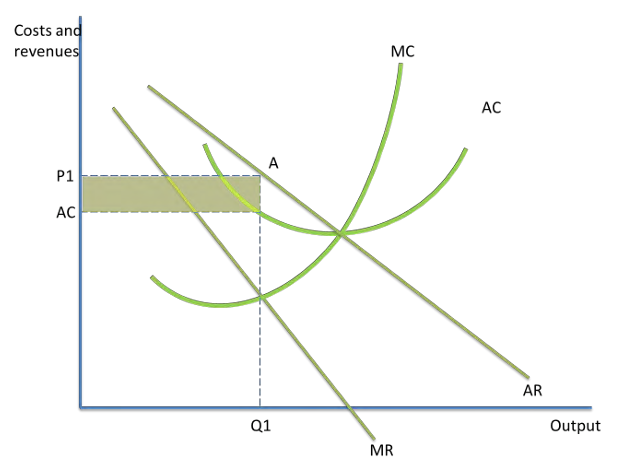
What type of profit do monopolies get, when do they get it + draw a diagram showing it
SNP
Both in the short run + the long run
What is third-degree price discrimination + give an example?
When the monopolist decides to charge different groups of consumers different prices, for the same good or service
E.g., peak/off-peak tickets or Adult + Child tickets, any student discount – Unidays, student beans
What are the necessary conditions for price discrimination?
The firm is a price maker
Seperate markets → firm can identify and seperate markets
Different elasticities of demand
Low admin costs for the price discrimination
Prevention of arbitrage
Same costs of production for both markets
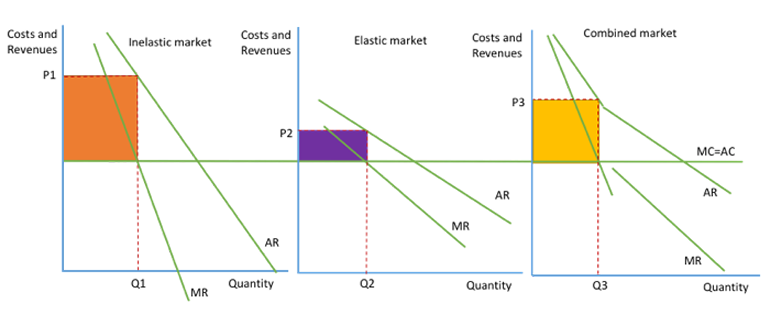
Draw the 3 diagrams involved in price discrimination
Explain cross-subsidisation in terms of third-degree price discrimination
Different PED between groups → firm charges higher prices to inelastic group → earns supernormal profit → uses this to lower prices for elastic group → cross-subsidisation occurs → lower prices for consumers with more elastic demand
What are the costs + benefits of third-degree price discrimination to consumers?
Benefits
Those in the elastic market have lower prices → benefit from cross-subsidisation
Costs
A fall in consumer surplus + those in the inelastic market have to pay a higher price
Some groups might not be inelastic because they are wealthier but because it is a necessity, e.g., peak time train travel → Unfair
What are the costs + benefits of third-degree price discrimination to producers?
Benefits
Increase profits for firms which can be reinvested to increase dynamic efficiency
Costs
Administration costs
Arbitrage
If it is used as a predatory pricing method, the firm could face investigation
What are the costs + benefits of monopolies to firms?
Cost
Firms may not always profit maximise + due to a lack of incentive to invest, as there is no competition → can lead to inefficiencies
Benefit
Due to high SNP, monopolists can increase dynamic efficiency
Since monopolies are large, they can exploit EoS + this means lower production costs
Firms with monopoly power will be able to compete against large overseas organisations
What are the costs + benefits of monopolies to consumers?
Cost
With a natural monopoly, consumers tend to be better off than if there was competition
Benefit
Due to EoS, firms will be more efficient + so consumers will enjoy a higher consumer surplus
Dynamic efficiency → higher quality goods
What are the costs + benefits of monopolies to employees
Cost
Monopolists produce at lower outputs, so will employ fewer workers
Benefit
However, the inefficiency of the monopoly may mean employees receive higher wages, particularly directors and senior managers
What are the costs + benefits of monopolies to suppliers
For suppliers, the impact of a monopolist will depend on the extent to which the monopolist is also a monopsonist → If the monopsonist buys all or most of the suppliers’ goods (so is a monopsonist), it will reduce the suppliers’ profits as the monopolist will decrease prices
What is a natural monopoly?
An industry in which the most efficient number of firms is 1 due to fixed costs being a high proportion of total costs so having more than one firm produce a good is inefficient
Explain a natural monopoly in terms of profits + provide an example
It is more effective to have one firm making SNP and charging a lower price than having multiple firms making normal profits but charging a higher price
Explain monopolies in terms of efficiencies (4)
Monopolies aren’t productively efficient because they don’t produce at MC=AC
They are also not allocatively efficient as P>MC
Since a monopolist is likely to make supernormal profits, they will be dynamically efficient. However, if there is no competition, they may have no incentive to invest
Monopolists may suffer from X-inefficiency because of the lack of competition
What is 'creative destruction' + what does it lead to? (2)
Creative destruction is the process where innovation replaces old products, firms, or industries with new ones → allows for resources to be reallocated to more efficient uses
Leads to economic growth, innovation, and efficiency but causes job losses and business failure in the short run

