Lake ecology final
 Studied by 7 people
 Call Kai
 Learn
Learn Practice Test
 Spaced Repetition
 Match
Match Flashcards
 Knowt Play
1/38

There's no tags or description
Looks like no tags are added yet.
Name | Mastery | Learn | Test | Matching | Spaced |
|---|
No study sessions yet.
39 Terms
What acreage and depth legally defines a shallow lake?
50 acres or greater with 4.6 meters (15ft) or less
What organism helps promote a clearwater state?
Daphnia
What is a clearing event?
a clearing event refers to the natural, often seasonal, phenomenon where a lake's water becomes highly transparent, usually in spring, after algae blooms die off due to increased zooplankton grazing and nutrient shifts, revealing a blue or clear water state, but can also describe human-induced efforts (like aeration or bioaugmentation) to remove muck and clarify turbid water for ecological benefit. It signifies a healthy shift from a turbid, algae-dominated state to a clearer, nutrient-balanced state, often involving food web changes and stratification.
What invasive species is good at clearing water?
zebra mussel
What plant density do large mouth bass prefer?
moderate, medium
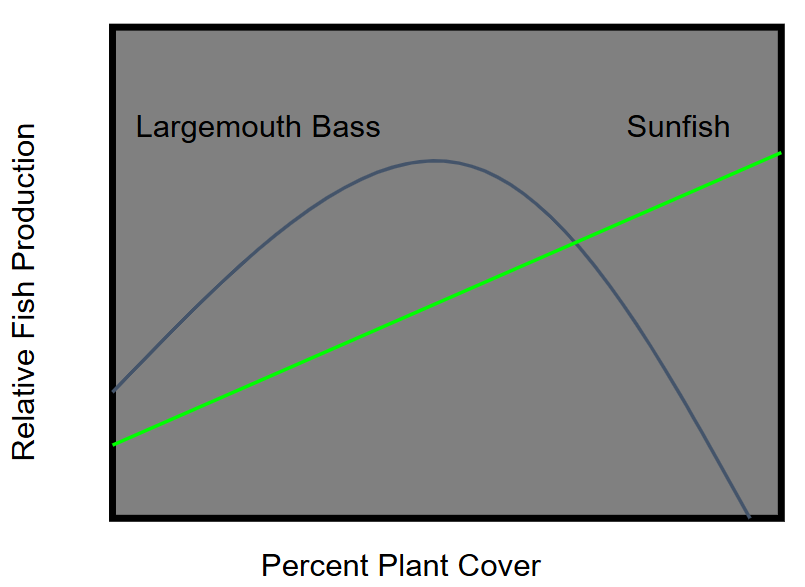
Interpret this figure
I think this figure shows that as percent plant cover increases, sunfish start to outcompete largemouth bass because greater plant cover is more ideal for sunfish than largemouth bass
What is aeration? (5)
Physical, chemical, or biological?
Inject air or oxygen into anaerobic hypolimnion
Increases oxygen, reduces taste/odor problems
Appropriate for lakes with large anaerobic hypolimnion
maintains lakes stratification
Helps decrease phosphorus release from sediments and decrease cyanobacteria blooms
physical
What are bubble curtains?
Physical, chemical, or biological?
Two aeration devices next to each other to create a somewhat controlled management
physical
Can be used to increase residence time of herbicides
What is Phosphorus Precipitation?
physical, chemical, or biological?
Add a binding agent to precipitate and inactivate soluble P
Usually uses alum which can be toxic to aquatic life
Alum treatments may be wildly effective in situations with low external loading and high internal loading
chemical
when you introduce a living organism for management purposes?
Biological control
What is shading?
physical, chemical, biological?
• Add nontoxic dye to
water
• Reduces growth of
algae, macrophytes
• Reduces oxygen
consumption
physical
What management is enforced when managing swimming zones?
Lake zoning
Creating/Limiting Public Access
How did hydrilla get into the US?
was used for aquariums because its a hardy, fast growing plant
what is hydrarch succession
the gradual change of a wet, aquatic environment (like a pond or lake) into a terrestrial (land) ecosystem
Modern view of lake ontogeny takes into account what?
disturbance
How did common carp get here?
intentionally introduced into Midwest waters as a game fish in the 1880s.
How did the sea lamp spread?
off of boats
How to manage cyanobacteria?
Adaptive Water management
Is water quantity a critical issue for the future
yes
Do different copper algaecides matter or are they all the same?
• Formulations have different chelators, pH, and chemical composition that effect their performance in varied water conditions
• Some copper formulations are only used for algae, some are almost exclusively used for vascular plants
• Not all copper algaecides are chelated equally
Which federal law affects point/nonpoint pollution?
Clean water act
What is the goal of aquatic plant management?
to achieve a balance in water bodies
Single best method for weed control
The easiest place to stop invasive species is at the border of
the host country
Treat before densities are absurd
Manage during lag phase
Characteristic of a shallow lake
more sun + wind can reach bottom
only littoral and photic zone
more nutrient availability
no stratification
Characteristic of a deep lake (4)
sun and wind cannot reach bottom
littoral, pelagic, photic, aphotic zone
less concentrated
stratification occurs
4 main categories of in lake management techniques
• Physical
• Chemical
• Biological
• Institutional
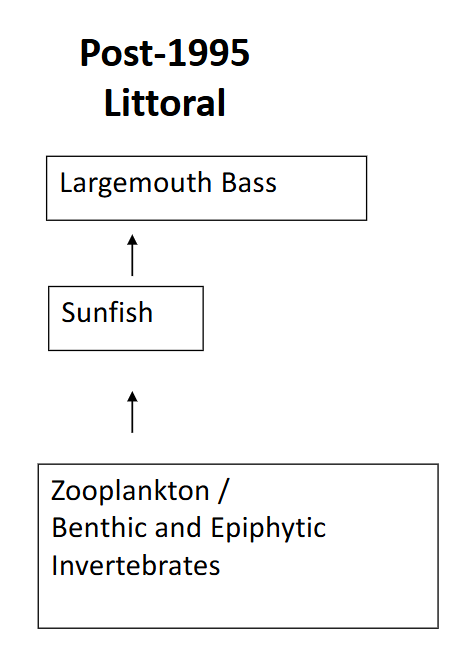
Basic littoral food web
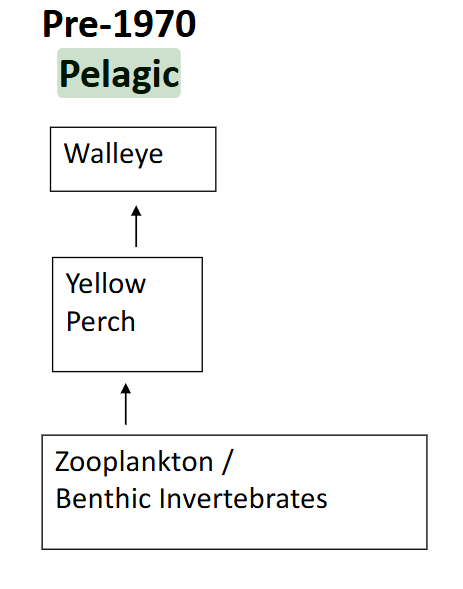
Basic pelagic food web
Clear water characteristics (6)
more daphnia
more vascular plants → more light attenuation
less rough fish stirring bottom
less cyanobacteria growth
Minnows
multiple positive feedback loops
turbid water characteristics (6)
more sediment suspension
more algae
more secondary rough fish
less apex predators
bullheads
multiple negative feedback loops
During a fish kill scenario would piscivores increase or decrease
decrease
During a fish kill scenario would planktivores increase or decrease
Benefits of dilution and flushing management (3)
physical, chemical, or biological
decrease concentration of nutrients by adding water of lower nutrient concetrations
flushing decreases retention time and increases turnover
moves nutrients downstream
physical
diver dredging
divers use air lift system to remove plants from sediment
expensive
highly selective
hypolimnatic withdrawl
remove nutrients from hypolimnion
- requires lake with dam/water outlet at hypo
rotovating
eurasian watermilfoil
Institutional control
docking regulations
fishing regulation
public access
classic biocontrol
Classical Biological Control introduces new, highly specific enemies
native biocontrol
uses or boosts existing local organisms
Explore top notes
 Note
Note Explore top flashcards
 Flashcards (25)