Materials & Methods Study Guide
 Call Kai
 Learn
Learn Practice Test
 Spaced Repetition
 Match
Match Flashcards
 Knowt Play
1/75

There's no tags or description
Looks like no tags are added yet.
Name | Mastery | Learn | Test | Matching | Spaced | Call with Kai |
|---|
No analytics yet
Send a link to your students to track their progress
76 Terms
What is the difference between shallow and deep foundations?
Shallow foundations transfer the building load to the base of the substructure, deep foundations penetrate unsuitable soil to reach suitable soil or rock
What are the different types of settlement and why do they occur?
-differential settlement occurs when the soil beneath the structure cannot bear weights imposed on it, sometimes due to different loads imposed on the soil or different soil types
-uniform settlement occurs where the structure settles a similar depth in each area due to proper load distribution and soil sampling
What are the different types of soil tests
-standard penetration test
-auger boring
-wash boring
What are the different types of unrestricted excavations? *
-sloped
-benched
What are the different types of sheeted excavations?
-soldier beams & lagging
-sheet piling (wood, steel, or precast)
-slurry wall
What are the differences between porous and expansive soils?
-porous soils have air spaces between particles to hold air and water for plants, allowing for better drainage
-expansive soils swell and shrink when water is introduced, which is undesirable when putting building foundations on this surface
What are the different types of deep foundations?
Caissons, Piles, and Piers
What are the different types of shallow foundations?
Isolated Footings, Wall Footings, Combined Footings, Cantilever / Strap Footings & Mat / Raft Footings
What are the primary factors affecting foundation choice?
-subsurface soil type
-groundwater conditions
-structural requirements
What are the causes of additional foundation cost?
-building below the water table
-building close to an existing structure
-using deep foundations
What are the advantages and disadvantages of isolated footings?
Advantages
-easier to construct compared to other foundation types
-generally more cost effective due to less material usage
-can be adapted to various soil conditions and loads
Disadvantages
-load limitations make it unsuitable for heavy loads or closely spaced columns
-if soil is improperly assessed, there is a risk of uneven settlement
What type of foundations are used in the Monadnock Building?
a mat or raft foundation
What type of deep foundation has the highest bearing capacity?
concrete friction piles
What are the different types of failures in retaining walls and how are they prevented?
-overturning > cantilever footing and reinforce the concrete
-sliding > install a key between the retaining wall and foundation
-wall fracture / undermining > used crushed stone drainage and install weeps
What are the constituent parts of concrete?
-air
-portland cement
-water
-aggregate
-admixtures
How long does concrete take to reach full strength?
28 days
What are the different types of admixtures and how do they affect the mix?
-air-entraining > improve the freeze-thaw durability of concrete
-water-reducing admixtures (plasticizers) & superplasticizers > lower water usage while maintaining workability and increase cement efficiency
-accelerant / retardant admixtures > slow / speed up rate of curing
-fly ash > improves workability, strength & durability of hardened concrete & reduces amount of portland cement needed in mixture
-workability agents > can improve flow / workability without other affects of adding water
-fibrous admixtures > lowers drying shrinkage crack frequency
-coloring agents > add color to the concrete
How can concrete be made more sustainably?
-use waste material as aggregates - can reduce water consumption and act as superplasticizer
-minimize formwork
-minimize mixed concrete leftovers
-reduce carbon emissions during concrete production
How does a slump test vary from a test cyclinder?
based on amount of water in mixture, concrete will slump from original test cylinder shape and will be used to test for structural strength
What is self-compacting concrete used for and why?
used for the pouring of mass concrete, in projects of complex shapes and congested rebar configurations, because it is segregation-resistant, fills easy, passes easy, very fluid, high deformation ability, and can maintain homogeneity during and after transportation and pouring
Explain the logic behind how rebar is numbered and how that translates to size
the number of rebar means how many eights of an inch wide the diameter of the rod is i.e. #5 rebar = 5/8”
Why is pre-stressed concrete used?
to increase the span length or reduce the member’s size by increasing the load carrying capacity of concrete
What is the function of a control joint in masonry and concrete construction?
to account for movement / plan where cracks in the material occur
What is the difference between pre-tensioned and post-tensioned concrete? How are they typically constructed?
-pre-tensioning happens before concrete placement, typically at a plant where steel is stressed before the load is applied to the beam, then further stressed under a load - none of the concrete is placed in tension
-post-tensioning occurs onsite with cables tensioned and anchored against concrete’s outer edges
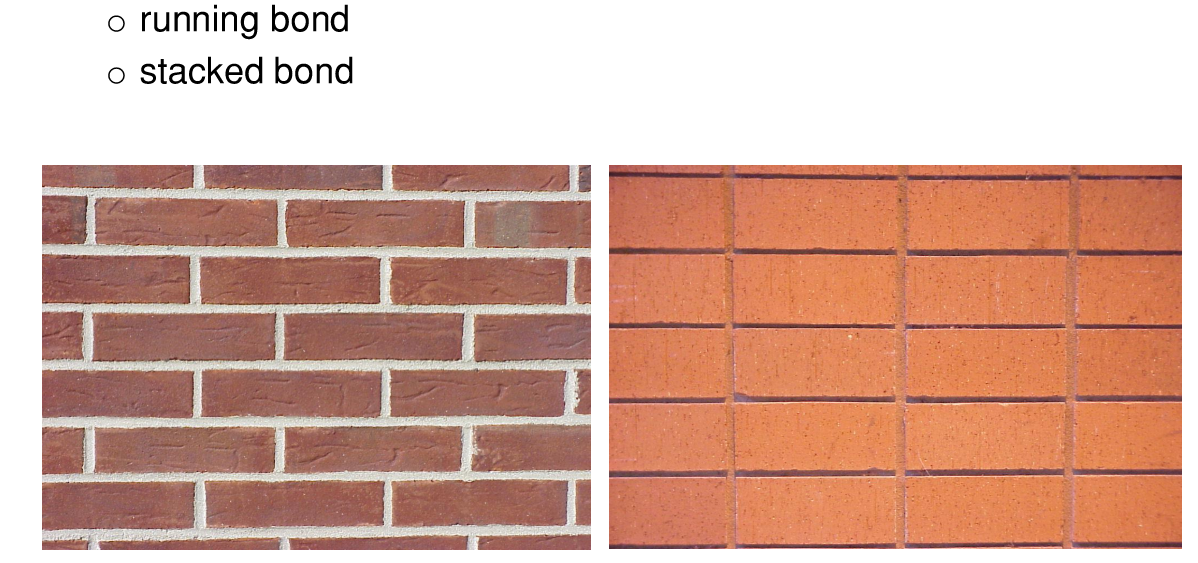
Which brick bonds are used exclusively in veneer applications? *
-stacked bond
-running bond
What is the difference between cored, hollowed, and frogged bricks?
cored - lightweight and aids in even firing
frogged - structural benefits
hollow - acoustic and thermal benefits
What advantages does CMU (concrete masonry unit) have over brick?
-less expensive
-larger unit size allows for faster wall construction
-comes in different types: lightweight, mediumweight & heavyweight
What types of reinforcing are used in CMU walls?
-rebar are inserted vertically into the hollow cores of the CMU wall and then grouted solid
-wire assemblies are horizontally laid into the bed joints of mortar
-rebar can be laid horizontally with bond beam blocks
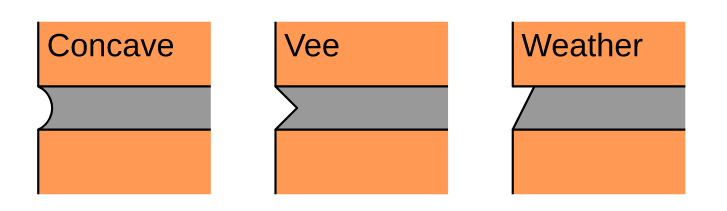
What types of mortar are used in extreme climates? *
-weather joints
-concave joints
-vee joints
What is the difference between a wythe and a course?
-a wythe is a continuous vertical section of masonry, one unit in thickness
-a course is a horizontal layer of bricks
What are the difference between bed joints, collar joints, and head joints?
-bed > the horizontal mortar joint between two courses of bricks,
-head > the joint between bricks on the same course
-collar > the mortar joint between different wythes of bricks
What do brick color and strength depend on?
The composition of the clay and the temperature and chemistry of the kiln fire
What did the Great Fire of New Orleans in 1788 spur the Spanish government to do?
Construct buildings in a new style with brick walls and slate roofs to prevent future fires
How do you measure the relative height of a brick wall?
3 bricks typically add up to 8” tall so count the how many multiples of 3 are in a single wythe.
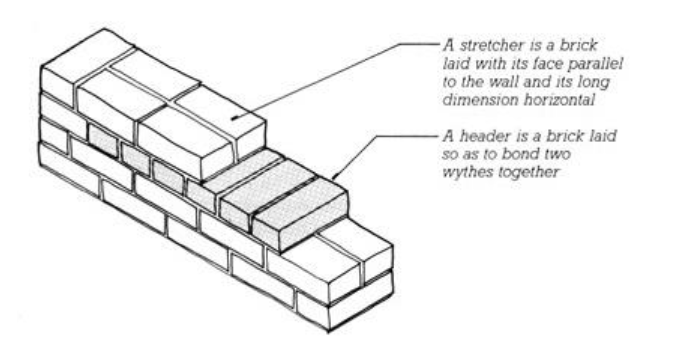
What is the difference between stretchers and headers?
A stretcher is a brick laid with its face parallel to the wall and its long dimension horizontal
A header is a brick laid to bond two wythes together
What functions do mortar serve?
-serves as a cushion to provide full bearing between units
-seals between masonry units to prevent water penetration
-adheres / bonds masonry units
-aesthetics
Why may lintels be used over arches?
Arches are very labor intensive compares to lintels
What is trabeated construction?
vertical columns support horizontal beams
What is the difference between igneous, sedimentary, and metamorphic stone applications?
igneous - structural applications (nonporous) ex: granite
sedimentary - masonry & cement applications (porous & soft) ex: limestone & sandstone
metamorphic - flooring, roofing & countertop applications (durable & visually striking) ex: slate & marble
What is the difference between carbon steel, stainless steel, and cor-ten steel?
-carbon steel has high strength and resistance to wear
-stainless steel contains 10-20% chromium for a protective layer - high corrosion resistance (200x more resistant to corrosion than mild steel) but pricy
-cor-ten steel has surface rust that adheres to base metal which limits further rusting, eliminating need for protective coating
What is the difference between standard structural steel shapes?
-S shape has rounded webs (?)
-W shape is similar to an I shape
-C shape is a channel shape (half of a w shape)
-HSS is a tube that can be square or rectangular
-L shape can be square or rectangular
What does each part of the wide flange beam designation mean? (W12 × 36)
-W signifies the shape of the member
-number next to it signifies the nominal depth of the member
-the second number signifies the weight it can withstand (lbs / ft)
What is the difference between common steel connections?
-rivets require heating, insertion into the hole and then hammering to create the second head - labor intensive
-bolts clamp members together and transfers load between members by friction but require consistent and reliable tightening
-welding heats surfaces of members to a molten state and adds additional molten metal to fuse members together to form one complete element
What are the common methods of fireproofing structural steel?
-concrete / masonry (adds dead weight)
-plaster (costly / labor intensive)
-drywall (serves as finish material)
-spray-on fireproofing
-fire-retardant intumescent paints
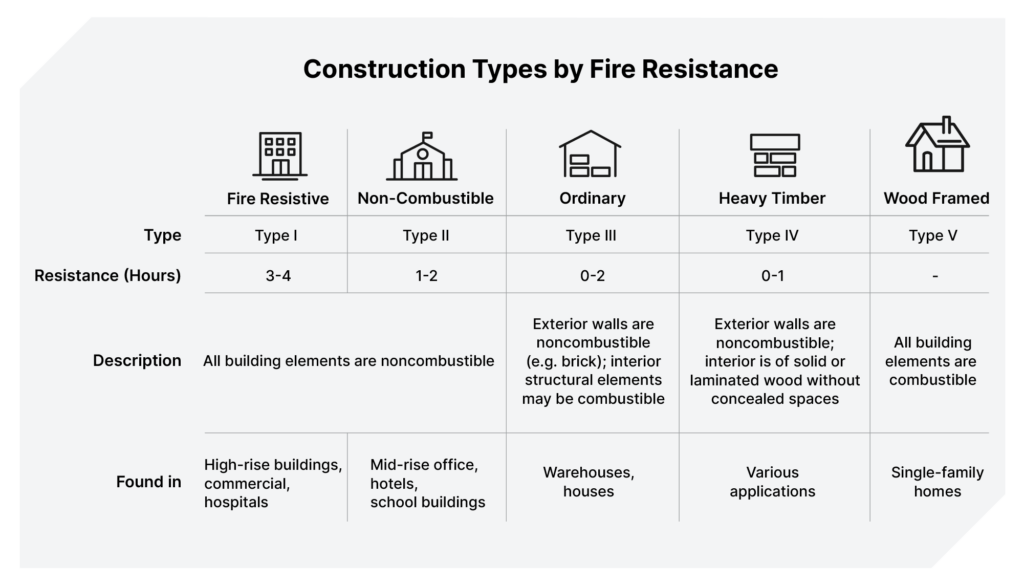
Understand the Construction Types by Fire Resistance chart
-Type I Fire-Resistive- highest level of safety because poured concrete and steel frame materials are used, can withstand fire for 2-4 hours, typically more expensive examples = highrise / multi-story buildings
-Type II Non-combustible - interior walls, framing, floors, roofing & exteriors all made of non-combustible materials like metal & concrete, less fire protection than Type I because not coated in fire-resistive coatings examples = shopping
-Type III Ordinary - exterior walls are made of non combustibles like brick, masonry, concrete block, precast etc, interior structures & roof can be wood framed, in case of fire the goal is to prevent spread & contain within walls
-Type IV Heavy-Timber - structure mainly uses large beams of wood, columns beams & girders must be at least 8” thick, materials take longer to burn and more resilient to collapse
-Type V Wood Framed - small buildings like single family homes, any code-allowed materials ok but typically wood is used
What is the minimum slope for a shingle roof?
4” / 12”
What is the minimum slope typically required for low-slope roofs?
1/4” per 1’0”
What are the common problems associated with low-slope roofs?
-water pooling
-leaks
Where is insulation located in warm and cold roofs?
-warm roof has insulation located above the roof deck
-cold roof has insulation located below the roof deck
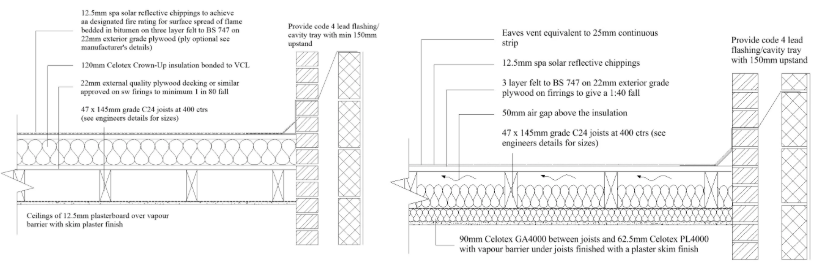
What is the difference between an intensive green roof vs and extensive green roof?
-intensive green roof can support 50-500 lbs / sf and vegetation like lawn perennials, shrubs, and small trees, with high cost and regular maintenance required for it
-extensive green roof can support only between 10-30 lbs / sf with vegetation like mosses, sedums, herbs, and grasses with low cost and low maintenance associated with it
What is the purpose of a blue roof?
a roof designed to capture stormwater runoff to use either in the buildings water supply such as flushing toilets, or to store and relieve pressure on the city’s stormwater systems
Which plastic material is commonly used for thermal insulation in buildings?
Polystyrene
What are the advantages and disadvantages of plastics?
-Advantages are its durability, high insulation value, lightweight and flexible nature as well as transparency
-Disadvantages are the high amount of energy required to manufacture plastics, not easily broken down at the end of its lifecycle, offgassing & VOCs emitted, and the flammability / meltability
What are VOCs and how can they be reduced?
volatile organic compounds are carbon based chemicals that easily evaporate into the air at room temperature from things such as paints, cleaners, adhesives and fuel emissions, significantly higher levels of these are found indoors and have serious health issues.
VOCs can be reduced by selecting low emitting paints, cleaning products and solvents, proper storage, and improving ventilation of spaces
What is a key advantages of heavy timber construction in fire conditions?
In the event of a fire, the outer layer of timber construction will burn and char, restricting further burning of the member and allowing for the building to maintain structural stability
Why do building codes restrict light wood framings in certain occupancies?
Some occupancies are more susceptible to highly combustible situations, such as program with young children or the elderly
What are the different components of a light wood framed wall?
-sheathing is applied to exterior of stud wall for shear force
-top plate (often doubled)
-header spanning window or door openings between studs
-studs (spanning from sole plate to top plate @ regular spacing (typ. 16” O.C.)
-sole plate (treated wood / decay resistant material that is anchor bolted to foundation)
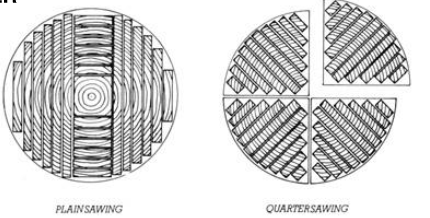
What is the difference between plain sawing and quarter sawing?
-plainsawing gets maximum yield from the log, with a varying grain pattern. Typically framing lumber is plain sawed
-quarter sawn lumber is cut perpendicular to rings and is less prone to seasoning distortions with a tighter grain figure and improve surface wearing qualities over plainsawed. Typically flooring interior trim, architectural millwork and furniture is quartersawn
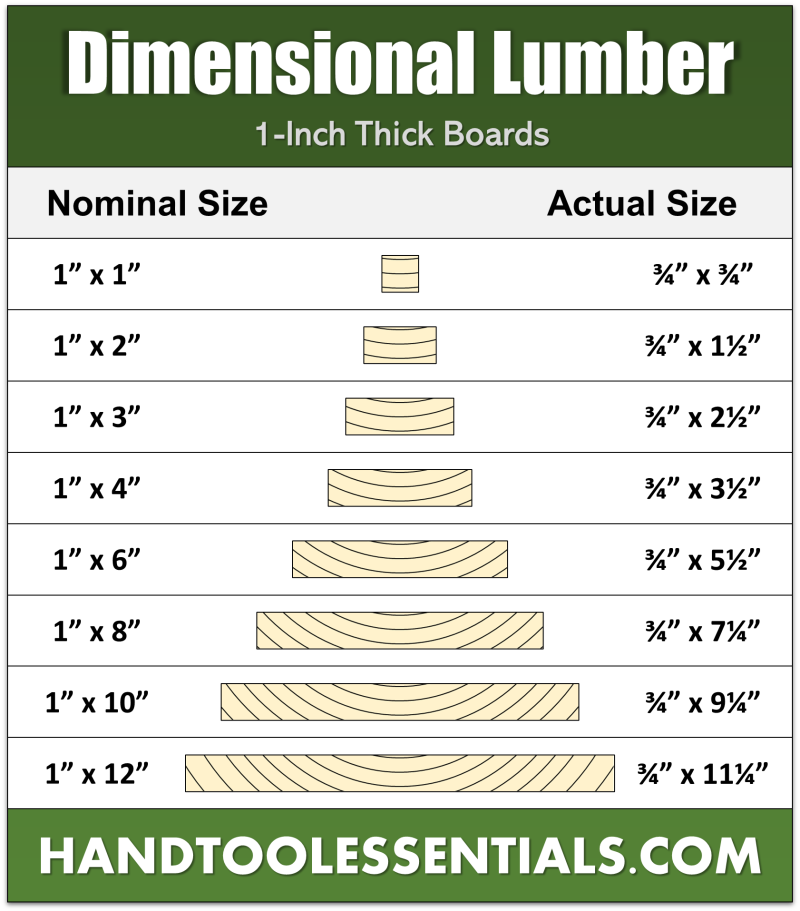
What is the difference between actual size of wood and nominal sizes?
Nominal size of wood is something like a 2” x 4” where the actual size is 1.5” x 3.5”
What are the different types of chemical treatment for wood framing?
-preservative treated
-water-borne preservatives
-creosote
-oil-borne
also some species can be more resistant such as redwood, cypress or cedar
What are the four methods to prevent water from moving through a cladding system?
-sloped sill to counteract gravity moving water into the interior
-upturned interior sill to counteract the momentum of water
-drip groove to break surface tension and capillary action
-interior weather stripping to counteract wind-driven rain
What are some examples of how plastics are used in architectural enclosure systems?
it is used in roofing (TPO membranes / polycarbonate panels) and cladding (polycarbonate or high-pressure laminate), insulation and barriers (XPS / EPS / Polyiso, water or weather barriers (Tyvek)), and in windows and doors (vinyl windows and doors, acrylic glazing)
What distinguishes platform framing from balloon framing?
Balloon framing uses longer studs that run from floor to roof, past second or third stories while platform framing uses shorter pieces of standardized lumber that terminate at intermediate floor slabs and offer increased affordability and fire rating
What are typical roof deck materials?
thatch, shingles, architectural sheet metals
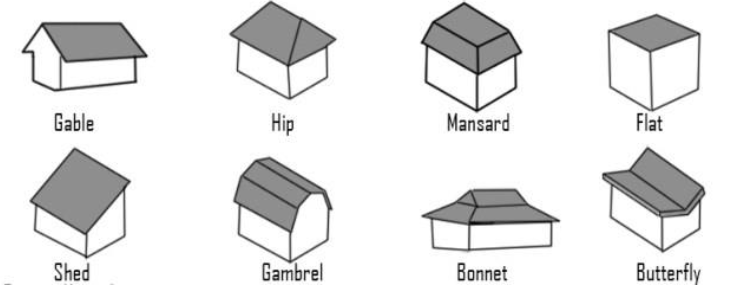
What are different roof forms?
-gable
-hip
-mansard
-flat
-shed
-gambrel
-bonnet
-butterfly
What are the different methods of roof ventilation? *
-ridge vent
-attic vent
-cold roof ventilation between plywood and insulation
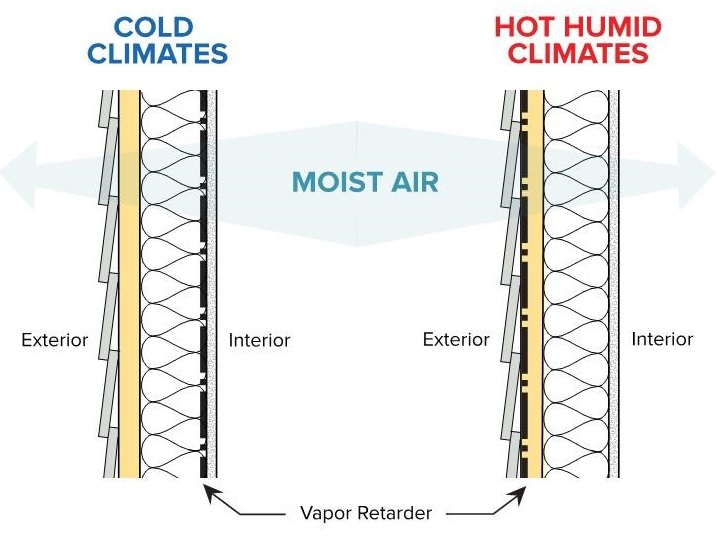
Where should a vapor barrier typically be located in a warm and cold climate?
warm climate-vapor barrier should be installed between the insulation and exterior
cold climate-vapor barrier should be installed between the insulation and the interior
What is the standard size of brick?
3 5/8” x 7 5/8” L x 3 5/8” W x 2 1/4” H
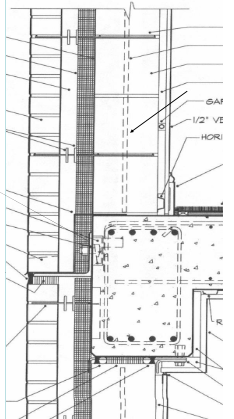
What is the function of a shelf angle in masonry construction?
supports brick veneer, is anchored to structure and is placed at every floor
What masonry construction bond pattern is the strongest structurally?
-English bond because the alternation of headers and stretchers
What is the distinction between well-graded and poorly graded soil?
Poorly graded soil has lower density, less stability and is overall weaker with uniform soil size, well graded soil has higher density, is more stable and stronger with a variety of soil sizes
What is the angle of repose?
-the steepest angle that soil can be piled without sliding or slumping
What is the difference between directly attached, curtain wall and rainscreen facades?
-directly attached facades are exterior cladding attached directly to the structural frame in larger panels
-curtainwall is attached to the structural frame with clip-angles or sub-framing, typically in metal or glass walls but also precast
-rainscreens are wall cladding stood off from the moisture resistant surface of an air barrier applied to the sheathing to create a capillary break and allow drainage and evaporation
What are the primary functions of cladding?
-keeping water out
-preventing air leakage
-controlling the passage of light
-controlling the radiation of heat
-controlling the conduction of heat
-controlling sounds
What was the primary cause of the Hard Rock Hotel collapse in New Orleans?
When the metal decking that held the concrete slab was changed to a more lightweight system that requires more structural columns, the engineers failed to add necessary structure required, which led to structural failure once construction went on.
Case studies.

