BIO Genetic Diseases Reading #1
 Studied by 0 people
 Call Kai
 Learn
Learn Practice Test
 Spaced Repetition
 Match
Match Flashcards
 Knowt Play
1/87

There's no tags or description
Looks like no tags are added yet.
Name | Mastery | Learn | Test | Matching | Spaced | Call with Kai |
|---|
No analytics yet
Send a link to your students to track their progress
88 Terms
Cell Theory
A fundamental concept of biology that states that all life is cellular and that all cells arise from preexisting cells.
Cell Division
The ability of cells to generate more cells that underlies all of life's processes.
Underlies many important processes:
1. the formation of gametes
2. development of an adult from an embryo
3. growth/repair of bodily tissues
4. asexual reproduction
Sexual Reproduction
The formation of genetically unique offspring.
- begins with fertilization and the creation of a zygote.
Fertilization
The joining of gametes to form a single cell (zygote)
Zygote
A single cell made from the joining of gametes in fertilization.
Asexual Production
The creation of a new indiviudal by a lone parent without sperm and egg.
- only one set of chromosome
- offspring is genetically identical to each other and the lone parent.
Core Question:
From a cell division perspective, why are all of the trillions of cells in your body genetically identical?
Because they all descended via cell division from a single original cell (the zygote).
Chromatin
A package formed from protein and DNA. Most of the time, chromosomes are unraveled in thin [WORD]
Sister Chromatids
Produced when a cell prepares to divides and copies its chromosomes and compacts them into dense pairs. Joined at the centromere.
Centromere
Joins the sister chromatids together
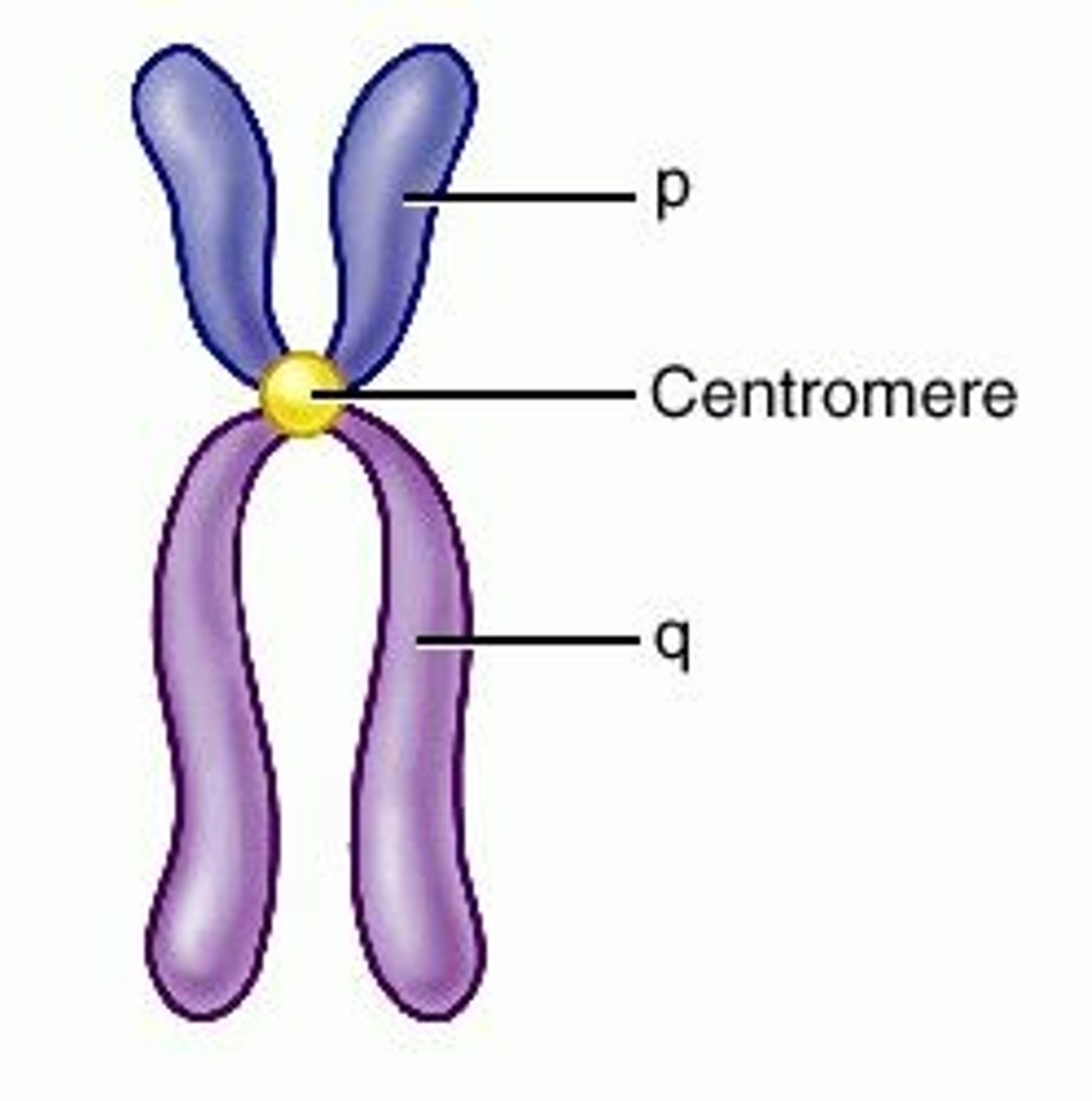
Core Question:
How many individual pieces of DNA are in the nucleus of each of your body cells?
Forty-six, one long piece of DNA for each chromosome.
Cell Cycle
How the lifetime of a cell is organized in a sequence of events from the time a cell is created from a dividing parent cell until its own division into two cells.
Two stages:
Interphase & Mitotic Phase
Interphase
The first stage of the cell cycle, during which a cell grows, matures, and replicates its DNA
- cell performs its normal functions
- spends 90% of its lifetime here
- near the end, the cell duplicates each chromosome.
Mitotic Phase
The second part of the cell cycle where the cell divides. Divided into 2 overlapping stages: mitosis and cytokinesis. Results in two genetically identical offspring cells that then begin their own cycles.
Mitosis
One stage of the mitotic phase where the nucleus (along with its already duplicated chromosomes) divides and is distributed to the 2 offspring cells.
Cytokinesis
One stage of the mitotic phase where the cytoplasm is divided and distributed.
Core Question:
Explain why the following statement is incorrect: "During mitosis, chromosomes are duplicated and distributed."
Because the chromosomes are already duplicated (during interphase) by the time the mitotic phase starts.
Prophase
The first stage of mitosis where the nucleus membrane begins to dissolve. Duplicated chromosomes condense and the mitotic spindle forms.
Mitotic Spindle
A spindle-shaped (like a football) structure formed of microtubules and associated proteins that is involved in the movement of chromosomes during mitosis and meiosis.
Metaphase
The second stage of mitosis where duplicated chromosomes line up at the center of the cell with each chromosome attached to the mitotic spindle.
Anaphase
The third stage of mitosis during which sister chromatids split apart, separate from each other, and move to the opposite sides of the cell.
Telophase
The final stage of mitosis during which chromosomes uncondense and new nuclei form at the 2 poles of a cell.
- different for animals and plants
Core Question:
What would happen if one pair of sister chromatids failed to split during mitosis?
One offspring cell would have one chromosome too many, and the other offspring cell would have one chromosome too few.
Cleavage
Cytokinesis in animal cells started by the appearance of a cleavage furrow until it contracts enough so that the parent cell is pinched into two. This leaves two independent offspring.
Cell Plate
A strip of membrane and cell wall materials that forms along the center line of the cell. The defining part of cytokinesis in plant cells where they use it to divide their cytoplasm. Builds up and eventually fuses with the plasma membrane, separating the two offspring cells.
Core Question:
Why can't a plant cell pinch inward and form a cleavage furrow?
All plant cells are surrounded by a stiff cell wall that prevents pinching inward.
Cleavage Furrow
The first sign of cytokinesis during cell divison in an animal cell; a shadow groove in the cell surface near the old metaphase plate.
Nuclear Transplantation
Procedure in which animals may be artificially cloned.
Nucleus is removed from an adult donor cell, injected into a nucleus-free egg cell, and then induced to grow into an embyro that may give rise to a whole organism.
Reproductive Cloning
A process where an embryo is produced through nuclear transplantation that develops into a new living indiviudal.
Stem Cells
A cell that embryos are rich in. A relatively unspecialized cell that can give rise to one or more types of specialized cells.
Therapeutic Cloning
The cloning of human cells by nuclear transplantation for therapeutic purposes, such as the replacement of body cells that have been irreversibly damaged by disease or injury.
Core Question:
If a nucleus is removed from a brown mouse, injected into a nucleus-free egg from a white mouse, and the resulting embryo is implanted in a black mouse, what color will the babies be?
Brown (since that is the source of the nucleus).
Life Cycle
The entire sequences of stages in the life of an organism, from the adults of one generation to the adults of the next.
Haploid (n)
A state where each gamete has a single set of chromosomes.
- sperm and egg
Diploid (2n)
Formed when gametes fuse into a zygote containing two sets of chromosomes.
Somatic Cells
Body cells other than the reproductive gametes. Mostly diploid in humans, most other animals, and many plants. Humans have 46 chromosomes organized as 23 homologous pairs of chromosomes.
Karyotype
A photographic inventory of the chromosomes in one person's cells.
Homologous Chromosomes
Two chromosomes in a matching pair that carry genes controlling the same inherited characteristics.
Core Question:
If you examine a human cell and observe that it has 23 chromosomes including one Y chromosome, where must it be from?
It must be from a sperm cell (since it is haploid and has a Y chromosome).
Meiosis
A type of cell division that in animals produces gametes from cells in the gonads, haploids with half the number of chromosomes as diploid body cells. . Drives sexual reproduction.
Meiosis I
The first round of meiosis as designated by "I"
Prophase I
The first stage of meiosis I where the nuclear memebrane dissolves.
Metaphase I
The second stage of meiosis I where the chromosomes condense and line up by homologous pairs along the center of the cell.
Anaphase I
The third stage of meiosis I where the homologous pairs of chromosomes separate with each member of a pair heading to the opposite ends of the cell. Notice that each chromosome still consists of two joined sister chromatids.
Telophase I
The final stage of meiosis I where the chromosome pairs separate and the nuclear membrane begins to re-form. At the same time, the cell divides into two cells during cytokinesis. There are now 2 offsprings cells.
Meiosis II
In each of the two cells produced by meiosis I:
Prophase II: The chromosomes, that are still duplicated with sister chromatids attached at a centromere, condense.
Metaphase II: They line up singly in the center of the cell
Anaphase II: The sister chromatids split apart, with one copy distributed to each side of the cell.
Cytokinesis II: Each cell splits to produce a total of 4 offspring cells, each with half the number of chromosomes as the starting cell.
Telophase II: The nuclear membranes re-form and the chromosomes uncondense.
Core Question:
What is the key feature of meiosis I with respect to the arrangement of chromosomes?
The chromosomes line up by homologous pairs (rather than singly, as they do in mitosis and meiosis II).
What is the key difference between mitosis and meiosis?
Mitosis involves one round of division that produces diploid cells, whereas meiosis involves two rounds that produce haploid cells.
- both involve the duplication and distribution of chromosomes to offspring cells.
Core Question:
With respect to the number of chromosomes, is there any difference between a cell about to start mitosis and a cell about to start meiosis?
No; both have duplicated chromosomes.
Independent Assortment
A source of genetic variation attributed from the different combinations of 23 homologous pairs of chromosomes lining one of two ways.
- shuffles chromosomes
Random Fertilization
A source of genetic variation when one gamete with random chromosomes fertilizes another gamete with random chromosomes. This results in tremendous variation in the 46 chromosomes that can end up in the zygote.
- shuffles chromosomes
Crossing Over
A process where homologous chromosomes line up during meiosis, the chromosomes derived from sperm and egg swap pieces. This produces hybrid chromosomes that are a blend of genetic material derived from the sperm and egg.
- creates hybrid chromosomes that may contain new combinations of genes. (recombinant chromosomes)
Core Question:
Is a chromosome in one of your gametes likely to be just like one that you received from your parents?
No. Due to crossing over, most chromosomes in your gametes are hybrids with parts from both of your parents' chromosomes (those from the egg and those from the sperm).
Nondisjunction
When chromosomes fail to separate properly during meiosis in the formation of sperm and eggs. The results is gametes with unusual number of chromosomes. A fertilized abnormal gamete usually cannot develop into a viable embryo.
Trisomy 21
A condition in which a person has 3 copies of chromosome 21 instead of 2 for a total of 47 chromosomes. This produces down syndrome, a condition that causes short stature, heart defects, a flattened face, among other features.
Character
An inherited feature in genetics that varies from individual to another.
Traits
Variations of characters.
Allele
Alternate forms of a particular gene.
Homozygous
Two alleles in a gene may be identical in an organism
Heterozygous
Two alleles for a gene may be different in an organism.
Dominant Allele
One allele that determines the organism's appearance for that character. Represented by an uppercase letter.
Recessive Allele
One allele that has no noticeable effect, but may be passed on to offspring. Represented by a lowercase letter.
Phenotype
An organism's observable traits.
Genotype
An organism's underlying genetic makeup.
Core Question:
If a Labrador retriever has a black coat, can you tell for certain what coat color genes it has?
No. It may be homozygous dominant (BB) or heterozygous (Bb)
Genetic Cross
A mating of 2 sexually reproducing individuals, called the P generation (parents) to produce F1 generation (first generation offspring). Represented in a Punnett Square.
Monohybrid Cross
A cross between 2 individuals that are heterozygous for one character.
Law of Segregation
A general rule of inheritance that states that two alleles in a pair segregate into different gametes during meiosis.
Testcross
A mating between an individual of dominant phenotype but unknown genotype and a homozygous recessive individual. The result can tell you the genetic makeup of an unknown genotype.
Dihybrid Cross
A cross between 2 organisms that are each heterozygous for two characters.
Law of Independent Assortment
States that the inheritance of one character has no effect on the inheritance of another.
Wild-type Trait
The trait most commonly found in nature.
Mutant Trait
The phenotypic trait that is less commonly observed in natural populations; the opposite of the wild-type trait.
Carrier
A heterozygous individual with one copy of the normal allele and one copy of the disease-causing allele.
Pedigree
A genetic family history. Can be used to track genetic traits in a family.
Incomplete Dominance
A type of inheritance in which the phenotype of a heterozygote (Aa) is intermediate between the phenotypes of the two types of homozygotes.
Multiple Alleles
The existence of more than 2 common versions of a gene.
- ex: the gene that determines human blood type comes in 3 common varieties.
Pleiotropy
When one gene influences many characters.
Polygenic Inheritance
The effect of many genes on a single a character.
Core Question:
Which two extensions of Mendelian genetics discussed here are essentially the opposite of each other?
Pleiotropy is one gene affecting many characters, whereas polygenic inheritance occurs when many genes affect a single character.
Codominant
A form of genetic inheritance in which heterozygous individuals display the traits of both alleles.
What are the extensions to classical Mendelian genetics?
Incomplete dominance, multiple alleles, pleiotropy, polygenic inheritance, and environmental influences.
Linked Genes
Whether or not an individual has a particular trait is affected by whether or not they have another trait because the genes are physically associated with each other on the same chromosome.
Core Question:
Can genes located on separate chromosomes be linked?
No. Only genes located near each other on the same chromosome can be linked and therefore inherited as a set.
Autosomes
Chromosomes that are common to every human. It makes up 44/46 of human chromosomes.
Sex Chromosomes
The two chromosomes that differ between males and females. Have several special properties and produce unique patterns of inheritance.
Sex-linked Genes
A gene located on a sex chromosome. Display unusual inheritance patterns because a lot of information is stored in the 2 X chromosomes.
Core Question:
Is it possible for a female carrier to have a female child with hemophilia?
Yes. If she mates with a male who has hemophilia, there is a one-quarter chance of having a daughter with hemophilia.
 Note
Note  Flashcards (84)