UNIT 2: CLIMATE CHANGE - KEY CONCEPTS

0.0(0)
studied byStudied by 0 people
0.0(0)
full-widthCall Kai
learnLearn
examPractice Test
spaced repetitionSpaced Repetition
heart puzzleMatch
flashcardsFlashcards
GameKnowt Play
Card Sorting

1/34

encourage image

There's no tags or description

Looks like no tags are added yet.

Study Analytics
Name
Mastery
Learn
Test
Matching
Spaced

No study sessions yet.

35 Terms

1
New cards

State the ‘Spheres’ of the Earth

There are four major subsystems

  • "lithosphere" (land)

  • "hydrosphere" (water)

  • "biosphere" (living things)

  • "atmosphere (air)

2
New cards

Explain the importance of Atmosphere in agriculture

The atmosphere consists of gases and tiny water particles that are helf in place by Earth’s gravitational force.

Without gravity, gases would escape into space. Therefore, planets with weaker gravity cannot hold onto their atmospheric gases as effectively, resulting in thinner or less dense atmospheres.

3
New cards

Identify the compositon of the atmosphere

Nitrogen, Oxygen, Argon, carbon dioxide, water vapour, and trace gases

4
New cards

Explain Shortwave radiation

Can be known as: Incoming Solar Radiation or ‘insolation

These are powerful energy emitted by the sun, in the form of visible light and UV light.

Distribution: Unevenly spread. The equator receives more radiation than the poles, due to the relative distance from the sun and the surface area.

This incoming radiation is then absorbed and circulated by the atmosphere and oceans, powering the planet’s weather and climate.

Absorption: Some incoming shortwave radiation is absorbed by atmospheric gases.

Reflection: Some incoming shortwave radiation is reflected by clouds.

5
New cards

Explain Longwave radiation

Relatively weaker energy emitted by the earth, in a form of infrared rays

How does this work: Powerful high-frequency shortwave radiation from the sun is absorbed and then re-emitted from both particles in the atmosphere and the surface of the earth at a lower, less powerful frequency (i.e. longer waves).

Absorption: Clouds in the troposphere absorb and prevent longwave radiation from escaping into space. If no clouds, 80% of emitted longwave radiation is lost to space. This is why clear days and nights in winter are so cold.

Greenhouse Gases: Water vapour, carbon dioxide and ozone absorb long-wave radiation very well, heating the earth. This is why they are known as ‘greenhouse’ gases.

6
New cards

What is the Greenhouse Effect?

A natural process that warms the earth’s surface.

Greenhouse gases absorb and reradiate longwave radiation that was initially shortwave, entering Earth’s atmosphere.

The absorbed energy warms the atmosphere and surface, maintaining the average global temperature at around 33°c

7
New cards

State all the GREENHOUSE GASES (GHGs)

A gas that absorbs and emits longwave radiation

Note: they do not absorb/emit shortwave radiation, it passes through them on their way to the earth’s surface.

GHG by concentration

  1. Water vapour

  2. Carbon Dioxide

  3. Methane

  4. Nitrous Oxide

  5. Ozone

  6. CFCs

8
New cards

What is Global Warming Potential?

A GHG potency in terms of how much heat it can re-radiate varies, as does its concentration in the atmosphere and the period it remains there. This is called ‘Global Warming Potential’

CO2 absorbs less heat than methane but remains in the atmosphere for a lot longer.

9
New cards

Which GHG has the biggest impact in the atmosphere?

Water vapour and carbon dioxide have the largest overall warming effect within the atmosphere.

Methane and nitrogen oxides have a lesser overall warming effect

10
New cards

What is meant by feedback loops?

All systems need to be balanced, to achieve this they need to self-regulate through feedback loops
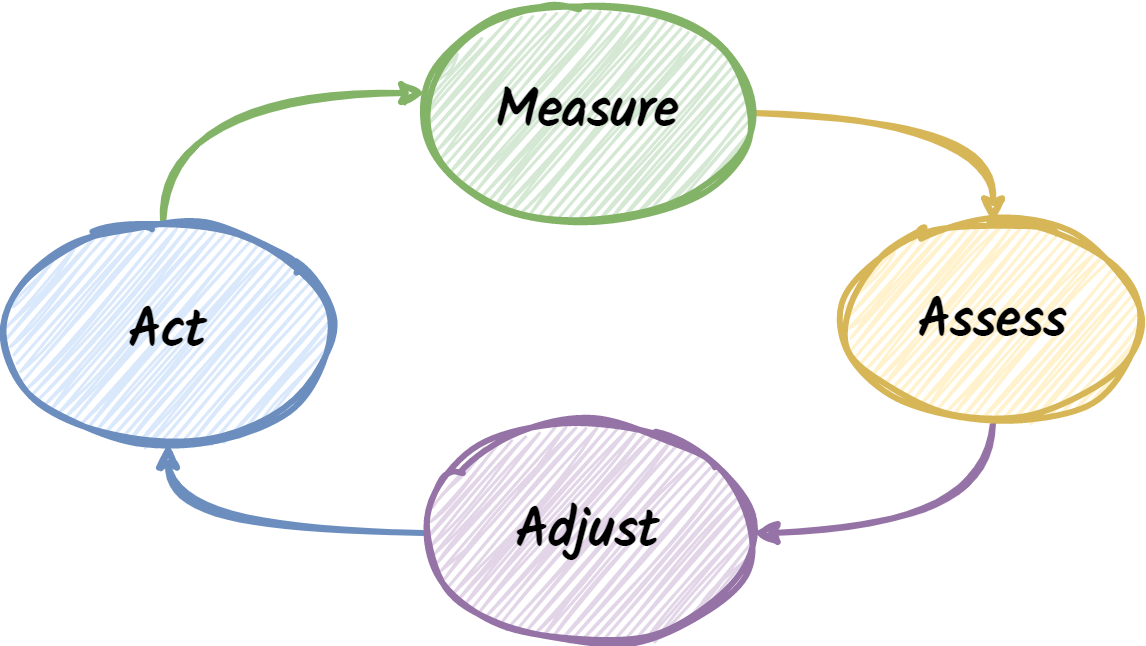
<p>All systems need to be balanced, to achieve this they need to <strong>self-regulate through feedback loops</strong></p>
11
New cards

Explain positive loops and provide 2 examples

A positive feedback loop increases the amount of change with each loop. This leads to an imbalance with the system spiralling out of control. (Less common in nature) = Unstable

Melting ice

As the planet warms, ice melts, revealing darker land or water that absorbs more heat. This causes more ice to melt, which leads to more warming, and so on.

Permafrost melting

As the planet warms, more permafrost melts, releasing methane, a greenhouse gas that traps heat in the atmosphere

12
New cards

Explain negative loops and provide 2 examples

A negative feedback loop decreases the amount of change by reducing some of the inputs with ‘checks’, returning the system to stability. Keeping it in a dynamic equilibrium = Stable

Coastal erosion:

If a storm erodes a large portion of a beach, the newly exposed cliff face can protect the base from further erosion, stabilizing the coastline

Predator-prey dynamics:

When a predator population increases, it puts pressure on the prey population, causing it to decline, which then leads to a decrease in the predator population.

13
New cards

Explain the Albedo Effect

In the context of climate change, it’s a measure of how much shortwave radiation from the sun is reflected back into space.

‘Bright white reflects light”

Lighter = High Reflectivity = High Albedo

Darker = Low Reflectivity = Low Albedo
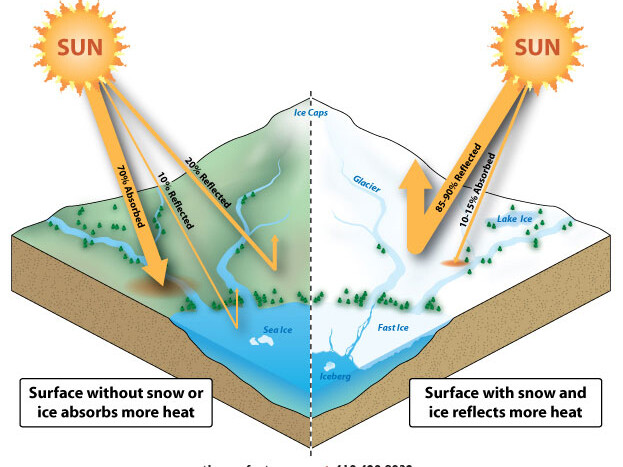
<p><strong>In the context of climate change, </strong>it’s a measure of how much <strong>shortwave radiation from the sun is reflected back into space.</strong></p><p></p><p><strong>‘Bright white reflects light”</strong></p><p>Lighter = High Reflectivity = High Albedo</p><p>Darker = Low Reflectivity = Low Albedo</p>
14
New cards

What does Permafrost contain?

Permafrost contains vast quantities of frozen, undecomposed, organic material (vegetation, bacteria, organisms, etc.) from when these regions were warmer - this is almost 50% of total global organic soil matter.

15
New cards

What is permafrost?

Any ground that remains completely frozen -0*C or colder for two consecutive years

  • A combination of soil, rock, and sand are held together by ice

  • There doesn’t need to be snow on the ground for the earth below the surface to be frozen.

16
New cards

What is the Solar Cycle?

The solar cycle is the cycle that the Sun’s magnetic field goes through approximately every 11 years.

17
New cards

How does the solar cycle alter climate?

Solar Minimum: The cycle where the sun has least sunspots

Solar Maximum: Middle of the cycle where the sun has the most sunspots

  • Variation in solar irradiance:

    During a solar cycle, the Sun's overall brightness fluctuates slightly, with more energy emitted during solar maximum and less during solar minimum. 

  • Impact on temperature:

    This variation in solar radiation can cause a small change in Earth's average temperature, usually less than 0.1 degrees Celsius. 

18
New cards

What is global dimming?

When incoming shortwave radiation is reflected back into space, preventing it from reaching the earth’s surface due to visible air pollution, such as soot, ash, sulphur compounds and other pollutants.

19
New cards

What are the issues caused by global dimming?

Changing Cloud Albedo: More shortwave radiation is reflected back into space due to polluted particles ‘seeding’ clouds, making the clouds denser and therefore changing their albedo.

Ocean Currents: Oceans absorb and release heat, driving the global climate system and making earth habitable. These clouds shield the oceans from shortwave radiation thus disrupting weather systems.

Regional Drought: This changing of weather patterns is suspected to have been responsible for many of the world’s droughts over the last 50 years.

Global Dimming Paradox: The big one - due to the dimming effect reducing temperatures we may well be underestimating the effects of manmade climate change.

20
New cards

What does Globlal Warming Potential mean?

Global warming potential is the calculation of the amount and time of gas that remains in the atmosphere.

CO2 is the benchmark gas for comparing GWP as it is the most abundant GHG in the atmosphere

The higher the GWP number, the greater potential warming impact it has.

21
New cards

What does anthropogenic climate change mean?

Anthropogenic means ‘man-made’ climate change

A theory that explains the long term increase in the average temperature of the Earth’s atmosphere as an effect of human industry and agriculture. AKA ‘the enhanced greenhouse effect’.

though industry, agriculture and transportation

22
New cards

What is the Hydrosphere?

The hydrophere is the total amount of water on the planet. This includes liquid, vapor, ice, ice sheets, glaciers, clouds, etc.

23
New cards

What are ‘Continental Glaciers’

This is also known as ‘ice sheets’, these are glacial land ice that extends more than 50,000km2

It is presently found on Greenland and Antarctic - due to these being the coldest regions of Earth

  • Contains 70% of all freshwater on Earth

  • Sea level rise, it will increase greatly if ice sheet completely melted

  • Ice sheets regulate temperatures that affect global climate patterns (due to albedo effect)

24
New cards

What is an ‘‘Ice Cap'“

A mass of glacial land ice that extends less than 50,000km2

Commonly in regions with cold temperatures

Melting ice caps provide essential water for many of the world’s densely populated regions, especially from the Himalayas to India, Bangladesh, China, and SE Asia.

  • Energy: Many glacially fed rivers are dammed for hydroelectric power, providing energy for industry.

25
New cards

What is the Cryosphere?

Locations on the planet where liquid water is turned into soil form

It can be found in extreme latitudes like the arctic/antarctic

  • Permafrost

  • Sea ice

  • Snow

  • Land cover

  • Ice sheets

Cryospheres include glaciers, ice, snow, icebergs, permafrost, mountains, etc.

26
New cards

Define the ‘Carbon Cycle’

The process in which carbon atoms continually move from the atmosphere to the earth and back again. There are two types of carbon cycles: Slow and Fast

27
New cards

Explain the slow carbon cycle

Over years, carbon moves between the atmosphere, lithosphere and oceans. Rocks are weathered and enter the atmosphere, and rivers. This solid matter: rocks (sediment) reaches the ocean floor and absorbed into the earth’s crust, then reentering the atmosphere and lithosphere through volcanic eruptions.

28
New cards

Explain the fast carbon cycle

Absorb atmospheric carbon dioxide through photosynthesis, as it is moved through the good chain and released through respiration. Prior to this, organisms use carbon to build cells, proteins and and DNA molecules. Fast carbon moves 1000 times more carbon per year than slow carbon cycle

29
New cards

What are extreme weather events?

Weather that is significantly different from the usual weather pattern in a given place over a period of day or longer.

Including unexpected, unusual, severe or unseasonal weather.

E.g. heatwaves, cold waves, droughts, temperate cyclones, tropical cyclones /8typhoons, hurricanes & cyclones)

CAUTION: Floods(caused by extreme weather), tsunamis, and earthquakes are not extreme weather, but are natural disasters

30
New cards

What are droughts and its different categories

Metrological drought Occurs when there is a prolonged period of time below average precipitation, it comes before the following

Agricultural drought: initially can be caused below average precipitation, but exacerbated by poorly planned irrigation systems and farming practices.

Hydrological drought: Caused by below average rainfall, followed decreases in quivers, lakes and reservoirs falling below replenish-able levels .

31
New cards

What are economical impacts of droughts?

  • Food insecurity

  • Energy insecurity

  • High food production costs

  • Reduction or loss of industrial production

  • Loss of tourism revenue

32
New cards

What are environmental impacts of droughts?

  • Lower water levels

  • Increased concentration of pollutants in water

  • Drying out of ecologically essential wetlands

  • More intense bushfires

  • Loss of biodiversity

33
New cards

What are the social impacts of droughts?

  • Direct effect of heat waves

  • Reduced access to drinking water

  • High food prices in supermarkets

  • Stress caused by failed harvests

  • Increase inequalities between HIC & LICs

34
New cards

What are biomes?

A community of plants & animals (flora & fauna) that have common characteristics for the climate or landscape that they live in

Different types of flora and fauna in each biome depends on the following:

  • Temperature range

  • Precipitation levels

  • Soil fertility

35
New cards

What are habitats?

A type of natural environment in which a particular species or organism lives. it provides food, shelter, protection and potential reproduction.

Explore top notes

Imperialism Rise in Nationalism • During the French and Industrial Revolution, nationalism continued to inspire nations to increase their political and economic power. • Nationalism became the ideal force in the political, economic, and cultural life in the world, becoming the first universal ideology-organizing all people into a nation state. Nationalism Defined • The strong belief that the interest of a particular nation-state is of primary importance. o Nation-State – a state where the vast majority shares the same culture and is conscious of it. It is an ideal in which cultural boundaries match up with political ones. • As an ideology, it is based on the idea that the individual’s loyalty and devotion to the nation-state surpass other individual/group interests. • Exalting one nation’s belief above all others and placing primary emphasis on promotion of its culture and interests, excluding the interests of others. Changing the World through a Nationalistic Vision • The French Revolution significantly changed the political world and how countries govern. • The Industrial Revolution significantly changed the economic world. • The Age of Imperialism (1870-1914) dramatically changed the political, economic, and social world. What is Imperialism? • Imperialism- The policy of extending the rule of authority of an empire or nation over foreign countries, or of acquiring and holding colonies and dependencies. Power and influence are done through diplomacy or military force. Reasons for Imperialism • There are 5 main motives for empires to seek to expand their rule over other countries or territories: 1. Exploratory • Imperial nations wanted to explore territory unknown to them. • The main purpose for this exploration of new lands was for resource acquisition, medical or scientific research. o Charles Darwin • Other reasons: o Cartography (map making) o Adventure 2. Ethnocentric • Europeans acted on the concept of ethnocentrism o Ethnocentrism- the belief that one race or nation is superior to others. • Ethnocentrism developed out of Charles Darwin’s “survival of the fittest” theory. Philosophers used the theory to explain why there were superior races and inferior races. o This became known as Social Darwinism. • Most imperial nations believed that their cultural values or beliefs were superior to other nations or groups. • Believed imperial conquest would bring successful culture to inferior people. 3. Religious • Imperial expansion promoted a religious movement of people setting out to convert new members of conquered territories. • With the belief that Christianity was superior, missionaries believed it was their duty to spread Christianity to the world. • Christian missionaries established churches, and in doing so, they spread Western culture values as well. • Typically, missionaries spread the imperial nation's language through education and religious interactions. 4. Political • Patriotism and Nationalism helped spur our imperial growth, thus creating competition against other supremacies. • It was a matter of national pride, respect, and security. • Furthermore, European rivalry spurred nations for imperial conquest. Since land equaled power, the more land a country could acquire the more prestige they could wield across the globe. • Empires wanted strategic territory to ensure access for their navies and armies around the world. • The empire believed they must expand, thus they needed to be defended. 5. Economic • With the Industrial Revolution taking place during the same time, governments and private companies contributed to find ways to maximize profits. • Imperialized countries provided European factories and markets with natural resources (old and new) to manufacture products. • Trading posts were strategically placed around imperialized countries to maximize and increase profits. o Such places as the Suez Canal in Egypt which was controlled by the British provided strategic choke hold over many European powers. o Imperial powers competed over the best potential locations for resources, markets, and trade. History of Imperialism • Ancient Imperialism 600 BCE-500 CE o Roman Empire, Ancient China, Greek Empire, Persian Empire, Babylonian Empire. • Middle Age Imperialism (Age of Colonialism-1400-1800s) o Great Britain, Spain, Portugal, France, Netherlands (Dutch), Russia. • Age of Imperialism 1870-1914 o Great Britain, Spain, Portugal, France, Germany, Belgium, Italy, Japan, United States, Ottoman Empire, Russia. • Current Imperialism...? o U.S. Military intervention (i.e. Middle East) o Russia’s Invasion of Ukraine. Imperialism Colonialism • Refers to political or economic control, either legally or illegally. • Refers to where one nation assumes control over the other. • Creating an empire, expanding into neighboring regions and expanding the dominance far outside its borders. • Where a country conquers and rules over other regions for exploiting resources from the conquered country for the conqueror's benefit. • Foreign government controls/governs a territory without significant settlement. • Foreign government controls/governs the territory from within the land being colonized. • Little to no new settlement established on fresh territory. • Movement to settle to fresh territory. Age of Colonialism WHEN? • Started around the late 1400s and ended around the late 1700s/early 1800s. WHY? • Primary Reason: European countries, wished to find a direct trade route to Asia (China & India) and the East Indies. o Quicker and relatively more effective than land routes over Asia. • Secondary Reason: Empire expansion (land power) WHO? • Countries involved: Great Britain, France, Spain, the Dutch & Portugal. • Individuals’ knowns as Mercantilists believed that maintaining imperialized territory and colonizing the region could serve as a source of wealth, while personal motives by rulers, explorers, and missionaries could therefore promote their own agenda. o This agenda being “Glory, God and Gold”. Mercantilism • Mercantilism was a popular and main economic system for many European nations during the 16th to 18th centuries. • The main goal was to increase a nation’s wealth by promoting government rule of a nation’s economy for the purpose of enhancing state power at the expense of rival national power. • It was the economic counterpart of political absolutism. Why did mercantilists want colonies? • Mercantilists believed that a country must have an excess of exports over imports. • By colonizing territory, it provided the nation with indispensable wealth of precious raw materials. • Therefore, the claimed territory served as a market and supplier of raw materials for the mother country. Which, in time, provided an excess of exports for the nation and thus created wealth. o Development of Trading Companies to support this economic system. Hudson Bay Company – (1670). Controlled primarily North America. o Dutch East Indie Trading Company (1682) o East Indian Trading Company (1600) o Royal African Trade Company (1672) WHERE? • European nations begun to colonize the America, India and the East Indies to create a direct trade route. • Great Britain was the leading power in India, Australia and North America, South Africa. • Spain colonized central and South America. • French held Louisiana, coastal land of Africa and French Guinea. • The Dutch built an empire in the East Indies. • The Portuguese was able to take control of present-day Brazil and the southern tip of South America and Japan. Age of Colonialism • As countries started to imperialize these regions, eventually the concept of colonization took hold: • This is what makes the Age of Colonialism extremely different! End of Colonialism • By 1800, colonialism became less popular • Why? o Revolutions (Spain, France & American) o The Napoleonic Wars o Struggle for nationalism and democracy. o Exhausted all money and energy to supervise their colonies. Waiting to wake again • Imperialism would stay quiet for close to 50 years before Great Britain and France’s economies revitalized. • The outbreak of the Industrial Revolution only encouraged and revitalized European nations to begin their conquest for new territory and resources. Age of Imperialism THE SCRAMBLE FOR AFRICA 1870-1914 Conditions Prior to Imperialism of Africa  European interest in exploiting Africa was minimal.  Their economic interests & profit in Africa primarily came through coastal trade that took place during the 1500-1700s.  The slave trade became the main source of European profit.  Furthermore, disease, political instability, lack of transportation and unpredictable climate all discouraged Europeans from seeking territory. Slave Trade & the Trans-Atlantic Slave Voyages  Forced labor was not uncommon during the 13-17th Centuries. Africans and Europeans had been trading goods and people across the Mediteranea for centuries.  This all changed from 1526 to 1867, as a new system of slavery was introduced that became highly “commercialized, racialized and inherited”  By 1690, the America and West Indies saw approximately 30,000 African people shipped from Africa. A century later, that number grew to 85,000 people per year.  By 1867, approximately 12.5 million people (about twice the population of Arizona) left Africa in a slave ship. What Changed? 1. End of the Slave Trade- Left a need for trade between Europe and Africa. 2. Innovation in technology- The steam engine and iron hulled boats allowed Europe 3. Discovery of new raw materials- Explorers located vast raw materials and resources and this only spurred imperialism with Europe in the wake of the Industrial Revolution. 4. Politics- Unification of Germany and Italy left little room to expand in Europe. Germany and Italy both needed raw materials to “catch up” with Britain and France so they looked to Africa. The Scramble for Africa  The scramble started in 1870.  Although some coastal land had previously been acquired before 1870, the need for territory quickly accelerated as European countries looked t get deeper into Africa.  Within 20 years, nearly all continents were placed under imperialistic rule. Who was Involved?  Great Britain  France  Germany  Italy  Portugal  Belgium  Spain (kind) Violent Affairs  Violence broke out multiple times when European nations looked to claim the same territory.  Germ Chancellor. Otto van Bismarck. Attempted to avert the possibility of violence against the European powers.  In 1884, Bismarck organized a conference in Berlin for the European nations. The Berlin Conference (1884-85)  The conference looked to set ground rules for future annexation of African territory by European Nations.  Annexation is the forcible acquisition and assertion of legal title over one state’s territory by another state, usually following military occupation of the territory.  From a distant perspective, it looked like it would reduce tensions among European nations and avert war.  At the heart of the meeting, these European countries negotiated their claims to African territory, made it official and then mapped their regions.  Furthermore, the leaders agreed to allow free trade among imperialized territory and some homework for negotiating future European claims in Africa was established. Further Path  After the conference, european powers continued to expand their claims in Africa so that by 1900. 90% of the African territory had been claimed. A Turn towards Colonization?  Upon the imperialization of African territory, European nations and little interest in African land unless it produced economic wealth.  Therefore, European governments put little effort and expertise into these imperialized regions.  In most cases, this emat a form of indirect rule. Thus, governing the natin without sufficient settlement and government from within the mother country. Some Exceptions  There were some exemptions through in Africa as colonization was a necessary for some regions i n Africa.  Some regions where diamonds and gold were present. Government looked to protectorate the regions and establish rule and settlement in the regions.  Protectorates: A state controlled and protected by another state for defense against aggression and other law violations. Would  Some examples include South Africa, Botswana, Zimbabwe and Congo. Conclusion  Although it may appear that the Berlin Conference averted war amid the African Scramble, imperialism eventually brought the world into worldwide conflict.  With the continued desire to create an empire by European nations. World War 1 would break out which can be linked to this quest at imperialism.
Updated 450d ago
note Note
Imperialism Rise in Nationalism • During the French and Industrial Revolution, nationalism continued to inspire nations to increase their political and economic power. • Nationalism became the ideal force in the political, economic, and cultural life in the world, becoming the first universal ideology-organizing all people into a nation state. Nationalism Defined • The strong belief that the interest of a particular nation-state is of primary importance. o Nation-State – a state where the vast majority shares the same culture and is conscious of it. It is an ideal in which cultural boundaries match up with political ones. • As an ideology, it is based on the idea that the individual’s loyalty and devotion to the nation-state surpass other individual/group interests. • Exalting one nation’s belief above all others and placing primary emphasis on promotion of its culture and interests, excluding the interests of others. Changing the World through a Nationalistic Vision • The French Revolution significantly changed the political world and how countries govern. • The Industrial Revolution significantly changed the economic world. • The Age of Imperialism (1870-1914) dramatically changed the political, economic, and social world. What is Imperialism? • Imperialism- The policy of extending the rule of authority of an empire or nation over foreign countries, or of acquiring and holding colonies and dependencies. Power and influence are done through diplomacy or military force. Reasons for Imperialism • There are 5 main motives for empires to seek to expand their rule over other countries or territories: 1. Exploratory • Imperial nations wanted to explore territory unknown to them. • The main purpose for this exploration of new lands was for resource acquisition, medical or scientific research. o Charles Darwin • Other reasons: o Cartography (map making) o Adventure 2. Ethnocentric • Europeans acted on the concept of ethnocentrism o Ethnocentrism- the belief that one race or nation is superior to others. • Ethnocentrism developed out of Charles Darwin’s “survival of the fittest” theory. Philosophers used the theory to explain why there were superior races and inferior races. o This became known as Social Darwinism. • Most imperial nations believed that their cultural values or beliefs were superior to other nations or groups. • Believed imperial conquest would bring successful culture to inferior people. 3. Religious • Imperial expansion promoted a religious movement of people setting out to convert new members of conquered territories. • With the belief that Christianity was superior, missionaries believed it was their duty to spread Christianity to the world. • Christian missionaries established churches, and in doing so, they spread Western culture values as well. • Typically, missionaries spread the imperial nation's language through education and religious interactions. 4. Political • Patriotism and Nationalism helped spur our imperial growth, thus creating competition against other supremacies. • It was a matter of national pride, respect, and security. • Furthermore, European rivalry spurred nations for imperial conquest. Since land equaled power, the more land a country could acquire the more prestige they could wield across the globe. • Empires wanted strategic territory to ensure access for their navies and armies around the world. • The empire believed they must expand, thus they needed to be defended. 5. Economic • With the Industrial Revolution taking place during the same time, governments and private companies contributed to find ways to maximize profits. • Imperialized countries provided European factories and markets with natural resources (old and new) to manufacture products. • Trading posts were strategically placed around imperialized countries to maximize and increase profits. o Such places as the Suez Canal in Egypt which was controlled by the British provided strategic choke hold over many European powers. o Imperial powers competed over the best potential locations for resources, markets, and trade. History of Imperialism • Ancient Imperialism 600 BCE-500 CE o Roman Empire, Ancient China, Greek Empire, Persian Empire, Babylonian Empire. • Middle Age Imperialism (Age of Colonialism-1400-1800s) o Great Britain, Spain, Portugal, France, Netherlands (Dutch), Russia. • Age of Imperialism 1870-1914 o Great Britain, Spain, Portugal, France, Germany, Belgium, Italy, Japan, United States, Ottoman Empire, Russia. • Current Imperialism...? o U.S. Military intervention (i.e. Middle East) o Russia’s Invasion of Ukraine. Imperialism Colonialism • Refers to political or economic control, either legally or illegally. • Refers to where one nation assumes control over the other. • Creating an empire, expanding into neighboring regions and expanding the dominance far outside its borders. • Where a country conquers and rules over other regions for exploiting resources from the conquered country for the conqueror's benefit. • Foreign government controls/governs a territory without significant settlement. • Foreign government controls/governs the territory from within the land being colonized. • Little to no new settlement established on fresh territory. • Movement to settle to fresh territory. Age of Colonialism WHEN? • Started around the late 1400s and ended around the late 1700s/early 1800s. WHY? • Primary Reason: European countries, wished to find a direct trade route to Asia (China & India) and the East Indies. o Quicker and relatively more effective than land routes over Asia. • Secondary Reason: Empire expansion (land power) WHO? • Countries involved: Great Britain, France, Spain, the Dutch & Portugal. • Individuals’ knowns as Mercantilists believed that maintaining imperialized territory and colonizing the region could serve as a source of wealth, while personal motives by rulers, explorers, and missionaries could therefore promote their own agenda. o This agenda being “Glory, God and Gold”. Mercantilism • Mercantilism was a popular and main economic system for many European nations during the 16th to 18th centuries. • The main goal was to increase a nation’s wealth by promoting government rule of a nation’s economy for the purpose of enhancing state power at the expense of rival national power. • It was the economic counterpart of political absolutism. Why did mercantilists want colonies? • Mercantilists believed that a country must have an excess of exports over imports. • By colonizing territory, it provided the nation with indispensable wealth of precious raw materials. • Therefore, the claimed territory served as a market and supplier of raw materials for the mother country. Which, in time, provided an excess of exports for the nation and thus created wealth. o Development of Trading Companies to support this economic system. Hudson Bay Company – (1670). Controlled primarily North America. o Dutch East Indie Trading Company (1682) o East Indian Trading Company (1600) o Royal African Trade Company (1672) WHERE? • European nations begun to colonize the America, India and the East Indies to create a direct trade route. • Great Britain was the leading power in India, Australia and North America, South Africa. • Spain colonized central and South America. • French held Louisiana, coastal land of Africa and French Guinea. • The Dutch built an empire in the East Indies. • The Portuguese was able to take control of present-day Brazil and the southern tip of South America and Japan. Age of Colonialism • As countries started to imperialize these regions, eventually the concept of colonization took hold: • This is what makes the Age of Colonialism extremely different! End of Colonialism • By 1800, colonialism became less popular • Why? o Revolutions (Spain, France & American) o The Napoleonic Wars o Struggle for nationalism and democracy. o Exhausted all money and energy to supervise their colonies. Waiting to wake again • Imperialism would stay quiet for close to 50 years before Great Britain and France’s economies revitalized. • The outbreak of the Industrial Revolution only encouraged and revitalized European nations to begin their conquest for new territory and resources. Age of Imperialism THE SCRAMBLE FOR AFRICA 1870-1914 Conditions Prior to Imperialism of Africa  European interest in exploiting Africa was minimal.  Their economic interests & profit in Africa primarily came through coastal trade that took place during the 1500-1700s.  The slave trade became the main source of European profit.  Furthermore, disease, political instability, lack of transportation and unpredictable climate all discouraged Europeans from seeking territory. Slave Trade & the Trans-Atlantic Slave Voyages  Forced labor was not uncommon during the 13-17th Centuries. Africans and Europeans had been trading goods and people across the Mediteranea for centuries.  This all changed from 1526 to 1867, as a new system of slavery was introduced that became highly “commercialized, racialized and inherited”  By 1690, the America and West Indies saw approximately 30,000 African people shipped from Africa. A century later, that number grew to 85,000 people per year.  By 1867, approximately 12.5 million people (about twice the population of Arizona) left Africa in a slave ship. What Changed? 1. End of the Slave Trade- Left a need for trade between Europe and Africa. 2. Innovation in technology- The steam engine and iron hulled boats allowed Europe 3. Discovery of new raw materials- Explorers located vast raw materials and resources and this only spurred imperialism with Europe in the wake of the Industrial Revolution. 4. Politics- Unification of Germany and Italy left little room to expand in Europe. Germany and Italy both needed raw materials to “catch up” with Britain and France so they looked to Africa. The Scramble for Africa  The scramble started in 1870.  Although some coastal land had previously been acquired before 1870, the need for territory quickly accelerated as European countries looked t get deeper into Africa.  Within 20 years, nearly all continents were placed under imperialistic rule. Who was Involved?  Great Britain  France  Germany  Italy  Portugal  Belgium  Spain (kind) Violent Affairs  Violence broke out multiple times when European nations looked to claim the same territory.  Germ Chancellor. Otto van Bismarck. Attempted to avert the possibility of violence against the European powers.  In 1884, Bismarck organized a conference in Berlin for the European nations. The Berlin Conference (1884-85)  The conference looked to set ground rules for future annexation of African territory by European Nations.  Annexation is the forcible acquisition and assertion of legal title over one state’s territory by another state, usually following military occupation of the territory.  From a distant perspective, it looked like it would reduce tensions among European nations and avert war.  At the heart of the meeting, these European countries negotiated their claims to African territory, made it official and then mapped their regions.  Furthermore, the leaders agreed to allow free trade among imperialized territory and some homework for negotiating future European claims in Africa was established. Further Path  After the conference, european powers continued to expand their claims in Africa so that by 1900. 90% of the African territory had been claimed. A Turn towards Colonization?  Upon the imperialization of African territory, European nations and little interest in African land unless it produced economic wealth.  Therefore, European governments put little effort and expertise into these imperialized regions.  In most cases, this emat a form of indirect rule. Thus, governing the natin without sufficient settlement and government from within the mother country. Some Exceptions  There were some exemptions through in Africa as colonization was a necessary for some regions i n Africa.  Some regions where diamonds and gold were present. Government looked to protectorate the regions and establish rule and settlement in the regions.  Protectorates: A state controlled and protected by another state for defense against aggression and other law violations. Would  Some examples include South Africa, Botswana, Zimbabwe and Congo. Conclusion  Although it may appear that the Berlin Conference averted war amid the African Scramble, imperialism eventually brought the world into worldwide conflict.  With the continued desire to create an empire by European nations. World War 1 would break out which can be linked to this quest at imperialism.
Updated 450d ago
note Note



