AA. Theme 4 - Macroeconomics Full textbook notes
 Call Kai
 Learn
Learn Practice Test
 Spaced Repetition
 Match
Match Flashcards
 Knowt Play
1/184

There's no tags or description
Looks like no tags are added yet.
Name | Mastery | Learn | Test | Matching | Spaced | Call with Kai |
|---|
No analytics yet
Send a link to your students to track their progress
185 Terms
Meaning of globalisation
Refers to a variety of ways in which countries are becoming more and more closely integrated, not just in the economic sense, but also culturally and politically.
Characteristics of globalisation (in the economic sense)
An increase in trade as a proportion of world GDP
Increased movements of financial capital and people between countries
Increased international specialisation and division of labour
The growing importance of global or transnational companies
An increase in foreign direct investment
What factors have contributed to globalisation?
Fall in transport costs
Fall in communication costs
Lowering of trade barriers since the Second World War
Decline in communism and the opening up of China
TNCs have taken advantage of the reduction of trade barriers to organise trade on a global scale
Growth in the number and size of trading blocs
What is the law of comparative advantage?
When countries specialise in the goods in which they have comparative advantage (i.e. goods can be produced at lower opportunity cost) then world output and living standards will increase.
Impacts of globalisation on governments:
Economic growth → higher incomes → higher tax revenues
However, transfer pricing may result in lower tax revenue from corporation tax
When a global company manages its accounting of internal transactions within the company to show the highest profits in the country in which corporation tax is lowest
Benefits of globalisation for producers and consumer
Producers: Lower production costs as a result of offshoring and economies of scale
The practice of moving business practices/operations to another country to benefit from lower labour costs, favourable regulations and access specialised skills
Consumers: A wider choice of goods and lower prices = increase in consumer surplus.
What assumptions underlie the theory of comparative advantage?
No transport costs
No trade barriers
Constant returns to scale - averaage cost of production is constant
Perfect mobility of resources between different uses
Buyers/consumers have perfect knowledge
What are terms of trade and how are they measured
The relationship between the price of exports and the price of imports
Index of export prices
—————————— x 100 = TOT
Index of import prices
Limitations of the principle of comparative advantage:
Transport costs might outweigh the benefits of comparative advantage
Similarly, trade barriers might distort comparative advantage
Increased specialisation and production might result in rising average costs caused by diseconomies of scale
Advantages of specialisation and trade
Efficient resource allocation: specialisation and free trade based on comparative advantage result in an efficient allocation of resources
Higher world output —> higher living standards
Lower prices and more choice for consumers
Incentive for domestic producers to become more efficient
Larger markets for firms, enabling them to benefit from economies of scale
Disadvantages of specialisation and trade
The law of comparative advantage is based on unrealistic assumptions
For developing economies, specialisation in the production of primary products might prevent diversification into more productive manufacturing strategies
A danger of overdependence on imports, especially those of strategic importance
A country’s goods and services may be uncompetitive, resulting in a persistent trade deficit
What factors influence the pattern of world trade?
Changes in comparative advantage
E.g. discovery of new natural resources, adoption of new technology, investment in infrastructure
The growth of emerging and developing economies
The growth since the Second W.W. in the number and size of trading blocs
A long-term change in a country’s exchange rates against those of other countries will affect the relative competitiveness of that country’s goods and services
Factors influencing a country’s terms of trade
Relative inflation rates
E.g. a higher inflation rate then export prices will be rising relative to import prices so a rise in the TOT
Changes in raw material prices
A developed country that imports most of its raw materials, a rise in raw material prices would cause a fall in TOT
Changes in exchange rates
Increase in exchange rate relative to other countries leads to export prices rising and import prices falling
Tariffs
A tariff imposed on imported goods would cause an increase in import prices and so would lead to a fall in TOT
Dependency on primary products (over long term)
Impact of changes in a country’s terms of trade
Increase in TOT = Increase in living standards: A country has to export less to gain a given quantity of imports
On the balance of payments on current account: Upward movement in a country’s terms of trade would decrease the competitiveness of its goods and services because its export prices would be rising relative to its import prices. So, BOP on CA likely to deteriorate
Resource-rich developing countries: ownership of minerals and fuels causes an appreciation in the exchange rates of the currencies of these countries, so an increase in the TOT. However, this leads to a loss of competitiveness of their manufactured goods and services, leading to slower economic growth than may have otherwise happened
What are regional trade blocs?
Intergovernmental associations that manage and promote trade activities for specific regions of the world
What are Free Trade Areas
Trade barriers are removed betwen member countries, but individual members can still impose their own tariffs and quotas on countries outside the area.
Example: NAFTA
What are Customs Unions
When there is free trade between member states and a common external tariff on goods imported from outside the bloc
Example: EU
What are common markets
Customs unions, but with the addition that it is not only goods and services that can be moved freely within the area, but also factors of production (especially labour.)
Example: Mercosur, a south american customs union
What are monetary unions
Customs unions that adopt a common currency
Costs of regional trade agreements
Trade diversion: trade may be diverted from low-cost producers outside the bloc to high-cost producers within the bloc
Distortion of comparative advantage: Lead to less efficient allocation of resources, lowering global economic growth
Loss of independent monetary policy: Countries would be unable to control their own interest rates and exchange rates
Benefits of regional trade agreements
Trade creation and more specialisation between member countries
Increase in FDI: Global companies may invest to be inside a trading bloc to avoid trade restrictions
————————————————— main ones
Elimination of transaction costs: so no costs in changing currencies when goods imported or exported
Price transparency makes it easier for consumers to compare prices across the whole bloc region
Elimination of currency fluctuations between member countries may help to attract FDI
What are the two key functions of the WTO?
Promote free trade among the 164 member countries through ‘rounds of talks’
Settle trade disputes between members
What is protectionism
Measures designed to limit free trade
Arguments for protectionism / restrictions on free trade
Protect infant industries - particularly for developing countries that are industrialising
Protect geriatric industries - particularly for developed countries that are losing their comparative advantage: these industries gain time to restructure and rationalise production
Employment protection by protecting industries
Prevents ‘dumping’ - goods exported to another country at below the average cost of production, a form of predatory pricing
Correct a balance of payments deficit on the current account
Restrict imports from countries who have less stringent health and safety - e.g. america’s pink sludge chicken
To raise tax revenue from tariffs for developing countries
In retaliation because another country has restricted the imports of its goods
Types of restrictions on trade:
Tariffs
Quotas on how much can be imported
Subsidies to domestic producers artificially lower domestic production costs = more competitive
Non-tariff barriers: health regulations, labelling, environmental standards, documentation for goods
Impact of protectionist policy on consumers, producers, government, living standards, equality:
Consumers: Higher prices and less choice
Producers: Less incentive for domestic producers to become more efficient
Governments: Yay: Tax revenue from tariffs, Nay: Subsidies are a cost and once barriers are in place its hard to remove them bc they’ll have negative effects on domestic producers
Living standards: Less efficient world resource allocation bc distorted comparative advantage and less specialisation —> lower world output → lower living standards
Equality: trade barriers by developed countries onto developing countries could increase inequality between these countries
What is the balance of payments
A record of all financial transactions between one country and other countries
Causes of current account deficit
Low productivity relative to other countries - not competitive internationally
High inflation relative to other countries
an overvalued exchange rate
Dependence on highly priced imported raw materials
Relocation of manufacturing industries to low-wage countries
protectionism by other countries
Measures to reduce a country’s imbalance on the current account
Supply side policies to increase productivity and competitiveness of countries exports
Market based: privatisation, deregulation
Interventionist: education to improve productivity, infrastructure investment
Expenditure-reducing policy - e.g. deflationary fiscal policy = less imports
Define nominal exchange rate
The number of units of the domestic currency that can purchase a unit of a given foreign currency
Define real exchange rate
Calculated to measure the movements of the competitiveness of the country’s currency in relation to another country’s currency on the basis of inflation differential between the countries.
The nominal exchange rate adjusted to reflect the different inflation rates inn the countries of the two currencies concerned
Define effective exchange rates
Measure the movements of a country’s currency value in a basket of currencies of trade-partner countries
Define trade-weighted exchange rate
The average exchange rate in a basket of currencies, weighted by the amount of trade with each country.
What are the 3 exchange rate systems?
Floating exchange rates - market forces determine the value at which one currency exchanges for another
Fixed exchange rates - the value at which one currency exchanges for another is fixed by the central bank or government against another currency or gold
Managed exchange rates - market forces determine the value at which one currency exchanges for another but intervention by the central bank influences the exchange rate
Revaluation V.S. Appreciation of currency
Revaluation: Only occurs under a system of fixed exchange rates when gov decides to increase value of currency
Appreciation: Under a system of floating exchange rates due to market forces
Factors influencing floating exchange rates
Relative inflation rates
Relative interest rates - foreigners place money in UK banks w high interest, increasing demand for pound
The state of the economy - if UK economy performing well, this will increase the confidence of speculators and foreign investors, increasing demand for pound
Political instability causing fall in confidence in the currency - esp in developing countries
What is a country’s international competitiveness
The ability to sell its goods and services in domestic and international markets at a price and quality that is attractive in those markets
What are the two ways by which the exchange rate of a currency against other currencies may be influenced?
Foreign currency transactions
Interest rates
How can the central bank intervene in the foreign exchange market to influence the exchange rate?
For an appreciation:
central bank buys it’s own currency on the foreign exchange market in exchange for foreign currency
Increase in demand for domestic currency increases the value of its currency against foreign currency
How can the central bank use interest rates to appreciate the currency?
For appreciation:
Raise interest rates
Makes domestic currency more attractive to foreign people to put money in these banks, increasing demand for it
How did Pakistan’s central bank change interest rates?
May 2018: 6.5%
July 2019: 13.25%
What is a competitive devaluation?
Also known as a currency war when one country’s devaluation/depreciation results in other countries copying
When a country deliberately reduces the value of its currency in order to gain a competitive advantage and this results in other countries taking similar action
Effects of competitive devaluations/depreciations:
Cause an increase in the rate of inflation because imports would become more expensive
Decline in world trade because of uncertainty due to fluctuating exchange rate
How does a depreciation impact the current account on the BOP (next slide is eval)
Makes goods and services more internationally competitive so SPICES = less imports more exports
Improvement on current account
EVAL for depreciation’s impact on the current account on balance of payments - what is the Marshall learner condition
Depends on price elasticity of exports
Marshall-Lerner condition: the sum of the price elasticities of demand for imports and exports must be greater than 1 for there to be an improvement on the current account
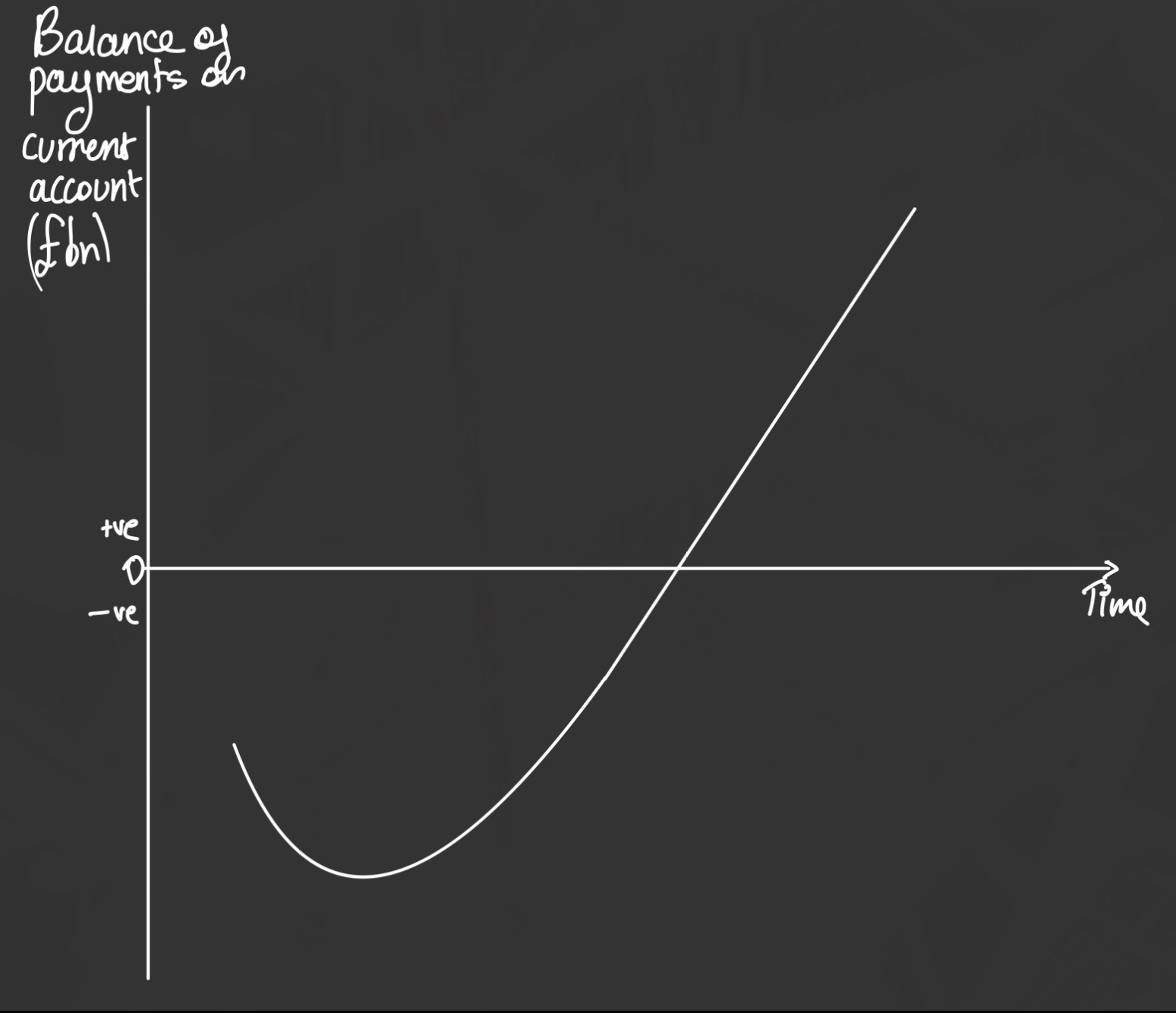
What is the J-curve effect
There could be a time lag before the effects of the depreciation of currency work through the economy:
The sum of the PEDs would be between 0 and 1 in the short run but above 1 in the long run
PED for imports price inelastic because of contracts for goods
PED for exports price inelastic because takes time for consumers to adjust to the price changes
Impact of depreciation on economic growth and employment
If there’s an increase in net exports, then AD will increase, so increase in RGDP. Therefore there should be an increase in employment
Impact of depreciation on the rate of inflation
Inflation could rise due to AD shifting out (from rise in net exports)
Rise in import prices (especially raw materials) likely to increase costs of production, causing AS to shift in and so an increase in the rate of inflation
Impact of depreciation on FDI flows
May make the country more attractive for foreign investors because a unit of their own currency would buy more units of this country’s currency
However, if depreciation is because of a lack of confidence in the country’s economy, FDI may decrease
What are some examples of non-price factors in international competitiveness?
Quality
Design
Reliability
Availability
What are 3 measures of international competitiveness
Relative unit labour costs - the measurement of labour costs in one country relative to those in another country
Relative export prices - might be affected by factors such as productivity e.g. labour productivity (output per worker per hours worked)
The global competitiveness index - measured devised by the WEF based on factors such as infrastructure, macroeconomic stability, health, education, innovation
top 3 rankings for 2018: USA, Singapore, Germany
What are the two main factors influencing international competitiveness
Real exchange rate - nominal exchange rate adjusted to reflect different inflation rates (nominal exchange rate x (domestic price level) / (foreign price level))
Wage costs and non-wage costs
How do wage costs and non-wage costs influence international competitiveness
Wage costs are the most important costs of production for many industries
relationship between labour productivity and wages is crucial in influencing unit labour costs
Non wage costs are much higher in developed countries than in developing countries, so reduce the international competitiveness of goods from developed countries. They include:
National insurance paid by employers
Health and safety regulations
Environmental regulations
Employment protection and anti-discrimination laws
contributions to company pension schemes
What other factors can improve international competitiveness?
Governments can improve it through supply-side policies such as:
Education and training schemes - increase occupational mobility of labour. This influences the level of human capital, which is the knowledge and skills of the workforce
Public sector reform that removes red tape
Privatisation
Incentives for investment - e.g. tax breaks if companies use profits for investment
What are some benefits of being internationally competitive?
Balance of trade surplus
Export-led growth leading to increase in real incomes
Low levels of unemployment
Increase in FDI
What is absolute poverty?
When incomes fall below the minimum level to meet basic needs such as food, shelter, clothing, access to clean water etc.
What are three problems with the benchmark of relative poverty
Subjective
Subject to change over time
Not comparable between countries
What is the distinction between wealth and income inequality
Wealth = Stock concept. Refers to inequality based on value of tangible assets e.g. property
Income = Flow concept. Refers to inequality based on incomes from wages and profit
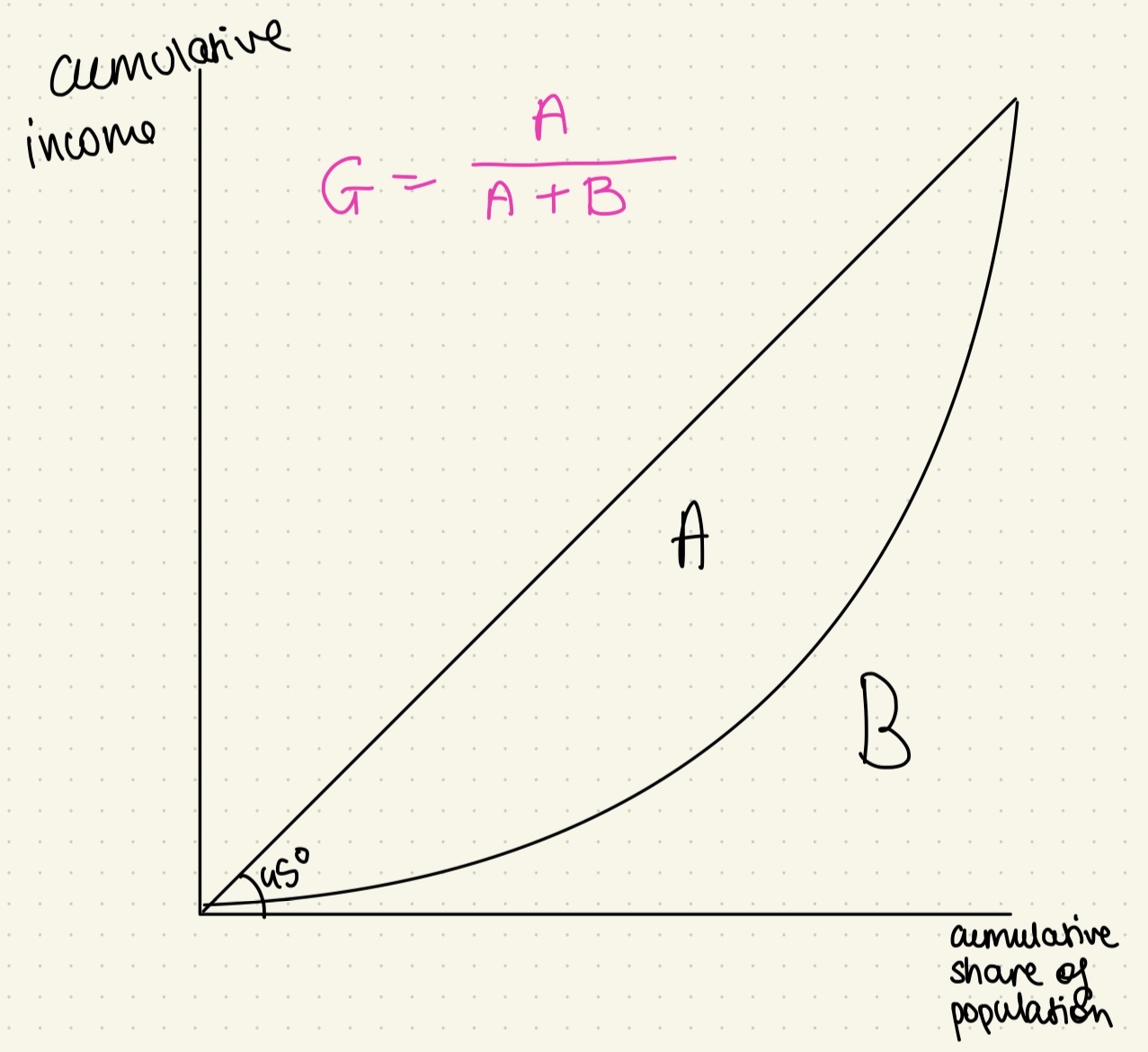
What does the Lorenz Curve do?
Plots the cumulative percentage of the population against the cumulative percentage of total income
How is the Gini coefficient calculated?
G = A / (A+B)
Causes of income and wealth inequality between countries?
Differences in natural resources like oil and gas
Geography
Differences in governance - command vs free economy
Political instability; civil wars
Natural disasters
Population growth and structure
Name some measures of development
The HDI
The Multi-dimensional poverty index (MPI)
Proportion of population with access to clean water / internet
Proportion of male population engaged in agriculture
What’s the HDI?
A composite index of development, including 3 elements:
Education (the mean years of schooling for a 25 year old)
Health (life expectancy)
Real GNI per capita
What’s the global MPI (multi-dimensional poverty index)
Composed of ten indicators corresponding to the same 3 components as the HDI, where GNI per capita → standard of living. Combines two aspects of poverty:
Incidence - percentage of people who are poor
Intensity - the average of the components above in which poor people are deprived
Name factors influencing growth and development:
Primary product dependency
Volatility in commodity markets
Levels of savvings and investment
Foreign exchange gap
Capital flight
Access to credit and banking
Infrastructure
Education
Absence of property rights
Corruption / poor governance / political instability
What are the problems with primary product dependency?
Price fluctuations
Fluctuations in tax revenues - fall in the price leads to fall in revenues leads to less tax
Difficult of planning investment and output
Natural disasters can cause severe disruption
Protectionism by developed countries - e.g. US gives big subsidies to US cotton farmers so India can’t compete
Low income elasticity of demand for primary products (Prebisch-Singer hypothesis)
A country with loadss of a natural resource → appreciation of currency → makes other products less competitive
What’s the Prebisch-Singer hypothesis?
Suggests that countries that export commodities (raw materials / primary product) would be able to import less and less for a given quantity of exports - the TOT would decrease for primary commodity exporters.
Common explanation: the YED for manufactured goods is greater than that for primary products, so as global incomes rise, the demand for manufactured goods rises more rapidly than for primary products. → the prices of manufactured goods rise compared to primary products, causing a decline in the TOT for primary product dependent countries
What is a criticism of the Prebisch-singer hypothesis
Some countries have developed on the basis of their primary products: e.g. diamonds account for 30% of Botswana’s GDP
Why is there such high volatility in commodity markets?
Demand and supply of commodities tend to be price inelastic
Demand inelastic because they’re required in the production of other low PED goods such as bread and steel
Supply inelastic because of the long growing period for soft commodities and long time to develop new mines for hard comoddities e.g. coal.
So, any demand- or supply-side shock will result in a significant price change
What is the Harod-Domar model:
Low incomes → Low savings → Low investment → Low capital accumulation → low incomes ….
What is the savings gap
The difference between the amount of domestic savings available and the amount of investment needed to meet a target rate of economic growth
Why do many developing countries face a shortage of foreign exchange?
Dependence on export earnings from primary products
Dependence on imports of capital goods and other manufactured goods
Capital flight
Debt
Why has debt become a particular problem for developing countries?
Risky decisions to borrow money to finance major investment projects when the prices of goods which they were exporting were high
An increase in oil prices → inflation → higher interest rates
A fall in the value of the currencies of developing countries, increasing the burden of foreign debt
What is capital flight?
When individuals or companies decide to remove deposits in domestic banks and place them in foreign banks / buy shares or assets in foreign countries.
What are the problems with capital flight?
Contributes to the savings gap and foreign currency gap
Restricts economic growth
Reduces the tax base - the country loses any tax payable on these assets
How does population growth impact development (Thomas Malthus)
Thomas Malthus preducted that famine was inevitable because population grows in geometric progression, whereas food production grows in the form of an arithmetic progression. This is believed to be relevant for some of the poorest developing countries.
Thomas Malthus’s theory in relation to Nigeria
Nigeria’s population increased from 42.8 million in 2000 ——→ 200 million in 2019
Population growth > GDP growth, so GDP per capita has been falling in Nigeria between 2014 and 2018
What is infrastructure?
The whole range of structures essential for an economy to operate smoothly, including: transport, telecommunications. energy supply, waste disposal
How does absence of property rights impact development?
Property/Land can act as collateral for a bank loan, and without this it can be too difficult to start a business
What are some non-economic factors that influence development/growth?
Corruption (the use of power for personal gain) - inefficient allocation of resources
Poor governance - inefficient allocation of resources
Political instability = consumer/business uncertainty
Geography - land-locked country like Niger is isolated from world markets
Name some market-orientated strategies promoting development:
Trade liberalisation
Promotion of FDI
Removal of government subsidies
Floating exchange rates
Microfinance schemes
Privatisation
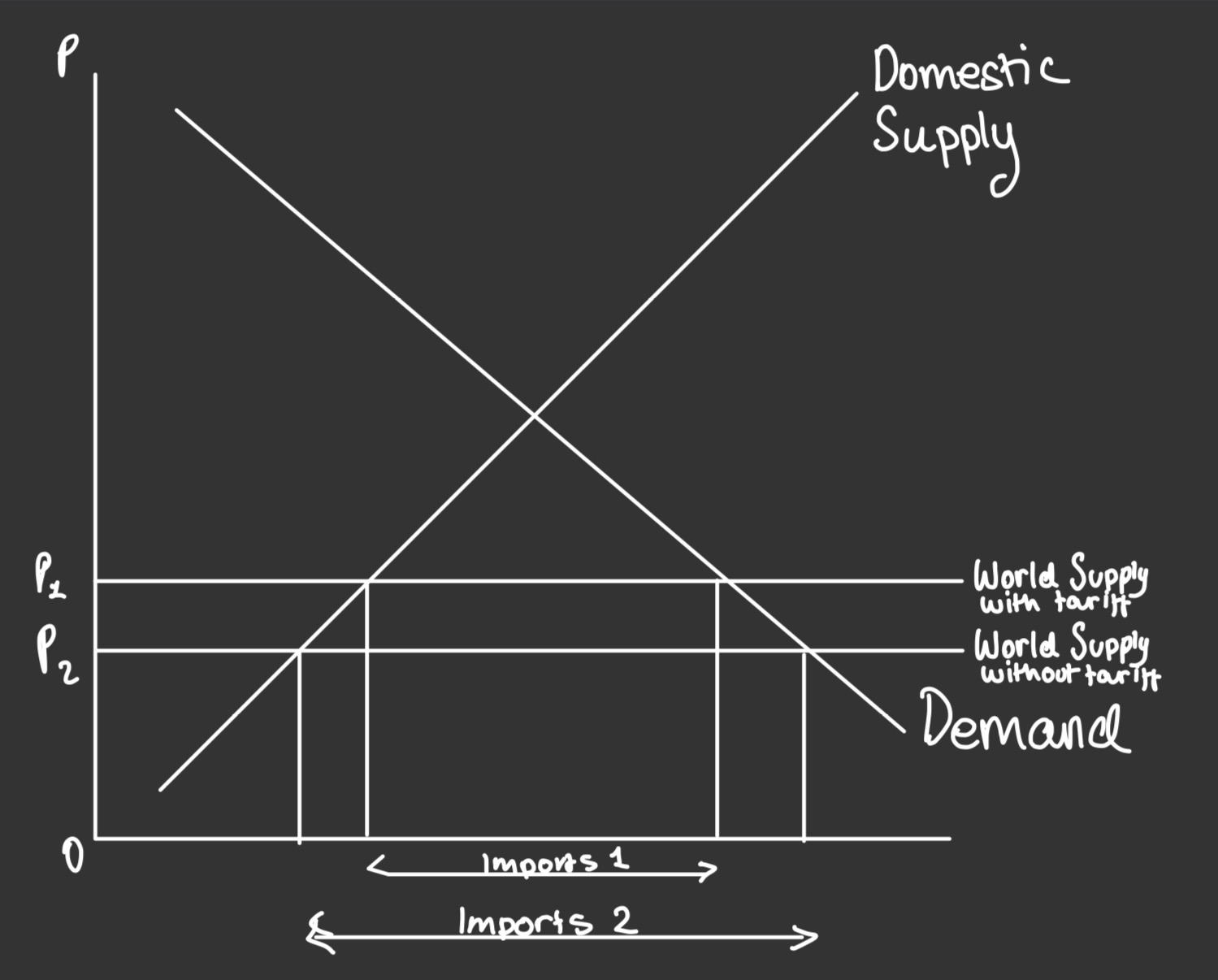
What is trade liberalisation?
The lowering or complete removal of trade barriers such as tariffs, quotas, and non-tariff barriers
What are the benefits of trade liberalisation for consumers, companies, and the country?
Consumers: lower prices so higher consumer surplus. Choice and quality of goods and services available will also increase
Companies: diversifies risk, and enables firms to benefit from economies of scale → lower LRAC
Country: promotes competition and usually leads to increased investment and productivity
The OECD has estimated that if G20 economies reduced trade barriers by 50% there would be up to a _ rise in real wages for lower and higher skilled workers
up to 8% rise in real wages
Some drawbacks of trade liberalisation:
Some domestic industries unable to compete with competition from foreign suppliers → loss of jobs in these industries
Adverse effects on the environment: more trade → more transport → more emissions
Infant industries in developing and emerging economies may not be able to survive competition from companies in developed countries
How may governments promote FDI?
Reduction in corporation tax (tax on profits)
Increases in tax incentives and grants towards investment (e.g. ‘tax holiday’ for first few years or subsidising workers)
Increasing ease of doing business in a country (less regulation, better infrastructure)
Liberalisation of labour laws e.g. zero hour contracts
Reducing trade barriers = easier to import components and export finished goods
What is microfinance
A means of providing extremely poor families with small loans (microcredit) to help them engage in productive activities / grow their tiny business.
Name some interventionist strategies influencing growth and development
Development of human capital
Protectionism
Managed exchange rates
Infrastructure development
Promotion of joint structures
Buffer stock schemes
What is the aim of protectionism?
Enable a country to diversify in a controlled way until it has built a strong domestic base. This approach will be most effective where a country’s domestic market is large enough to enable industries to benefit from economies of scale - then allowing them to cope with foreign competition.
Two problems with protectionism:
Distorts comparative advantage → resources not allocated efficiently
Lack of competition → inefficiency
Why might some countries manage exchange rates to keep them high / low?
Overvalued: Keep down the cost of imports, especially of oil, raw materials, and capital equipment
Devalued: Keep cost of exports low to become more internationally competitive
What is a joint venture
An association of two or more businesses for the purpose of engaging in a specific enterprise for profit
Advantages of joint ventures:
Access to new markets - helps businesses to access new markets (esp foreign) that they wouldn’t have been able to enter on their own
Reduced risk
Increased efficiency - pooling resources and expertise
Transfer of knowledge and skills - esp between advanceed-developing countries
Problems with joint ventures:
Loss of control
Conflicts of interest - different goals for the venture
Disagreement
What is a buffer stock scheme?
A way of reducing price fluctuations. It involves setting a ceiling and floor price and the buying and selling of stocks to maintain price within these limits
Why is supply assumed to be perfectly inelastic in a buffer stock diagram?
It’s a reasonable assumption because a set amount will be produced each year
Problems with buffer stock schemes:
Floor price too high → surpluses every year
Ceiling price too low → insufficient stocks
There are costs of storage
Success depends on ensuring that all the major producers agree to be part of the scheme and that none of them cheats e.g. selling to a major consumer at a reduced price
What are some other strategies influencing growth and development
Industrialisation
Development of tourism
Development of primary industries
Fair trade schemes
Aid
Debt relief
(Industrialisation) What view does the Lewis model have?
Based on the view that development requires a move away from traditional agriculture (characterised by subsistence, low productivity, and barter) to more productive manufacturing (characterised by high productivity and monetary exchange)
What are the key features of the Lewis model
Describes the transfer of surplus labour from a low productivity agricultural sector to a high productivity industrial sector
Due to the excess supply of workers, the marginal productivity of agricultural workers is almost zero - based on the law of diminishing returns
MP = 0, so opportunity cost of transferring workers agricultural → industrial sector is zero
Industrialisation → investment (possibly from TNCs) → higher productivity and profitability
The savings ratio will increase, providing more funds for investment and continued growth