FP 8 - Tissue Management & Impression (Dr. Nui)
 Call Kai
 Learn
Learn Practice Test
 Spaced Repetition
 Match
Match Flashcards
 Knowt Play
1/88

There's no tags or description
Looks like no tags are added yet.
Name | Mastery | Learn | Test | Matching | Spaced | Call with Kai |
|---|
No analytics yet
Send a link to your students to track their progress
89 Terms
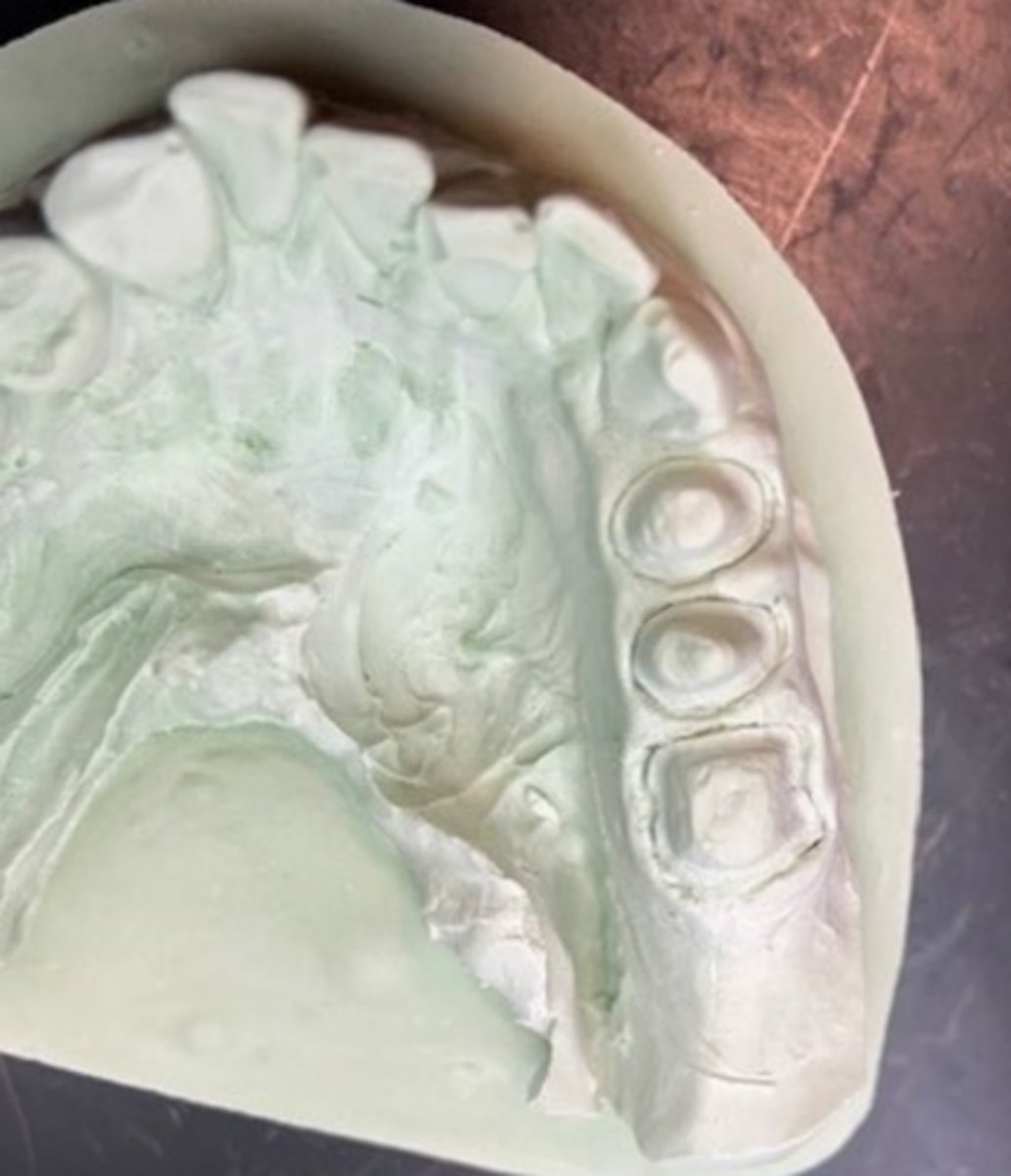
Is this acceptable?
Yes
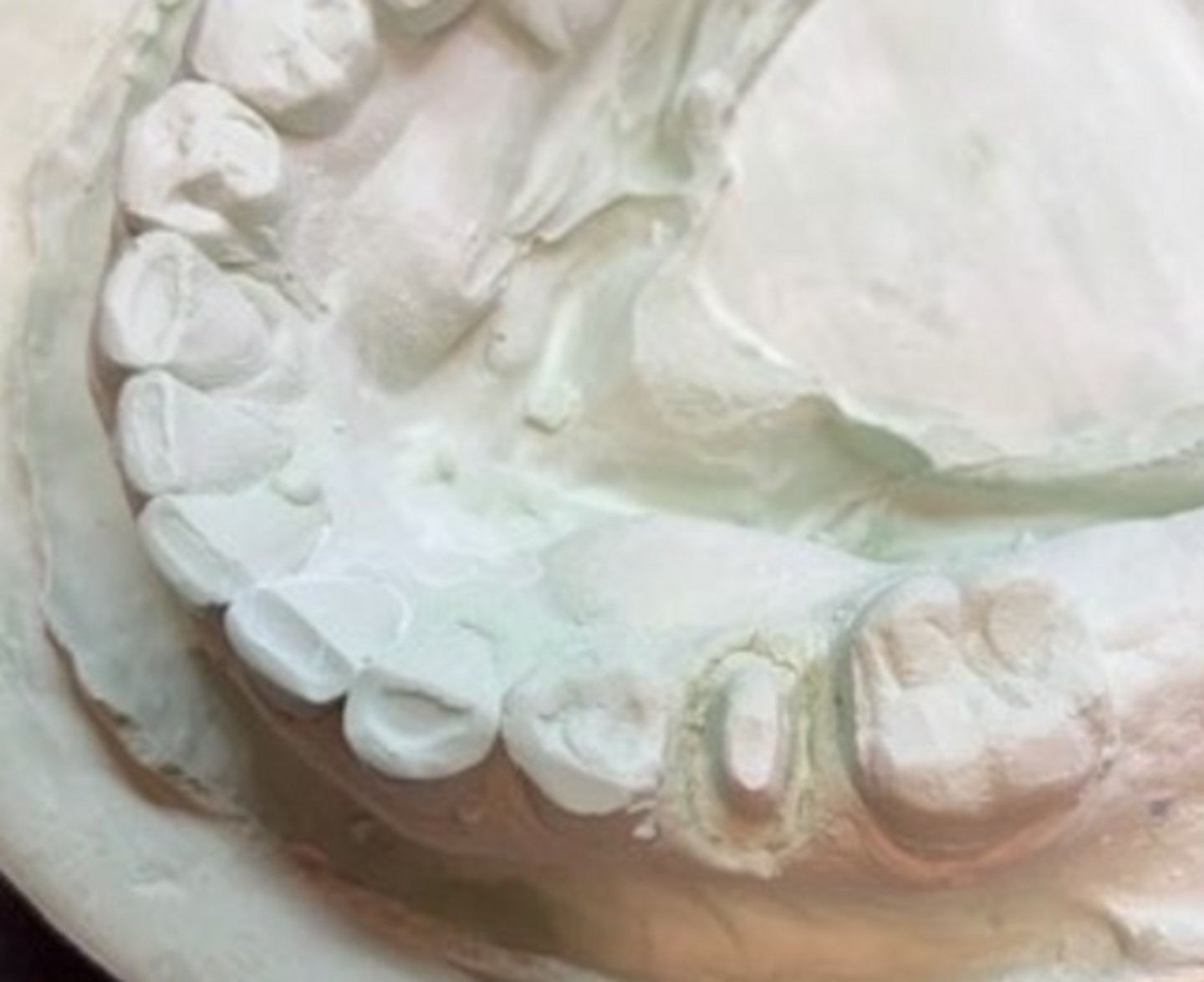
Is this acceptable?
No
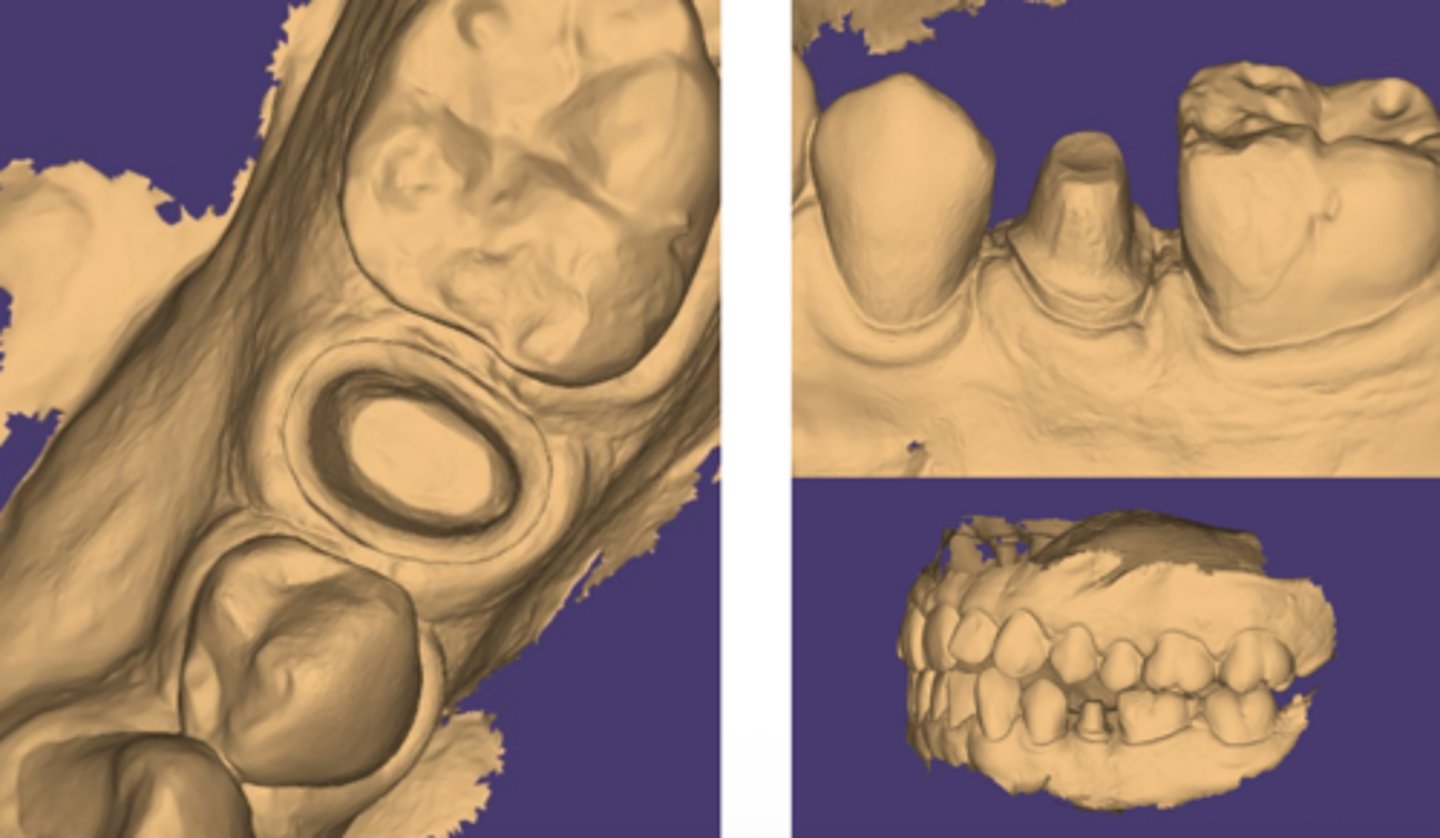
Is this acceptable?
Yes
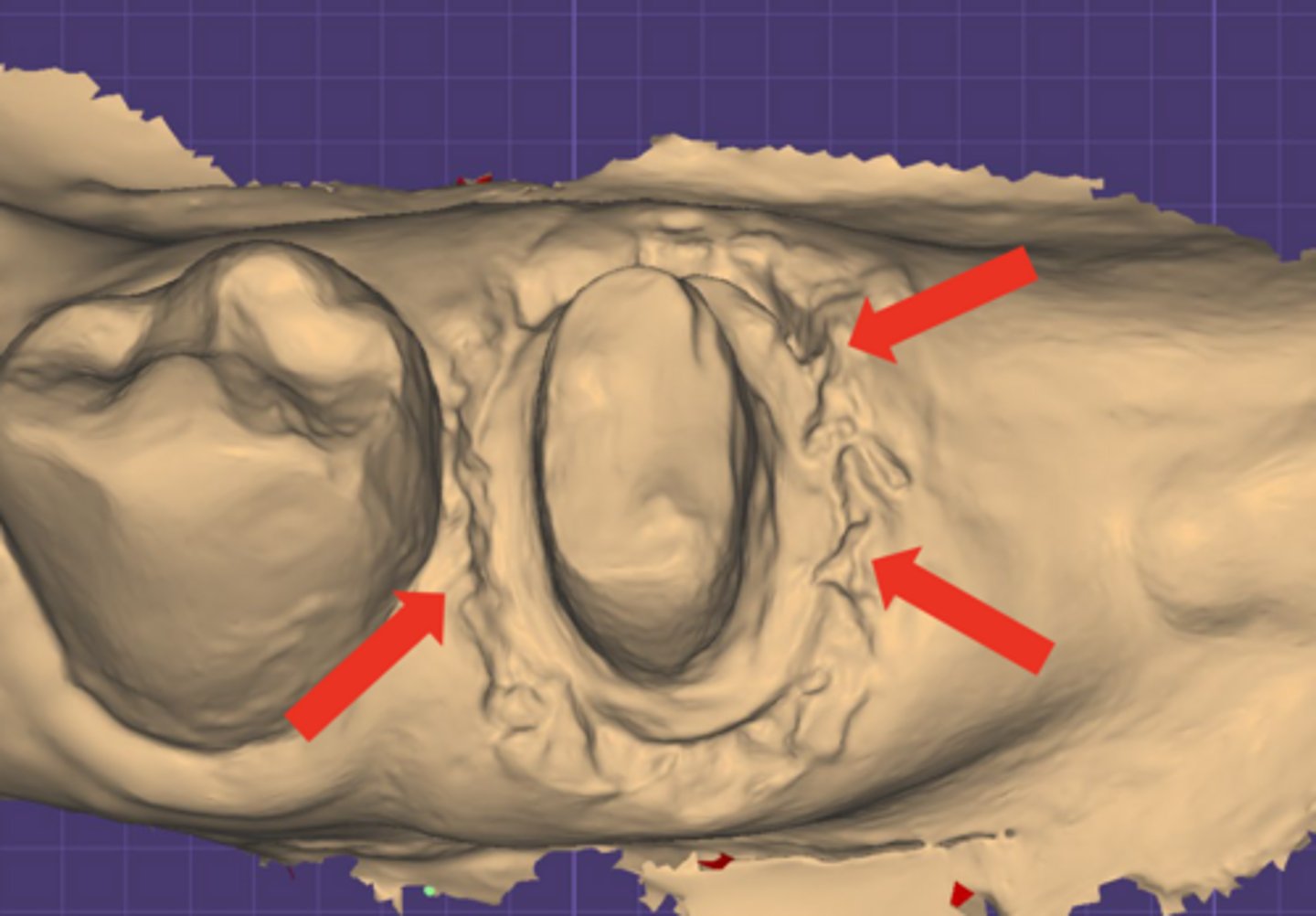
Is this acceptable?
No
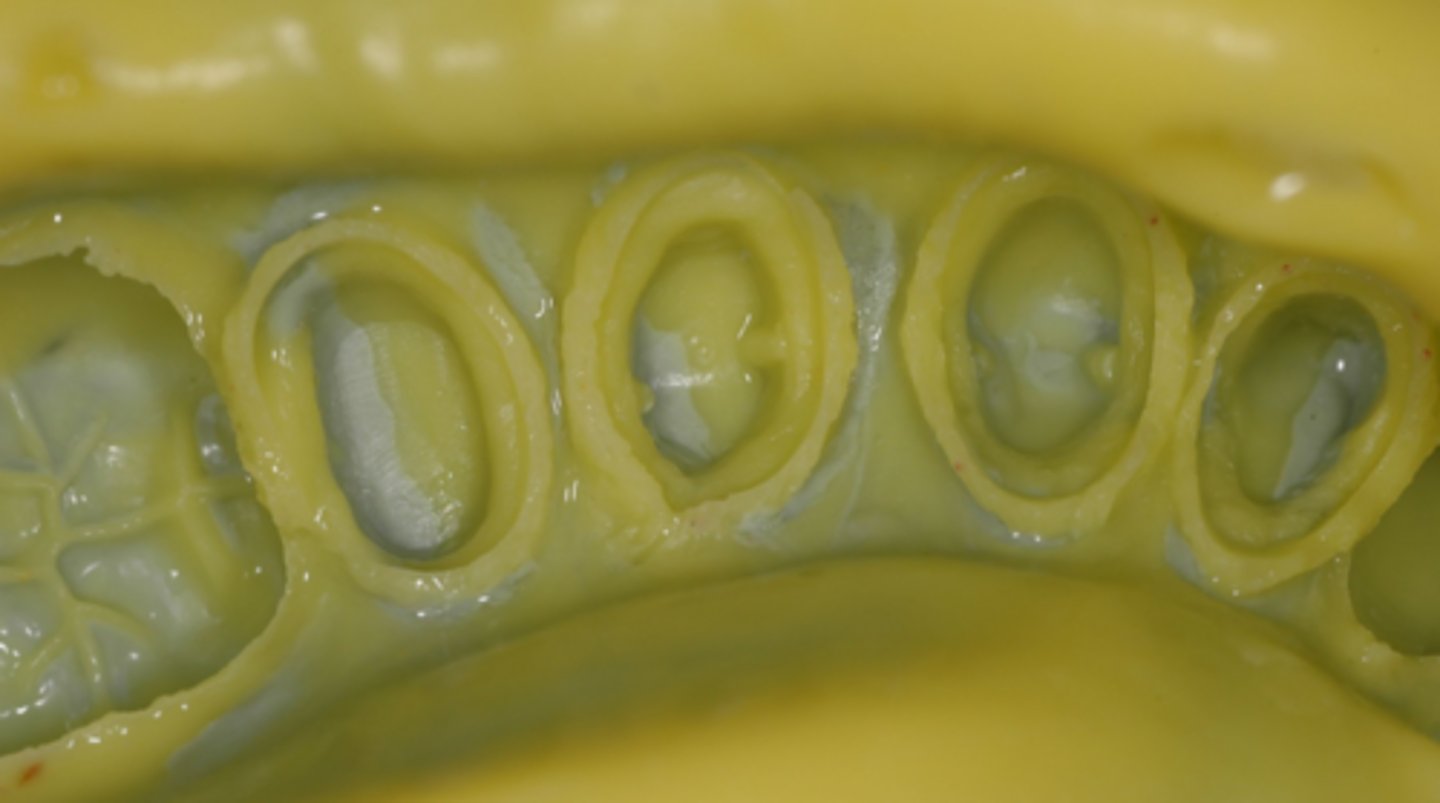
What two things are you looking for here in the impression?
- Finish line
- Cuff (360°)
A good impression will have a clear surface on what two things?
- Prepared teeth/margins
- Neighboring teeth (for occlusion & appearance purpose)
- - Especially neighboring teeth that serve as abutment for RPD (for path of insertion purpose)
T/F: If your treatment is planned to have this prepared tooth to serve as one of the future RPD abutments, you will need to capture all the remaining teeth in the dental arch since some of them will be used to dictate the path of insertion and desirable undercuts for your future surveyed crown
True
What are three things that should NOT be seen on impressions?
- No voids
- No pulls
- No see through of tray
What are the three items of the armamentarium for making an impression?
- Impression Material
- Cord packer
- Retraction cord + Hemostatic agent
Define the requirement of a final impression:
The relative stiffness of the material after setting
Elasticity/rigidity
Define the requirement of a final impression:
The materials desire to stick to itself
Flow
Define the requirement of a final impression:
Ability of a material to resist tearing after setting
Tear strength
Define the requirement of a final impression:
Relative ability of an impression material to tolerate moisture in an impression site
Hydrophilic
Define the requirement of a final impression:
Exact duplicate, no voids, detailed
Accuracy/Dimensional stability
All of the following are requirements of a final impression, EXCEPT:
A) Elasticity/rigidity
B) Flow
C) Tear strength
D) Hydrophobic
E) Accuracy/Dimensional stability
F) Working and setting time
G) Ease of manipulation
H) Cost effectiveness
D) Should be hydrophilic
Polyether (Impregum) can be used in which type of traditional impressions?
One-step
PVS can be used in which type of traditional impressions?
- One step
- Two step
- Modified two step
What material is used for most impressions, except for very long and thin teeth?
polyether (impregum)
These are advantages of what impression material?
- Dimensional stability (can be poured more than once, even the next day)
- Accuracy
- Low polymerization shrinkage
- Relatively short setting time
- Automix available (Pentamix machine)
Polyether (Impregum)
These are disadvantages of what impression material?
- Set material very stiff
- Absorption of water (should be stored dry)
Polyether (Impregum)
What precaution must you take when taking a final impression with Polyether (Impregum)? (3)
- Care not to break teeth when separating cast
- Block out undercuts
- Care for perio involved teeth
ID the impression material:
Advantages
- Great dimensional stability (can be poured more than once, even the next day)
- Accuracy
- Very short setting time
- Automix available
Addition silicone (PVS)
What precaution must you take when taking a final impression with addition silicone (PVS)? (2)
- Care to avoid bubbles when pouring
- Setting inhibition for some putties by latex gloves
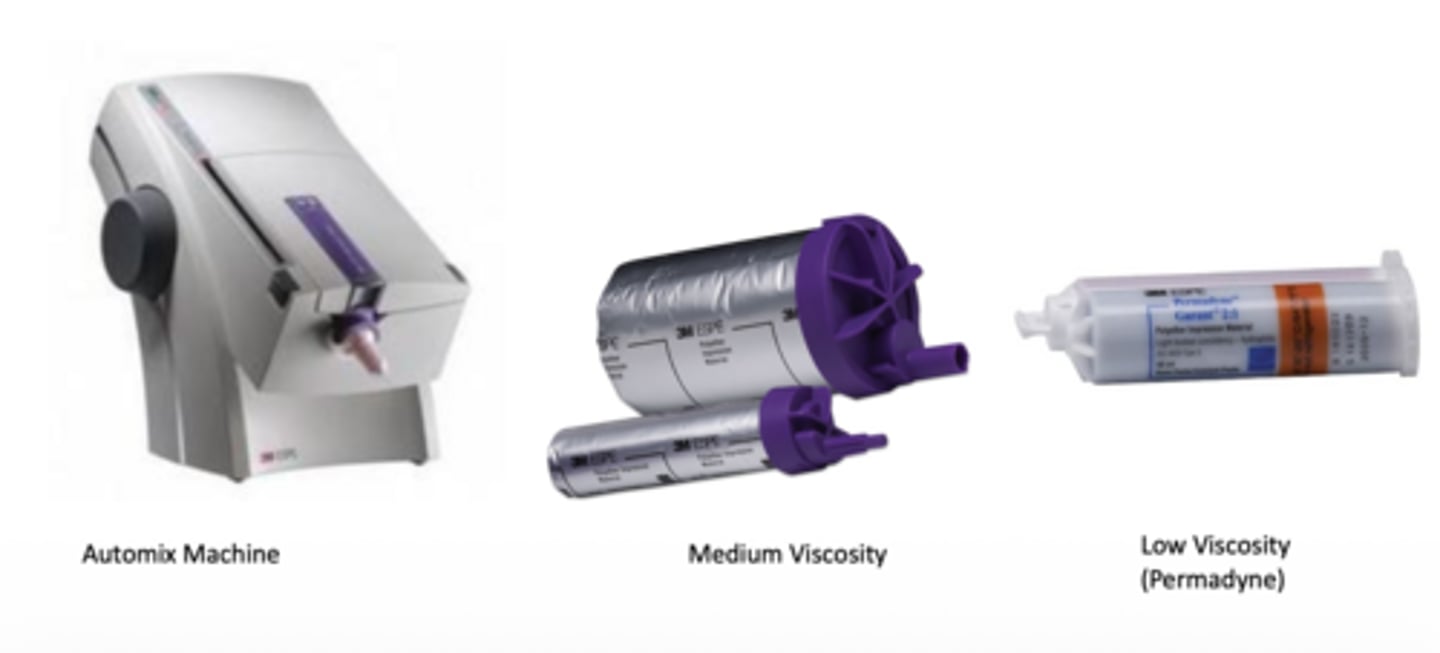
What type of material is this used at TUSDM?
Polyether impression material
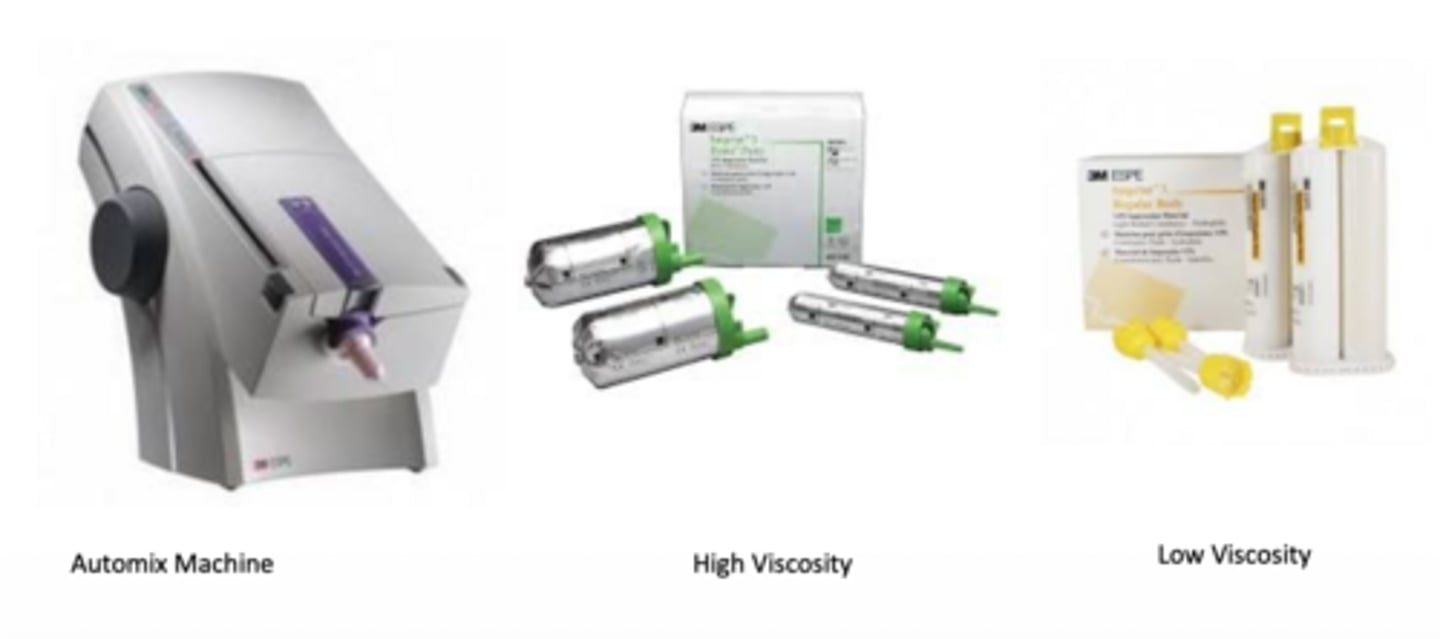
What type of material is this used at TUSDM?
Polyvinylsiloxane impression material
What type of tissue?
Amount of reduction is adequate, no sharp edges, no undercuts or any deficiencies that can cause distortion to the impression and ultimately, cause breakage of a working cast and die
Hard Tissue
What type of tissue?
Reasonably healthy, minimal inflammation
Soft Tissue
What is the key to determine both hard and soft tissue health prior to taking a final impression?
Good Provisional Restoration
This is the purpose of what?
Deflection of marginal gingiva away from tooth
1) Create sufficient lateral and vertical space between finish line and gingiva tissue
2) Provide control of gingival fluid
3) No significant, irreversible damage to soft/hard tissue
4) Not produce any potentially dangerous side effect
gingival/tissue displacement
What are the 4 tissue displacement techniques?
- Mechanical
- Chemicomechanical - Tissue Displacement using Retraction cord with hemostatic agent
- Surgical: Electrosurgery, LASER, Rotary cutting instrument
- Cordless
What is important to do prior to packing a retraction cord?
use LA and saliva control
What are the 4 ways we can obtain saliva control?
- Use of cotton rolls, dry angles
- Saliva evacuators
- Use of local anesthetics
- Prescription of anticholinergics
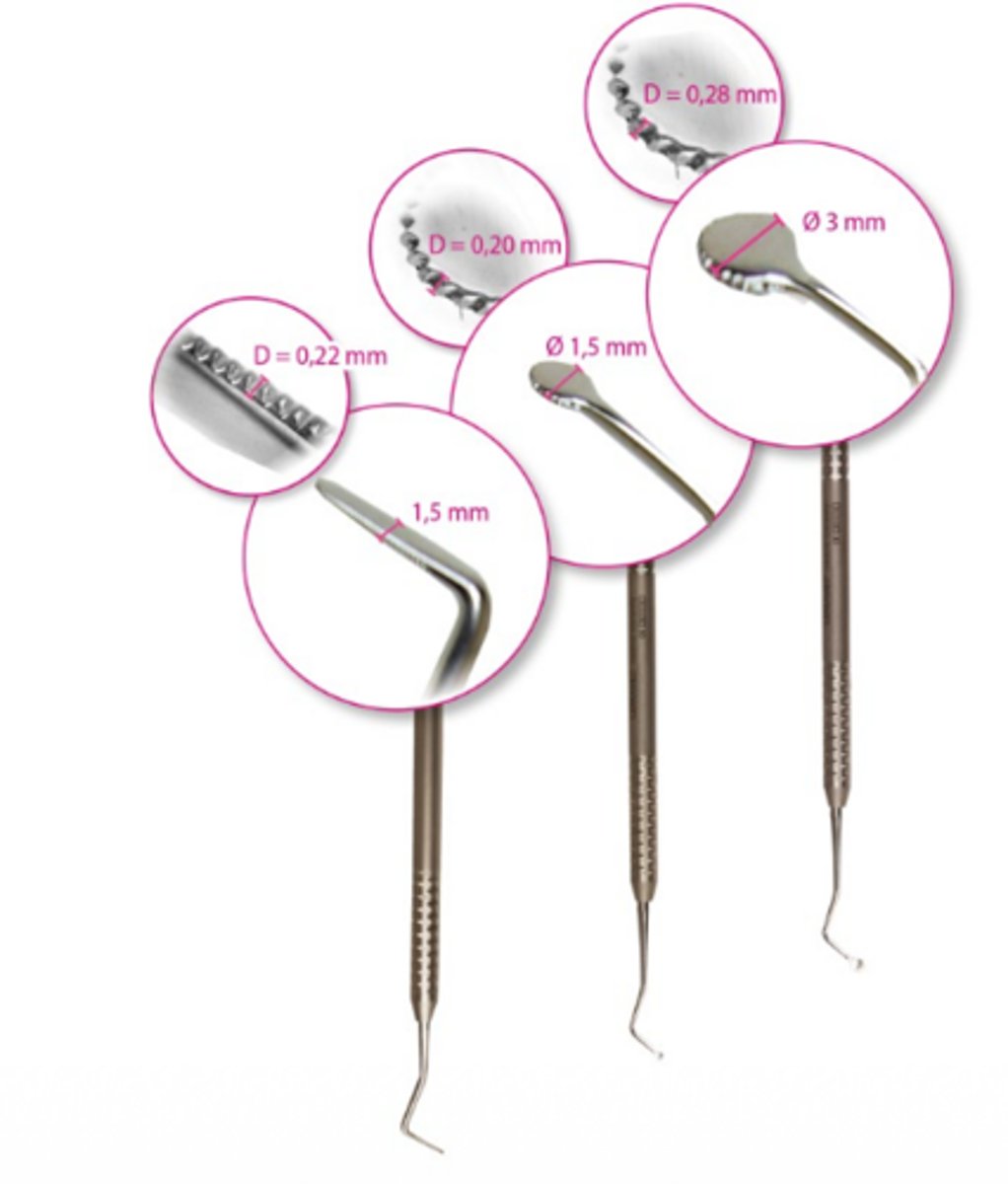
Serrated or non-serrated cord packer?
Serrated
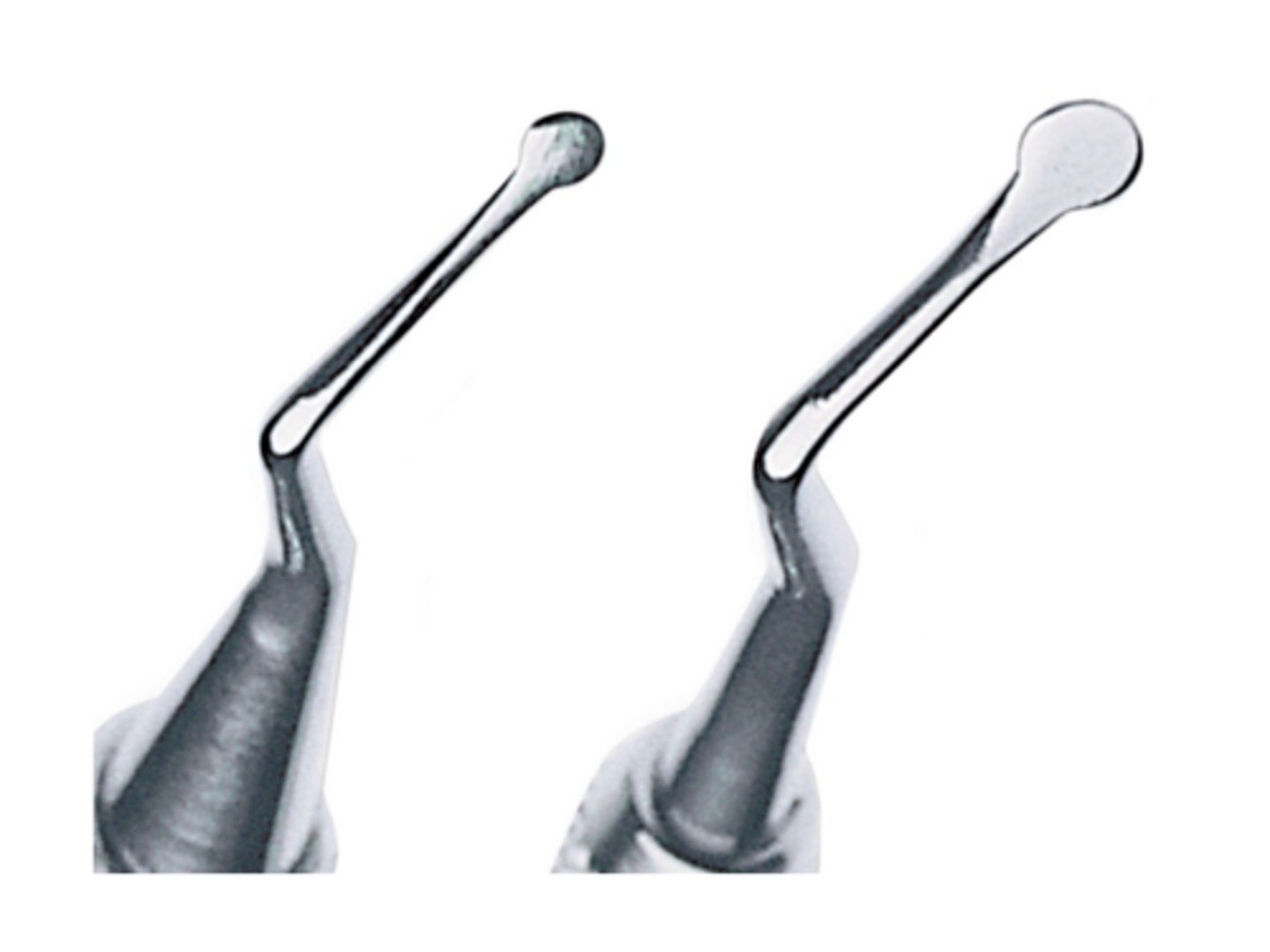
Serrated or non-serrated cord packer?
Non-Serrated
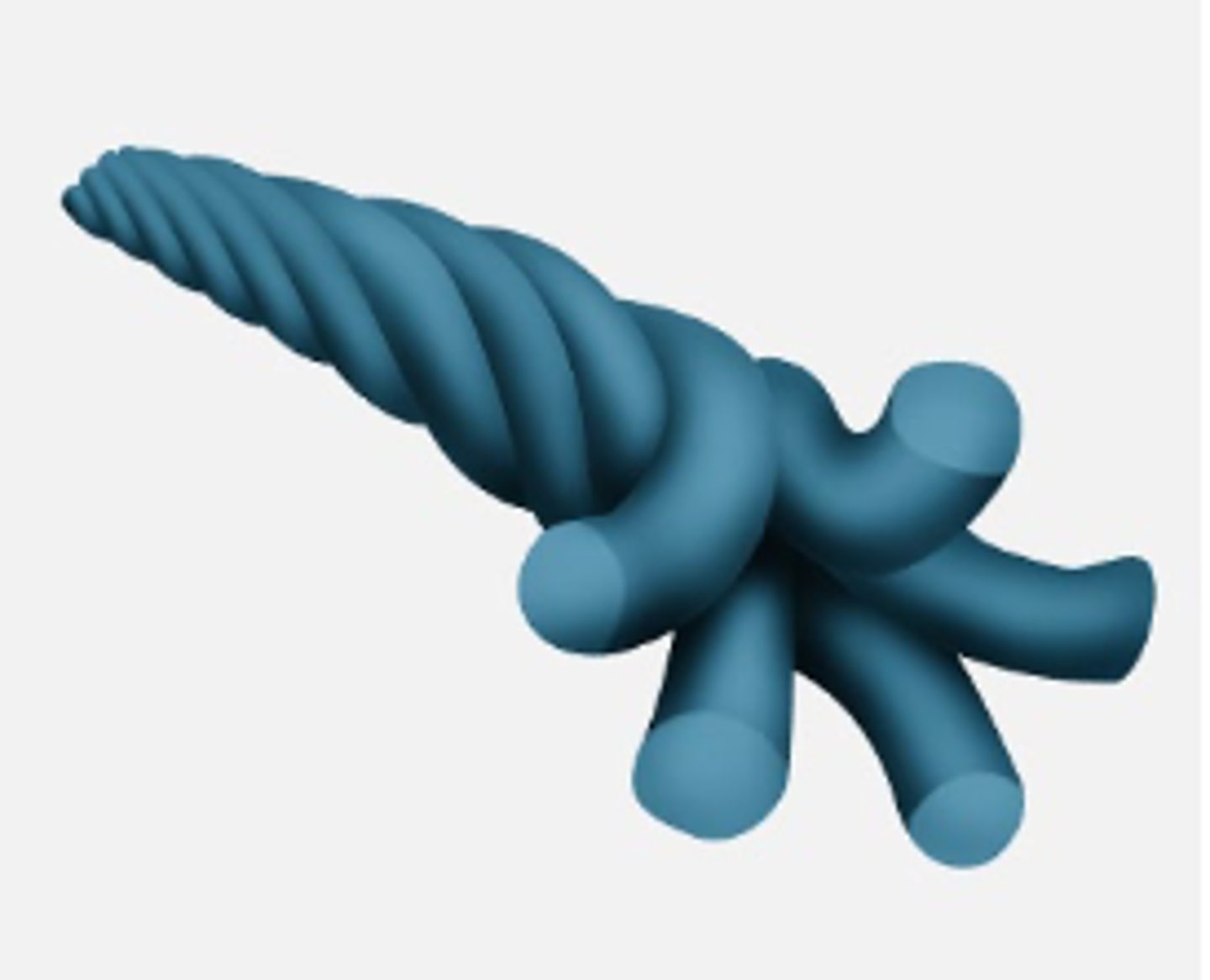
What type of retraction cord?
Twisted cord
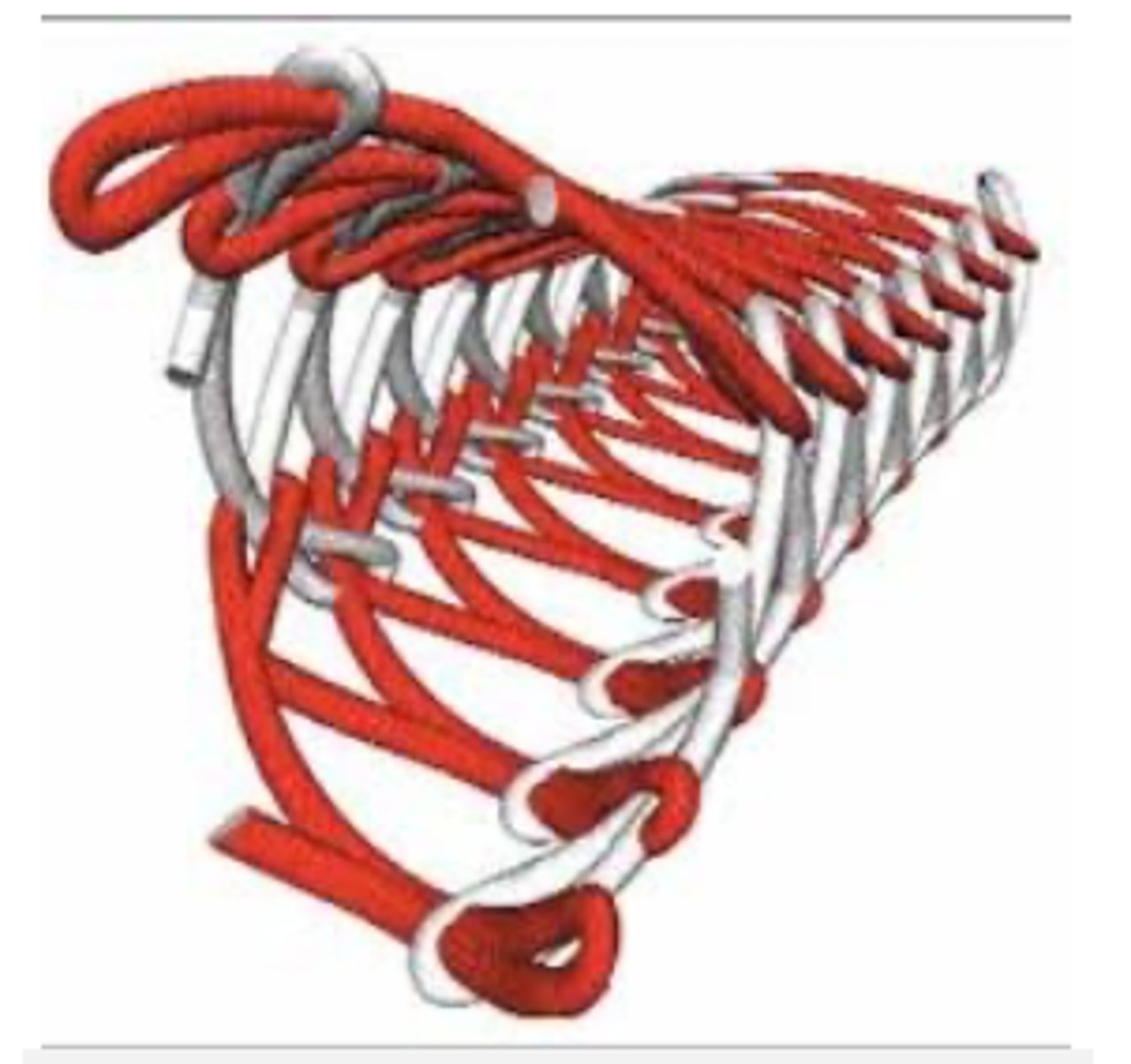
What type of retraction cord?
Knitted cord
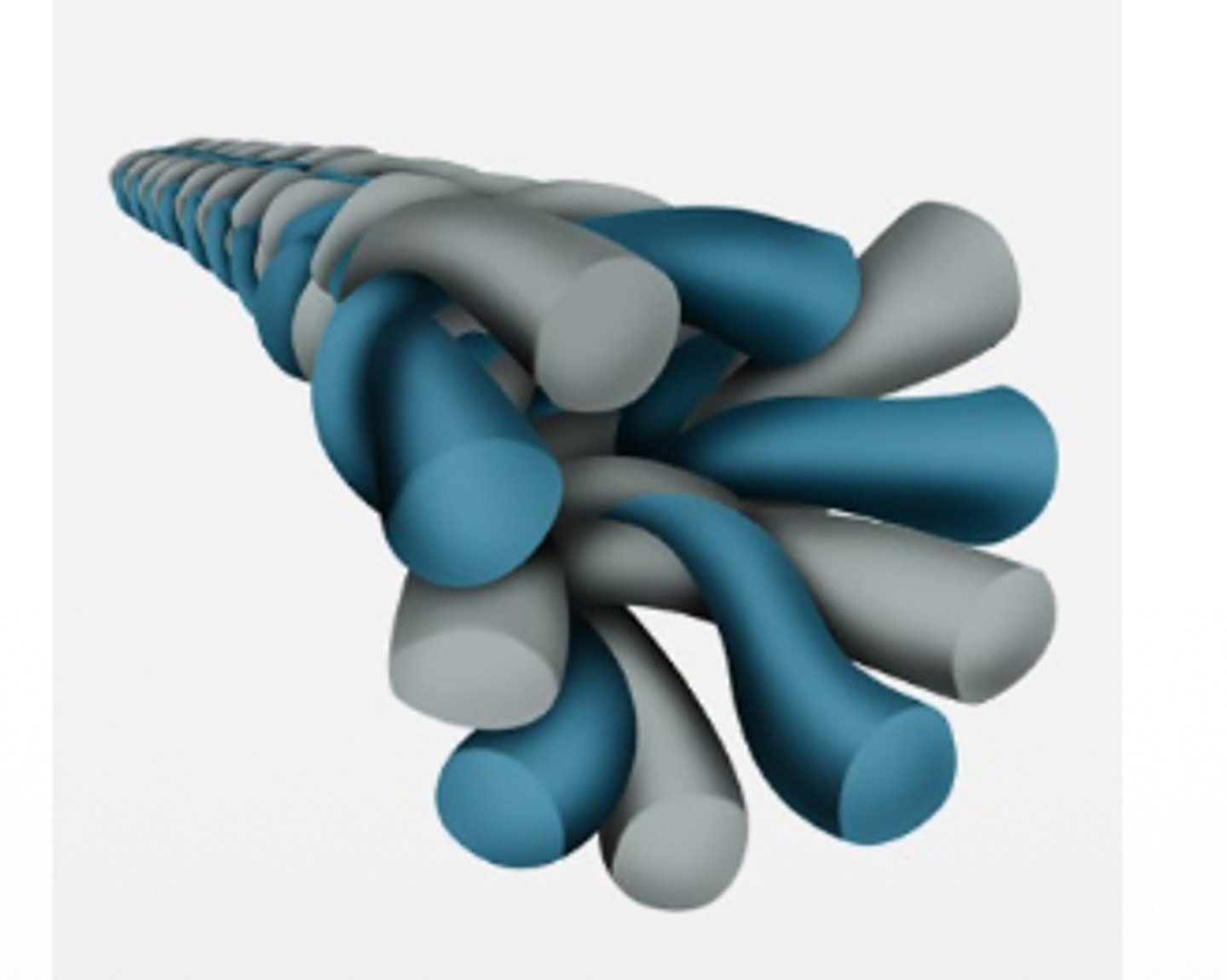
What type of retraction cord?
Braided cord
Pre-Impregnated Cords contain ______
vasoconstrictor/epinephrine (use caution!)
Pre-Impregnated Cords are contraindicated in what patient populations? (2)
- Cardiovascular disease
- Diabetes (epi suppresses insulin secretion, which can lead to hyperglycemia)
T/F: When placing any retraction cord, LA is optional
False - LA is necessary!
Hemostatic Gingival Retraction Class I Agents contain ___________
Vasoconstrictor/ adrenergic
Hemostatic Gingival Retraction Class II Agents contain ___________
Astringents/aluminum chloride
Class I or Class II Non-Impregnanted Cord?
- Aluminum Pottasium Sulfate
- Aluminum Sulfate
- 20-25% Aluminum Chloride
- 15.5-20% Ferric Sulfate
Class II
What % of Aluminum Chloride is in Class II Non-Impregnated cords?
20-25%
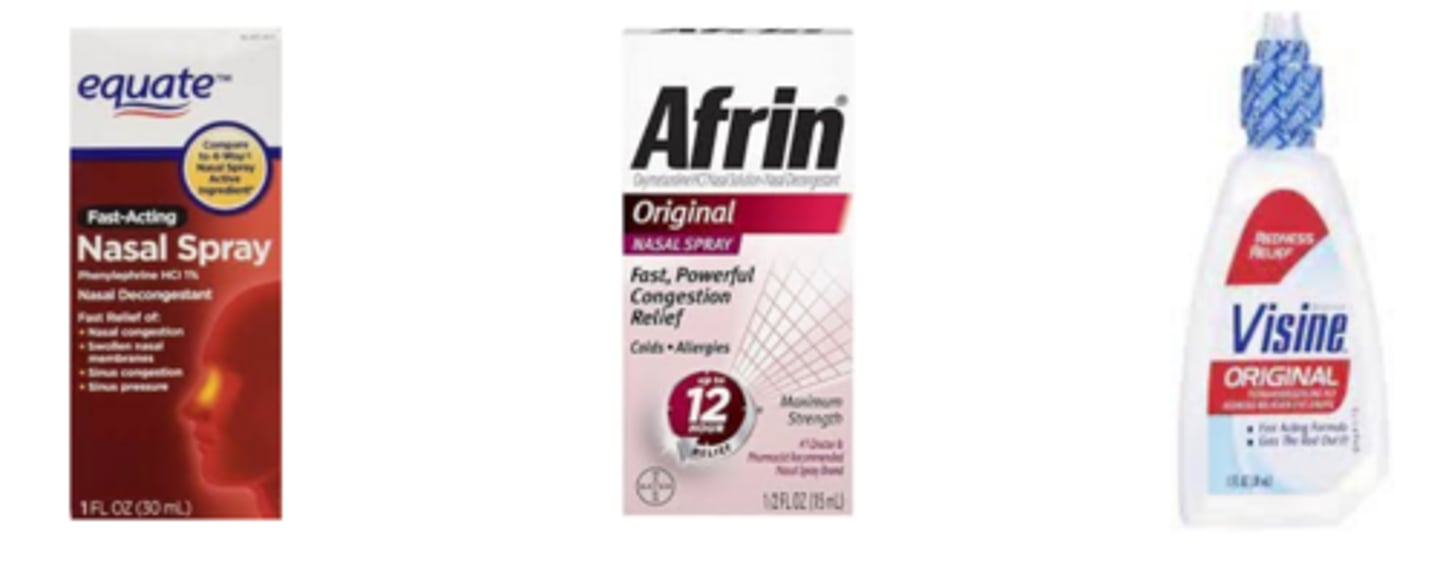
T/F: The following can all be used as a gingival retraction agent to control sulcular bleeding before making a final crown impression:
- Phenylephrine Hydrochloride
- Oxymetazoline Hydrochloride
- Tetrahydrozoline Hydrochloride
True
Placement of the retraction cord is begun by pushing it into the sulcus on the mesial surface of the tooth. It should also be tacked lightly into the distal crevice to hold the cord in position while it is being placed.
When placing displacement cords, the instrument must be angled slightly toward the ________ to facilitate the subgingival placement of the cord
Root
If the instrument is held parallel to the long axis of the tooth, the retraction cord will be pushed against the wall of the gingival crevice, and it will __________
Rebound
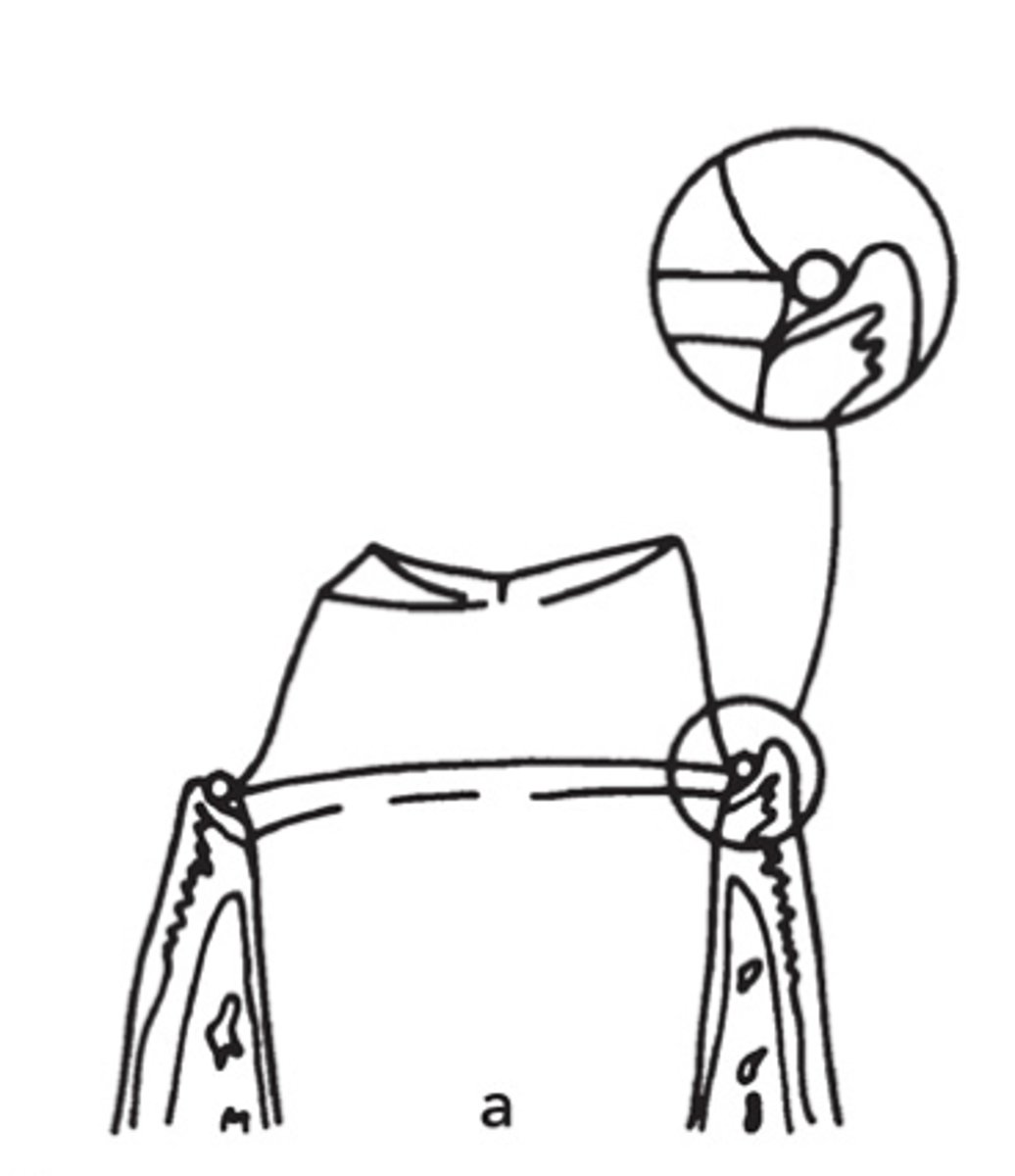
Is the placement of this retraction cord in the sulcus acceptable?
Yes
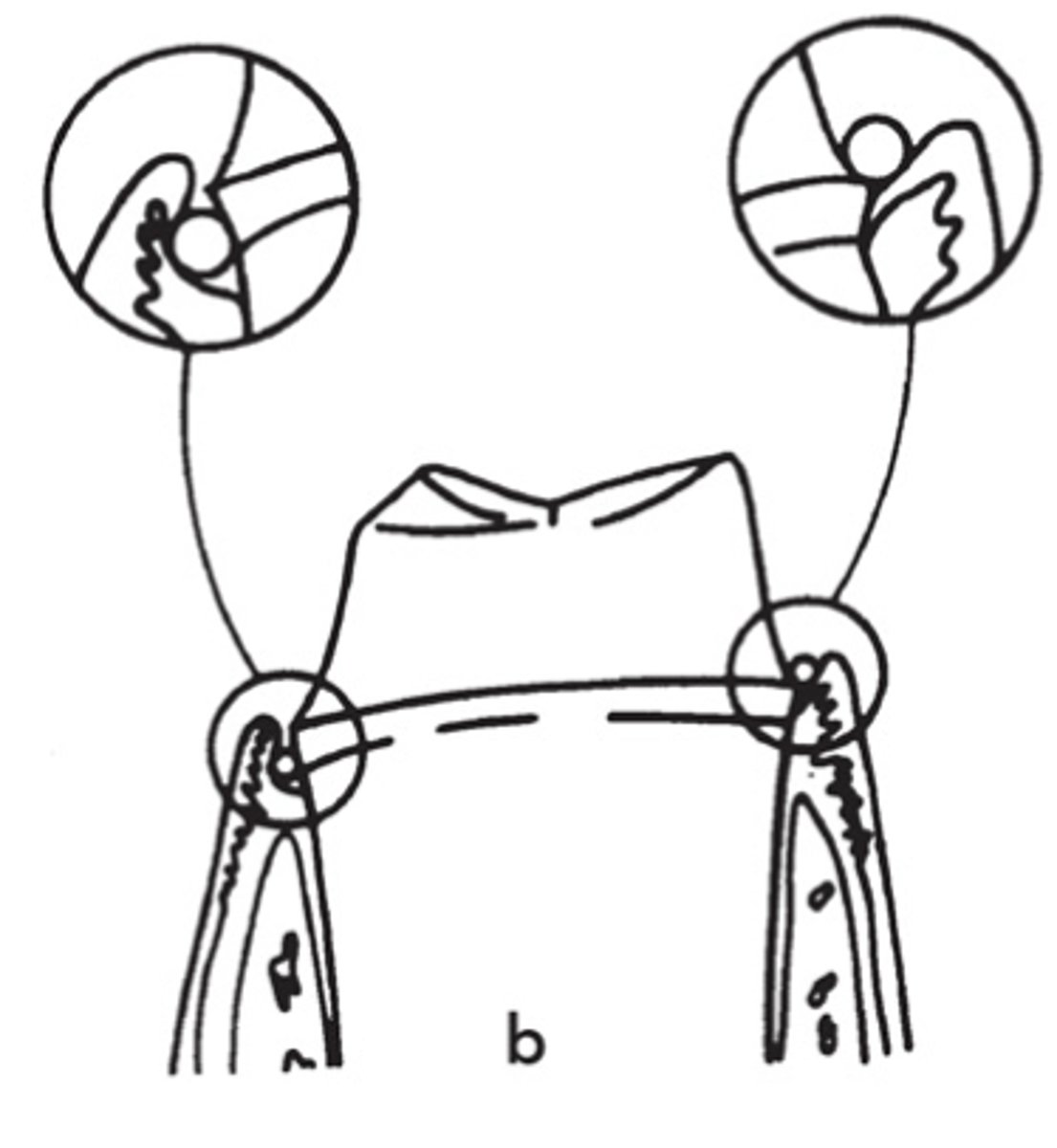
Is the placement of this retraction cord in the sulcus acceptable?
No
Tissue displacement technique where:
- The inner epithelial lining of the gingival sulcus is removed
- Access for a subgingival crown margin
- Control of post surgical hemorrhage
- Passage of a high-frequency current through the tissue from a large electrode to a small one
- At the small electrode the current induces rapid localized polarity changes that cause cell breakdown (“cutting")
Electrosurgery
All of the following are precautions regarding electrosurgery EXCEPT:
A. Profound local anesthesia is needed
B. Suitable on thin attached gingiva
C. It should not be used with metal instruments
D. The electrode should not touch any metallic restoration (can cause pulp damage)
E. It should not be used on or near patients with cardiac pacemaker or insulin pump
B - should be NOT SUITABLE on thin attached gingiva
Electrosurgical electrode _________ the gingival sulcus
Enlarges
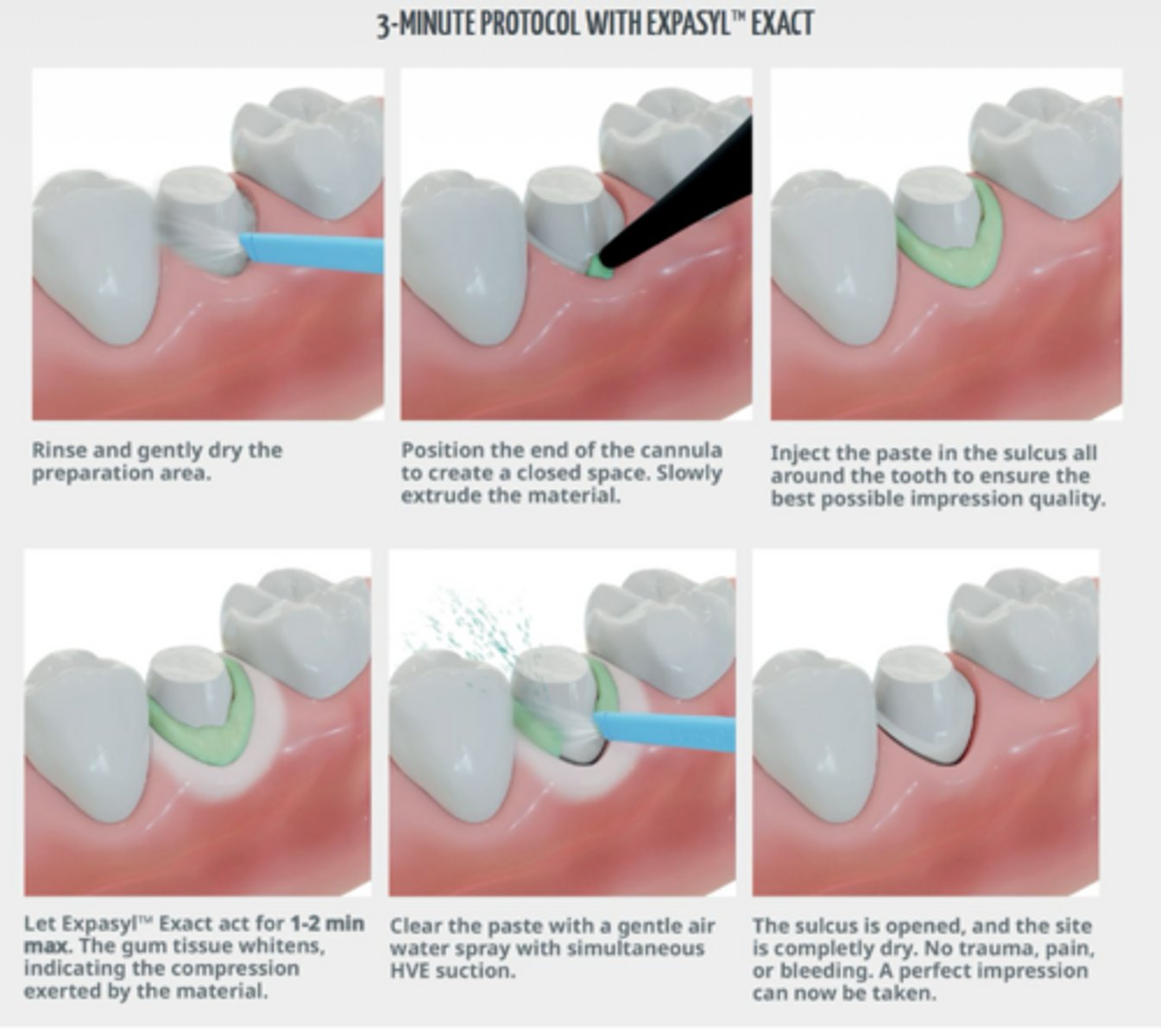
What technique is shown?
Cordless technique
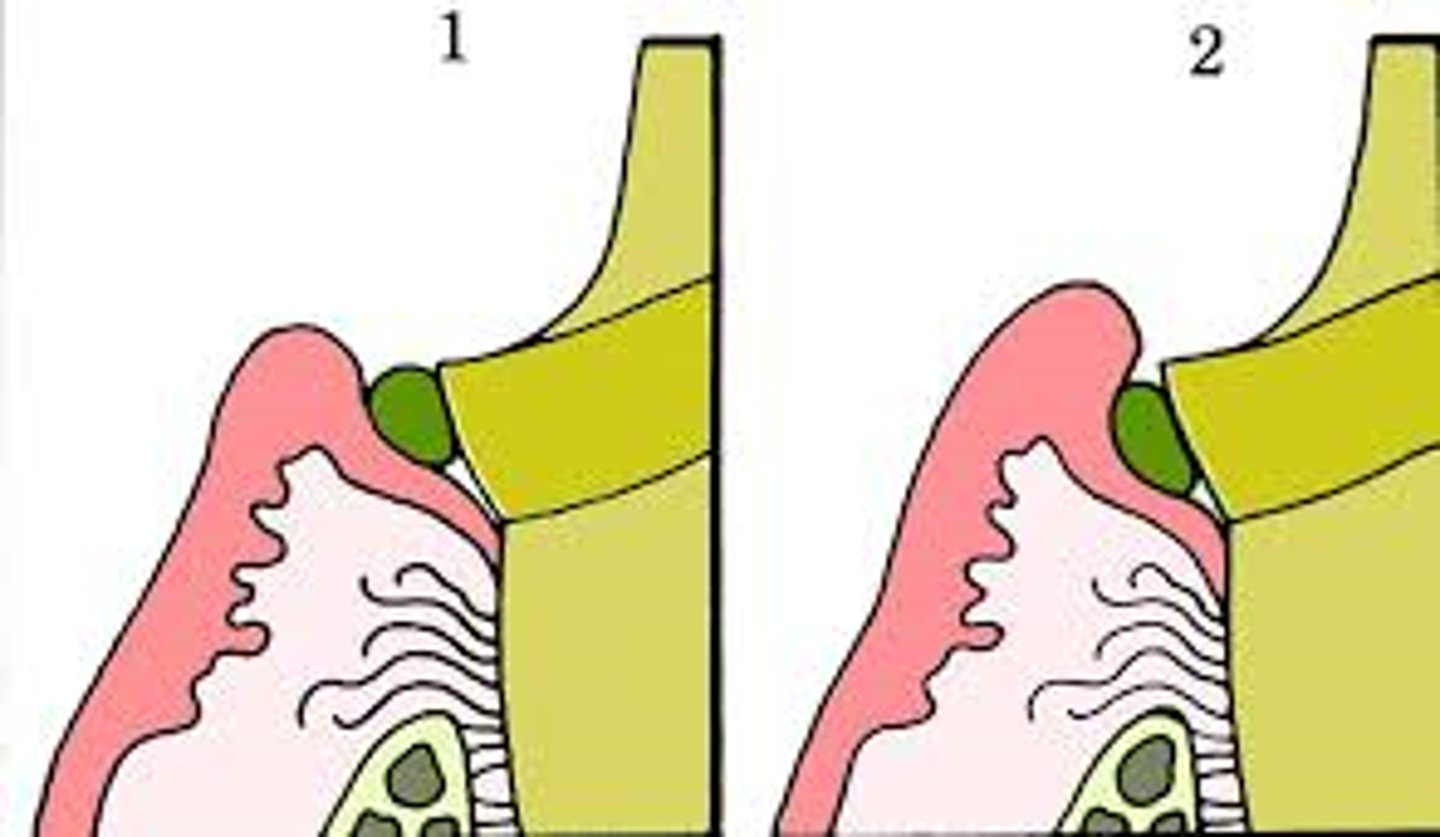
Which diagram is incorrect cord packing?
2
Where should heavy body material be loaded?
Into impression tray
Where should light body material be loaded?
Into the sulcus covering the entire preparation including margins
These are the steps for what technique?
1. Anesthesia
2. Provisional restoration and temporary cement removal
3. Probing
4. Gingival retraction
5. Apply adhesive to the tray
6. Material mixing (Load heavy body material into tray)
7. Isolation
8. Removal of retraction cords
9. Dry area
10. Light body Material injection into the sulcus covering the entire preparation including margins. An air syringe is used to drive the impression material into the sulcus and preparation detail.
11. Evaluation and possible defects
Final impression
What are the following used for?
- Glutaraldehyde 2% 10 min soak (not for polyether)
- Iodophor (1:213 dilution)
- Chlorine compounds (1:10 dilution of commercial bleach)
Disinfection
When doing a double cord packing, the cord with the smaller diameter should be placed more _________
apically
When doing a double cord packing, the cord with the larger diameter should be placed more _________
coronally
What material has the following characteristics?
- Material and/or agent should be effective in lateral & vertical displacement of gingival tissue
- Provide hemorrhage control and sulcular fluid seepage
- Material and/or agent should not cause any significant irreversible soft tissue damage
- Material and/or agent should not cause any potential harmful systemic effects
Gingival retraction material
What 3 factors determine whether you use a single or double cord packing technique?
- Sulcus depth
- Finish line location
- Tissue quality
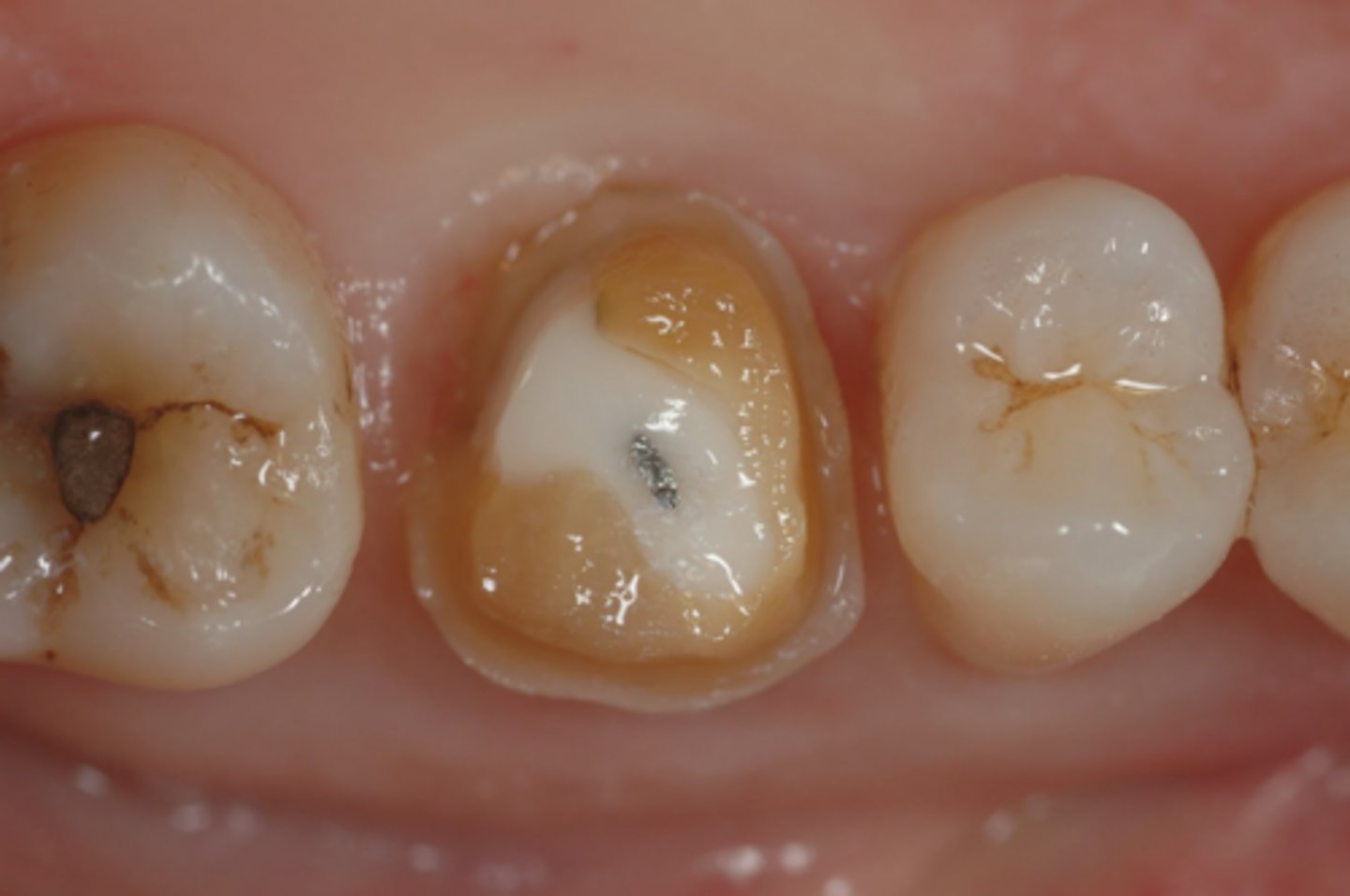
T/F: For a tooth that is prepped where part of the finish line is subgingival and part of it is supragingival, you only need to pack part of the tooth with the sub-G finish line
true
The average amount of Gingival Recession is ≈ ___ mm with a traditional chemicomechanical tissue displacement technique
0.2mm
What four things does the amount of gingival recession depend on?
- The pre-existing tissue quality
- Tissue displacement technique
- Type of hemostatic agents
- Amount of time that retraction cord was left in the sulcus
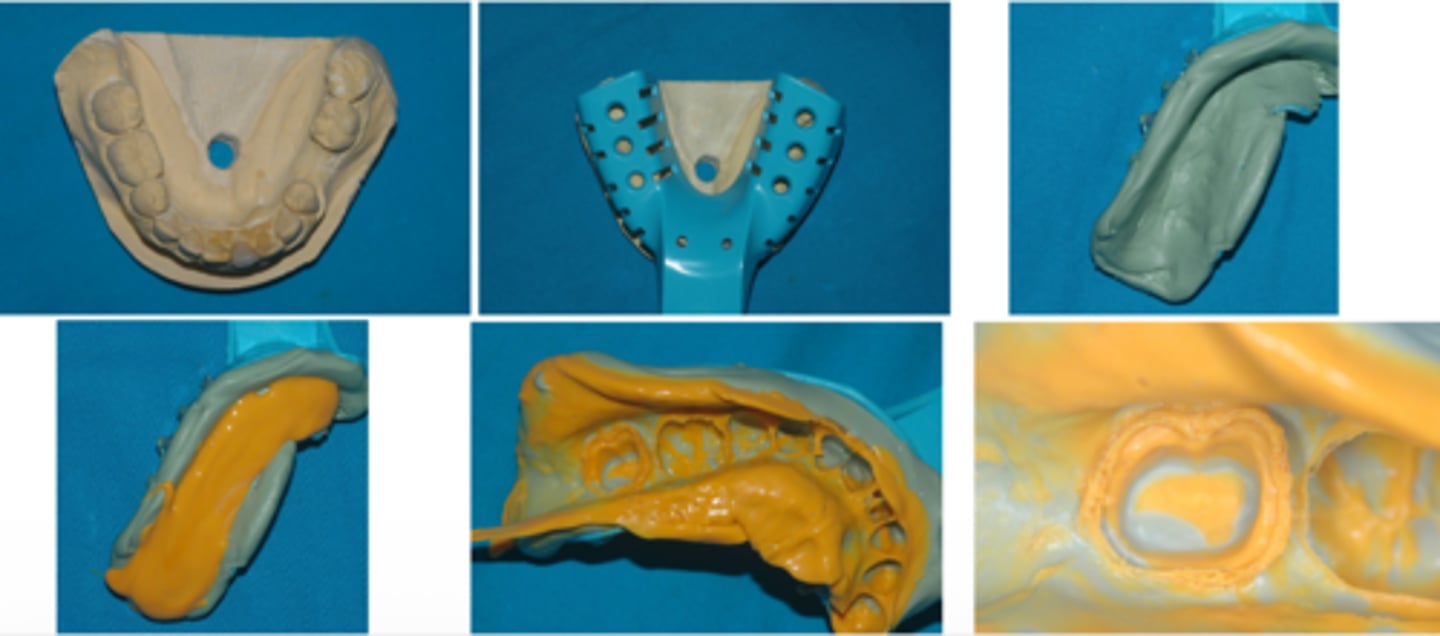
What technique is shown?
- Tray Material — Medium or Heavy Viscosity
- Syringe Material — Low or Medium viscosity
- Use simultaneously (nick name Putty-Wash impression tech)
Single step technique
Using the same medium viscosity material for both tray and syringe is known as what technique?
monophase impression technique
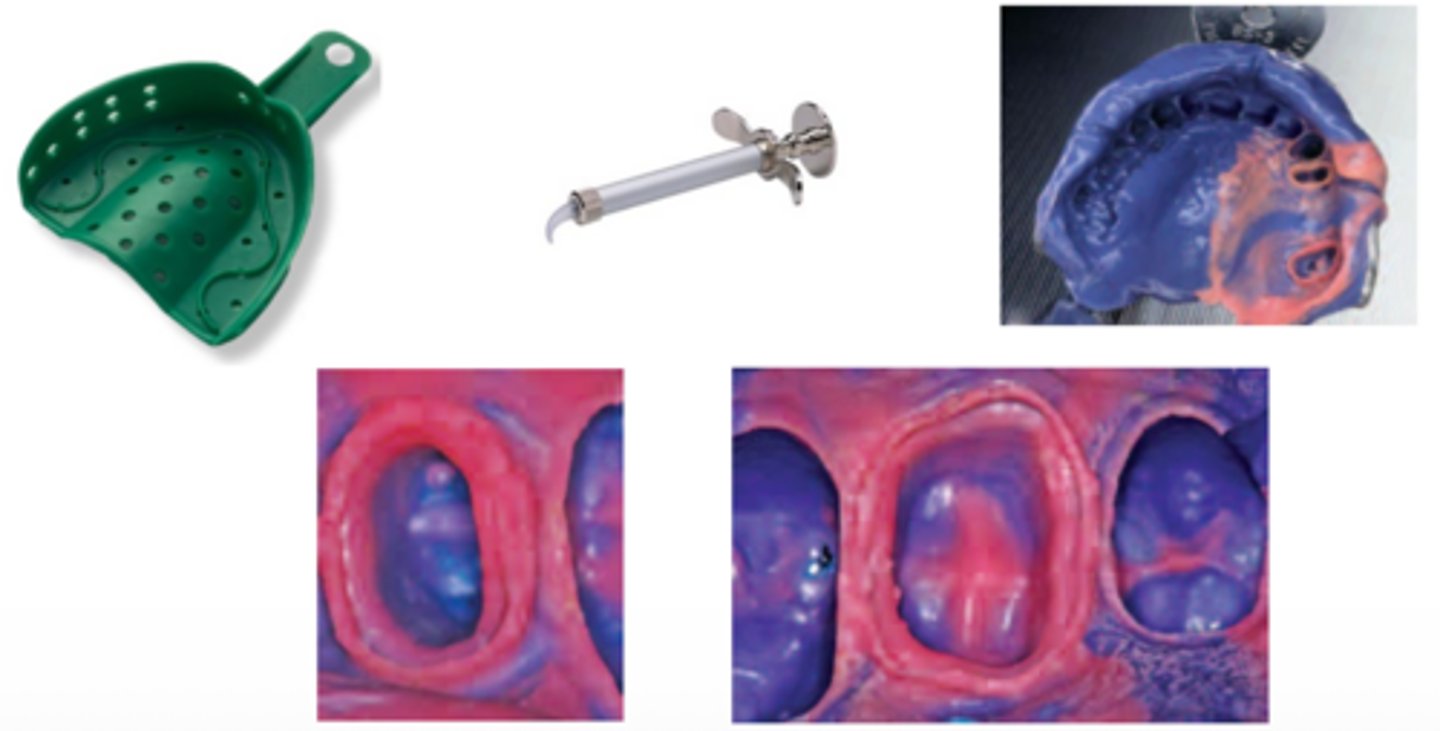
What technique is shown?
- Tray Material — Heavy to Putty Viscosity
- Require Spacer or some sort of space relief or by grinding the tray material after it set
- Syringe Material — Low viscosity
Two step technique
What technique?
- Make putty impression first using either stock tray or a custom tray
- After putty impression material is set, remove the spacer or hollow out putty material
- Remove retraction cord
- Apply low viscosity impression material into the tray and syringe low viscosity material into sulcus
- Reseat the original impression onto the prepared tooth (nick name 2-step Putty-Wash impression tech)
Two step technique
What technique?
- Tray Material—Putty
- Syringe Material—Low viscosity
- NO SPACER
- Time sensitive (but can be modified with working time of putty and low viscosity impression material)
- Use concept of primary pressure from partial polymerization of putty material
Modified Two Step Technique
What technique?
- Make Putty impression while retraction cord is in the sulcus
- Keep Retraction cord in place
- Remember the position of the tray handle
- Wait for 30-45 seconds
- Remove the putty tray
- Remove Retraction Cord
- Inject low viscosity in putty tray
- Inject low viscosity into sulcus
- Reseat the tray and wait until material is set
Modified Two Step Technique
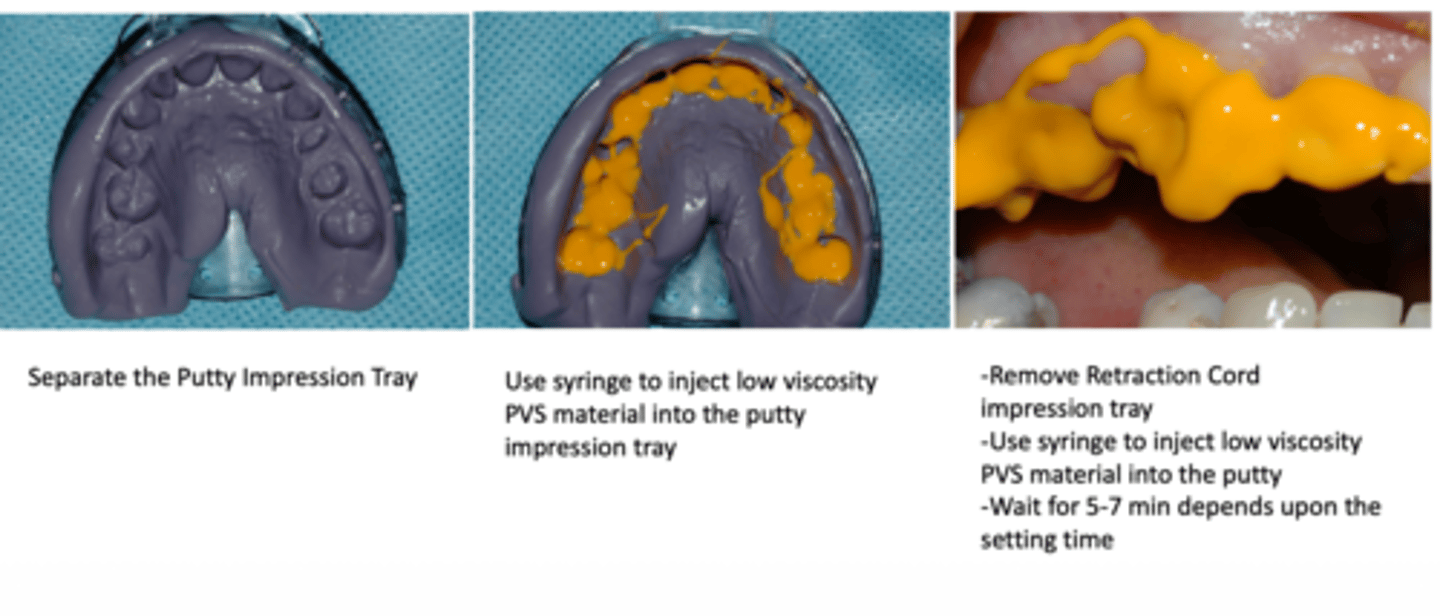
What technique?
Modified Two Step Technique
These are the advantages of what technique?
- Allow putty to form around the prepared tooth and create greater pressure for syringe material to penetrate into the sulcus
- Accurate detail
- Less time consuming than the traditional two step technique
- No delamination
Modified Two Step Technique
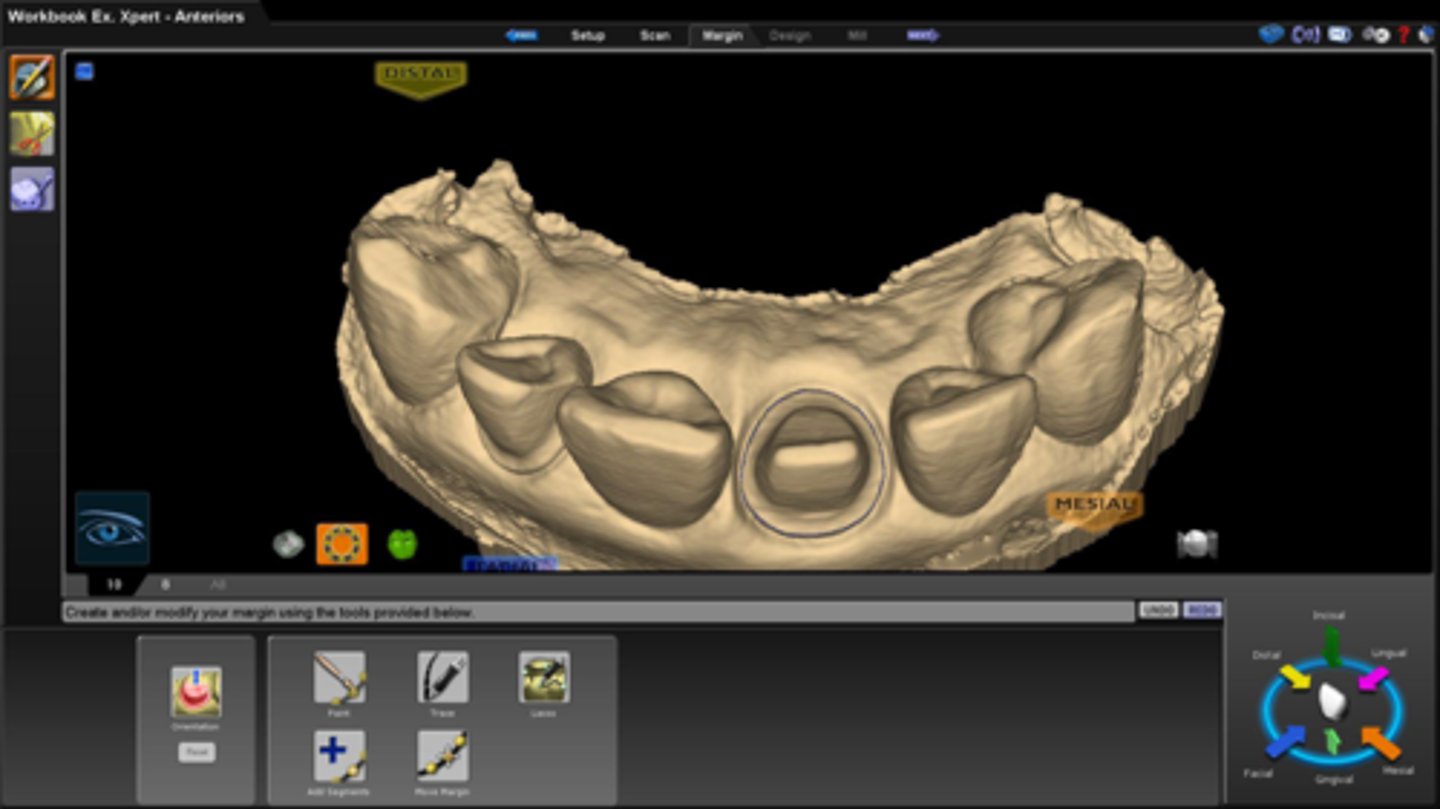
If you want to take digital impressions, what must you still expose?
The finish line
How long should the retraction cord be left in the sulcus in order to create lateral and vertical space?
7-8 minutes
T/F: When taking a final impression you need to capture Root Surface (by placing retraction cord to obtain lateral & vertical space) or must have 360 degrees cuff surround finish line
True
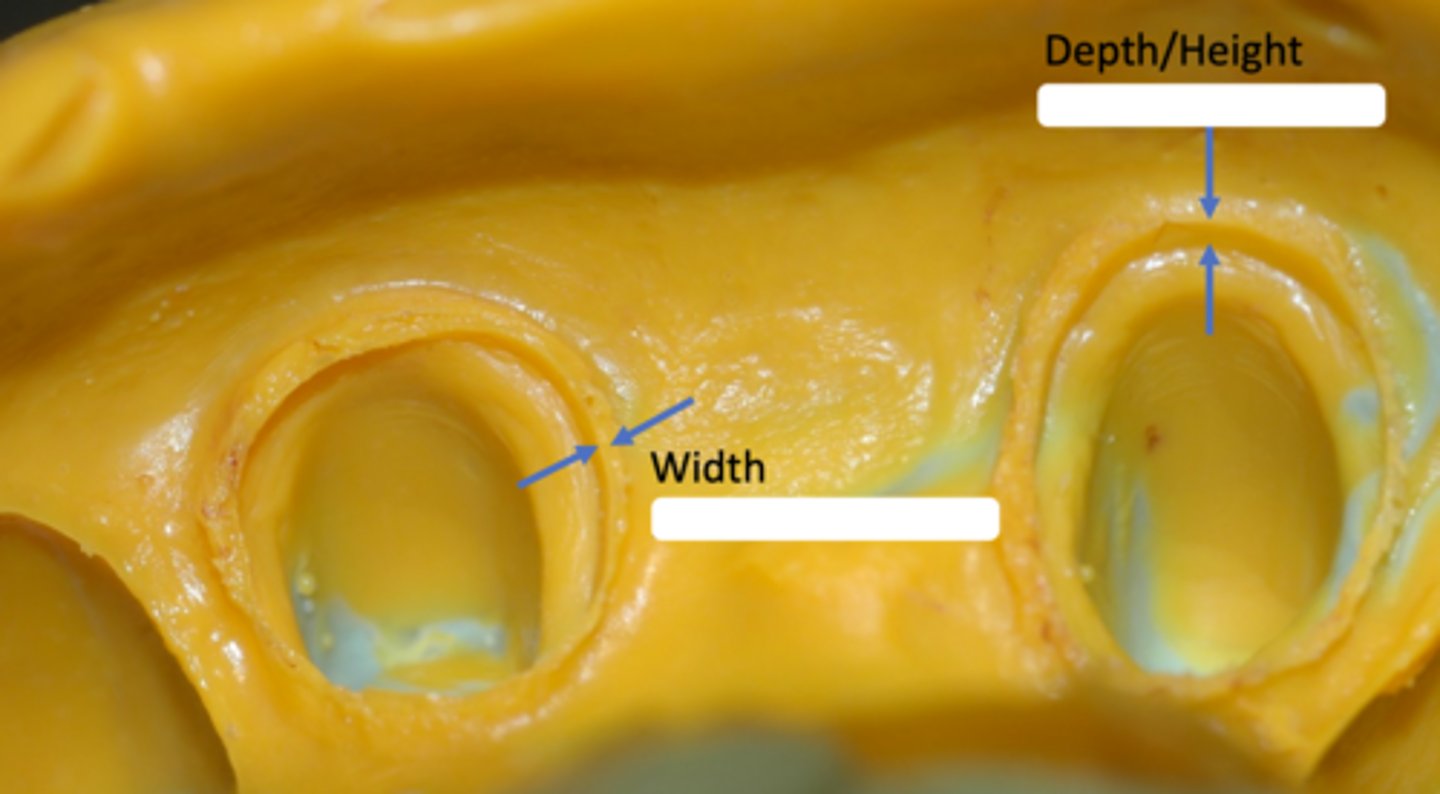
Width of the impression cuff needs to be at least____ mm (more is better)
0.2 mm
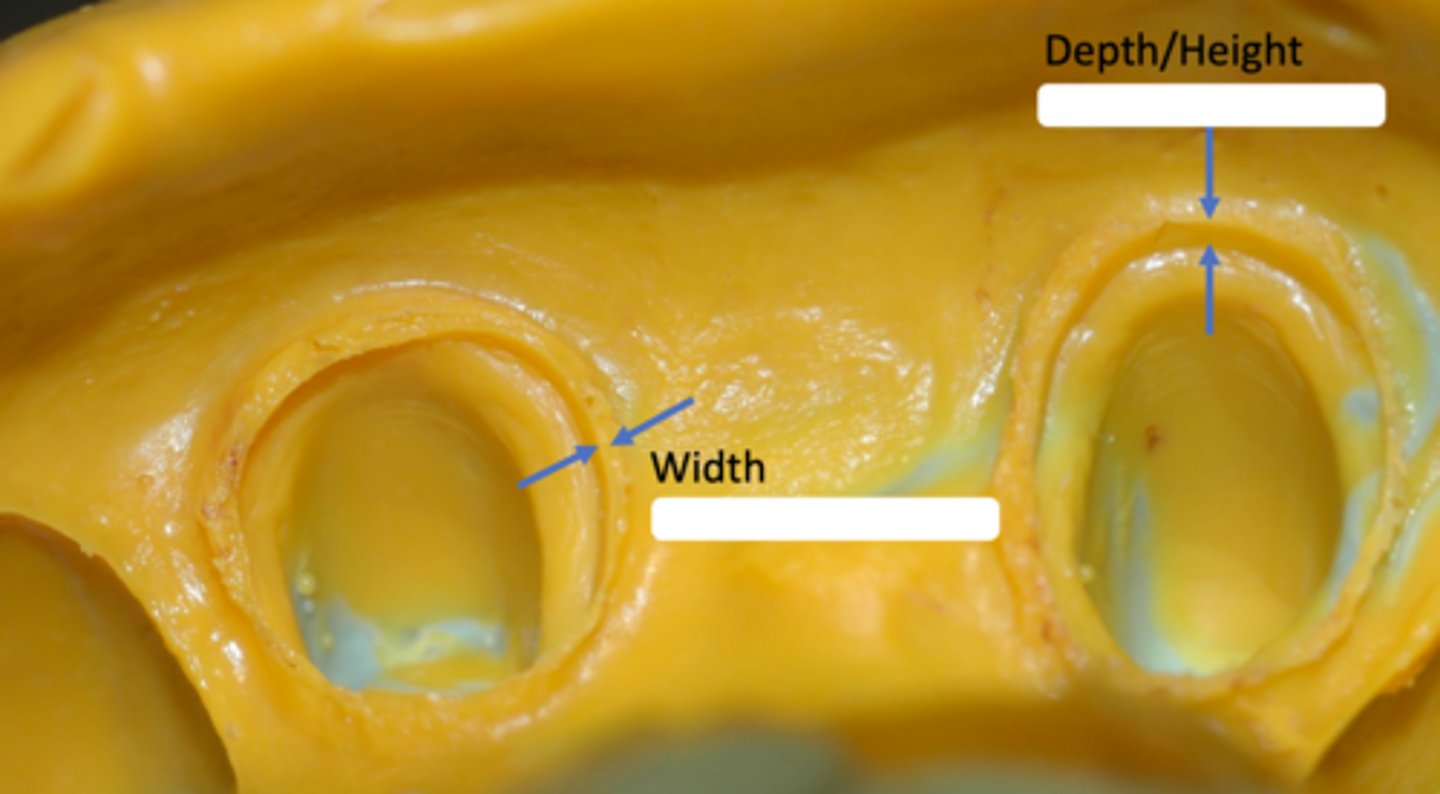
Depth of the impression cuff needs to be at least____ mm (more is better)
0.5 mm
After placing a retraction cord, about how much time do you have to place the impression material into the sulcus before soft tissue returns to its normal position?
20-40 seconds
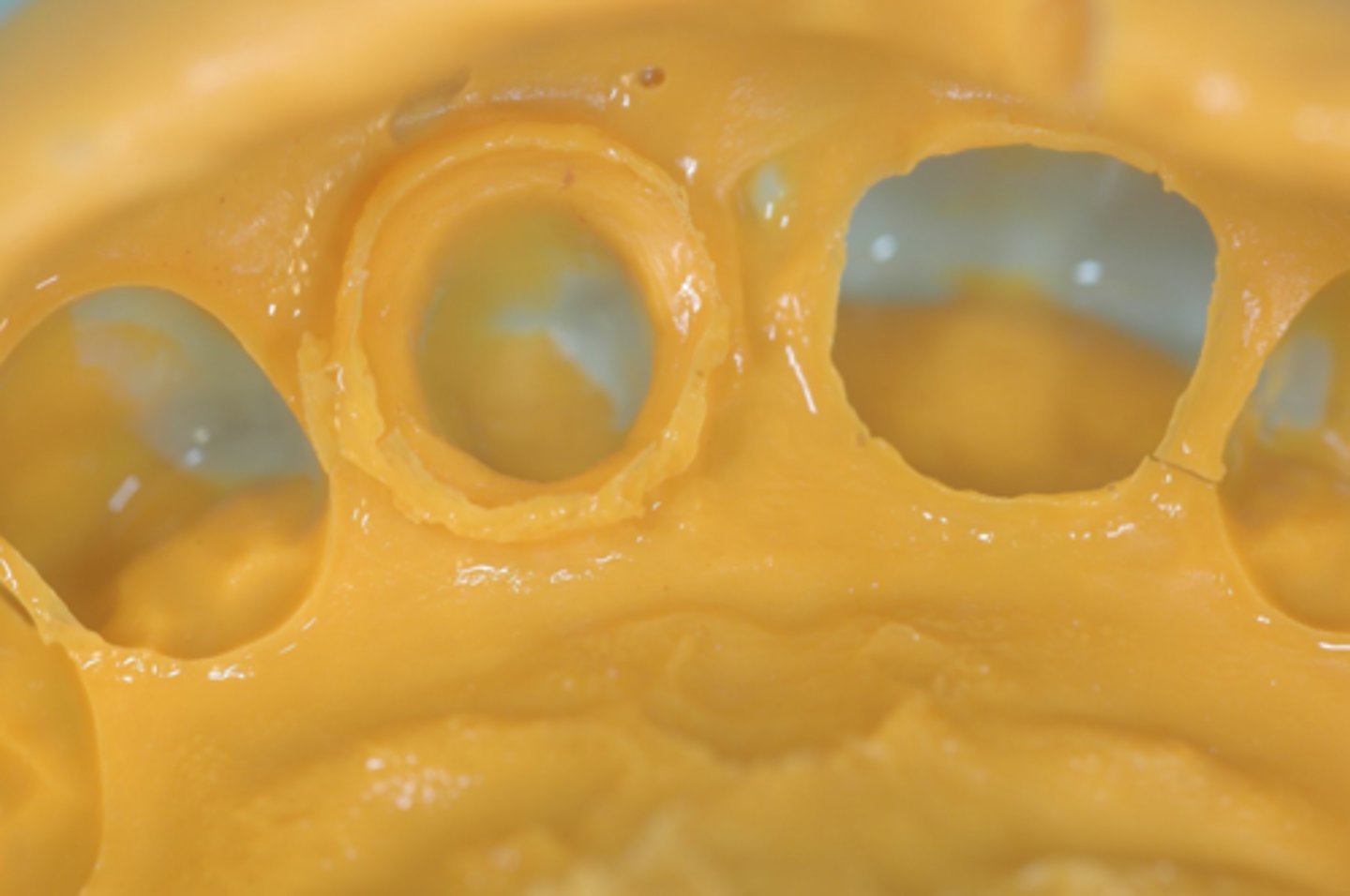
is this acceptable?
Yes
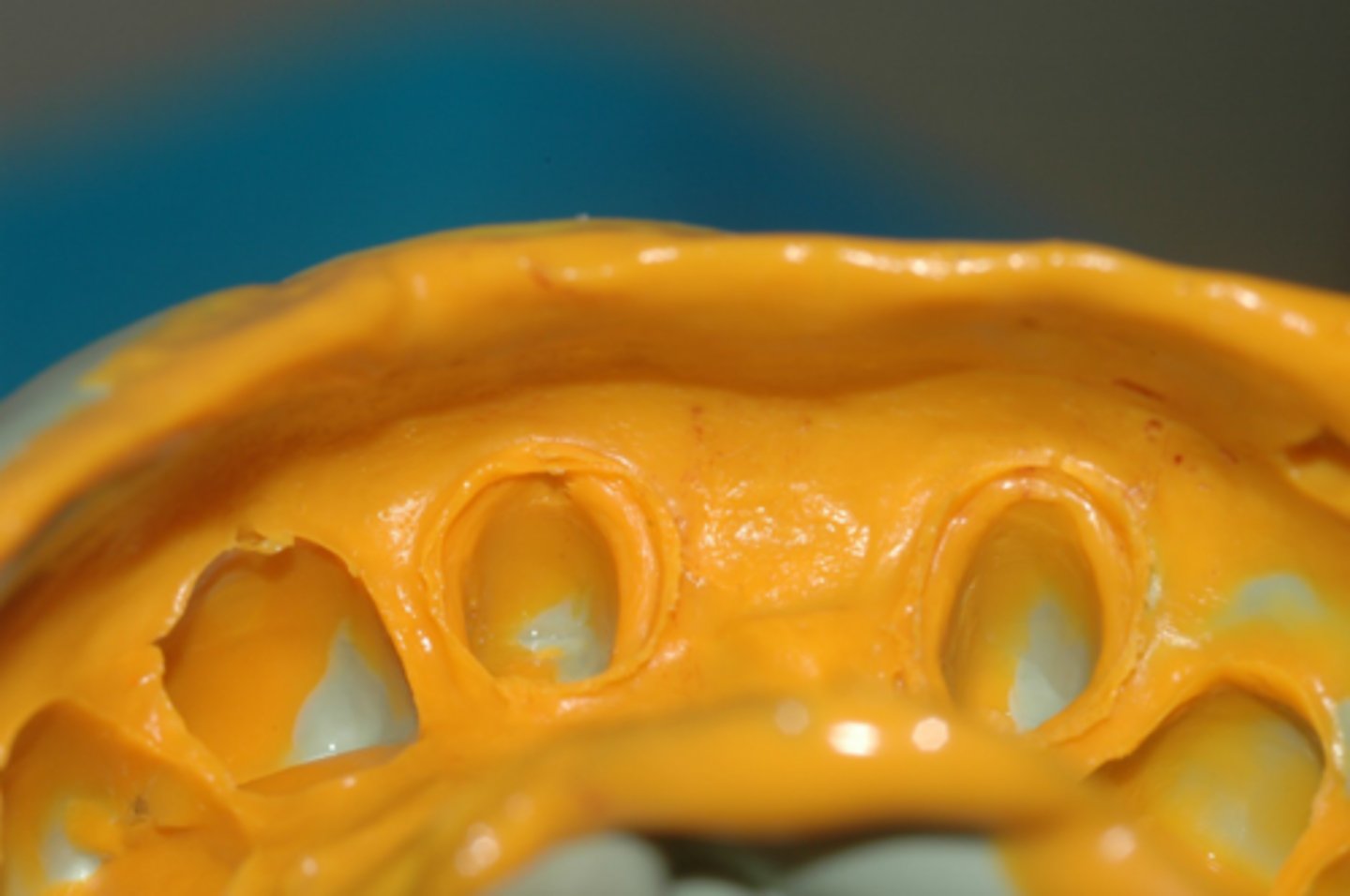
is this acceptable?
No
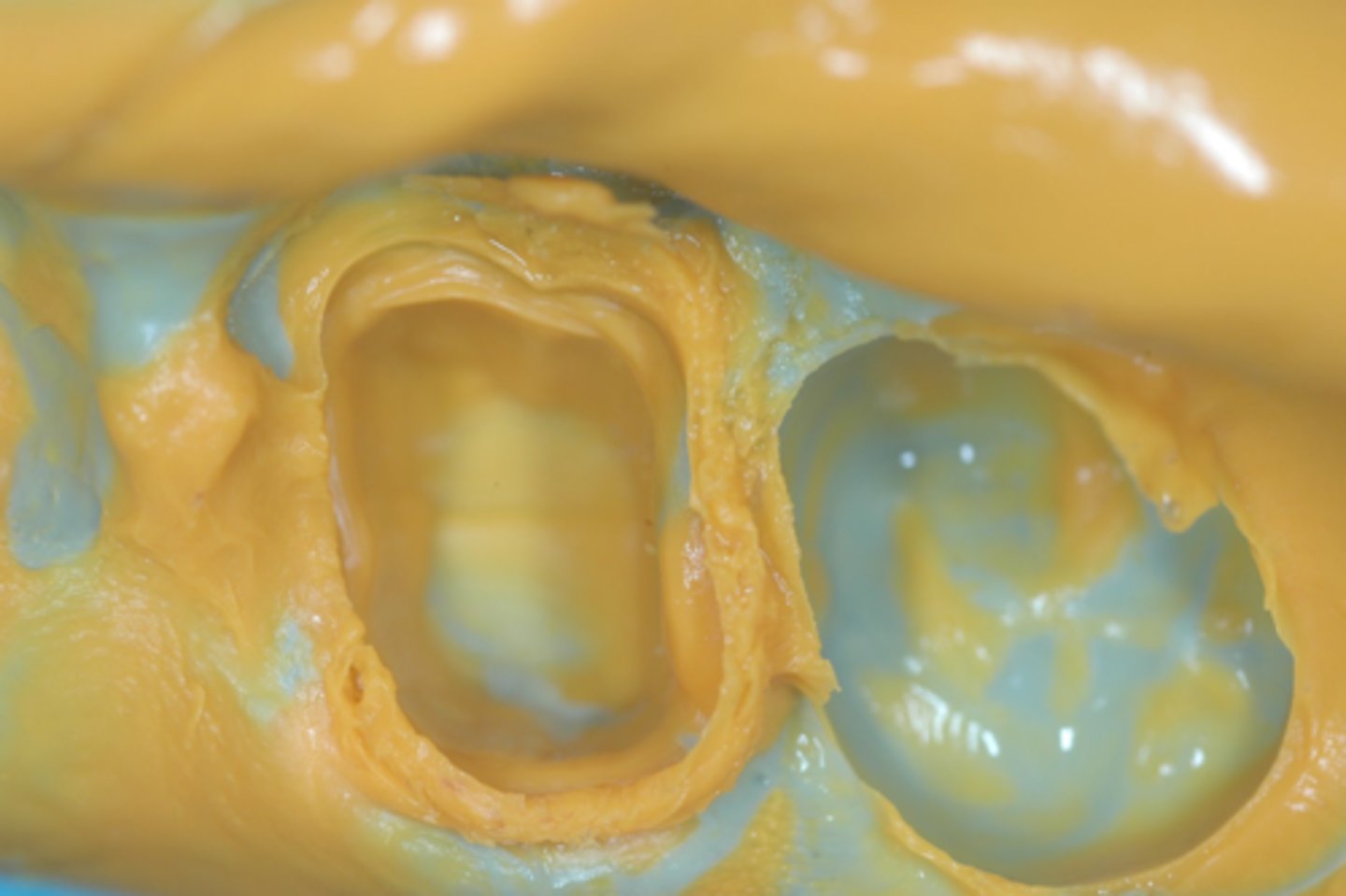
is this acceptable?
Yes
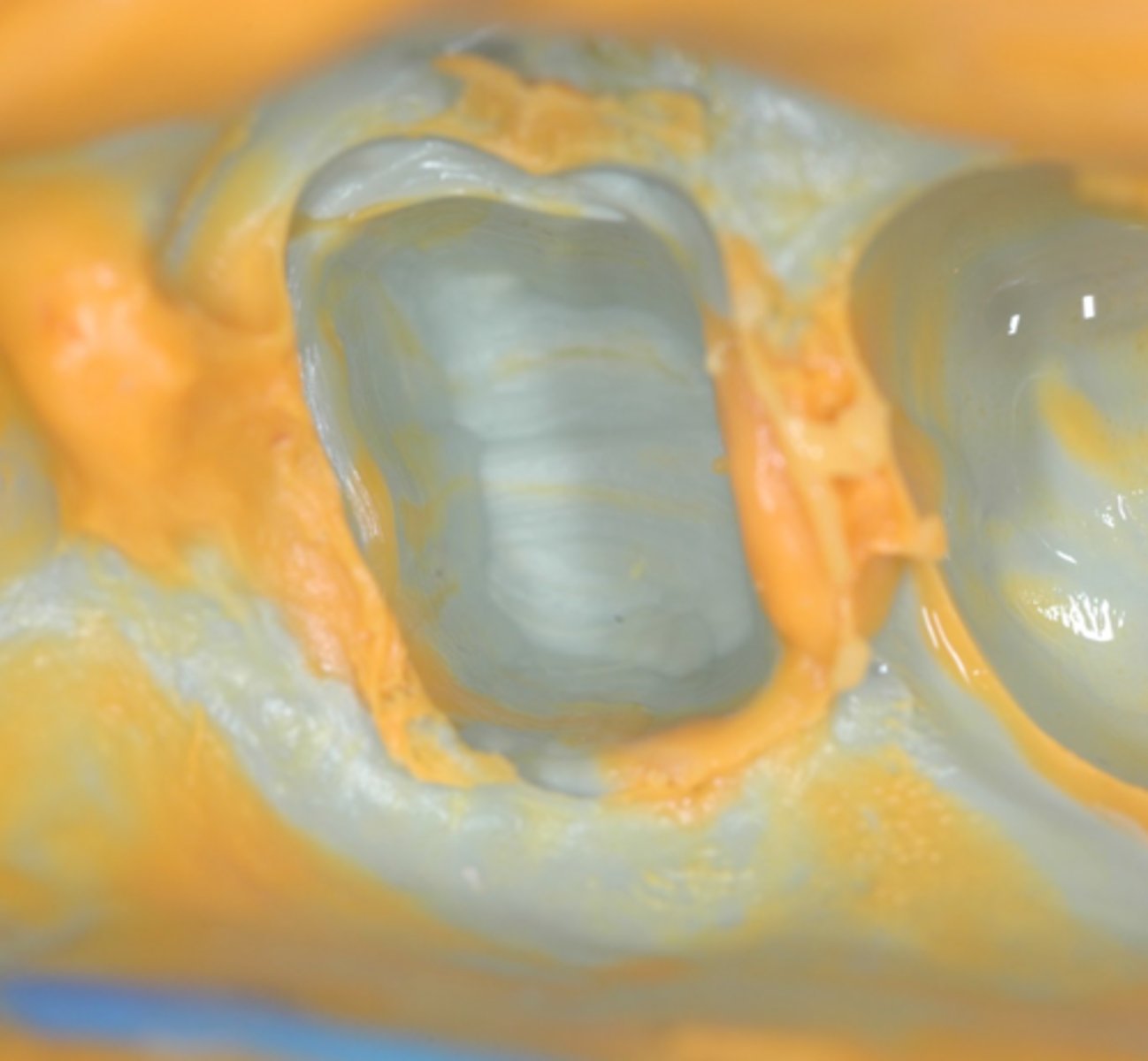
is this acceptable?
No
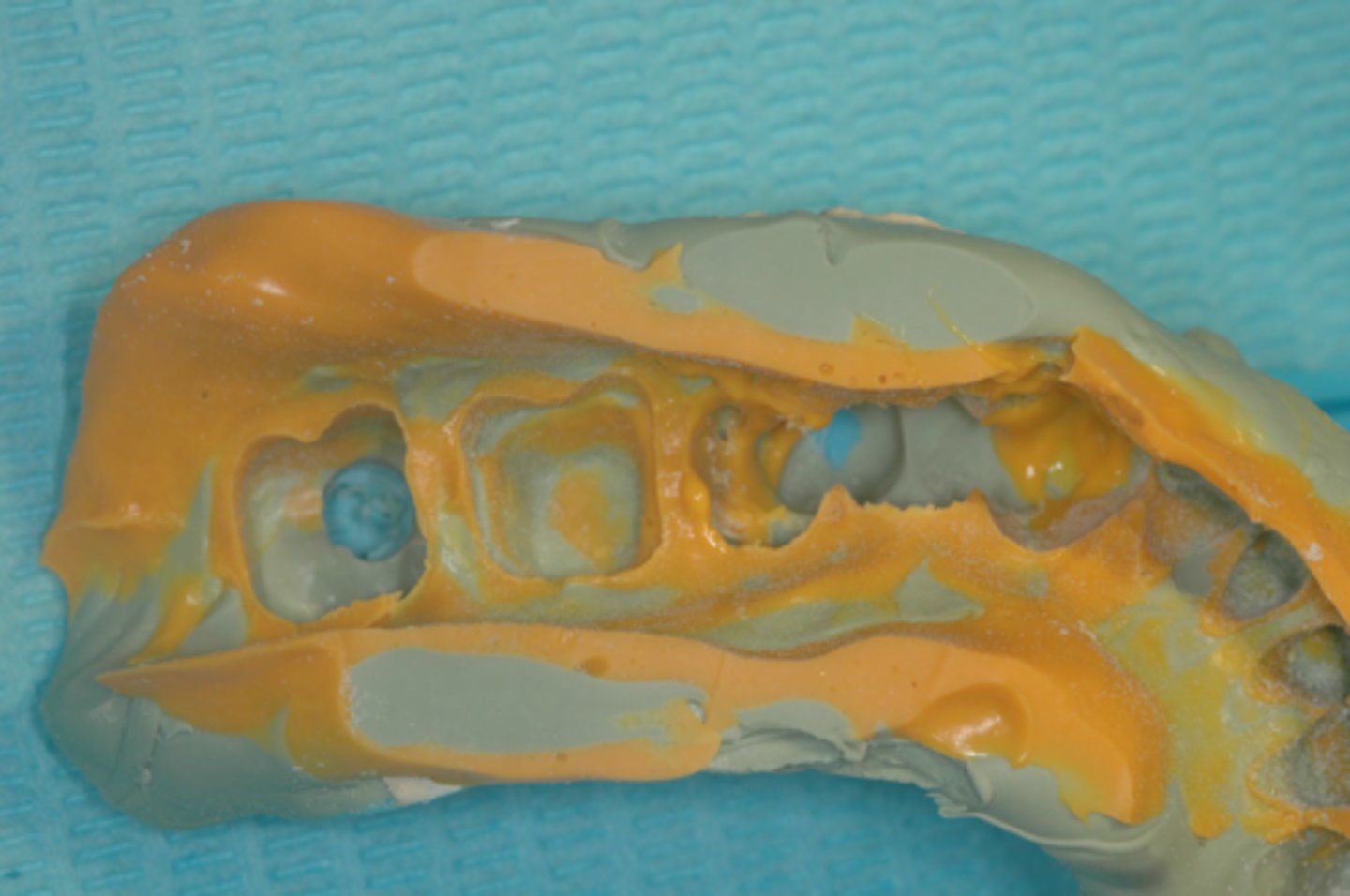
is this acceptable?
No
What might happen if you blow air into the sulcus?
may entrap air create bubble and voids
Dual Arch impression tray, Sectional Tray may lead to inaccurate ___________
Articulation
What Impression may have more polymerization shrinkage and may not capture minute detail?
Monophase technique
What can be used but avoid hard tissue and you need to be careful when adjusting the temperature?
Electrosurgery
What has no long term efficacy and be careful when tissue quality is very thick?
Expasyl

