3A: Adaptations for Gas Exchange
 Call Kai
 Learn
Learn Practice Test
 Spaced Repetition
 Match
Match Flashcards
 Knowt Play
1/62

There's no tags or description
Looks like no tags are added yet.
Name | Mastery | Learn | Test | Matching | Spaced | Call with Kai |
|---|
No analytics yet
Send a link to your students to track their progress
63 Terms
Define surface area.
The total area of an organism that is exposed to the external environment.
Define volume.
The total internal volume of an organism.
As the overall size of an organism increases, what happens to the SA:V ratio?
Why?
The SA:V ratio decreases.
This is because volume increases more rapidly than surface area as size increases.
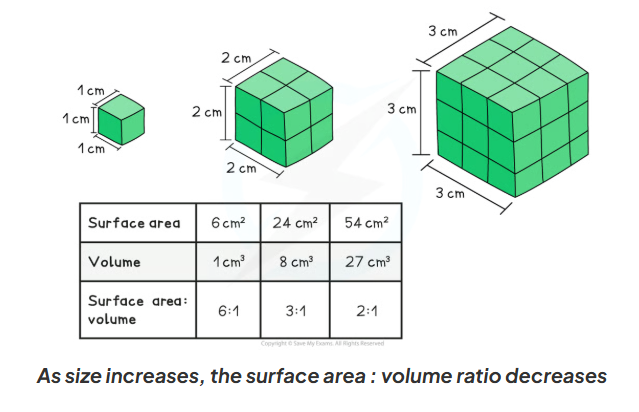
How do you calculate SA:V ratio?
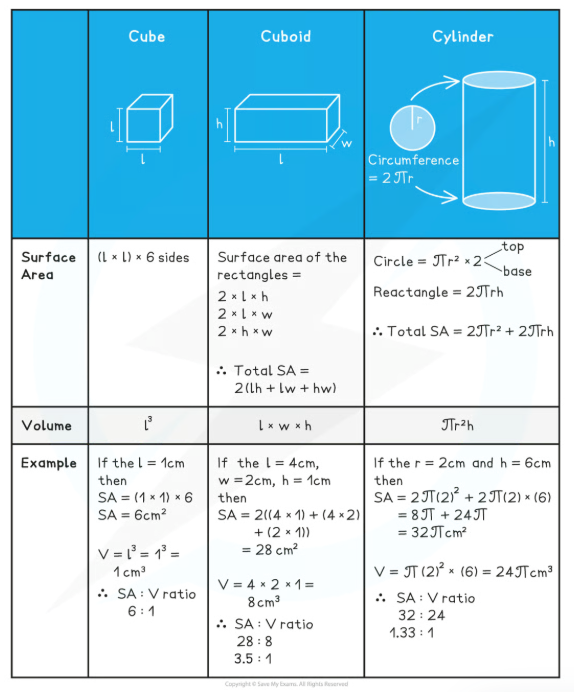
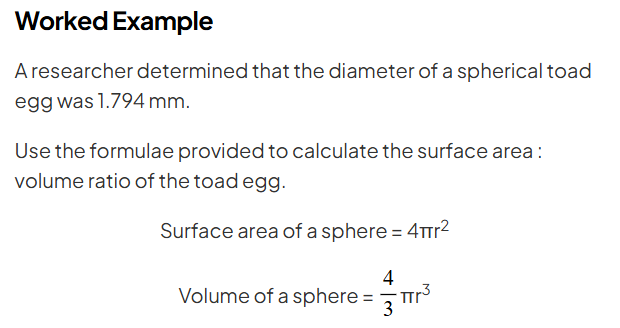
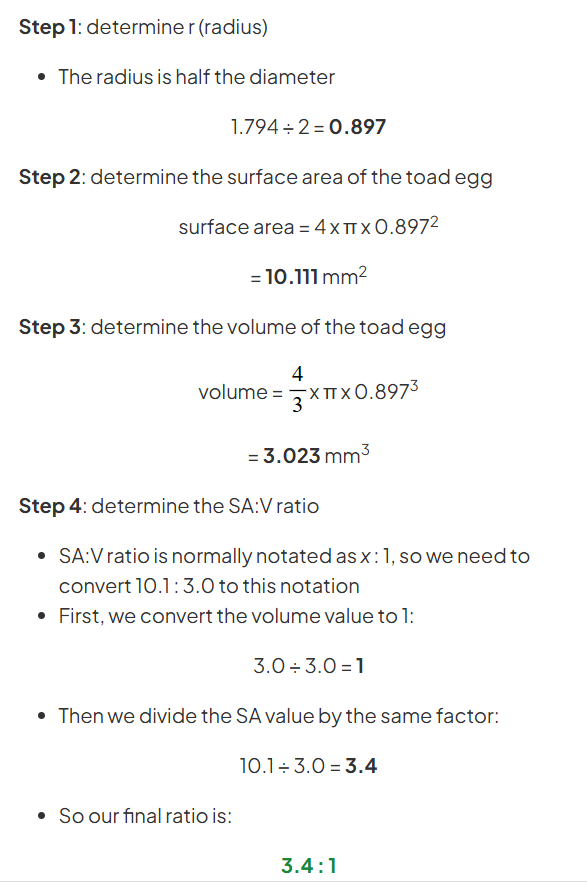
Which shapes should you kow how to calculate the surface area to volume ratio of?
cube
cuboid
cylinder
sphere
What is the required practical for this topic?
Investigating the effect of surface area to volume ratio on diffusion rate.
Single-celled organisms have a low/high SA:V ratio.
high
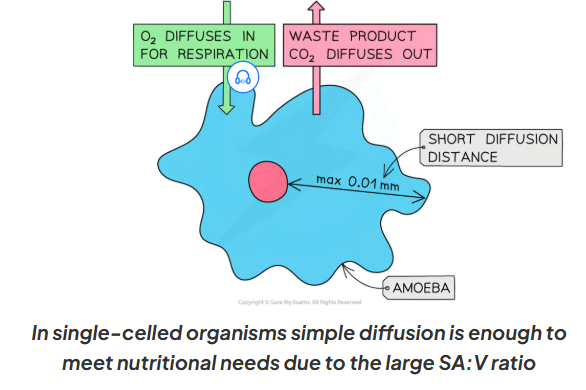
How does exchange work in single-celled organisms? Why?
Simple diffusion at the cell surface is sufficient to meet the needs of the cell, because of its high SA:V ratio.
The large surface area allows for maximum diffusion of nutrients and gases.
The small volume means the diffusion distance to all parts of the cell is short.
As organisms increase in size, their SA:V ratio increases/decreases.
decreases
What does a lower SA:V ratio mean for diffusion?
There is less surface area for diffusion compared to the size of the organism
The greater volume results in a longer diffusion distance to all parts of the organism, e.g. there may be many layers of cells
How have multicellular organisms adapted for better diffusion?
Thave evolved adaptations to facilitate the exchange of substances with the environment
E.g. the gas exchange system and digestive system in mammals, and the leaves of plants
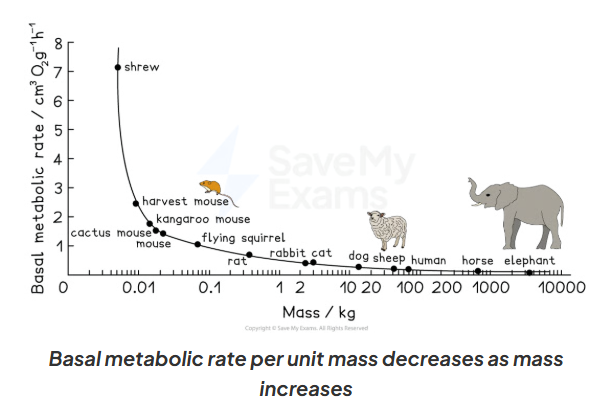
The SA:V ratio of an organism is related to its…
…metabolic rate.
Define metabolic rate.
The energy expended by an organism within a given period of time.
Why does the relationship between SA:V ratio and metabloic rate exist?
Because of the relationship between surface area to volume ratio and heat loss.
Explain the relationship between SA:V ratio and heat loss.
Heat is lost to the environment at the body's surface, so having a large body surface in relation to volume will allow more heat to be lost.
How have small animals adapted their metabolic rate?
They have a higher SA:V ratio, will lose more heat to their surroundings, meaning that they need a relatively high metabolic rate to maintain body temperature.
How have large animals adapted their metabolic rate?
They have a lower SA:V ratio, will lose less heat, meaning that they can maintain body temperature at a relatively low metabolic rate.
Give a table showing the relationship between mass and basal metabolic rate.
What are factors you should remember not to confuse?
SA vs SA:V ratio
BMR per unit mass VS total BMR
Why does effective gas exchange need to happen?
to supply oxygen for respiration
to remove waste carbon dioxide from respiration
Where/how do single-celled organisms carry out gas exchange?
At the cell surface by simple diffusion.
The high SA:V ratio of single-celled organisms means that…
diffusion occurs at a high rate over their relatively large surface area
the diffusion distance from the surface to all parts of the cell is short
What are the non-human specialised gas exchange systems you need to know about?
Insects
Fish
Dicotyledonous Plants
Gas exchange in insects occurs via which system?
The tracheal system
How does air enter the bodies of insects?
Via openings in the exoskeleton known as spiracles.
What is the pathway of oxygen in insects?
spiracles → trachea → tracheoles → muscle fibres
How are tracheoles adapted?
Many tracheoles lead to the muscle fibres, where their endings provide a large SA for gas exchange.
How do gases move through this pathway in insects into the muscle cells?
Rely on diffusion gradients for this movement.
Explain how gases are exchanged in instects.
Oxygen moves down its concentration gradient from the air into the respiring muscle cells.
Carbon dioxide moves down its concentration gradient from the respiring muscle cells into the air.
How can insects gain a morerapid supply of oxygen during physical activity?
By using rapid contractions of the abdominal muscles to draw oxygen into the tracheae down a pressure gradient.
Give a digaram to show insects’ exchange system.
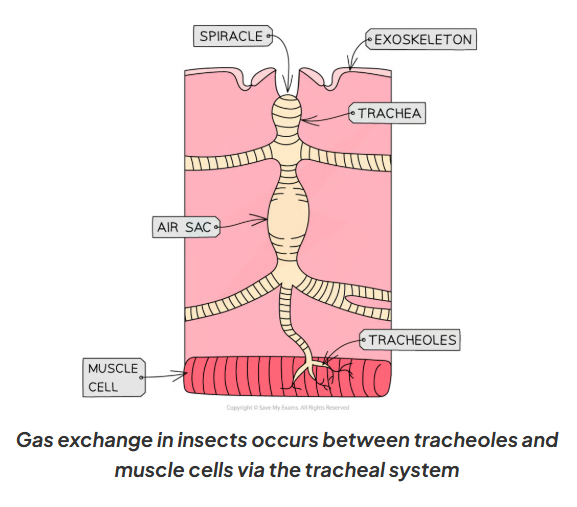
How do fish get oxygen?
They are adapted to extract oxygen from water.
What are the adaptations of fish for gas exchange?
gills
counter-current flow
How are gills an adaptation for gas exchange?
They maximise the SA for gas exchange.
Explain the structure of gills.
There are a series of gills on each side of the head
Each gill arch is attached to two stacks of filaments
On the surface of each filament, there are rows of lamellae
The lamellae surface consists of a single layer of flattened cells that cover a vast network of capillaries
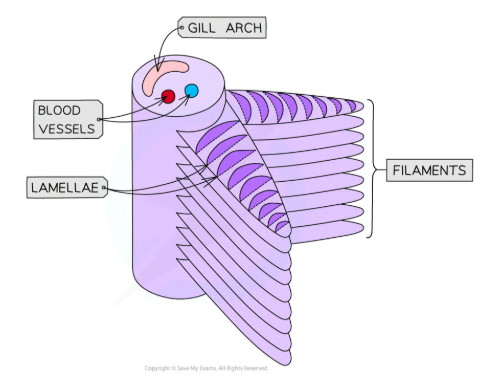
What is counter-current flow?
The blood in the capillary system flows in the opposite direction to the flow of water as it passes over the gills.
How is counter-current flow an adaptation for gas exchange?
It ensures that the concentration gradient is maintained along the whole length of the capillary.
The water that enters the capillary has the highest oxygen concentration, and this flows adjacent to the blood that is already partially oxygenated.
The water that exits the capillary has the lowest oxygen concentration, and is adjacent to the most deoxygenated blood.
Give a diagram to show counter-current flow.
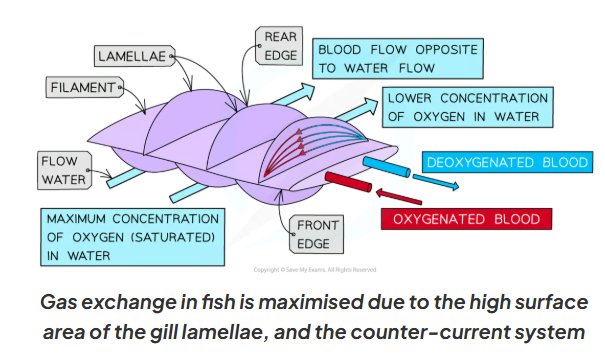
What is the name fo the type of plant leaves learnt about in A-Level?
Dicotyledonous Plants
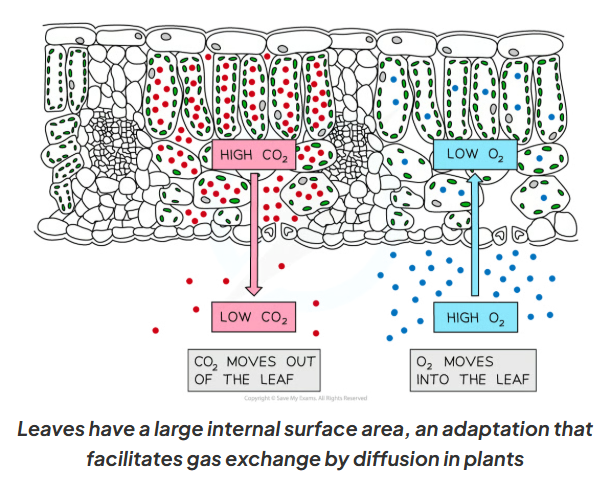
Which gases do plants need? How do they get these?
Plants need carbon dioxide for photosynthesis, and oxygen for respiration, and the leaves are adapted to maximise exchange of these gases.
What are the leaves’ adaptations for gas exchange?
the spongy mesophyll layer
the stomata
the shape of leaves
How is the spongy mesophyll adaptated for gas exchange?
Air flows into and around the air spaces.
The surfaces of the spongy mesophyll cells come into contact with the air spaces, creating a large surface area for gas exchange.
What are stomata?
Pores on the underside of most leaves which allow air to enter and exit the leaf.
How is the stomata adaptated for gas exchange?
Guard cells control the opening and closing of the stomata.
How is the shape of leaves adaptated for gas exchange?
Leaves are flat and thin, reducing the diffusion distance for gases.
How do gases move in and out of the leaf?
By diffusion down their concentration gradients.
Give a diagram to show the structure inside leaves.
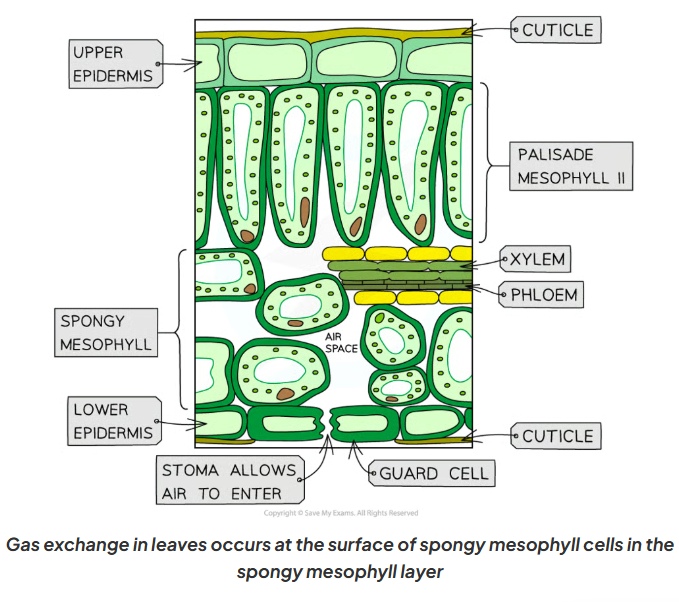
What are the features of an exchange surface?
Large surface area
Short diffusion distance
Steep concentration gradient
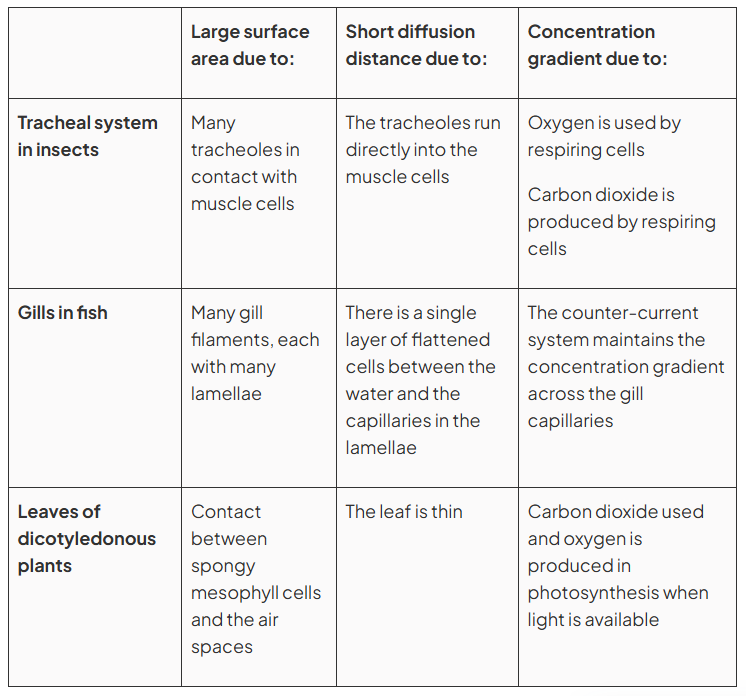
For each of the 3 non-human gas exchange systems, name:
why they have large SA
why they have a short diffusion distance
why they have a concentration gradient
Adaptations that aid gas exchange tend to increase/decrease to the potential for water loss.
increase
Organisms need to compromise between ________ gas exchange and ________ water loss.
Organisms need to compromise between maximising gas exchange and minimising water loss.
Where can we see examples of organisms finding compromise between maximising gas exchange and minimising water loss?
terrestrial insects
xerophytic plants
How are the surface of insects adapted?
Insects have a waterproof exoskeleton that prevents water loss by evaporation.
Despite their waterproof exoskeleton, insects still experience water loss. Why?
The spiracles provide openings through which water vapour can be lost.
Insect features that minimise water loss include…
the ability to close spiracles
hairs around the spiracles to reduce diffusion of water vapour
What is the problem with stomata?
Plants need to keep their stomata open to allow gas exchange to occur, but open stomata also allow the loss of water vapour.
Plants that live in conditions where fresh water is limited have evolved adaptations to conserve water, including…
few stomata
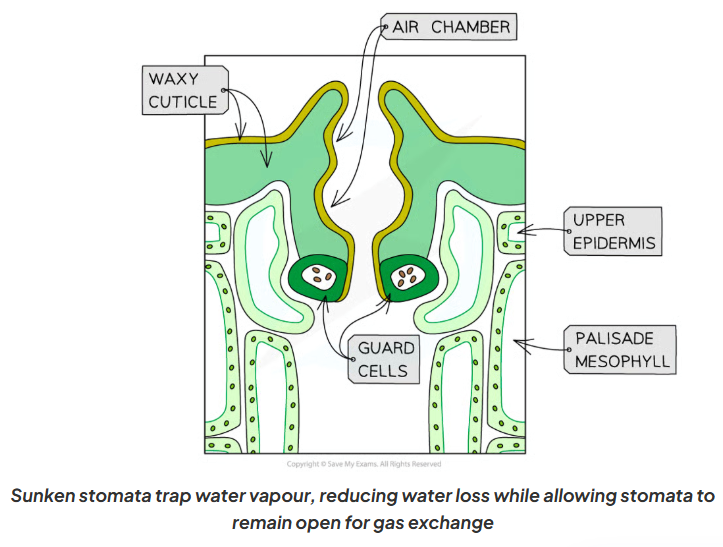
stomata that are in pits
hairs surrounding stomata
needle-shaped leaves with a reduced surface area
a thickened waxy cuticle
Plants with these adaptations are described as xerophytic.
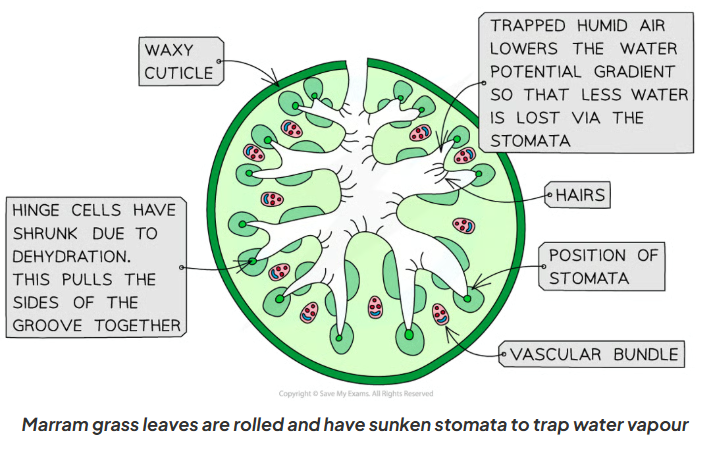
Give a diagram showing sunken stomata.
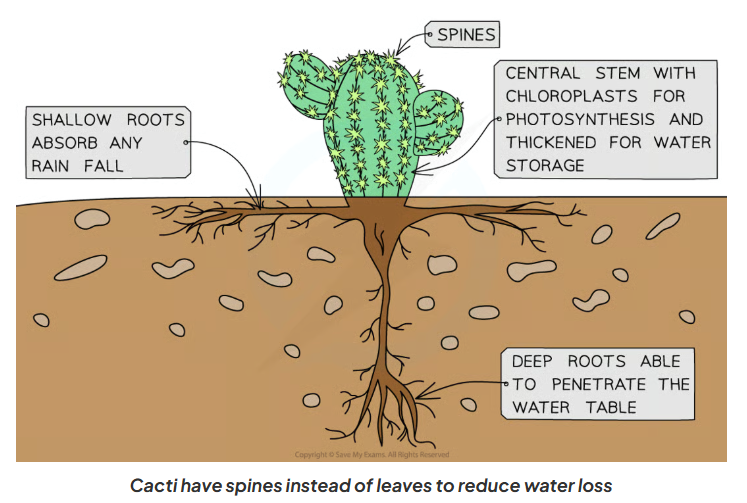
How are cacti adapted to reduce water loss?
leaves reduced to spines to reduce surface area for water loss
the stem has a thick cuticle to prevent water loss
Where is marram grass typically found?
on sand dunes
How is marram grass adapted to reduce water loss?
Leaves can roll up to reduce the exposure of surfaces to the wind
The rolling of the leaf provides deep grooves which protect the stomata
The exposed surface has no stomata and a thick cuticle
The inner surface of the leaf possesses a large number of hairs