Memory
 Studied by 1 person
 Call with Kai
 Learn
Learn Practice Test
 Spaced Repetition
 Match
Match Flashcards
 Knowt Play
1/77

There's no tags or description
Looks like no tags are added yet.
Name | Mastery | Learn | Test | Matching | Spaced | Call with Kai |
|---|
No analytics yet
Send a link to your students to track their progress
78 Terms
What is learning?
• acquisition of new information
What is memory?
• outcome of learning
What underlies learning and memory in the nervous system?
• cellular and circuitry changes
What characteristics differentiate types of memory? (5)
• storing different types of information
• operating over different time courses
• having different storage capacities
• being conscious or not
• relying on different brain circuits
What are the three stages of memory processing?
• Encoding
• Storage
• Retrieval
What does encoding include?
• acquisition
• consolidation
What is storage in memory?
• retention of memory traces
What is retrieval in memory?
• access to stored memory traces
What is amnesia?
• memory loss, mostly due to brain damage
What is retrograde amnesia?
• loss of memory before the brain lesion
What does Ribot’s law state?
• retrograde amnesia is greatest for the most recent memories (after brain lesion, but also after electroconvulsive therapy or severe head trauma)
What is anterograde amnesia?
• loss of memory after the brain lesion (problems with encoding or consolidation)
What was H.M.’s memory deficit?
• severe anterograde amnesia after bilateral hippocampus lesion
What’s a single dissociation?
• damage to brain area X impairs task A but not task B
• brain area X and task A are associated, whereas brain area X and task B are dissociated → interpretation problematic
What’s a double dissociation?
• damage to area A impairs memory type A but not type B, while damage to area B impairs memory type B but not type A → strongest evidence for distinct systems, indicated that two cognitive operations are independent
What are the two main types of memory?
• long-term memory
• short-term memory/working memory/sensory memory
Which 2 subtypes does short-term memory have?
• sensory memory
• working memory
Which 2 subtypes does long-term memory have?
• explicit memory (declarative memory)
• implicit memory (nondeclarative memory)
Which 2 subtypes can explicit memory be divided into?
• episodic memory (events) → specific personal experiences from particular time and place
• semantic memory (facts) → world knowledge, object knowledge, language knowledge, conceptual priming
Which brain structures are responsible for explicit (episodic and semantic) memory?
• medial temporal lobe
• middle diencephalon
• neocortex
Which 4 subtypes can implicit memory be divided into?
• procedural memory
• perceptual representation system
• classical conditioning
• nonassociative learning
What’s procedural memory and where does it take place?
• skills (motor and cognitive)
• basal ganglia, skeletal muscle
What is the perceptual representation system and where is it located?
• perceptual priming
• perceptual and association neocortex
What is classical conditioning and where does it take place?
• conditioned responses between two stimuli
• cerebellum
What is nonassociative learning and where does it take place?
• habituation, sensitization
• reflex pathways
How is sensory memory characterized in terms of time course, capacity, conscious awareness and mechanism of loss?
• time course: milliseconds to seconds
• capacity: high
• conscious awareness: no
• mechanism of loss: primarily decay
How is short-term and working memory characterized in terms of time course, capacity, conscious awareness and mechanism of loss?
• time course: seconds to minutes
• capacity: limited (7 +-2 items)
• conscious awareness: yes
• mechanism of loss: interference and decay
How is long-term nondeclarative memory characterized in terms of time course, capacity, conscious awareness and mechanism of loss?
• time course: minutes to years
• capacity: high
• conscious awareness: no
• mechanism of loss: primarily interference
How is long-term declarative memory characterized in terms of time course, capacity, conscious awareness and mechanism of loss?
• time course: minutes to years
• capacity: high
• conscious awareness: yes
• mechanism of loss: primarily interference
How are the processing stages and types of memory connected?
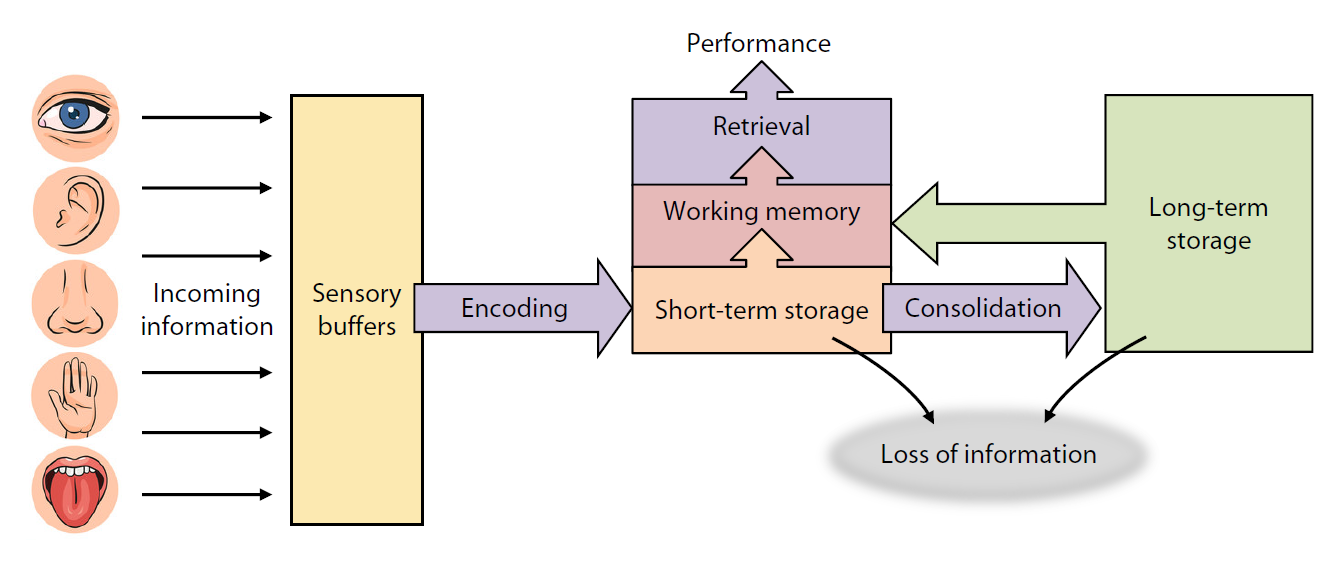
Which two subtypes of sensory memory are there?
• echoic memory (auditory)
• iconic memory (visual)
How is echoic memory characterized in terms of persistence, capacity and time course?
• persistence: unattended auditory information persists like an echo
• has high capacity and can be partially accessed when attended
• auditory sensory memory trace can last up to 10 seconds (ERP mismatch negativity)
How is iconic memory characterized in terms of persistence, capacity and time course?
• Persistence: unattended visual information persists like an “informational” afterimage
• Has high capacity and can be partially accessed when attended (partial report)
• Visual sensory memory trace lasts only 300–500 ms (partial report advantage)
How many items can most people report from a visual scene when tested and what does that imply?
• ~4 items
• at odds with our subjective experience of rich visual world
What’s the Sperling paradigm?
• researcher flashed 3 rows of 4 letters, then showed black screen
• participants were asked to give “whole report” of what they saw → on average: 4 letters → measures short-term memory (capacity limited)
• other condition: participants were played short tone (either high, medium or low)
• then asked to report letters → “partial report” of ~3-4 items, but from cued row → 9-12 items were available in brain → cue makes high-capacity memory trace accessible, revealing sensory memory
What’s the modal model and what does it say?
• by Atkinson & Shiffrin
• influential hierarchical, serial model of memory → basis for account of partial vs. whole report
• attention moves items from sensory to short-term memory
• rehearsal moves items from short-term to long-term memory
• information can be lost by decay or by interference
Why is the modal model debated?
• does information have to be encoded in short-term memory before being stored in long-term memory? → is it really serial?
• evidence against modal model from neuropsychological patients
What was recorded in a patient with long-term memory without short-term memory?
• patient K.F. (left parietooccipital damage)
• impaired verbal short-term memory (e.g. measures of digit, letter, and word span)
• normal declarative long-term memory (e.g. learning of ten words, 7 still remembered after two months)
→ single dissociation
What was recorded in a patient with short-term memory without long-term memory and what does that imply together with the results from patient K.F.?
• patient H.M. (bilateral hippocampus damage)
• preserved short-term memory (e.g. digit span)
• impaired declarative long-term memory (anterograde amnesia)
→ double dissociation
How does working memory compare to short-term memory?
• working memory = extended concept of short-term memory
• maintenance of information (e.g. remembering list of number)
• manipulation of information (e.g. summing list of numbers)
What does the Baddeley and Hitch working memory model say?
• central executive: role in executive control
• two subordinate short-term memory stores (rather tan one unitary one):
• phonological loop: rehearsal via acoustic code (e.g. of words, letters) instead of visual or semantic → verbal working memory
• visuospatial sketchpad: rehearsal via visual code → visuospatial working memory
• different brain circuits for two stores: verbal → left inferior frontal, spatial → right (fronto)parietooccipital
What characterizes nondeclarative long-term memory?
• not expressed verbally (cannot be declared), instead: previous experiences influence performance on tasks that don’t require intentional recollection of these experiences
• intact in H.M. → doesn’t rely on medial temporal lobe, but on other brain structures
What’s the serial reaction time task and for which type of memory is it relevant?
• for procedural memory: motor skill learning
• press corresponding button as fast as possible upon stimulus presentation
• structured/repeated (s) or random (r) sequence
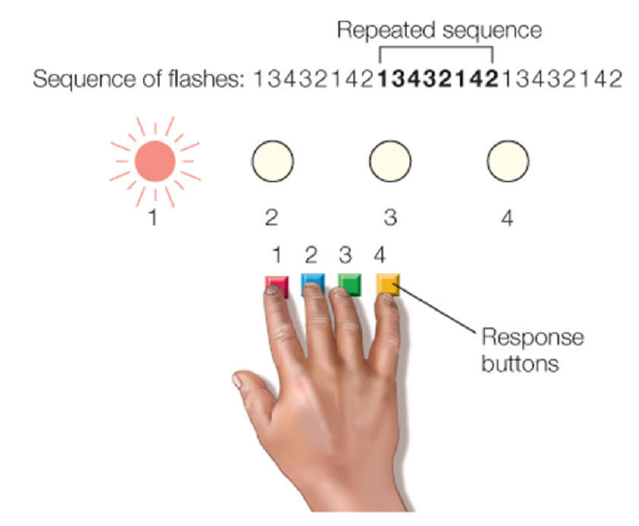
What leads to faster responses on the serial reaction time task?
• generally, practice
• faster responses with structured sequence, even without awareness of structure
• intact in anterograde amnesia (e.g. H.M.)
Which network is involved in the early learning phase in the serial reaction time task?
• motor skill learning network (premotor, SMA, basal ganglia, cerebellum, parietal cortex)
How can the brain activity in the later learning phases be described?
• reduced activity in motor skill learning network (reduced demands for error correction)
What is priming?
• change in processing of stimulus following prior exposure to that or related stimulus
• in absence of intentional memory strategies
What are the three types of priming?
- Perceptual Priming
2a. Conceptual Priming
2b. Semantic Priming
What’s perceptual priming?
• full or partial repetition of stimulus can prime form of objects and words
• example: word-fragment completion task
• specific to sensory modality of learning phase → relies on sensory cortices
• can last hours to months
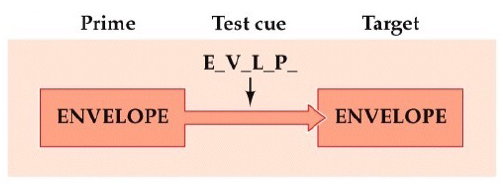
Does perceptual priming work in H.M. and what does that imply?
• intact in anterograde amnesia (H.M.) → patients show priming without any memory of ever having encountered stimuli before
• double dissociation: patient M.S. (right occipital lobe damage) with intact episodic memory but no visual priming
What’s conceptual priming?
• test cue is conceptually/semantically related to prime
• example: category-association test (generate words in response to cue)
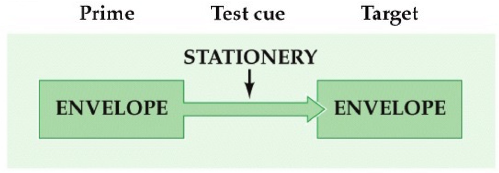
What’s semantic priming?
• prime and target are different stimuli (words) from same category
• example: simple speeded decisions on words are faster for semantically related prime-target pairs
• assumes that semantic memory is organized in associative networks
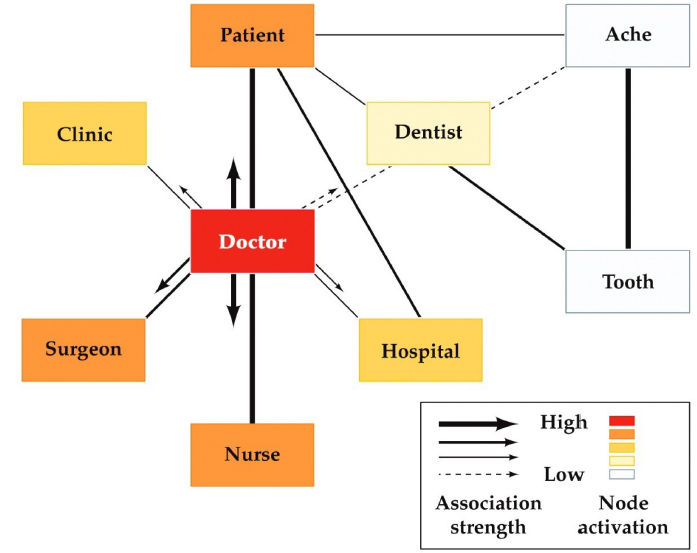
How do conceptual and semantic priming compare to perceptual priming?
• do not last as long as perceptual priming and are independent of sensory modality
Does conceptual and semantic priming work in H.M. and what does that imply?
• intact in anterograde amnesia (H.M.) → do not rely on medial temporal
Which brain areas do conceptual and semantic priming rely on?
• on anterior lateral temporal and inferior frontal (Broca’s) regions
What characterizes declarative long-term memory?
• can be expressed verbally (”declared”), is consciously accessible
• impaired in H.M. → relies on medial temporal lobe
How are encoding and storage affected by damage to the medial temporal lobe (MTL)?
• encoding: impaired by MTL damage → MTL key for formation of new long-term memories
• storage: less affected by MTL damage → MTL not key for storage of long-term memories
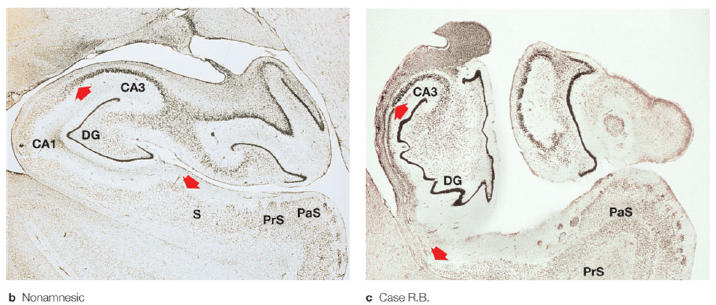
How was the hippocampus lesioned in patient R.B. with anterograde amnesia and only mild retrograde amnesia?
• seemingly intact hippocampi
• but selective lesions to CA1 region of hippocampi with CA1 pyramidal cells
How do the brain areas for episodic and semantic memory differ?
• encoding of episodic memories: hippocampus CA1 region in MTL
• semantic memory loss after lesions of lateral cortex of anterior temporal lobe that don’t involve hippocampus
What happens in semantic dementia?
• isolated retrograde amnesia
• anterior temporal lobe damage: loss of semantic knowledge → may be involved either in storage or retrieval of semantic knowledge
• episodic memory is intact, can learn new episodic information
Which stage of memory processing involves which brain area?
• encoding: involves MTL (hippocampus)
• storage: not necessarily MTL, primarily neocortex
• retrieval: involves MTL (hippocampus)
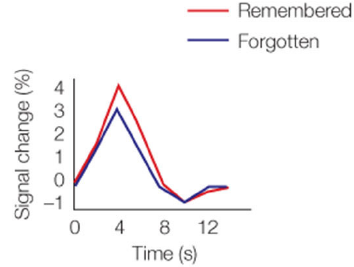
What’s the subsequent memory paradigm and which stage of memory processing does it concern?
• measure brain activity during encoding of items
• test memory for those items later outside of scanner
• analyze imaging data collected during encoding as function of remembered vs. forgotten items
• greater MTL activity for remembered vs. forgotten items during encoding
What’s the difference between recollection and familiarity-based recognition?
• episodic recollection: correctly identifying item as encountered before (incl. context, → what happened where, when and with whom)
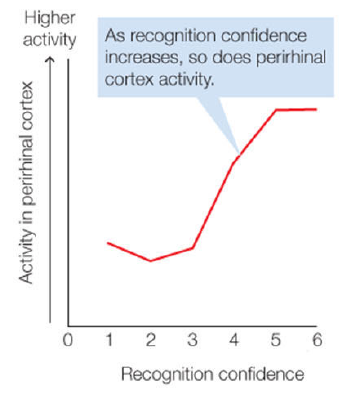
• familiarity-based (non-episodic) recognition: merely identifying item as being familiar
How do you measure hippocampus activity during retrieval of recollection or familiarity and what are the results of these measurements?
• encoding outside scanner, scan during retrieval
• hippocampus only for correct episodic recollection but not for familiarity-based recognition
How do you measure hippocampus activity during encoding of recollection or familiarity and what are the results of these measurements?
• = subsequent memory paradigm
• hippocampus only for correct episodic recollection
• familiarity-based recognition in perirhinal cortex
Where are the perirhinal cortex and the hippocampus located?
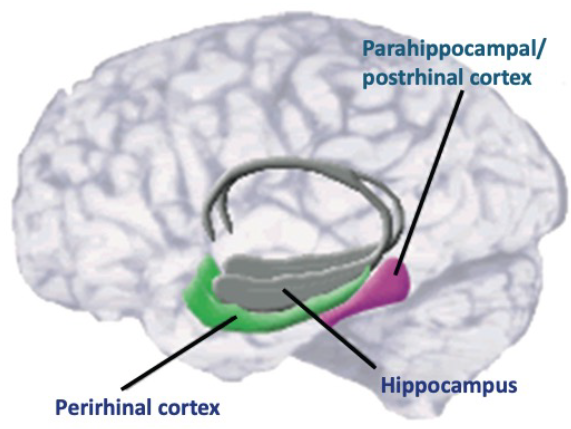
Which brain area does retrieval reactivate?
• during encoding of sounds and pictures, high-level, modality-specific sensory areas provide input to hippocampus
• during retrieval, similar sensory areas are activated
• suggests that information stored in long-term memory is retrieved by reactivation of neocortical areas
How can you induce false memories?
• e.g. editing childhood photographs into hot-air balloon ride
• 50% of participants actively created false childhood memories
How do false memories compare to true memories?
• false memories often lack sensory detail
How does the retrieval of true vs. false memories differ?
• only true memories: hippocampus + sensory cortex
• false memories: frontoparietal areas (top-down mechanisms)
Which brain structure does initial storage involve and what happens after?
• MTL (hippocampus), e.g. impaired in H.M.
• mechanics of subsequent slower consolidation process = controversial
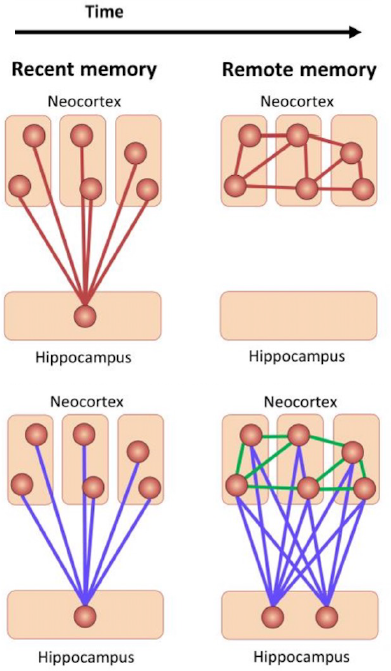
What’s the standard theory of consolidation?
• neocortex is key
• initially, hippocampus binds event information distributed across neocortex
• next, information is slowly transferred to neocortex
• repeated memory retrieval creates intracortical connections, hippocampus is unnecessary
• Ribot’s law: more recent events have not completed the consolidation process yet
What’s the multiple trace theory?
• hippocampus remains key
• episodic memory relies on hippocampus for retrieval
• repeated memory retrieval creates new memory traces involving hippocampus
• Ribot’s law: remote events have more traces as they have been retrieved more often
What’s Hebb’s law?
• cells that fire together, wire together
What’s Hebbian learning?
• strengthening of synaptic connections when weak and strong input act on neuron at same time
Which studies supported both Hebb’s law and Hebbian learning?
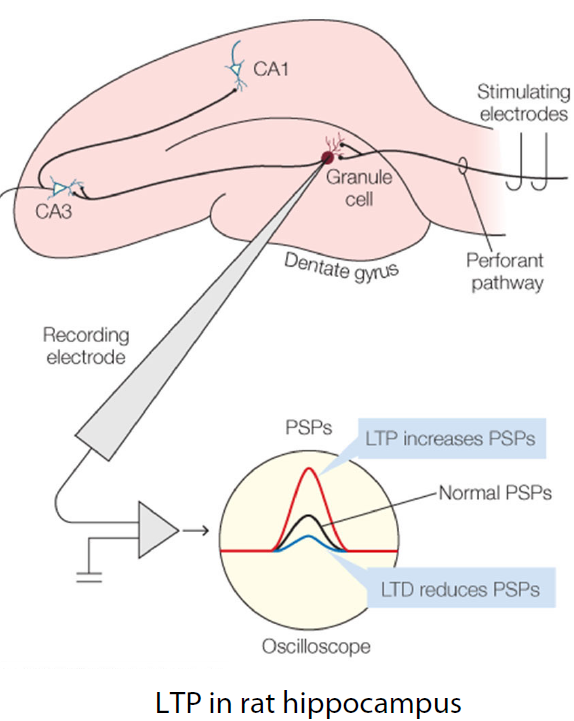
• studies on long-term potentiation (LTP)
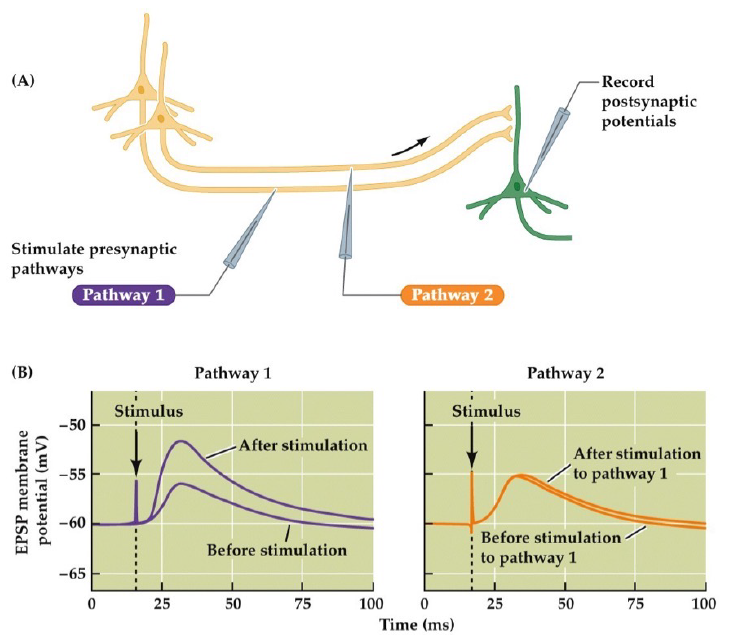
What’s long-term potentiation?
• after high-frequency burst to pathway 1, post-synaptic neuron exhibits stronger responses to pathway 1
• specific to stimulated change (no response to pathway 2)
• increases sensitivity is long-lasting → LTP
• long-term depression happens with very low-frequency bursts → weakening of synapses
What are properties of LTP?
• can happen after one burst (”one-shot learning” possible) and can last for weeks
• associative: weak inputs are potentiated when co-occurring at the same target neuron with strong inputs (and inputs become associated)
 Note
Note  Flashcards (24)