4. genetics
 Call Kai
 Learn
Learn Practice Test
 Spaced Repetition
 Match
Match Flashcards
 Knowt Play
1/148

There's no tags or description
Looks like no tags are added yet.
Name | Mastery | Learn | Test | Matching | Spaced | Call with Kai |
|---|
No analytics yet
Send a link to your students to track their progress
149 Terms
what is an ecosystem?
community of living organisms in a particular area
what is species richness?
no. of different species in a community
what is a community?
a group of interacting populations of different species living in the same place at the same time
what is a population?
a group of individuals of the same species living and interbreeding in the same area
what is the index of diversity?
index giving the relationship between the no. of species in a community and the no. of individuals in each species
what is a species?
organisms that can breed to produce fertile offspring
what is a habitat?
the environment in which an organism/population of organisms usually live(s)
what is a gene pool?
all of the alleles of all of the genes in a population
what is genetic diversity?
when a population has a large difference in alleles in a gene pool
what is a niche?
the role a species plays w/in an ecosystem
what is biodiversity?
the variety of living organisms in an area
give 6 ways in which intensive farming causes a decrease in biodiversity:
monocultures
converting woodland and hedgerows into fields
filling in ponds, draining marshes and overgrazing of land
removing weeds w/ herbicides
using pesticides to kill crop pests
using inorganic fertilisers
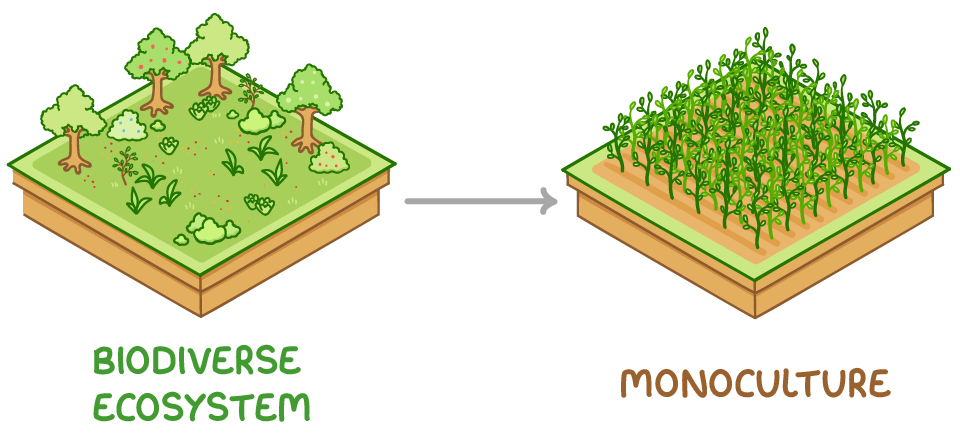
how does the use of monocultures decrease biodiversity?
deplete nutrients from soil
decrease diversity of plants/species which. depend on a biodiverse ecosystem for food/habitat
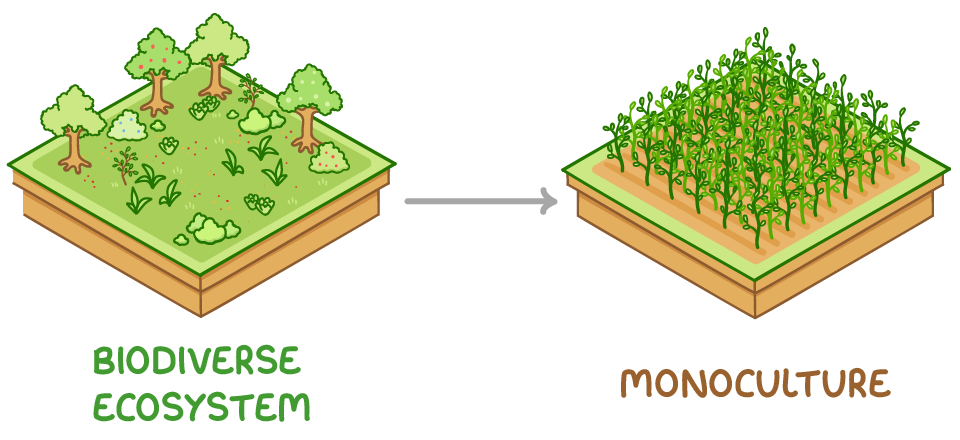
how does converting woodland and hedgerows into fields decrease biodiversity?
decreases no. of trees and other species
destroys habitats relied on by many species
how does filling in ponds/draining marshes/over-grazing land decrease biodiversity?
directly destroys habitats and reduces species diversity
how does removing weeds w/ herbicides decrease biodiversity?
may harm other species or those that depend on target species
how does using pesticides to kill crop pests?
may harm other species or those that depend on target species
how does using inorganic fertilisers decrease biodiversity?
may run off into water courses, causing issues for aquatic species
how can we balance conservation and agriculture?
maintaining hedgerows
reducing pesticide/herbicide use
using organic fertilisers
using crop rotation
give 7 effects of climate change on biodiversity:
hanges in temp/rainfall may negatively affect species adapted to specific climates
changed conditions make certain areas more/less habitable
suitable habitats for some species may expand/contract
climate change may influence species distribution/migration
warmer → tropical diseases more likely to spread
rising sea levels → more flooding in low lying land
why are bumblebees disappearing and why is this significant? 🐝
intensive farming and pesticide use are causing a bumblebee decline
sig as bumblebees are vital pollinators of arable crops which allows price of fruit and crops to remain low
bumblebees require a high diversity of plants so farmers must maintain this to maintain the bumblebee population
give an example of the balance between conservation and farming:
balancing pesticide use:
pesticides decrease pollination by bees which will decrease crop yield/profit
however using pesticides kills pest species which will increase crop yield/profit
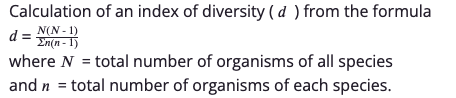
what does an index of diversity describe? what is the formula?
describes relationship between no. of species in a community and the no. of individuals in each species
what is a nucleosome?
eukaryotic DNA wrapped around histone proteins
what is the function of the protruding tails of histone proteins?
determine how tightly DNA is packaged
what is a haploid cell?
cell w/ 1 set of chromosomes (23)
what is a diploid cell?
cell w/ 2 sets of chromosomes/chromosomes in pairs (46)
what is a chromosome?
linear DNA molecule tightly associated w/ and so wrapped around histone proteins
what is chromatin?
non linear DNA molecule loosely associated w/ histone proteins
what is a gene?
sequence of bases that codes for one polypeptide/functional RNA
what is an allele?
different variation of a gene
what makes chromosomes homologous?
same length and order
(can still be homologous even if alleles!)
why is DNA enclosed in the nucleolus (rather than just freely floating in the nucleus)?
very big - needs to be more compact
difficult to find genes to code/replicate DNA
histones scaffold DNA into place
how many amino acids can make up the polypeptides in the human body?
20
how many bases code for 1 amino acid? what is this called?
3 bases code for 1 amino acid - codon
give 3 key features of the genetic code:
degenerate
universal
non-overlapping
what does it mean for the genetic code to be degenerate?
some amino acids are coded for by multiple codons
what does it mean for the genetic code to be universal?
genetic code is the same for humans as in other organisms (all species use same 4 bases)
what does it mean for the genetic code to be non-overlapping?
bases are only read 1x
what is an intron?
a section of non-coding DNA/RNA
what is an exon?
a section of coding DNA/RNA
what is the genome?
compete set of genes in a cell
what is the proteome?
full range of proteins coded for by the cell’s DNA/genome
how did Watson, Crick and Franklin’s discovery of DNA’s molecular structure serve to explain how DNA replicates?
the complementary bases allow for DNA strands to be predicted as complementary pairs of bases are always the same
describe the process of semi conservative replication:
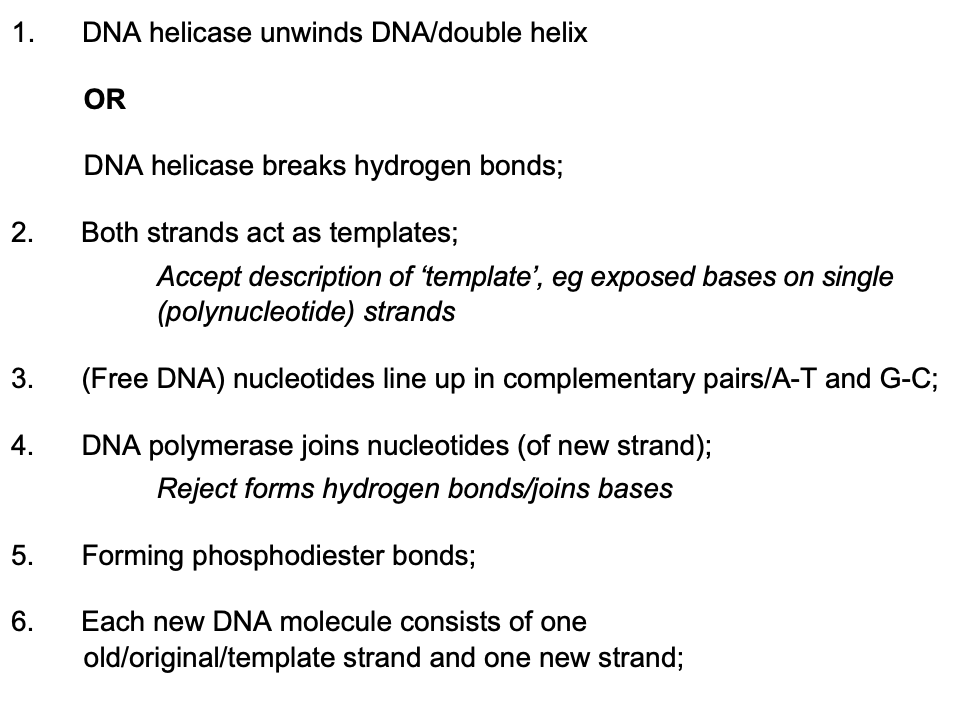
name the enzymes involved in semi conservative DNA replication:
DNA helicase
DNA polymerase
DNA ligase
what is the function of DNA helicase?
unzips DNA helix by breaking H bonds
DNA unwinds and separates into 2 strands
what is the function of DNA polymerase?
free nucleotides that have been activated are attracted to their complementary bases and joined together
this forms a phosphodiester bond
why does DNA polymerase only work in the 5’ - 3’ direction?
DNA strands antiparallel
DNA polymerase active site is specific and only complementary to 5’ endshape of 5’ end different to shape of 3’ end
describe and explain an experiment that shows evidence for semi-conservative replication:
grew bacteria on a medium containing 14N for multiple generations before transferring bacteria to a medium containing 15N for a single generation
extracted and centrifuged DNA
if conservative: original DNA would only contain 15N and settle at bottom of tube, new DNA would only contain 14N and settle at top of tube
if semi-conservative: all DNA would contain both 15N and 14N and so all would settle in middle of tube
one band formed in middle of tube → each DNA molecule contained a mixture of the heavier and lighter N isotopes
(if left to continue, ratio of 15N:14N would go from 1:1 to 3:1 to 7:1 etc.)
what is the function of mRNA?
messenger RNA - transfers genetic info between nucleus and ribosomes
what is the function of rRNA?
ribosomal RNA - acts as a component of ribosomes
what is the function of tRNA?
transfer RNA - needed to bring amino acids to the ribosomes
what is pre-mRNA?
long, single stranded molecule of RNA transcribed by a gene
contains introns
what is splicing? why is it important?
process of removing introns from pre-mRNA to form mRNA
this means than the mRNA is shorter so it can leave the nucleus through the nuclear pores and reach the ribosomes
describe the process of transcription:
RNA polymerase binds to and moves along DNA double helix, separating DNA strands by breaking H bonds between strands
non-coding strand acts as template
RNA nucleotides join to complementary bases by RNA polymerase
RNA polymerase catalyses formation of phosphodiester bonds between adjacent RNA nucleotides
ends when RNA polymerase reaches a stop codon, detaches from DNA and terminates transcription
mRNA displaced by DNA molecules becoming rejoined
mRNA is spliced and leaves through nuclear pore
what is tRNA?
single strand of RNA that carries a specific amino acid to the ribosome
describe the process of translation:
mRNA strand leaves nucleus via nuclear pore and is w/in cytoplasm
ribosome attaches to mRNA strand
tRNA molecule attaches to mRNA strand at anticodon, which is complementary to the codon
2nd tRNA molecule binds
anticodon complementary to codon
3rd tRNA molecule binds and peptide bond formed between 1st and 2nd amino acid, facilitated by ribosome
1st tRNA molecule moves away and ribosome moves along
repeats until stop codon reached, causing translation to terminate → polypeptide chain
what is the anticodon?
the part of the tRNA complementary to the codon
what is the function of the sections of dsRNA in the tRNA molecule?
to form the shape of the tRNA molecule
what are the products of meiosis?
4 genetically different haploid cells
name the 2 ways genetically different daughter cells occur in meiosis:
independent segregation
crossing over
describe the process of meiosis i:
meiosis i:
chromosomes replicate
chromosomes condense and homologous pairs join together
nuclear envelope breaks down and spindle fibres form
chromosomes are attaches to spindle fibres at the centromere and line up in pairs randomly along the equator of the cell → independent segregation
crossing over - homologous chromosomes exchange parts with each other
homologous chromosomes pulled to opposite poles of cell by spindle fibres
cytoplasm divides, forming 2 daughter cells
chromosomes decondense
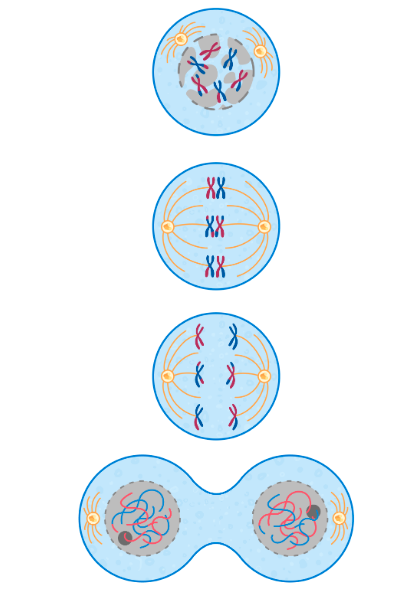
describe the process of meiosis ii:
nuclear envelope reforms and chromosomes recondense
in each cell, spindle fibres attach to centromere of chromosomes and pull sister chromatids apart to opposite poles of the cell
chromosomes recondense
cytoplasm /es and nuclear envelopes form around 4 genetically different haploid daughter cells

what is independent segregation?
random alignment of homologous pairs along the equator of the cell
what is crossing over?
non sister chromatids exchanging alleles by sections of chromatids being broken off, exchanged and rejoined
what is the formula used to calculate the number of different possible combinations of chromosomes following meiosis (w/o crossing over)?
2n
give and explain 4 processes which result in an increase in genetic diversity w/in a species:
mutations
independent segregation of homologous chromosomes
crossing over between homologous chromosomes
random fertilisation of gametes
all produce new allele combinations
describe the process of crossing over and explain how it increases genetic diversity:
homologous pairs of chromosomes associate/form a bivalent
chiasmata form
= length of non sister chromatids/alleles are exchanged
producing new allele combinations
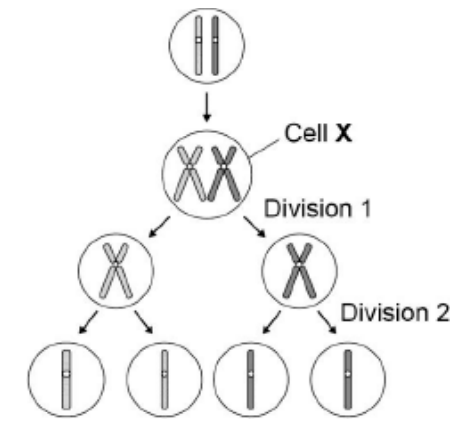
describe and explain the appearance of cell X:
chromosome formed of 2 chromatids
DNA replication has occurred
sister chromatids held together by the centromere
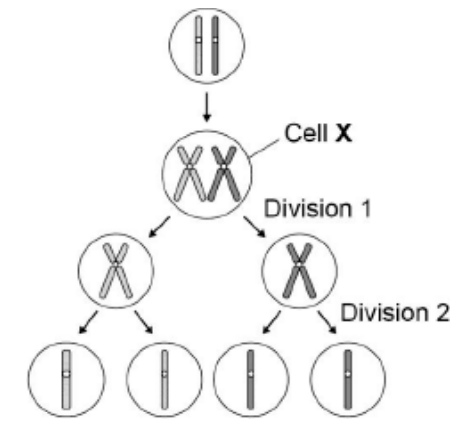
describe what has happened during division 1:
chromosomes in homologous pair
one of each/haploid number into daughter cells
give 5 processes which result in an increase in genetic variation w/in a species:
mutations
independent segregation of homologous chromosomes
crossing over between homologous chromosomes
random fertilisation of gametes
all produce new allele combinations
what is a gene mutation?
a change in the base sequence of chromosomes
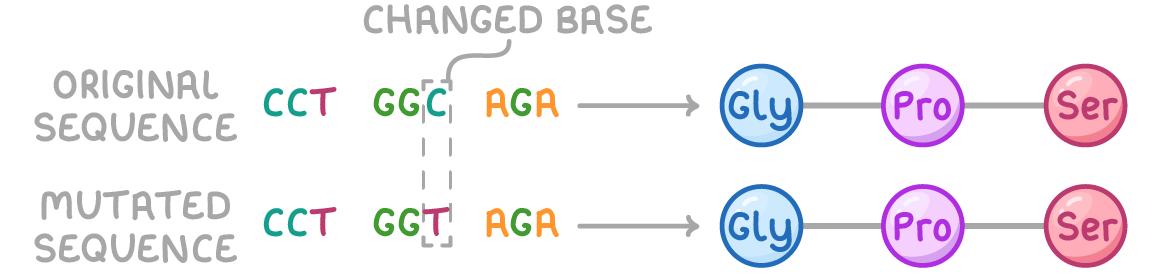
why may not all base substitutions cause a change in the encoded sequence of amino acids?
the genetic code is degenerate - more than one codon may code for the same amino acid
what is a mutagenic agent?
a factor that increases the rate of mutations
e.g. UV light, ionising radiation
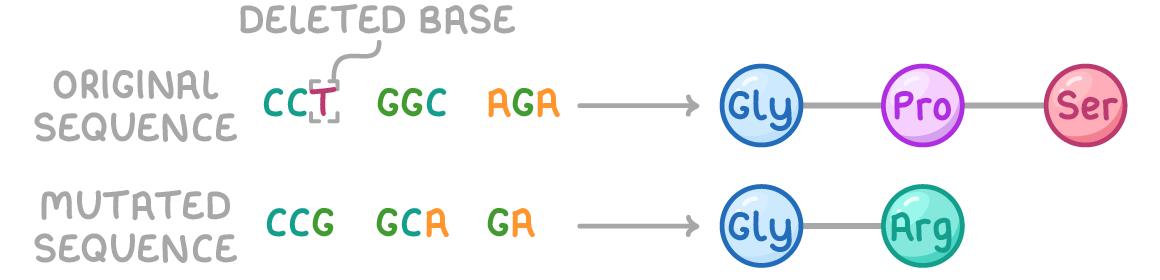
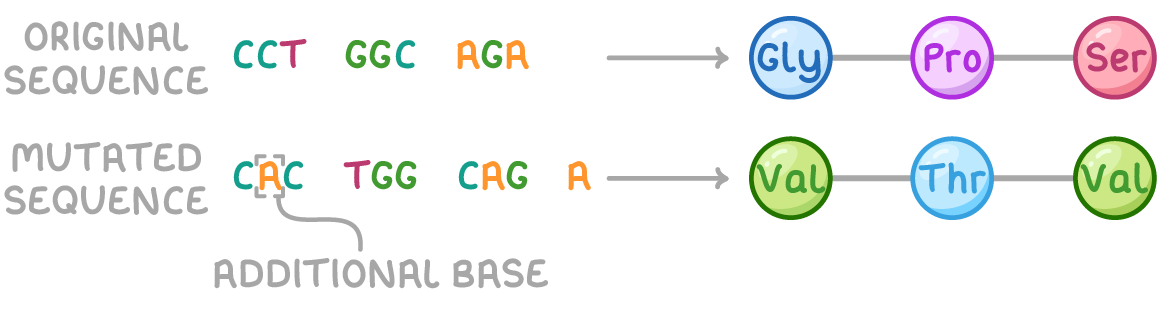
what is a frameshift mutation?
where an insertion/deletion mutation changes the triplets in a DNA sequence as the sequence shifts right/left (respectively) by one base
what is a point mutation?
a mutation where a single nucleotide is altered
how may gene mutations occur?
spontaneously, if DNA is misread during DNA replication
what are the 5 types of gene mutation?
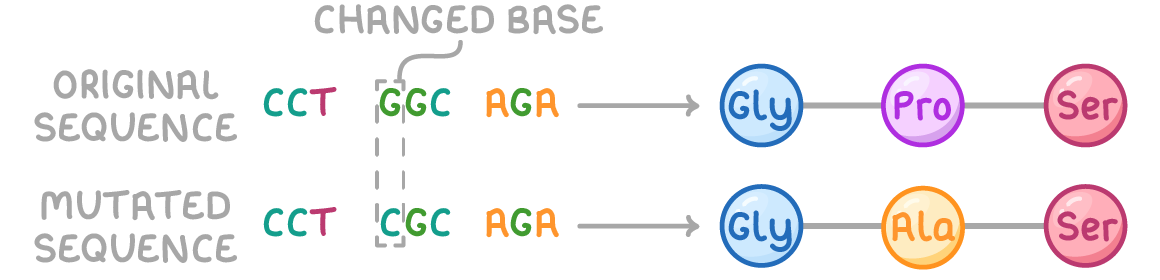
substitution
deletion
insertion
duplication
inversion
what effect may gene mutations have?
change amino acid sequence coded for by gene
→ different polypeptide
→ potentially different tertiary structure
→ potentially changing organism’s phenotype
(if enzyme, potentially different active site shape, preventing E-S complex forming)
what is a substitution gene mutation?
one or more nucleotides substituted for another in a DNA base sequence
what is a deletion gene mutation?
one or more nucleotides deleted from a DNA base sequence
what is an insertion gene mutation?
one or more nucleotides inserted into a DNA base sequence
what is a duplication gene mutation?
one or more nucleotides in a DNA base sequence are duplicated
what is an inversion gene mutation?
a group of nucleotides in a DNA base sequence separate and rettach in the same position but in the reverse order
what is a chromosomal mutation?
change in the structure/number of chromosomes in a cell
what causes chromosomal mutations?
errors in cell division
what are the 7 types of chromosomal mutation?
deletion
insertion
duplication
inversion
translocation
non disjunction
what is a translocation mutation?
a portion of one chromosome switches places w/ another non homologous chromosome
what is a non disjunction mutation?
in meiosis, the chromosomes are not separated properly/all chromosomes stay in one cell
chromatids go to different poles
what is polyploidy?
a cell having 3 or more sets of chromosome (e.g. triploid/tetraploid cells)
describe the process of natural selection:
a population has a gene pool w/ a wide variety of alleles
random mutation may introduce new alleles, increasing variation
some alleles may make individuals better adapted to the environment (sometimes due to an environmental pressure)
better adapted individuals are more likely to survive and reproduce (differential reproduction)
individuals that reproduce pass on their advantageous alleles to the next generation (heredity)
over many generations, advantageous alleles increase in frequency
what are the 4 main principles of natural selection?
variation
environmental pressure
differential reproduction
heredity
what does natural selection result in?
species being better adapted to their environment
what are the 3 types of adaptation?
anatomical
physiological
behavioural
what are anatomical adaptations? provide an example:
structural features of an organism’s body that increase its chance of survival
e.g. whale blubber → keep warm
what are physiological adaptations? give an example:
processes inside an organism’s body that increase its chance of survival
e.g. brown bears hibernating over winter → conserves energy
what are behavioural adaptations? provide an example:
ways in which an organism acts that increase its chance of survival and reproduction
e.g. possums ‘playing dead’ → evades attack from predators
what is a genetic bottleneck?
an event which causes a large reduction in population
this reduces no. of different alleles in gene pool and so reduces genetic diversity
survivors reproduce and a larger population is created from a few individuals
what is the founder effect?
type of genetic bottleneck
a few organisms from a pop start a new colony
this means there are only a small no. of different alleles in the initial gene pool
freq of allele in new colony may be different to original colony

