Cog Neuro Lec 7 - Motor Coordination
 Studied by 5 people
 Call Kai
 Learn
Learn Practice Test
 Spaced Repetition
 Match
Match Flashcards
 Knowt Play
1/50

There's no tags or description
Looks like no tags are added yet.
Name | Mastery | Learn | Test | Matching | Spaced | Call with Kai |
|---|
No analytics yet
Send a link to your students to track their progress
51 Terms
what is electromyography? (EMG)
like EEG but for the muscle
what happens to your triceps when your bicep is flexed? and visa versa
triceps relaxed when bicep is flexed
bicep is relaxes when triceps is flexed
what causes muscle contractions?
Ach releasing
what does botox do to Ach?
suppresses release to cause muscles to relax (ironic)
what does black widow venom do to Ach
stimulates release causing muscle spasm, potential impact to respiration (can’t breath)
what is Myasthenia Gravis
grave muscle weakness
fewer receptors and more that don’t operate optimally
caused by membrane damage and causes difficulty moving
what is an efferent signal?
motor output (ventral)
what is an afferent signal
somatosensory input (dorsal)
what is the corticospinal tract and explain its path
cerebral cortex → spinal
originates in the primary motor cortex _. midbrain → medulla (cross at meduall pyramids) → spinal cord
contralateral
dermatome
zones of the body
plegia (plegic)
paralysis of a body region
paresis (paretic)
weakness/partial paralysis
quadriplegia
inability to move all four limbs
may be caused by damage above T1 (eg. C5)
carrying somatosensory and motor pathways for the entire body high up
paraplegia
inability to move the trunk or lower two limbs
caused by damage below T1 (eg. T4)
is spinal injury more commonly bilateral or ipsilateral?
mostly bi because the areas that control either side are basically on the same disk/close to each other
is brain injury more commonly bilateral or contralateral?
usually contralateral because of the tracts
hemiplegia
paralysis of half of the body
hemiparesis
weakness/partial paralysis of the body
what is the bundle of motor fibers that dive down to the brain stem
internal capsule
from the internal capsule go
medullary pyramids where it crosses and goes to the spine accordingly
what happens if your internal capsule is damaged during a stroke
you loose all motor control contralateral to where the stroke was
central pattern generator
code complex movement that is highly learned and over-practiced
motor circuits in the spine can control walking without the brain
hierarchical control of movement
activating a central pattern generator that simulates combination of movements necessary to do an over-practiced test
why do cnetral pattern generators only exist in animals
because they have 4 legs and can be supported by the other two legs when the bottom ones are cut
can an animal regain ability to move their legs if the spinal cord is damaged?
yes, if Schwann cells are introduced
primary cortex role (M1)
codes for the direction of movement
what is a tuning curve and how does the M1 use it
it is like a normal distribution where the brain more favourably moves in a certain direction and then not so much in the others the more it deviates.
if your moving left 180 degrees, how would your neurons react?
neurons responsible for moving to the left and neurons that are responsible for moving up would work together (in vectors) to make an angle.
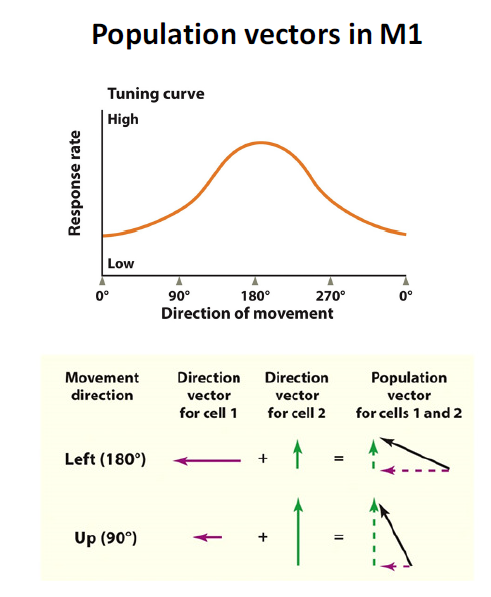
how can population vectors predict the direction of forthcoming movement?
depending on the vector of neurons active, we can track which neurons have a favourable reaction to a certain direction
intraparietal sulcus: parietal reach region (PRP)
reaching
lateral intraparietal area (area LIP)
eye movements
anterior intraparietal area (AIP)
grasping
what is the “where” pathway?
dorsal stream
what is the “what” steam?
ventral stream
what happens to your ability to “reach” with your eyes (saccade memory-guided movement) if you damaged the parietal reach region
nothing, it works completely fine, this is called optic ataxia : cannot use vision to guide action
what happens if you TMS to aIPS (anterior intraparietal area)
disrupts online correction of movement as your making this movement
damaged in optic ataxia as well
PMC (premotor cortex)
observational learning and understanding the actions of others
mirror neurons
in the PMC where neurons are active if your watching someone do something or doing it yourself or hearing action sounds
what kinds of sounds does the PMC care about?
action sounds, if its white noise or anything else, it does not care because it doesn’t reflect something YOU can do
peripersonal and extrapersonal mirror neuron
extrapersonal mirror neurons only activates if its far from you
peripersonal mirror neurons only activates if its in your personal space because you can work on them immediately
what is the most prominant mirror neuron
neurons that care about peripersonal and extrapersonal spaces
after how many cm does something have to move to you for your peripersonal mirror neurons to have peak activation?
about 28cm
is your peripersonal space a fixed space?
no, if you have something blocking you from reaching to something in your peripersonal space, it activates extrapersonal neuron
it also expands when we have some time of tool or arm extended that increases our reach limits
supplementary motor area (SMA)
holds information about sequence involved in remembering a detailed motor sequence like sports or a dance routine
role of the cerebellum
smooth, efficient, coordinated motor movement
cerebellar ataxia
difficulty with coordinated movement
impaired voluntary coordination of movements due to cerebellar lesion
dysmetria
dys: dysfunction
metria: reach
cannot reach for things smoothly because of cerebellar ataxia
dysarthria
severe slurring of speech because they lost fine motor control of larynx
cerebellar posture, gait
cannot walk properly, very discoordinated
what happens if your born without a cerebellum?
can function quite well because of neuro plasticity, but very bad if you lose it later in life
progression of the methods section of an article
participants → task #1 (key IV and DV’s) → task #2 (key IV and DV’s)
 Note
Note  Flashcards (24)