Week 3 - General Senses - Touch, proprioception, vibration
 Call Kai
 Learn
Learn Practice Test
 Spaced Repetition
 Match
Match Flashcards
 Knowt Play
1/10

There's no tags or description
Looks like no tags are added yet.
Name | Mastery | Learn | Test | Matching | Spaced | Call with Kai |
|---|
No analytics yet
Send a link to your students to track their progress
11 Terms
General senses Breakdown
Senses that are spread throughout the entire body.
Do not have a dedicated organ like special senses
3 Types:
General sense → receptor
Touch, proprioception, vibration → mechanoreceptors
Temperature → thermoceptors
Pain → nociceptors
Touch, proprioception, vibration: Skin anatomy: Mechanoreceptor types
Mechanoreceptors help distinguish between different touch types
Types of mechanoreceptors:
Merkel’s discs - detects edges & points
Lamellated (Pacinian) corpuscles - detects vibration
Tactile (Meissner’s) corpuscles - detects skin motion & movement
Bulbous (Ruffini’s) corpuscles - skin stretching
Touch, proprioception, vibration: Skin anatomy: Mechanoreceptor types: Merkel’s discs
Touch, proprioception, vibration: Sensation
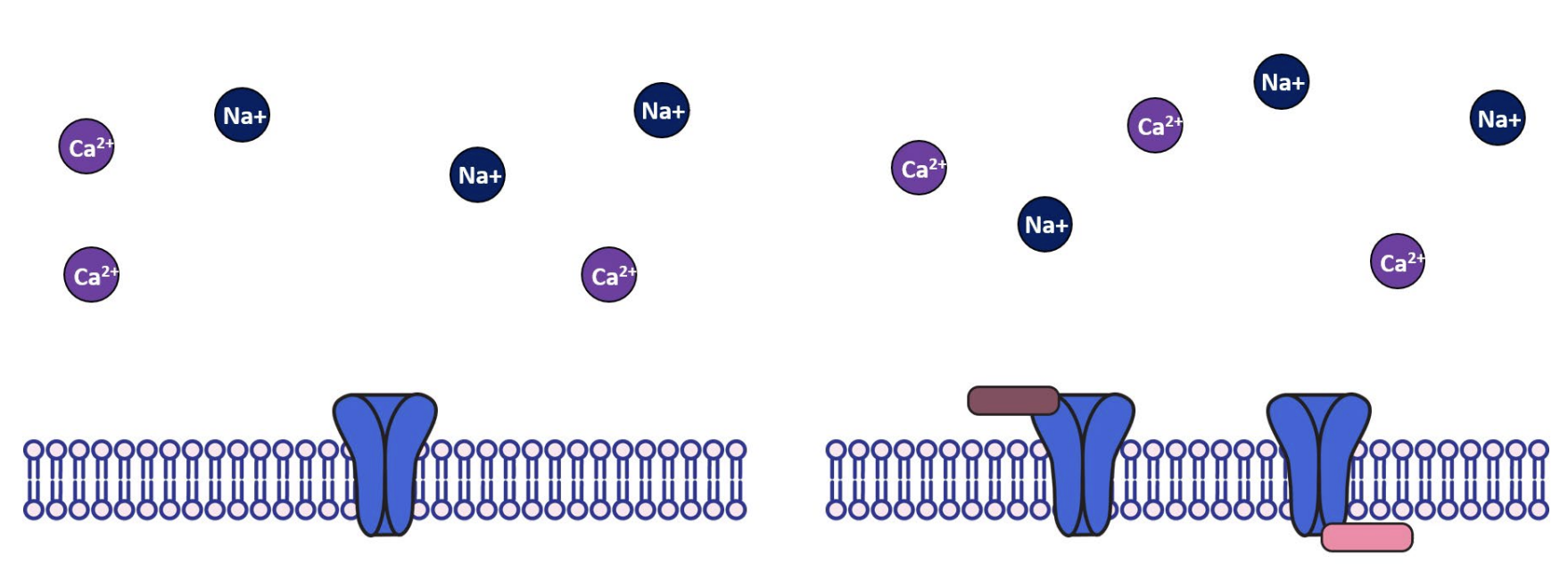
As mechanoreceptors transduce touch, physical distortion of the sensory cell membranes stretch the membrane.
Mechanically gated-ion channels of Na+ & Ca2+ open, allowing them to travel down the concentration gradient into the cell
Results in cell depolarisation
Second messenger cascades occur
If graded receptor potential is strong enough, action potential is sent
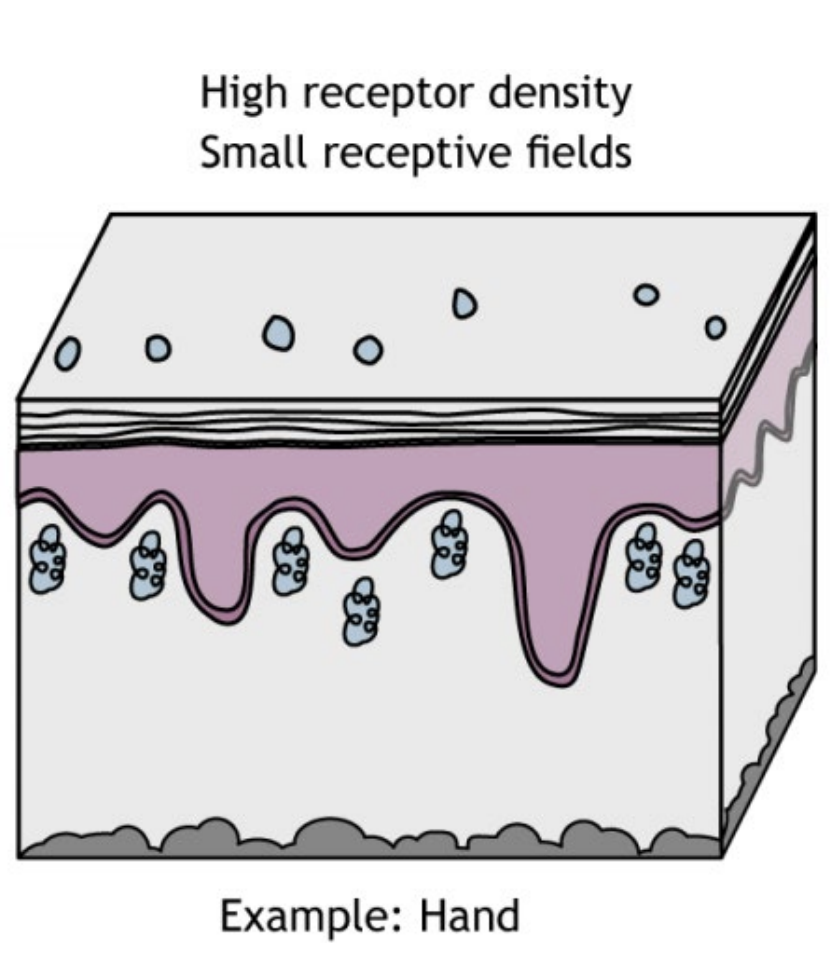
Touch, proprioception, vibration: Skin anatomy: Receptive fields
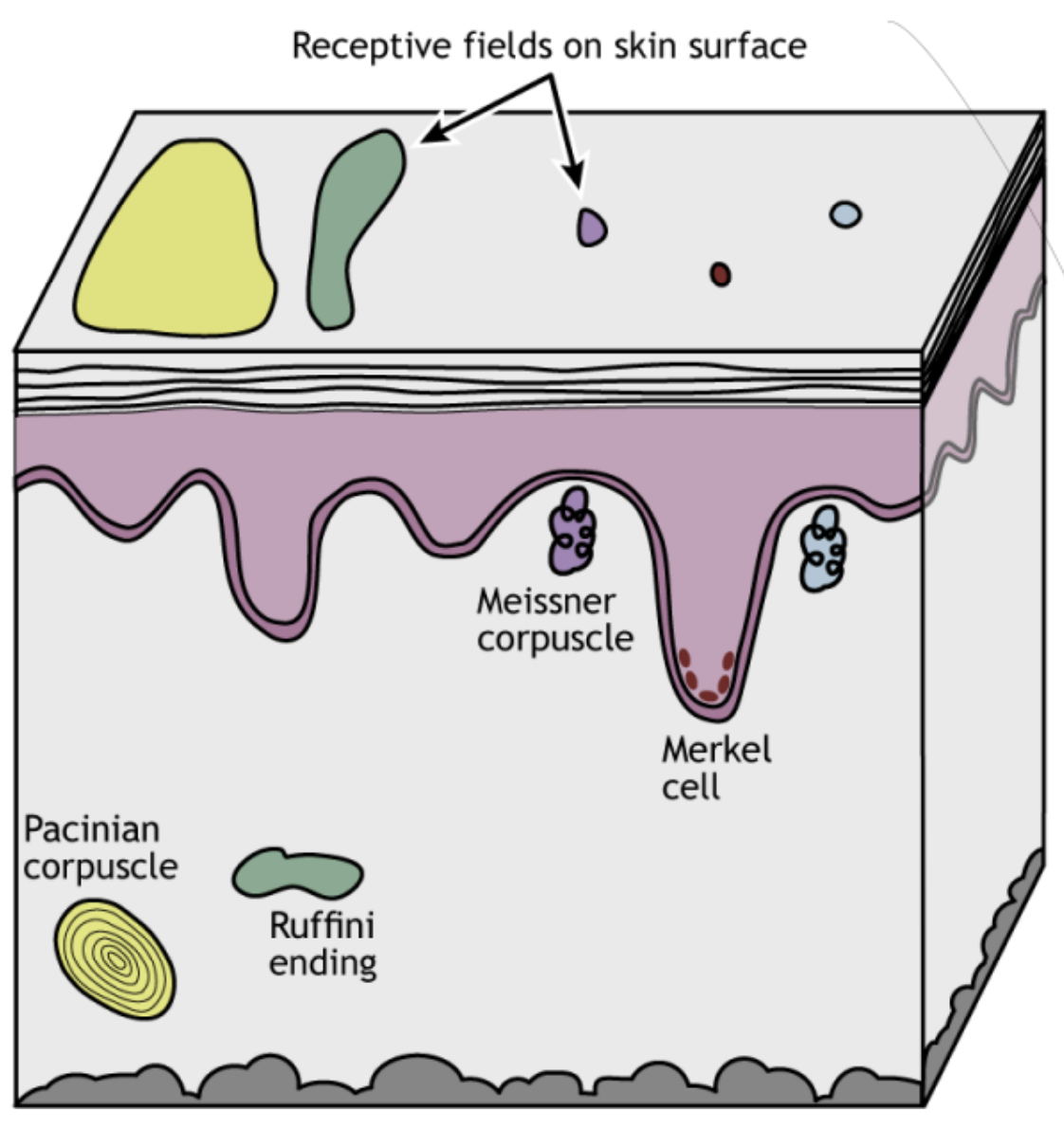
When a certain receptive field is touched, respective mechanoreceptor type is activated.
Each mechanoreceptor type has a varying size in their receptive fields.
Small receptive fields:
High receptor density, many cells found in one general location
Provides precise information about the contours of an object
Found mostly in face, lips, hands
Large receptive fields:
Low receptor density, less cells found in one general location
Can be large enough to cover part of the palm
Provides precise information about the contours of an object
Found mostly in face, lips, hands
Touch, proprioception, vibration: Sensation: Two-point discrimination
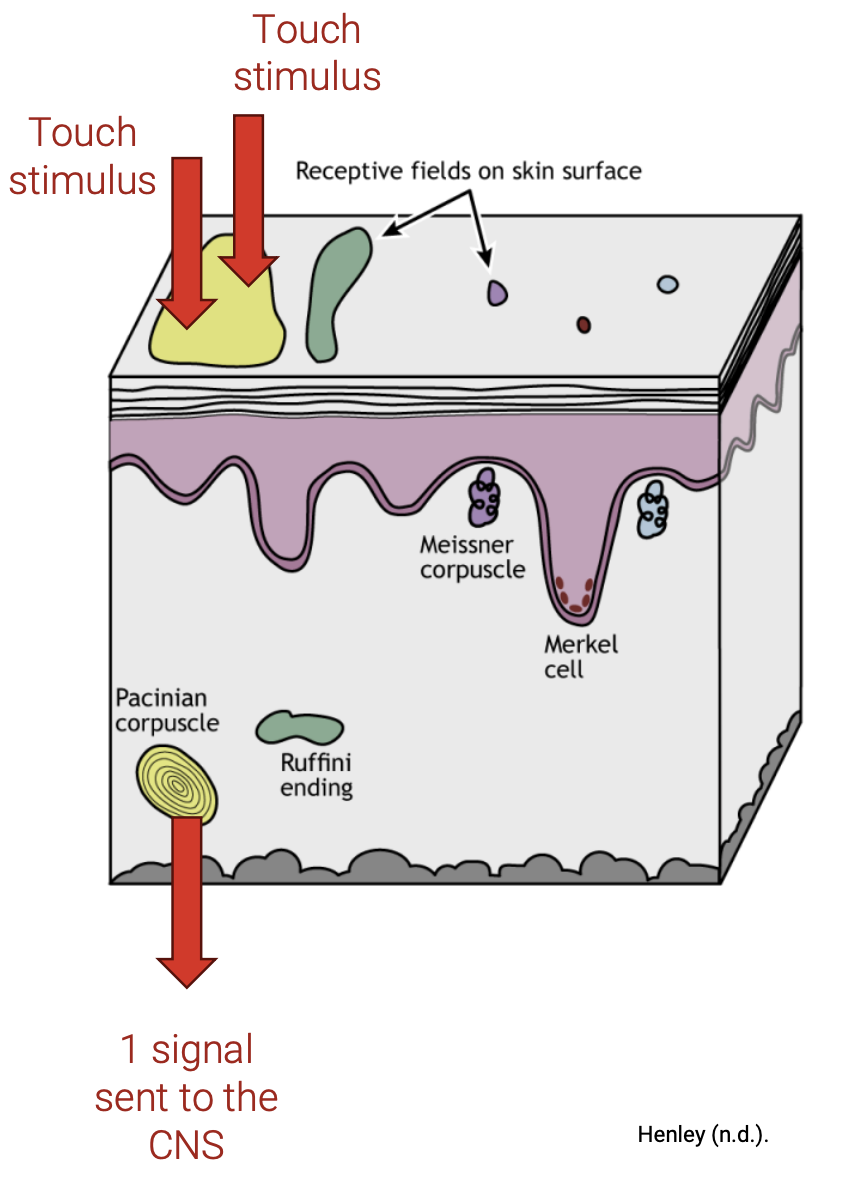
When a receptive field is touched, the neuron sends an action potential to the CNS
No. of action potentials sent based on the number of touches is based on the size and density of the receptive fields stimulated
i.e
Skin with smaller, but more numerous receptive fields can distinguish between two close touches because different receptive fields are stimulated
Skin with larger, and less numeroud receptive fields cannot distinguish between two close touches because the same receptive field is stimulated
Touch, proprioception, vibration: Sensation: Acuity
Acuity describes how accurately our brains can understand a stimulus.
Greater acuity with smaller, more numerous receptive fields, more accurate informations
Less accuracy with larger receptive fields (provide “coarse information” a.k.a rough information)
Touch, proprioception, vibration: Sensation: Adaption
Skin mechanoreceptor types adapt at different rates.
Phasic receptors: Rapidly adapting receptors, Fire only when stimulus changes (i.e taking a watch off after wearing it for a day)
Tonic receptors: Slow adapting receptors, Fire continuously, produces a sensation of pressure (i.e too tight socks)
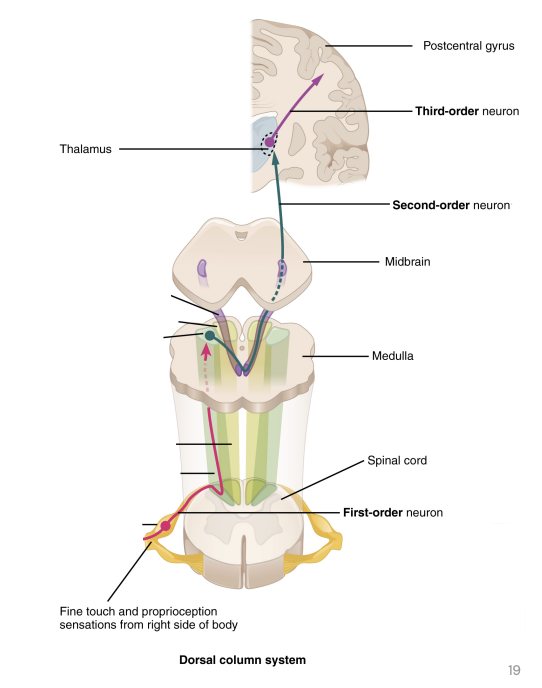
Touch, proprioception, vibration: Sensation: Neural pathways; Dorsal column pathway
Mechanoreceptor stimulated
First-order neuron:
Action potential travels up the dorsal column in the spinal cord on the same side as the sensation
Synapses at the medulla
Second-order neuron:
Decussates in the medulla, crossing over to the other side (travels contralateral to the first sensory neuron)
Synapses in the thalamus
Third-order neuron:
Travels to the primary somatosensory cortex
Touch, proprioception, vibration: Sensation to perception
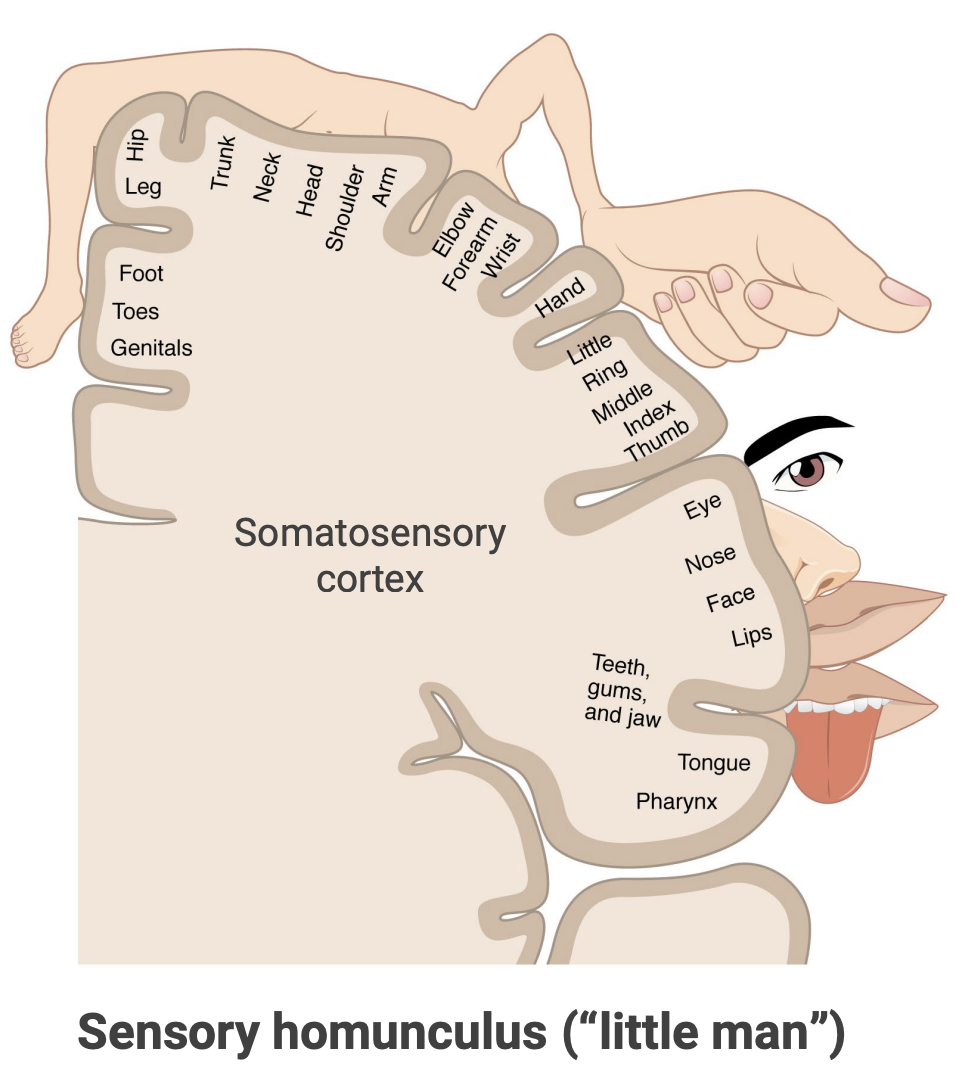
Information arrives to the primary somatosensory cortex inside the parietal lobe
Each region in the cross-section of the primary somatosensory cortex receives input from a specific section of the body (homunculi)
Due to the decussation of the second-order neuron, information received in one hemisphere, originated from the opposite side of the body
Hence, damage to the left primary somatosensory cortex effects info arriving from the right side of the body