Memory Questions
 Call Kai
 Learn
Learn Practice Test
 Spaced Repetition
 Match
Match Flashcards
 Knowt Play
1/17

Earn XP
Description and Tags
Name | Mastery | Learn | Test | Matching | Spaced | Call with Kai |
|---|
No analytics yet
Send a link to your students to track their progress
18 Terms
Research has suggested that the encoding and capacity of short-term memory are different from the encoding and capacity of long-term memory.
Explain what is meant by coding. (2 marks)
It is the way that information is processed before it enters a certain memory store
Eg. semantic in long-term memory
The sensory register is a component of the multi-store model of memory. Describe the sensory register. (3 marks)
receives information from any sense
can be divided into subsystems/each sense has a store (register) eg iconic, echoic, haptic etc
coding is modality-specific eg visual in iconic store, acoustic in echoic store
capacity is very large
duration – information is stored for milliseconds/fraction of a second, eg 50 milliseconds–2 seconds duration (iconic) to a few seconds (echoic); information is lost quickly
directs attention to some incoming information which it passes on to STM
forgetting from sensory register, eg trace decay/displacement can occur as information is lost quickly if it is not attended to.
Briefly outline two criticisms of studies into short-term memory. (4 marks)
lack of mundane realism: use of artificial material (eg recall of trigrams, lists of unconnected words etc)
early research often lacked adequate control, introducing confounding variables into the study, reducing validity
inconsistent findings: span for letters is lower than span for digits
overestimation of capacity: capacity is only 4 chunks not 7±2 items
lack of ecological validity: studies carried out in an artificial laboratory setting or with artificial tasks, do not reflect real life memory
issues with participant variables in studies that used independent measures design (eg Baddeley’s study of coding)
The MSM proposes that there are separate short-term and long-term stores.
Explain two differences between STM and LTM in this mode. (2 marks)
Different duration - the duration of STM is a lot shorter - only 18-30s, while LTM is a potentially forever
Coded differently - LTM is coded for semantically, while STM is coded acoustically
Two groups of participants took part in a memory experiment. The researcher read 20 words to the participants.
Participants in Group A had to write down the words immediately after they had heard them.
Participants in Group B had to write down the words after they had read a book for one minute.
The researcher noticed that:
Participants in Group A generally recalled words from the beginning and the end of the list.
Participants in Group B generally recalled words from the beginning of the list only.
Explain these results with reference to the MSM. (4 marks)
The words at the start were transferred to the LTM
The words at the end were stored in the STM, so Group A recalled beginning and end
Since Group B were tested later the words left the STM and they recalled only from the beginning of the list
Distraction task of reading prevented maintenance rehearsal for Group B
Describe one strength of research that has investigated different types of LTM. (3 marks)
Supported by case studies of individuals with amnesia
Eg. CW lost most of his episodic memories and couldn’t remember past events, but not his procedural memory as he could still play piano
Shows that episodic and procedural memories are separate memory stores
What is a field experiment? (2 marks)
A field experiment takes place in the real world rather than in a carefully controlled environment
The IV is manipulated by the experimenter
Aaron was upset as he left the Spanish exam. In the unfamiliar room and full of nerves, his mind had gone completely blank. He was regretting studying both French and Spanish because he was sure he had mixed up lots of the words.
Outline one explanation of forgetting. How might this explanation account for Aaron's poor performance in the Spanish exam? (4 marks)
Forgetting is due to the absence of cues
Lack of external contextual cues - where environment for learning and recall is different (e.g. different room) - ‘an unfamiliar room’
Lack of internal contextual cues - where physical state for learning and recall is different (e.g. mood) - ‘full of nerves’
Annie can still skateboard even though she hasn’t skated for many years. Germaine can still recall what happened on his first day at university even though it was ages ago. Billy remembers the names of the tools he needs to repair the broken tap.
Identify three types of long-term memory and explain how each type is shown in one of the examples above. (6 marks)
Annie’s case/remembering how to skateboard is an example of procedural memory
because she is remembering an action or muscle-based memory
Germaine’s case/remembering what happened is an example of episodic memory
because he recalls the events that took place at a specific point in time
Billy’s case/remembering the names of tools is an example of semantic memory
because he remembers facts
Read the item and then answer the question.
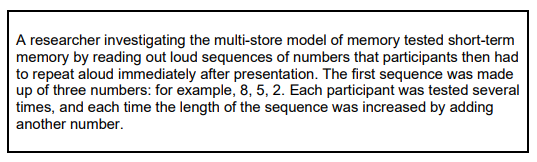
Use your knowledge of the multi-store model of memory to explain the purpose of this research and the likely outcome. (4 marks)
Purpose is to test the capacity of short-term memory.
Short-term memories are coded acoustically
Outcome – most of the people tested would be able to repeat correctly a sequence of between 5 and 9 items
Because according to the multi-store model, short-term memory has a limited capacity of 7±2.
After the study was completed, the researcher decided to modify the study by using sequences of letters rather than numbers.
Suggest one 4-letter sequence and one 5-letter sequence that the researcher could use. In the case of each sequence, give a justification for your choice. Use a different justification for each sequence. (4 marks)
Justification points:
Words - have meaning - can be recalled as wholes
Multiple repetitions - reduce cognitive demand
Three components of the working memory model are the central executive, the phonological loop and the visuo-spatial sketchpad.
Briefly outline each of these components. (6 marks)
The central executive has a supervisory function and controls the slave systems. It has limited capacity but can process information from any sensory modality.
The phonological loop is a limited capacity, temporary storage system for holding verbal information in a speech based form.
The visuo-spatial sketchpad is a limited capacity, temporary memory system for holding visual and spatial information.
Evaluate the central executive as part of the working memory model. (4 marks)
Central executive is vague and untestable (despite being the component in overall charge)
Central executive itself may be divided into separate sub-components
Links with attention research – allocation of resources/divided attention/dual-tasking
Bryan has been driving for five years. Whilst driving, Bryan can hold conversations or listen to music with little difficulty.
Bob has had four driving lessons. Driving requires so much of Bob’s concentration that during lessons, he often misses what his driving instructor is telling him.
With reference to features of the working memory model, explain the different experiences of Bryan and Bob. (4 marks)
Because driving is an ‘automated’ task for Bryan, it makes fewer attentional demands on his central executive so he is free to perform other tasks
Bob requires all of his attentional capacity for driving.
Bob is unable to dual-task and to divide resources effectively between components of working memory.
Bryan is able to divide resources between his visuo-spatial sketch pad (driving) and articulatory process (talking and listening to music) and thus to dual-task.
The multi-store model of memory has been criticised in many ways. The following example illustrates a possible criticism.
Some students read through their revision notes lots of times before an examination, but still find it difficult to remember the information. However, the same students can remember the information in a celebrity magazine, even though they read it only once.
Explain why this can be used as a criticism of the multi-store model of memory. (4 marks)
Mere rehearsal is too simple a process to account for the transfer of information from STM to LTM.
The type of information is important in whether it is recalled or not.
Rehearsal is a transfer mechanism, even though students rehearse the information it doesn't transfer from STM to LTM as predicted by the model.
However, information in the magazine is only presented once, but it does transfer to LTM, despite lack of rehearsal.
Briefly evaluate the cognitive interview technique. (4 marks)
See mock
Describe the cognitive interview. (6 marks)
Reinstating the context - interviewee mentally reinstates the environmental and personal context of the incident, e.g. weather (based on the principle of retrieval failure)
Report everything - interviewer encourages the reporting of every single detail of the event, even though it may seem irrelevant; (such detail may trigger other memories)
Changing order - recall event in a different order (reduces possibility that recall may be influenced by schema / expectations)
Changing perspective - interviewee recalls from different perspectives, e.g. for other witnesses; (reduces influence of schema)
Features of enhanced cognitive interview to facilitate recall - focus on social interaction, reducing anxiety / distractions, use of open-ended questions.
Danielle was walking down the high street when she witnessed a crime. A young man attacked an elderly woman. After a struggle, the man ran away with the woman’s handbag. Danielle and another couple of witnesses stayed with the woman until the police arrived. Explain how the police could use the cognitive interview to help Danielle’s recall of the event. (6 marks)
Danielle is encouraged to mentally reinstate the context, reminded of, e.g. why she was walking down the high street, the weather etc as this may trigger further information (reinstate the context)
Danielle should be asked to report every detail even if it seems irrelevant, e.g. what the attacker was wearing, the style of the handbag etc (report everything), this technique might trigger additional information
Danielle should be asked to recall the event in a different order, e.g. beginning from when she comforted the elderly woman and working backwards (changing order), this technique might have disrupted the influence of schema/expectations
Danielle should recall the event from the perspective of others, e.g. the couple of other witnesses who were present at the time (changing perspective), this technique might have disrupted the influence of schema/expectations
Credit features of enhanced cognitive interview to facilitate recall if applied to Danielle’s experience.