America 1920-1973: Opportunity and Inequality - American People and the 'Boom'
0.0(0)
 Studied by 1 person
 Call Kai
 Learn
Learn Practice Test
 Spaced Repetition
 Match
Match Flashcards
 Knowt Play
Card Sorting
1/115

Earn XP
Description and Tags
Last updated 12:52 PM on 5/8/23
Name | Mastery | Learn | Test | Matching | Spaced | Call with Kai |
|---|
No analytics yet
Send a link to your students to track their progress
116 Terms
1
New cards
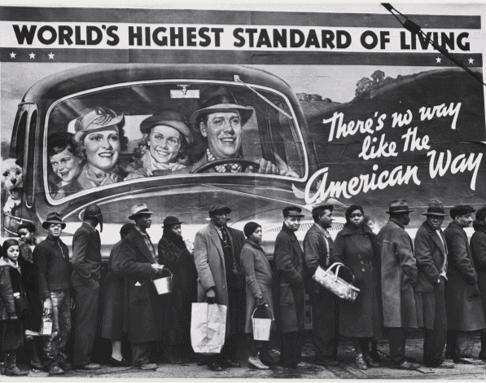
What are the two types of government in America?
The Central Federal Gov. was based in Washington, DC and was ran by the President, a cabinet of advisors and Congress. They oversee matters that affect the whole country. The State Govs. are based in capital of each state. Each state has its own laws, police and court system, and its own government in charge.
2
New cards
What are the two main political parties in America?
Republican Party: Preserves traditional values, adopts 'laissez-faire' policy; against high taxes (pleased many rich businessmen); Had more support in industrial North; Conservative. Democratic Party: Preferred to intervene in everyday life if necessary; Favoured helping the vulnerable; Had more support in poorer, rural South; Liberal.
3
New cards
What is the Bill of Rights?
Guarantees a series of freedoms and rights, including the right to vote, and freedom of belief, freedom of information and freedom in law.
4
New cards
What was society like for Native Americans and Early Immigrants in 1920 America?
Native Americans had lived across America prior to the colonisation of European settlers; The White settlers took much of their land and forced them to live in reservations; 250,000 NA in America by 1900. Early Immigrants were the white settlers who arrived from all over Europe in the 1600s to America; The British regarded America as part of the British Empire; By 1900s, white English-speakers became the most powerful group in America; 10% of Americans owned 90% of the wealth - these were descendants of WASPs (White Anglo-Saxon Protestants)
5
New cards
What was society like for New Immigrants and African Americans in 1920 America?
New Immigrants were people from eastern and Southern Europe, but also people from China and Japan etc, immigrated to America. Many were poor and illiterate - some WASPs saw new immigrants as a threat. Millions of Africans taken to work as slaves between 1600 and 1800; Slavery ended in 1865 and by 1920 there were 10 million AAs; Most had limited freedom, including no right to vote. They had no access to good jobs, decent housing and proper education. They were among the poorest in 1920 America.
6
New cards
What was the economic boom in 1920s America?
During the 1920s the American economy grew so rapidly that it became known as the 'boom'. Wealth increased and businesses became much bigger.
7
New cards
What is an economic boom?
An economic boom is when the wealth and prosperity of a country grows very quickly. Businesses make more profit and expand, and the standard of living rises. The cycle of prosperity begins.
8
New cards
How did the First World War cause the American Boom?
USA followed the policy of isolationism, staying out of European affairs and WWI. This allowed the US to proper financially, loaning money to Britain and allies to buy food, weapons and equipment - this created many jobs for Americans. By the end of WWI, USA led the world in the production of medicine, dyes and other materials. America was the only major nation without huge wartime debts.
9
New cards
How did the consumer society cause the American Boom?
People could buy modern electric 'gadgets' such as vacuum cleaners, gramophones, radios, telephones and refrigerators. In addition, huge demand for goods created jobs. Hire purchase (paying in instalments) made goods more affordable, and increased the number of people who wanted to buy them.
10
New cards
What percentage of homes had electricity from 1916 to 1927?
The number of homes with electricity in the US grew rapidly, from 15% in 1916 to nearly 70% in 1927
11
New cards
What is hire purchase?
'Buy now, pay later' schemes - paying a deposit for an item, and paying it off in instalments over a period of time.
12
New cards
How did Republican Economic Policies contribute to the American Boom in the 1920s?
Laissez-Faire policy meant that government would have a 'hands off' approach to businessmen, allowing Americans freedom to make money. Fordney-McCumber tariff increased tax on foreign goods, making them more expensive. This encouraged Americans to buy US-made goods. Tax cuts on the rich, leading to them investing more money in businesses, creating more jobs.
13
New cards
What was the Fordney-McCumber Tarrif 1922?
Legislation passed in 1922 by the US Congress that raised tariffs on imported goods.
14
New cards
How did advertising contribute to the American Boom in the 1920s?
Colourful billboards, magazines, catalogues and newspapers advertised the latest gadgets and goods. Adverts also encouraged the hire purchase scheme and encouraged Americans to 'keep up with the Joneses', and to buy the latest goods to improve their social standing.
15
New cards
What was the sales of cars in 1919, and what did this grow to by 1929?
The sales was 9 million in 1919, grew to 26 million by 1929.
16
New cards
What was the sales of radios in 1919, and what did this grow to by 1929?
The sales was 60,000 in 1919, grew to 10 million by 1929.
17
New cards
What was the sales of telephones in 1919, and what did this grow to by 1929?
The sales was 10 million in 1919, grew to 20 million by 1929.
18
New cards
What did the number of fridges increase to from 1921?
From 1921, the number soared from 5,000 to 900,000.
19
New cards
How did the motor industry contribute to the American Boom in the 1920s?
Car production used up 20% of America's steel, 80% of her rubber, 75% of her glass and 65% of her leather. Henry Ford created the Model T car in 1903, and used mass production and assembly lines to mass produce his cars for sale. 15 million people bought Model Ts between 1911 and 1929.
20
New cards
What did the price of a Model T car fall to from 1908 to 1925?
The price fell from $850 in 1908 to $295 in 1925.
21
New cards
What was the impact of the boom on the motor industry?
There were new jobs created, such as building roads, highways and oil refineries to supply the fuel as well as petrol stations, roadside hotels, garages and restaurants. Car owners had a new sense of freedom; they didn't need to live close to where they worked. However, traffic jams, car accidents and pollution became a rising problem.
22
New cards
What is mass production?
The rapid manufacture of goods in a large quantity. This is how Henry Ford made his Model T cars, along with assembly lines.
23
New cards
How many Model T cars were being made each second? What was this the result of?
One every 10 seconds as a result of mass production.
24
New cards
What is the cycle of prosperity?
More sales \---\> Increased production \---\> More workers, higher wages \---\> More spending (repeat)
25
New cards
What is the stock market?
People could invest in a company and own a 'share'. If the company does well, people who bought the share (shareholders) received a certain amount of the profit made by the company (dividends). Shareholders could then sell their share for a higher amount than they paid it for.
26
New cards
How many people owned shares in 1920? What did this number increase to by 1929?
In 1920, there were only 4 million people who owned shares - by 1929, there were five times as many.
27
New cards
What was buying on the margin?
People borrowing money from the banks to buy shares of a company, and paying the bank back with the profit made by the company when the shares were sold.
28
New cards
What were the inequalities of wealth in 1920s America?
The richest 5% of the population owned 33% of the wealth. The poorest 44% of the population earned just 10% of the wealth. In 1929, 60% of Americans lived below the poverty line, earning less than $2000 a year.
29
New cards
Which groups were affected by the inequalities of wealth in America?
Farmers, traditional industries, African Americans and Native Americans
30
New cards
How did the government contribute to inequal wealth in 1920s America?
The government had no fixed minimum wage; There was no state health system, no state pensions, no unemployment pay and no sickness pay; SCOTUS declared that two laws banning child labour was 'unconstitutional'.
31
New cards
How many union members were there in 1920? What did this decrease to?
In 1920, 5.1 million Americans were union members, but decreased to 3.6 million in 1926.
32
New cards
How was rural areas in America affected by inequalities of wealth?
Europe no longer needed American imports after the First World War; Almost 50% of Americans were involved in farming. New machinery meant farmers weren't needed; It also produced a surplus of food, which meant prices fell and farmers became poorer as a result. The total American farming income fell from $22 billion in 1919 to $13 billion in 1928. Farmers couldn't afford to pay their mortgages, and were evicted.
33
New cards
How many farmers lost their farms in 1924?
600,000
34
New cards
How were traditional industries affected by inequalities of wealth in America?
Coal mines were closed as other fuels were being used for homes. Coal miners lost their jobs as a result. 70% of American industrial workers worked over 10 hours a day. The textile industry suffered heavily; man made materials were being made and in demand, so there was no need for cotton or leather anymore. Price of cotton and woollen cloth fell and many factories shut down.
35
New cards
How were African Americans affected by inequalities of wealth in America?
Many AAs worked on farms as labourers or were sharecroppers who rented small areas from landowners. AAs were already poor, so many had to move to the North to find jobs, which were just as bad. 1 million black farm workers lost their jobs as a result of wealth inequality.
36
New cards
How many people left to leave the countryside for better work in 1920?
6 million American workers left the countryside to find better work in the city. By 1930, over half of American people were living in the 100 biggest cities as a lack of opportunity in the countryside forced people to do so
37
New cards
How were Native Americans affected by inequalities of wealth in America?
Large amounts of their land were seized to make room for new factories and mines. NAs were forced to live in reservations, and were unable to grow crops due to poor soil conditions. Many NAs were uneducated, poor and had a lower life expectancy than any ethnic group in the US at the time.
38
New cards
What was the Roaring Twenties?
A period in American history of dramatic social, economic and political change
39
New cards
What were the changes being made to American society during the Roaring Twenties?
Millions of people had more money, there were new forms of entertainment such as the cinema, women began to gain more freedom and Americans had much more leisure time than ever before.
40
New cards
What were the average working hours per week in America in the '20s and what did it fall to?
The average working hours were 47.4 hours per week and fell to 44.2 per week, giving Americans more leisure time.
41
New cards
What was the Jazz Age?
Originated in the Southern states of America among AAs, and spread north when AAs began searching for work. It became very popular in 1920s, and became known as the Jazz Age. Both black and white people enjoyed this type of music, as it was known for its improvisation, fast tempos and lively rhythms. It soon became popular in bars and nightclubs in big Northern cities such as Chicago and New York
42
New cards
Which musicians grew popular as a result of the Jazz Age?
Duke Ellington, Bessie Smith and Louis Armstrong began to grow in fame as a result of the Jazz Age.
43
New cards
What else was introduced during the Jazz Age?
New dances such as the Charleston, the One Step and the Tango were introduced also during the Jazz Age, and were known for their sexually suggestive dance moves.
44
New cards
Who disproved of the Jazz Age?
Many older white Americans, criticised the Jazz Age, saying that it encouraged drunkenness and that the dances were too sexual.
45
New cards
Which entertainment industry grew rapidly in the 1920s?
Movie industry
46
New cards
How many people per week went to the cinema by 1929?
110 million people per week
47
New cards
Why was the cinema so popular in 1920s America?
Advertising had a massive impact on the popularity of cinemas: Actors like Rudolph Valentino and Gloria Swanson were advertised heavily, along with emerging film companies like MGM and Warner. People also had more leisure time, and cinema tickets were cheap.
48
New cards
Which actors were popular in America 1920?
Popular actors in America during the 1920s included Charlie Chaplin, Rudolph Valentino, and Mary Pickford.
49
New cards
What was the 'star system'?
Film studios would use this system to promote their main actors, by making sure the media had full access to the star e.g. magazine interviews, photoshoots, and make public appearances.
50
New cards
How many films were being produced a year by 1929?
Hollywood film studios were producing over 500 films a year by 1929.
51
New cards
What was the 'talkie'?
The 'talkie' was the first movie that included sound. It was called 'The Jazz Singer', and was released in 1927.
52
New cards
What were people's reactions to the rise of movies?
Many older people disliked movies as they worried about the sexual content of some films and the impact i had on the young.
53
New cards
What was the Hays Code?
This was a list of strict rules introduced by Hollywood to ensure that their movies were not banned in other conservative states. This included a ban on nudity, and said that kisses could not last longer than 10 feet of film.
54
New cards
How did sports influence 1920s culture in America?
Sportspeople such as Babe Ruth and Jack Dempsey became celebrities.. Radio broadcasts, newspapers and magazines helped bring major sporting events to a mass audience.
55
New cards
How much was Babe Ruth earning as a baseball player in 1930?
By 1930, Ruth was earning $80,000 a year, the equivalent of earning $7 million a year today.
56
New cards
What were women's lives like before the First World War?
Most women led restricted lives and could not vote; There were high expectations for upper and middle class women - They rarely played energetic sport and wore little make-up. Poorer women who had to work had little promotion opportunities and had to settle for poorly paid jobs such as cleaning, low-skilled factory work and secretarial work.
57
New cards
What were women's lives like during the First World War?
Women took over the jobs that men left behind ebcause they has to fight in the war. They worked just as hard as the men and earning money gave them a sense of independence.
58
New cards
How many women had jobs by 1929?
10.5 million women had jobs by 1929, around 25% more than in 1920.
59
New cards
When were women given the right to vote?
1920, as a result of the 19th Amendment. This was partly due to their war work.
60
New cards
How did the lives of some women change after the world war?
More women lived on their own after the war; they were less likely to stay in an unhappy marriage - as a result, the divorce rate doubled during the 1920s. Some women began to adopt the 'flapper' look and personality.
61
New cards
How many divorces were there in 1914, and what was this number at 1929?
There were 100,000 divorces in 1914, and this rate doubled in 1929.
62
New cards
What percentage of college students had not had sex before marriage in 1900? What was this number in 1920?
80% of college students had not had sex before marriage in 1900. By 1920, only 31% had not had sex before marriage.
63
New cards
What was a 'flapper'?
Young women in the 1920s who rebelled against traditional ways of thinking and acting. Most came from Northern states, and were upper/middle class. They wore revealing outfits, smoked, wore heavy makeup, drank, cut their hair short and were sexually active. Some rode motorbikes and went to nightclubs with men until the early hours of the morning. In addition, flappers walked around the cities without a male chaperone.
64
New cards
What were people's reactions to flappers?
Many conservative people of society disliked and disapproved of flappers. They disliked their liberal attitude and viewed flappers as an example of the evils of modern life, and felt that family life, religion and traditional values were under threat. An Anti-Flirt League was formed to protest against the flappers.
65
New cards
What didn't change for some women in 1920s America?
Women still earned less than men for the same jobs; few women went into politics e.g. Florence Kelley and Alice Paul; The women in the rural south could not adopt the flapper life style as they were much poorer.
66
New cards
What was prohibition?
Prohibition in the United States was a nationwide constitutional ban on the sale, production, importation, and transportation of alcoholic beverages that remained in place from 1920 to 1933.
67
New cards
What amendment introduced Prohibition?
The 18th Amendment
68
New cards
What was the Volstead Act 1919?
The Volstead Act declared any drink that had more than 0.5% alcohol in it 'alcoholic'.
69
New cards
Why was Prohibition introduced?
People were spending too much money on alcohol and not enough on bare necessities such as food, clothes for family, mortgages; Drinkers during WWI was seen as unpatriotic because many beers were imported from Germany or brewed by German immigrants. Some politicians believed that America would be a healthier place without alcohol. Religious organisations disapproved of alcohol because of its social problems it creates e.g. poverty and addiction.
70
New cards
What were the Women's Christian Temperance Movement and the Anti-Saloon League?
The Women's Christian Temperance Movement was set up in 1873 and the Anti-Saloon League in 1893. They were organizations that promoted the legal abolition of saloons, believed liquor was a moral evil or economic obstacle, viewed the saloon as a cornerstone of urban party machines.
71
New cards
How many infants died due to drunk parents a year?
3000 infants a year were smothered in bed by their drunken parents.
72
New cards
How was Prohibition successful?
In 1929, 50 million litres of illegal alcohol were discovered and destroyed. The actual consumption of alcohol fell for many years after prohibition and did not reach pre-1914 levels until 1971.
73
New cards
How was prohibition enforced?
There were only 4000 agents who tried to enforce the Prohibition law across the entirety of America. Many of these 4000 were bribed and sacked - 10% of agents were sacked for taking bribes. Millions of people also broke the Prohibition law, so it was difficult to enforce.
74
New cards
How was Prohibition a failure?
Many people smuggled in alcohol via the coastline (bootleggers) as it was impossible to patrol; Criminal gangs got involved with the production and selling of alcohol in underground bars called speakeasies. Gangs also sold moonshine, which was poor in quality and sometimes killed people. Gangs also made a lot of money that they were able to bribe agents, judge s and border guards to turn a blind eye.
75
New cards
How many speakeasies were the in the USA?
200,000
76
New cards
What was the effect of Prohibition on society?
Ordinary people were made into criminals; Many people died as a result of poorly made alcohol; America was becoming a more corrupt society leading to the rise of gangsters, organised crime and further police corruption. By 1929, alcohol consumption was back to 70% of its 1914 level, despite being illegal to make, sell or transport.
77
New cards
What was organised crime?
Gangs made more money through fixing horse and dog racing, running brothels and racketeering. This became known as organised crime. Al Capone was a gangster who made $10 million a year from racketeering alone.
78
New cards
Who were some of the best known gangsters during the Prohibition era?
Al Capone, 'Lucky' Luciano, 'Machine Gun' Kelly and Vito 'Chicken Head' Gurino.
79
New cards
What was the St Valentine's Day Massacre in 1929?
St Valentine's Day Massacre was when Al Capone's men machine gunned 7 members of 'Bugs' Moran's gang.
80
New cards
What amendment abolished Prohibition and when?
In 1933, the 21st Amendment abolished prohibition
81
New cards
What was the American Dream?
The idea that anyone can be successful when they put in hard work.
82
New cards
Why did people want to immigrate to the US?
There were many job opportunities in America in steel, coal and textile industries and car, electric and chemical industries. The standard of living was higher in America and workers were paid more. In addition, various groups were persecuted because of their faith in Europe, and Europe was also divided by class.
83
New cards
How many people emigrated to America after the First World War?
More than 14 million people between 1900 and 1920.
84
New cards
Which groups of people emigrated to the US in the 1920s?
Many were Jewish or Catholic, but others also came from Eastern Europe and China. They were poor, and many could not speak English, and were illiterate. They came from countries where there were strong beliefs in new and radical political ideas, such as communism or anarchism.
85
New cards
What percentage of people in Europe left to go to live in America?
10%
86
New cards
Why were Americans worried about immigrants in the 1920s?
People were worried that they would accept lower wages and take their jobs away. They were a different religion and had different cultures. They were seen as bringing dangerous and radical political ideas. After the Russian Revolution of 1917 many (Russian) immigrants were seen as communist. They were often poor and illiterate. People worried that they would take more from society than they would contribute.
87
New cards
What was the immigrant experience in the 1920s?
Some immigrants achieved great success, opening thriving businesses and making a good living. However, for many, working and living conditions were generally very poor and difficult. Many immigrants were poorly educated and willing to work for very low wages in any kind of job.
88
New cards
What was the Literacy Act 1917?
Immigrants had to pass a series of reading and writing tests. The Act banned entry to any immigrant over the age of 16 who could not read a sentence of 40 words.
89
New cards
What was the Emergency Quota Act 1921?
This law restricted the number of immigrants to 350,000 per year, and also set down a quota. Only 3 per cent of the total population of any overseas group already in the USA in 1910 could come into America after 1921.
90
New cards
What was the National Origins Act 1924
This law reduced the maximum number of immigrants to 150,000 per year and cut the quota to 2 per cent, based on the population of the USA in 1890.
91
New cards
What were Jim Crow laws?
These laws legalised segregation and helped to keep black Americans in inferior positions in society, politics and the economy.
92
New cards
In what ways did African Americans face racism in the 1920s?
Schools for black Americans were deliberately kept inferior, so that they would remain uneducated and not advance in society. As a result, they occupied the worst housing in the poorest areas of the cities. Voting was made difficult for black Americans. AAs were often the last to be hired and the first to be fired.
93
New cards
How was voting made difficult for African Americans?
AAs had to pass a literacy test - people had to prove that they could read difficult extracts from texts, but literacy levels were low amongst black Americans so few could vote. AAs also had to pay a poll tax - due to low wages, many black Americans were too poor to pay the tax, and were therefore unable to vote
94
New cards
What was the Grandfather Clause?
Laws that allowed people who did not pass the literacy test to vote if their father or grandfathers had voted before 1867. As a result, this allowed more poorer white people to vote, whereas black people could not as their ancestors did not have voting rights.
95
New cards
What was the Black Renaissance?
AAs expressed their frustrations at discrimination through their music and literature. Their culture flourished in the 1920s, especially in inner city areas, like Harlem in New York. Music, such as jazz, soul and blues, became popular. When jazz was banned in many cities, performers moved to the speakeasies. Thus, young white people were influenced by black American culture.
96
New cards
Who was W.E.B. DuBois?
W.E.B. DuBois was an the descendant of an African slave, and set up the NAACP in 1910
97
New cards
What is the NAACP?
National Association for the Advancement of Coloured People, set up in 1910. The NAACP worked to improve the rights of African-Americans such as campaigning for the right to vote.
98
New cards
What was the KKK?
The Ku Klux Klan was a racist group which began in the southern states at the end of the American Civil War in 1865. It was revived in 1915 and grew quickly. Only White Anglo-Saxon Protestants (WASPs) could join. They believed in the supremacy of white Protestants who were "native" to the USA (i.e. the original immigrants to America). The KKK initially discriminated against black Americans, but in the 1920s it also attacked and terrorised Roman Catholics, Jews, new immigrants, communists and socialists.
99
New cards
How many members did the KKK have in 1921 and then 1925?
In 1921, it had over 100,000 members but by 1925 the movement was at its strongest with 5 million members.
100
New cards
What were the activities of the KKK?
They would hold night-time meetings, burning crosses and marching in white clothing with hoods over their heads; violently attack minority communities; murder and lynch which were mob killings of black Americans without trial, known as "Rope Law".
 Note
Note  Flashcards (37)