Semantic Memory and Categorization: Hierarchies, Models, and Theories
 Call Kai
 Learn
Learn Practice Test
 Spaced Repetition
 Match
Match Flashcards
 Knowt Play
1/75

There's no tags or description
Looks like no tags are added yet.
Name | Mastery | Learn | Test | Matching | Spaced | Call with Kai |
|---|
No analytics yet
Send a link to your students to track their progress
76 Terms
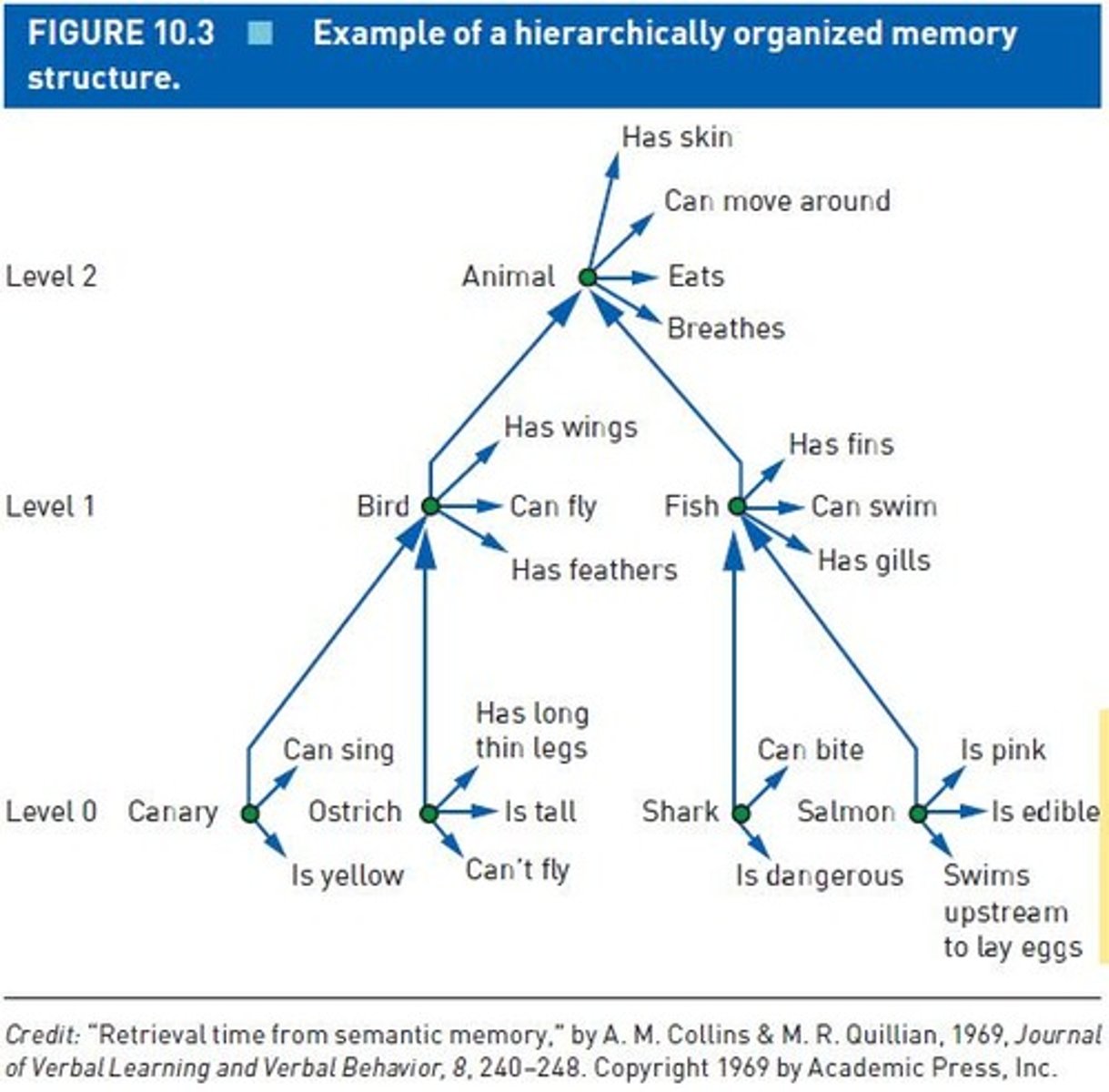
What did Bower et al. (1969) demonstrate about hierarchical organization?
They showed that organizing semantic information hierarchically improves recall.
What is the optimal category size for hierarchical organization according to Bower et al. (1969)?
Category size seems to range from 2 to 5 items.
What are taxonomic relations in the context of semantic organization?
Taxonomic relations involve organizing concepts based on their similarity or shared features.
What are thematic relations in semantic organization?
Thematic relations involve organizing concepts that appear in the same context.
What is a semantic network?
A semantic network organizes concepts based on their relations to each other, with concepts as nodes and links representing relationships.
What types of links exist in semantic networks?
Types of links include hierarchical relations, part (p) links, and type (t) links.
What do part (p) links indicate in semantic networks?
Part (p) links indicate that the lower concept is part of the higher concept.
What do type (t) links indicate in semantic networks?
Type (t) links indicate that the lower concept is an instance of the higher concept.
What is the dependent variable (DV) in the semantic verification task?
The DV is reaction time (RT) in the semantic verification task.
What does the hierarchical network model predict about reaction times?
It predicts that the more jumps required in the hierarchy, the longer the reaction times will be.
What is the facilitation effect in the hierarchical network model?
Facilitation occurs when verifying a concept after following the same path in the model, leading to faster reaction times.
What problem does the hierarchical network model face regarding verification?
It sometimes fails to account for verification that is not based on hierarchical organization.
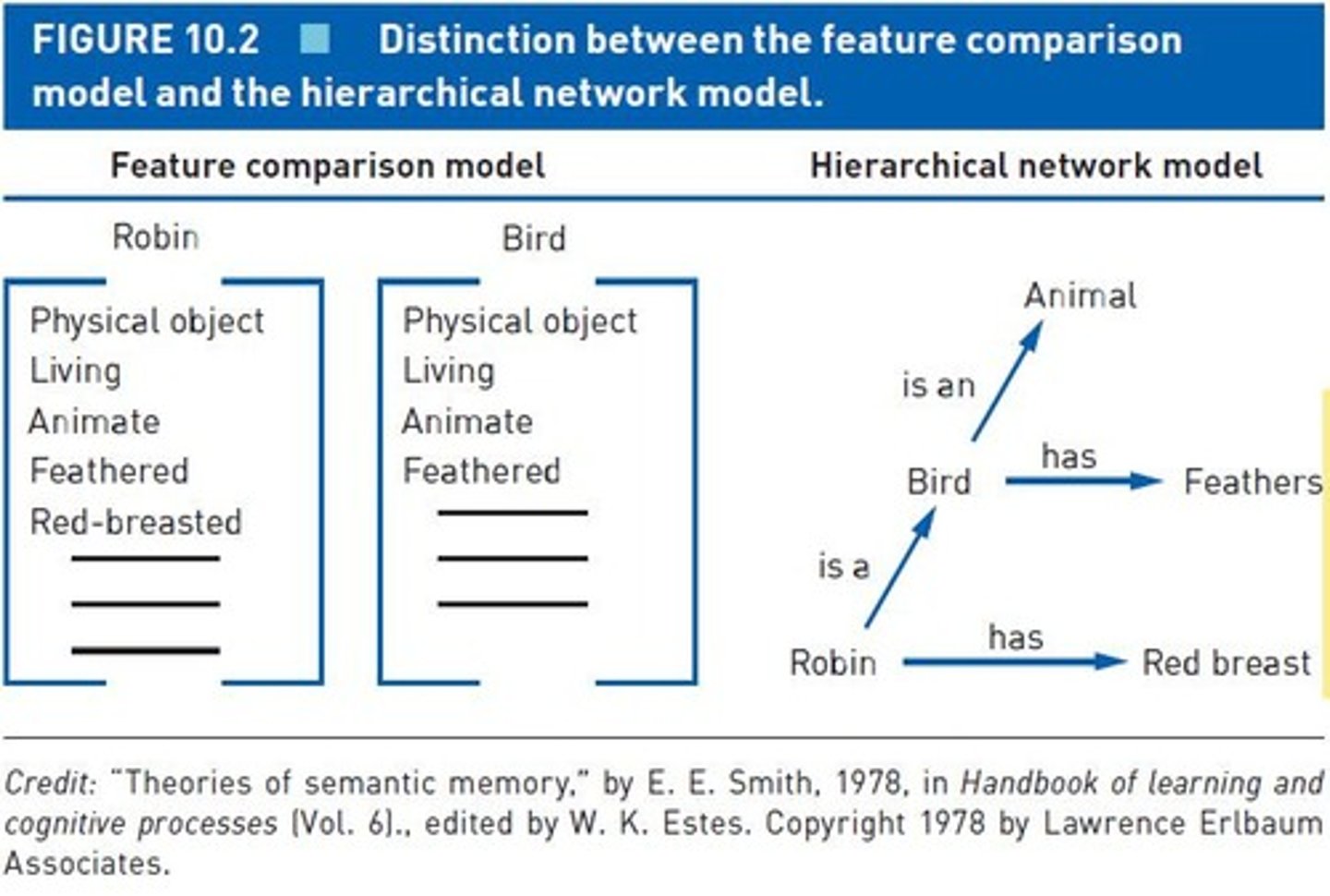
What is the feature comparison model?
The feature comparison model posits that concepts are stored in memory as a list of features and comparisons are made based on these features.
What are defining features in the feature comparison model?
Defining features are necessary to be a member of a category, such as 'birds have feathers.'
What are characteristic features in the feature comparison model?
Characteristic features are common to many but not all members of a category, such as 'birds can fly.'
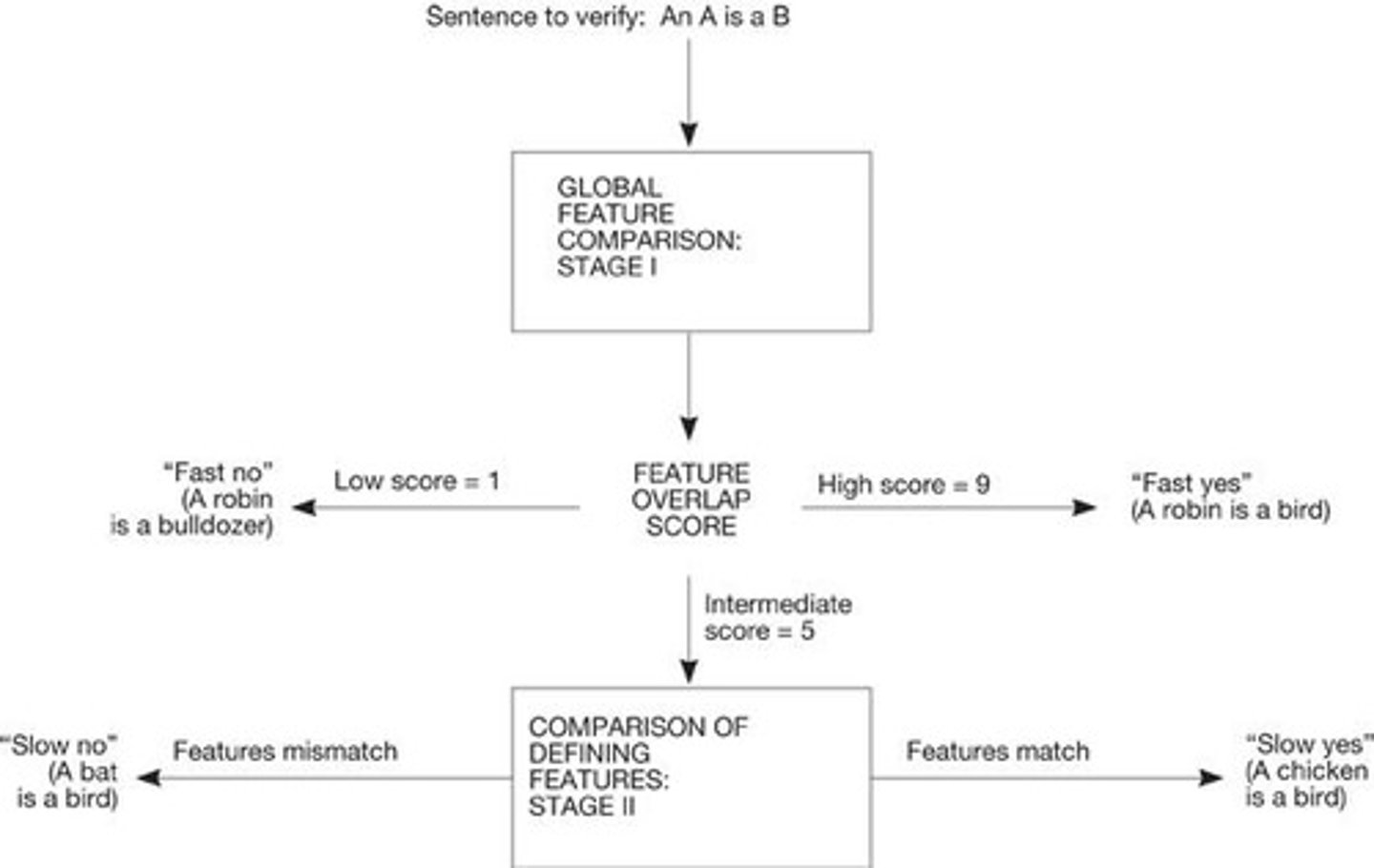
What are the two stages of the feature comparison model?
1) Compare all features; 2) If necessary, compare only defining features.
What is the typicality effect in the feature comparison model?
The typicality effect refers to the phenomenon where more typical members of a category are verified faster.
What is a limitation of the feature comparison model?
It relies on similarity judgments and lacks evidence for the primacy of defining features.
How do defining and characteristic features differ in terms of children's development?
Children become more sensitive to defining features as they develop, while characteristic features are often more salient.
What is the significance of the study by Smith, Shoben, & Rips (1974)?
They proposed the feature comparison model, explaining how concepts are compared based on features.
What is the reaction time for the statement 'A canary is an animal' according to Collins & Quillian (1969)?
1.20 seconds.
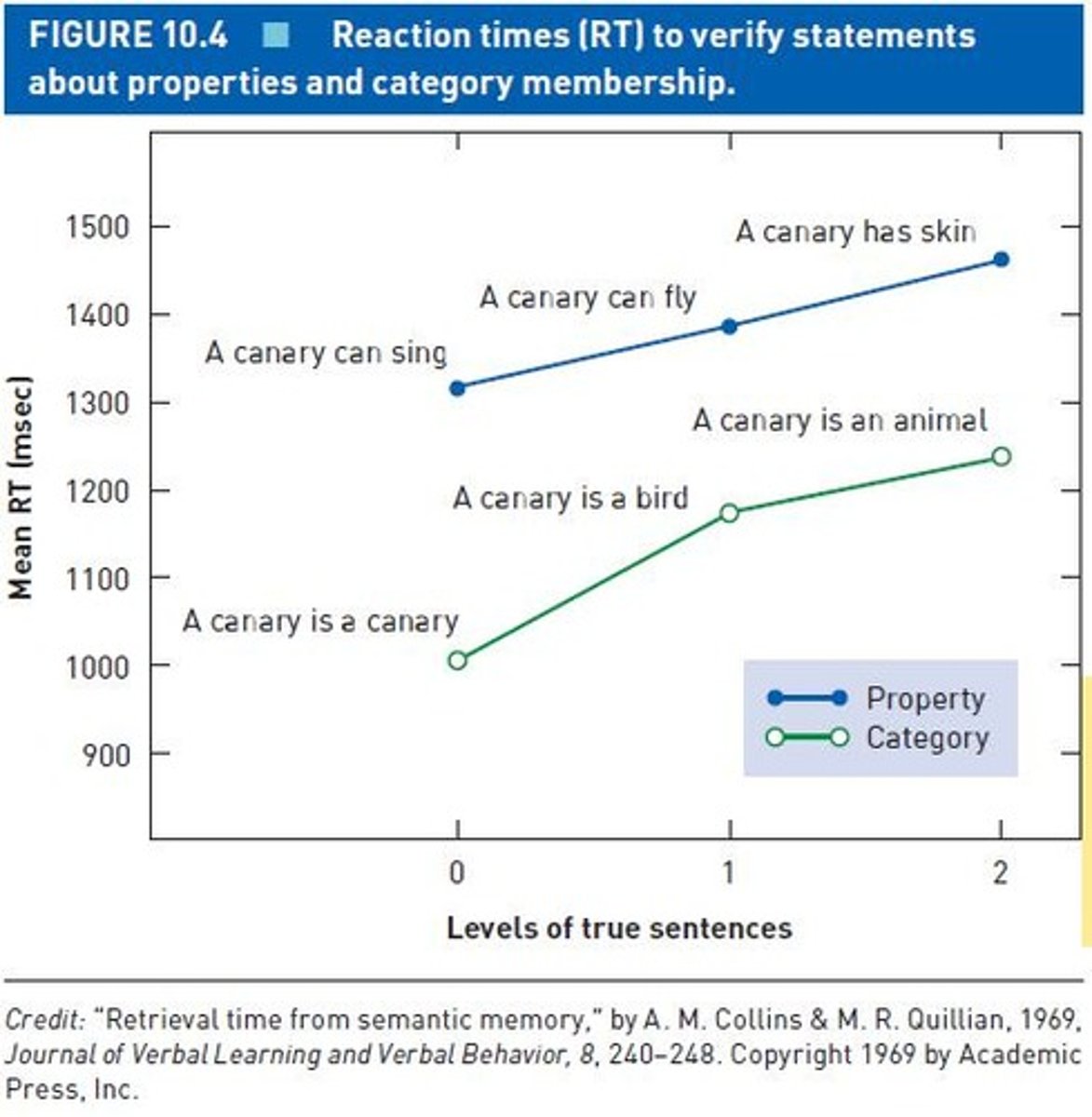
What is the reaction time for the statement 'A canary is a bird' according to Collins & Quillian (1969)?
1.15 seconds.
What is the reaction time for the statement 'A canary can fly' according to Collins & Quillian (1969)?
1.39 seconds.
What is the reaction time for the statement 'A canary is yellow' according to Collins & Quillian (1969)?
1.31 seconds.
What is the reaction time for the statement 'A canary is a canary' according to Collins & Quillian (1969)?
1.00 seconds.
What are the defining features of a chicken?
Lays eggs (white, brown, or yellow), has feathers, a beak, clucks, is large, and cannot fly.
What are the defining features of a bird?
Has feathers, a beak, wings, sings, lays eggs, migrates, and is colorful.
What is the first step in the feature comparison model?
Compare all features of the concepts.
What is the second step in the feature comparison model?
Compare defining features only.
What is the Spreading Activation Model?
A model that accounts for semantic relatedness through nodes and links, where activation spreads outward from a concept.
What happens to activation in the Spreading Activation Model as distance increases?
Activation loses effectiveness with distance traveled.
What is mediated priming in the context of the Spreading Activation Model?
Priming a concept that is two or more links away, with less activation than the first concept.
What is the lexical decision task?
A task where participants respond 'Yes' to words to measure activation and recognition.
What is the fan effect in the ACT Model?
Response times increase as the number of links to a person or location node increases.
What is the Modified ACT Model?
An adaptation of the ACT Model that introduces subnodes to link related ideas together.
What is a schema?
A stored framework or body of knowledge about a topic.
What did Bartlett's research focus on?
Memory for meaningful material using folktales, prose, and pictures.
What is reconstructive memory?
The process of constructing a memory by combining elements from original material with prior knowledge.
What are two notable aspects of Bartlett's results?
People recalled few specific details and tended to normalize and rationalize events.
What does modern schema theory suggest?
Schemas form a skeleton structure that incorporates details of specific instances.
What are scripts in schema theory?
A type of schema that represents typical events, organized temporally or by importance.
What is an example of a script?
A restaurant script that outlines typical events in a dining experience.
What is the role of schemas in memory?
Schemas provide default knowledge and help organize information in memory.
What is the significance of the length of links in the Spreading Activation Model?
Shorter links indicate stronger semantic relatedness between concepts.
How does the Spreading Activation Model account for typicality effects?
Typical members are connected by shorter links than atypical members.
What is the effect of intervening activity on activation in the Spreading Activation Model?
Activation decreases with intervening activity, affecting the recognition of related concepts.
What is the purpose of the confirmational strategy in model testing?
To look for evidence that confirms the model's predictions.
What is the disconfirmational strategy in model testing?
To look for evidence that disconfirms the model's predictions.
What is the primary criticism of the Spreading Activation Model?
It makes many assumptions that are difficult to test.
What is the relationship between activation and time in the Spreading Activation Model?
Activation decreases over time.
What is the purpose of categorization?
To reduce complexity, recognize patterns, establish hierarchies, and take appropriate actions.
What is a conjunctive rule in concept identification?
A logical rule that uses 'and' to define a concept (e.g., striped and square).
What is a disjunctive rule in concept identification?
A logical rule that uses 'or' to define a concept (e.g., large or a circle).
What does a conditional rule state?
It uses 'if, then' to establish a relationship between attributes (e.g., if striped, then it must be a square).
What is a biconditional rule?
It states that if one attribute is present, the other must also be present and vice versa (e.g., if striped then square; if square then striped).
What is the difference between attributes and rules in logical concepts?
Attributes are distinct features of objects, while rules are the logical relationships between those attributes.
What is the significance of family resemblance in categorization?
It measures the overlap between members within a category based on shared attributes.
What does typicality refer to in categorization?
It refers to how well members relate to their category, with some members being more typical than others.
What is the defining-attribute view of concepts?
It characterizes a concept by a set of defining attributes that must all be present.
What is the basic level in natural category hierarchy?
It balances informativeness and economy, usually acquired first by children and recognized quickly by non-experts.
What is the exemplar model in categorization?
It compares new items to examples of the category to determine membership.
What is the prototype model in categorization?
It categorizes items by finding the best match to a prototype or typical member of the category.
What is the nearest-neighbor rule?
A rule that selects the category with the member that has the most overlap with the new item.
What is the average-distance rule?
A rule that selects the category with members that have the greatest average similarity to the new item.
What is the impact of brain damage on categorical knowledge?
It can lead to a selective loss of knowledge about living or nonliving things, affecting semantic memory.
What is frequency theory in attribute learning?
It explains differences in learning as a function of exposure to attributes, where more exposure leads to quicker learning.
What are the criticisms of concept identification?
It is seen as highly artificial, not reflective of natural categories, which have fuzzy boundaries and typicality gradients.
What is the role of typicality gradients in categorization?
They predict categorization times, with more typical members being named first.
What is the difference between intension and extension in defining attributes?
Intension refers to the set of attributes defining a concept, while extension refers to the set of entities that are members of that concept.
What is attribute learning in concept identification?
It involves telling people the logical rule and allowing them to discover the relevant attributes.
What is a natural category?
A category that is characterized by typicality gradients and is organized hierarchically.
What is the significance of the basic level category?
It conveys a balance of informativeness and economy, often recognized first by children.
How does the prototype model differ from the exemplar model?
The prototype model uses an average or typical instance, while the exemplar model compares to specific examples.
What is the effect of exposure on learning attributes?
More exposure to attributes leads to quicker learning of the relevant concepts.
What are goal-derived categories?
Categories that are based on an underlying principle rather than shared attributes, where typical members satisfy a specific goal.
What is an example of a biconditional rule?
If and only if both relevant attributes are present or both are absent.

