BIOC 4331 Lecture 22

0.0(0)
Studied by 0 people
call kaiCall Kai
learnLearn
examPractice Test
spaced repetitionSpaced Repetition
heart puzzleMatch
flashcardsFlashcards
GameKnowt Play
Card Sorting

1/18

encourage image

There's no tags or description

Looks like no tags are added yet.

Last updated 4:32 PM on 4/6/26
Name
Mastery
Learn
Test
Matching
Spaced
Call with Kai

No analytics yet

Send a link to your students to track their progress

19 Terms
1
New cards
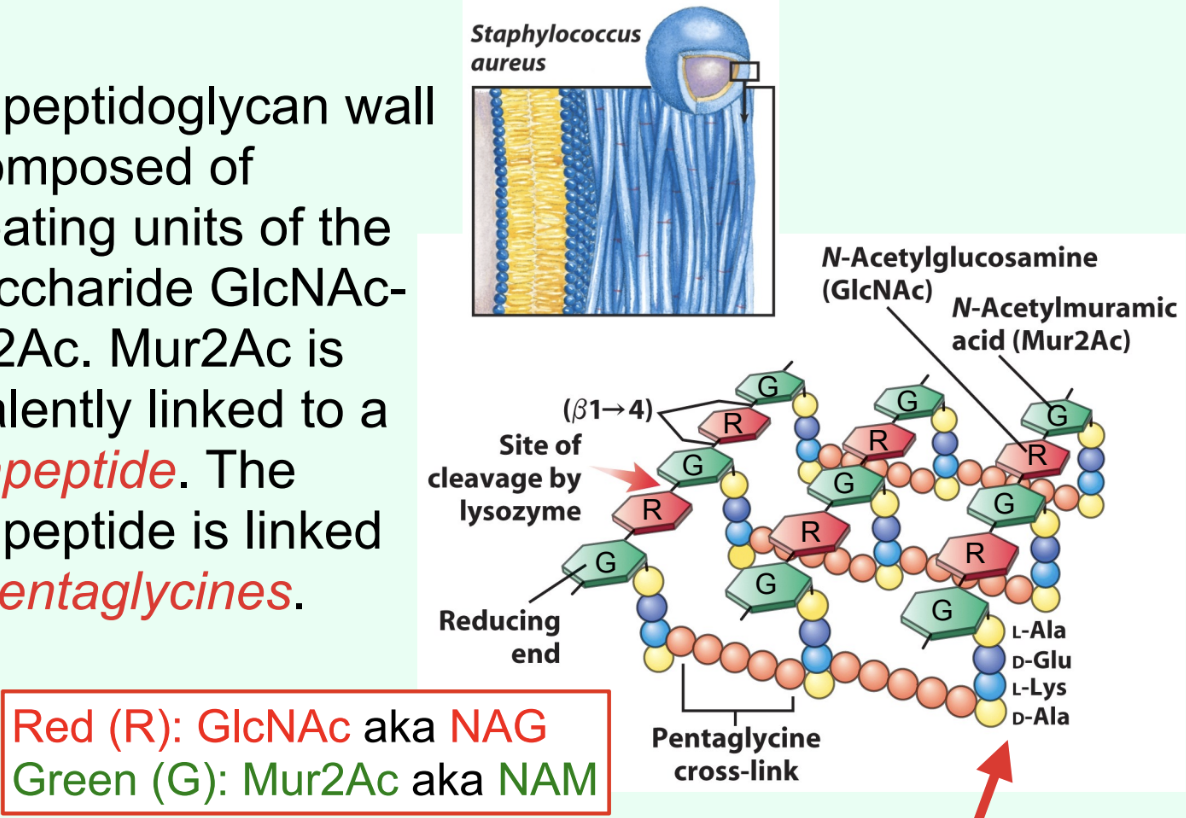
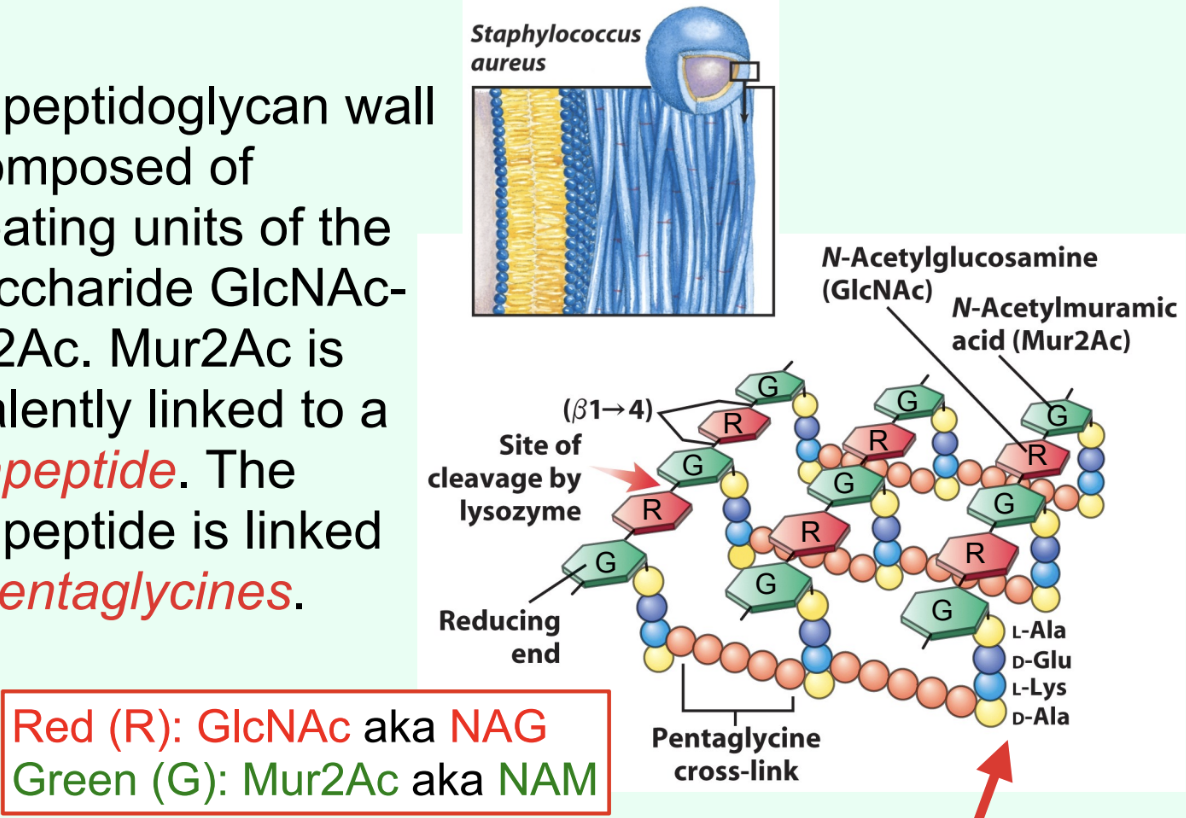
<p>What is the Gram-positive bacterial cell wall primarily composed of?</p>

What is the Gram-positive bacterial cell wall primarily composed of?

Peptidoglycan made of repeating disaccharide units: GlcNAc (NAG) and Mur2Ac (NAM).
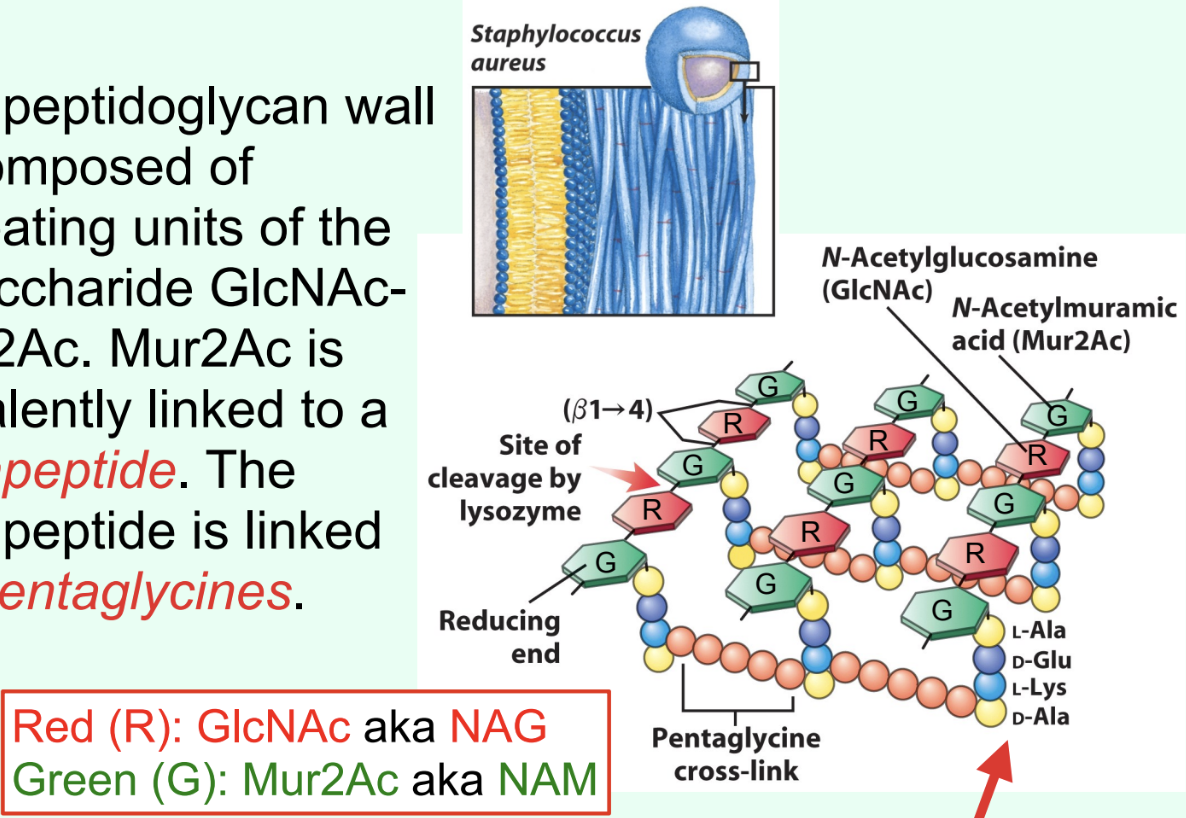
<p>Peptidoglycan made of <strong>repeating</strong> <strong>disaccharide</strong> units: <strong>GlcNAc</strong> (<strong>NAG</strong>) and <strong>Mur2Ac</strong> (<strong>NAM</strong>).</p>
2
New cards
<p>What is attached to Mur2Ac (NAM) in peptidoglycan?</p>

What is attached to Mur2Ac (NAM) in peptidoglycan?

A tetrapeptide covalently linked through the lactyl group.
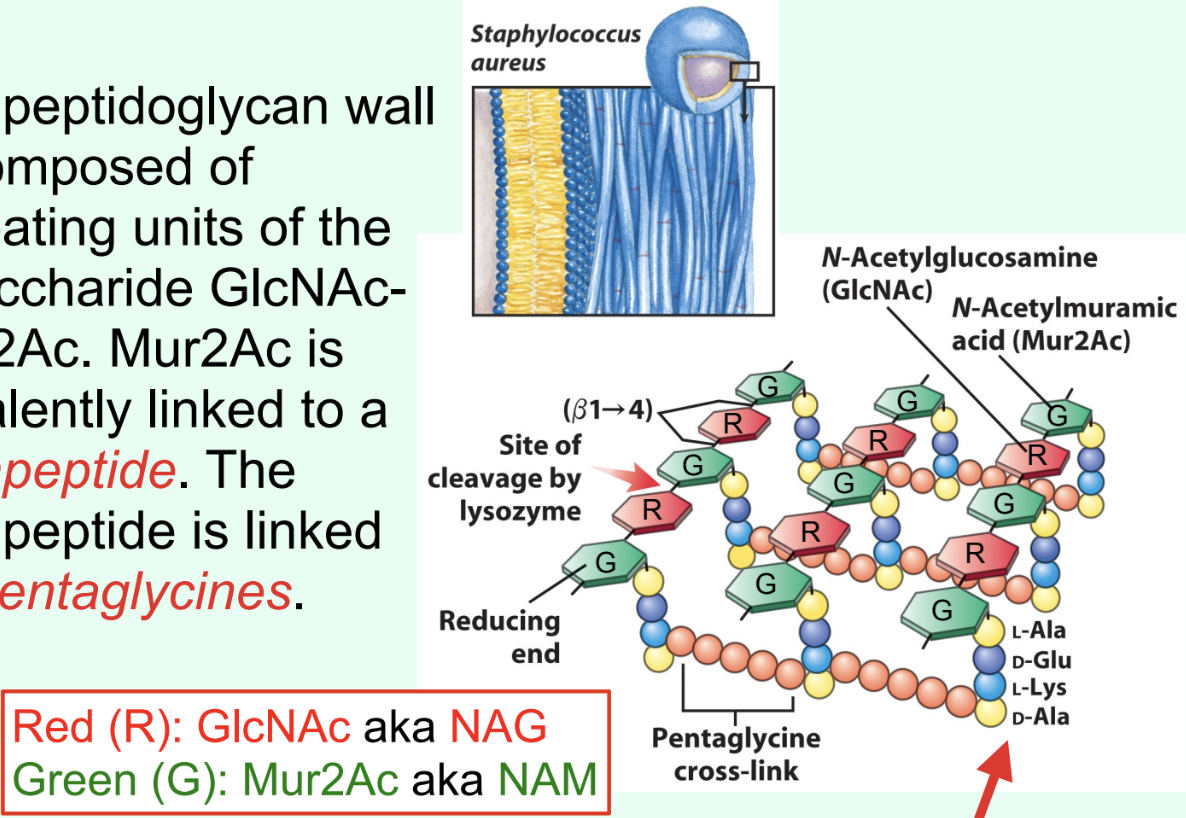
<p>A <strong>tetrapeptide</strong> covalently linked through the lactyl group.</p>
3
New cards

How are tetrapeptides cross-linked in Gram-positive bacteria?

By pentaglycines (bridges).
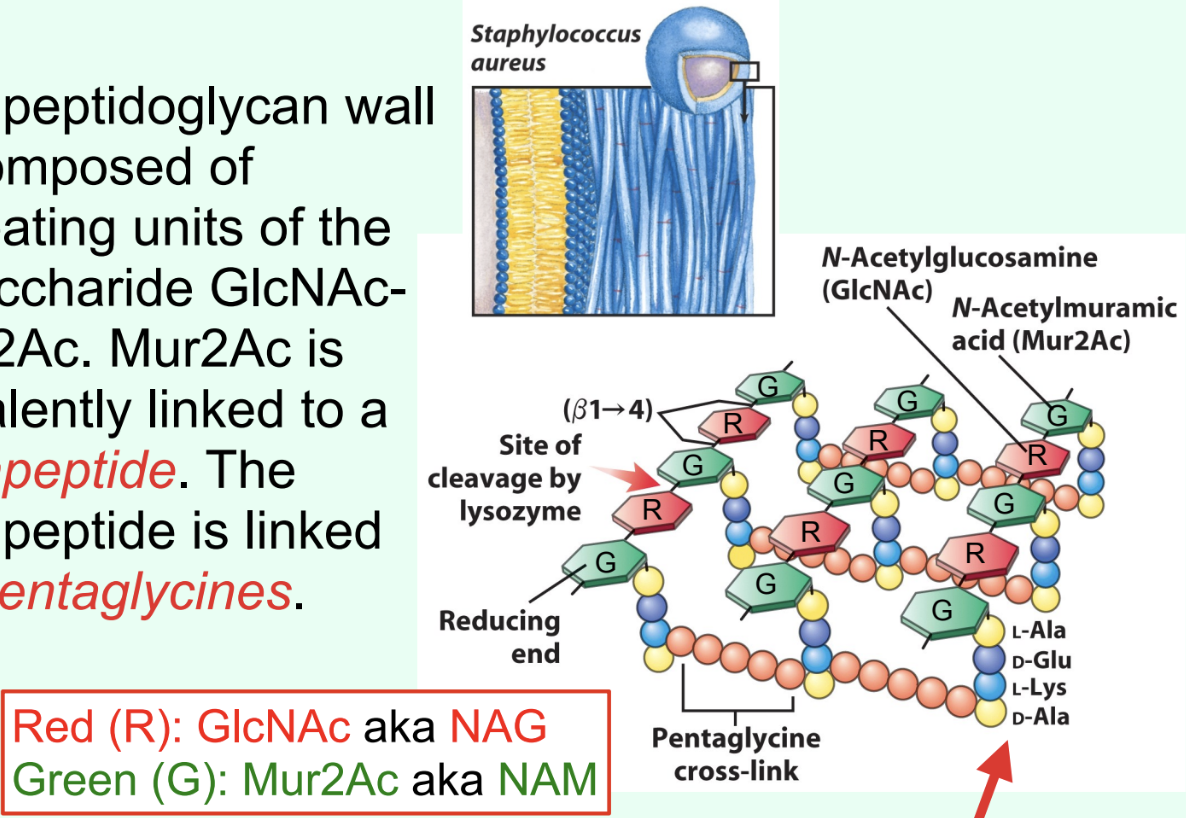
<p>By <strong>pentaglycines</strong> (bridges).</p>
4
New cards
<p>What is unusual about the tetrapeptide in peptidoglycan?</p>

What is unusual about the tetrapeptide in peptidoglycan?

It contains D-amino acids (proteins are almost exclusively made of L-amino acids).
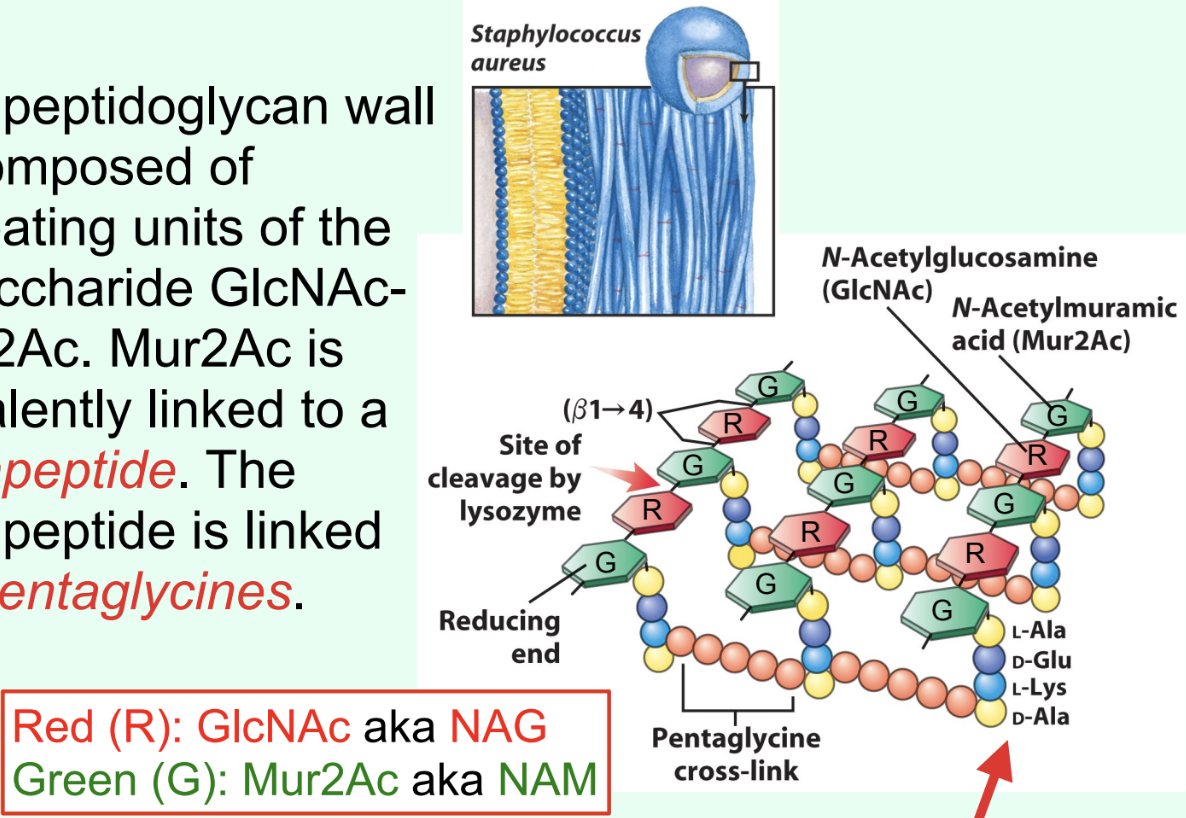
<p>It contains <strong>D-amino acids</strong> (proteins are almost exclusively made of L-amino acids).</p>
5
New cards

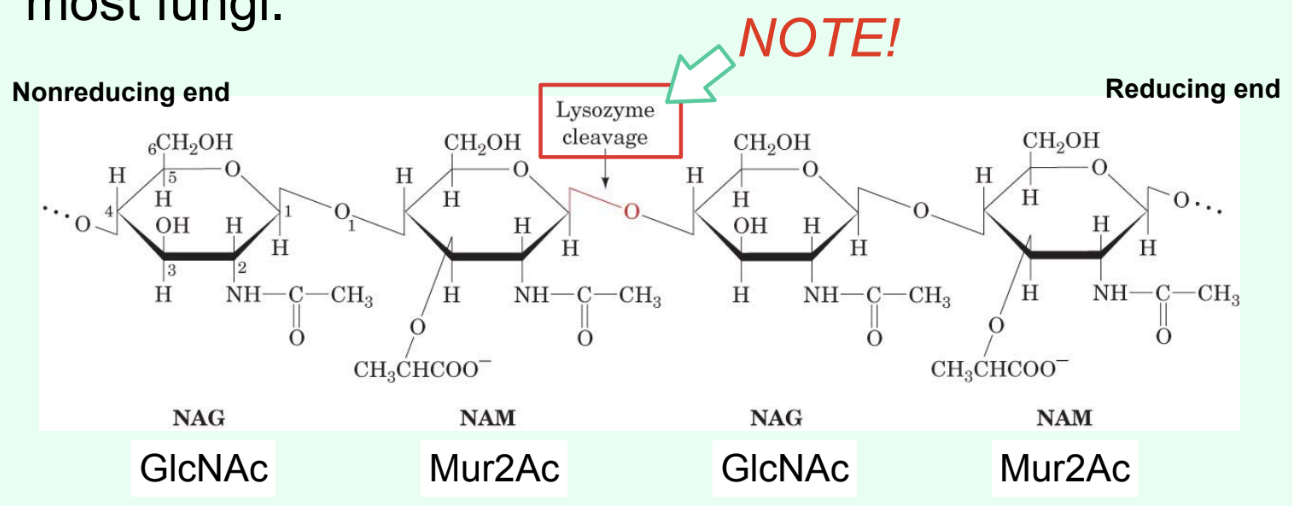
What type of ring do GlcNAc and Mur2Ac contain?

A 6-membered pyranose ring.
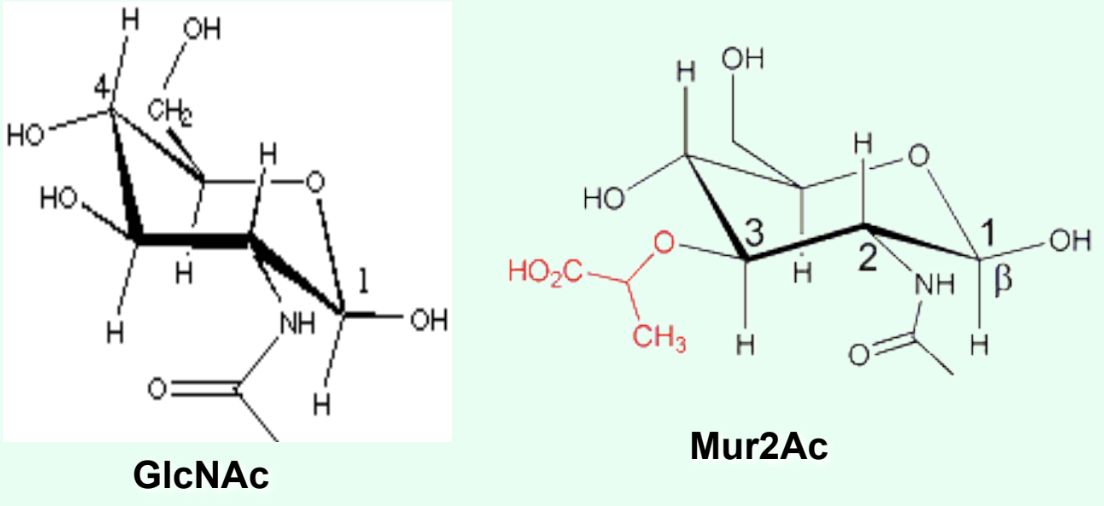
<p>A 6-membered <strong>pyranose</strong> ring.</p>
6
New cards

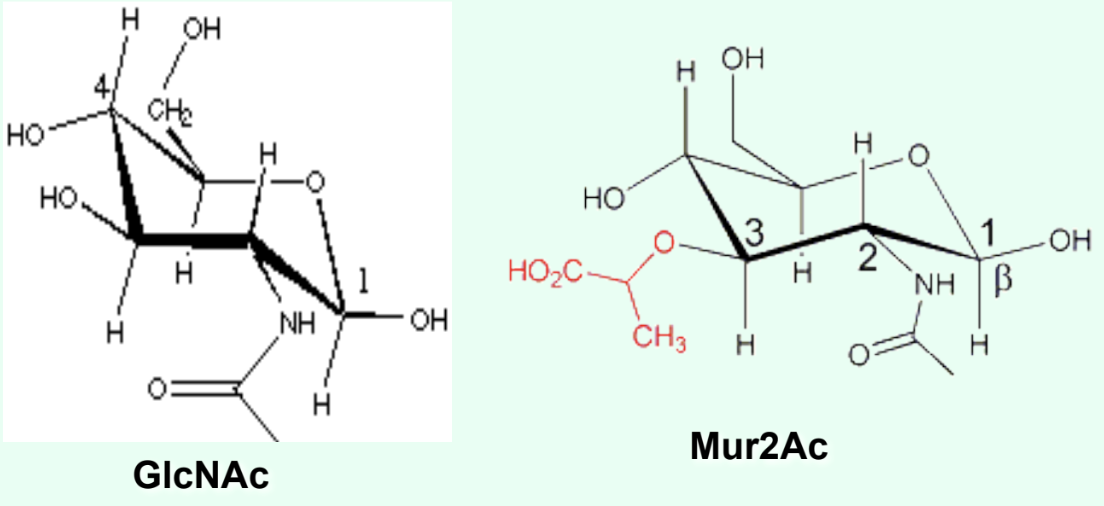
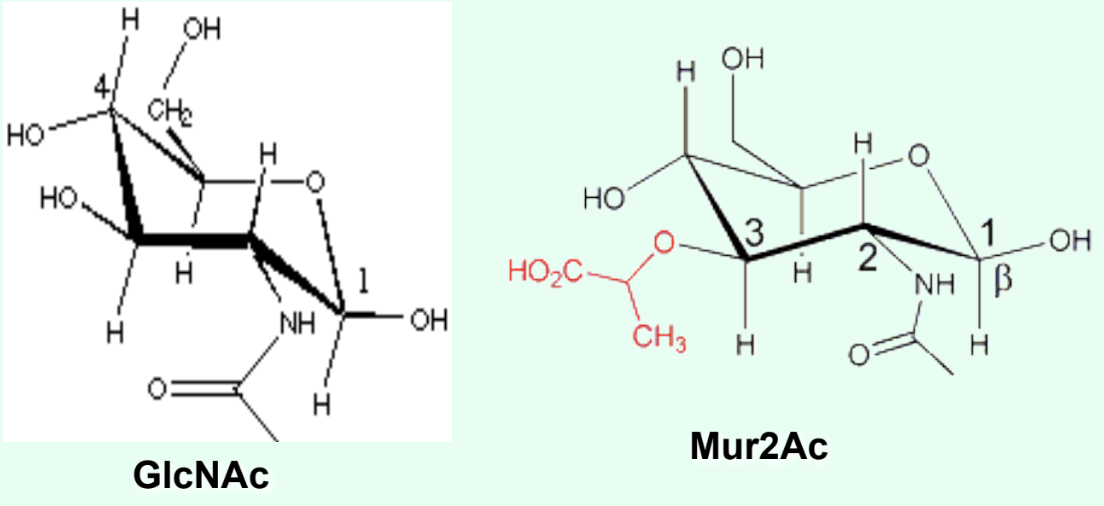
What is the ONLY structural difference between GlcNAc and Mur2Ac?

GlcNAc has an –OH at C3

Mur2Ac has a lactyl group at C3
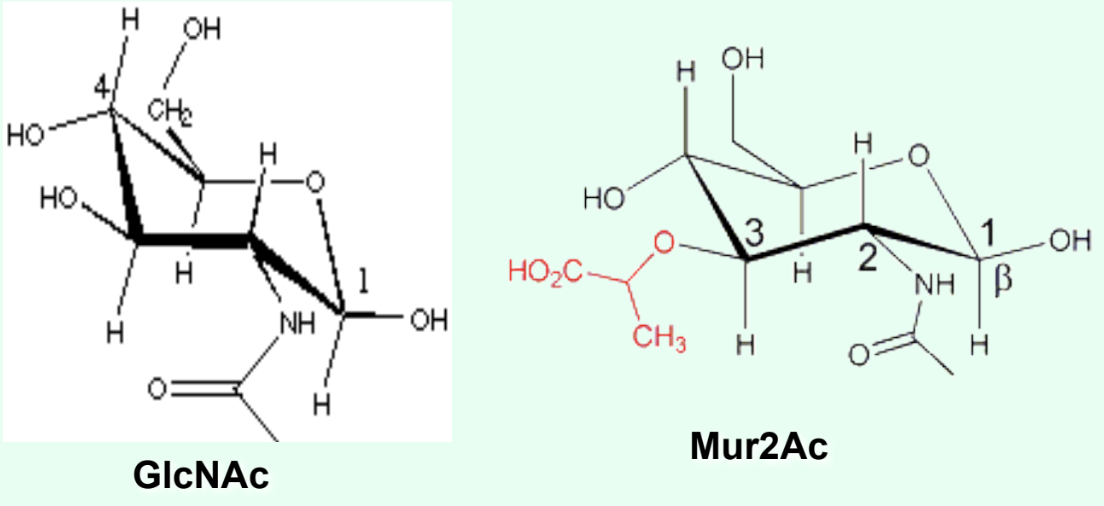
<p>GlcNAc has an <strong>–OH at C3</strong></p><p>Mur2Ac has a <strong>lactyl group at C3</strong></p>
7
New cards

Through what group is Mur2Ac covalently linked to the tetrapeptide?

Through the lactyl group at C3.
<p>Through the <strong>lactyl group at C3</strong>.</p>
8
New cards

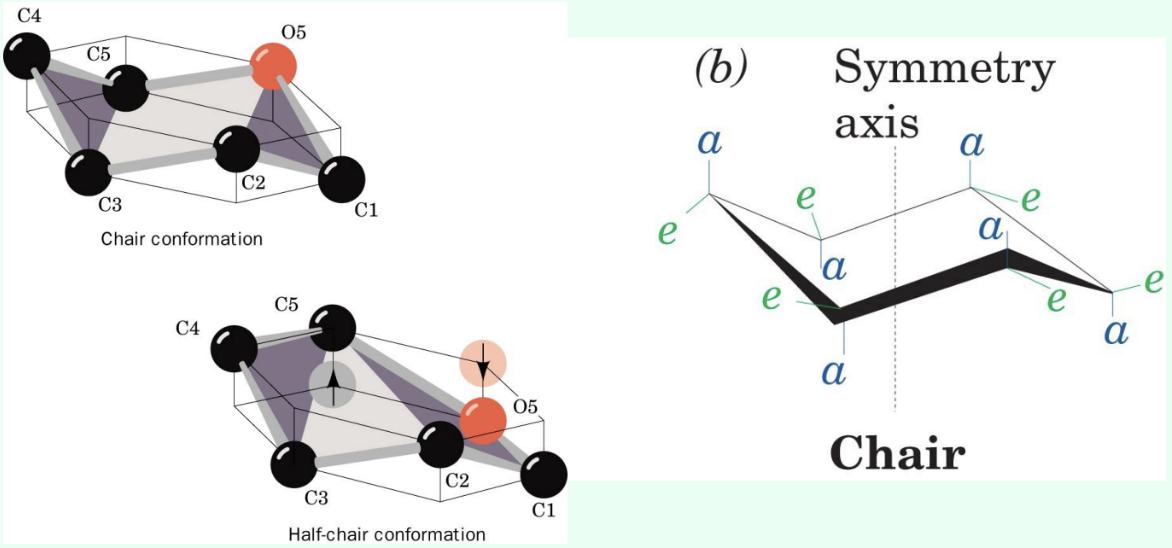
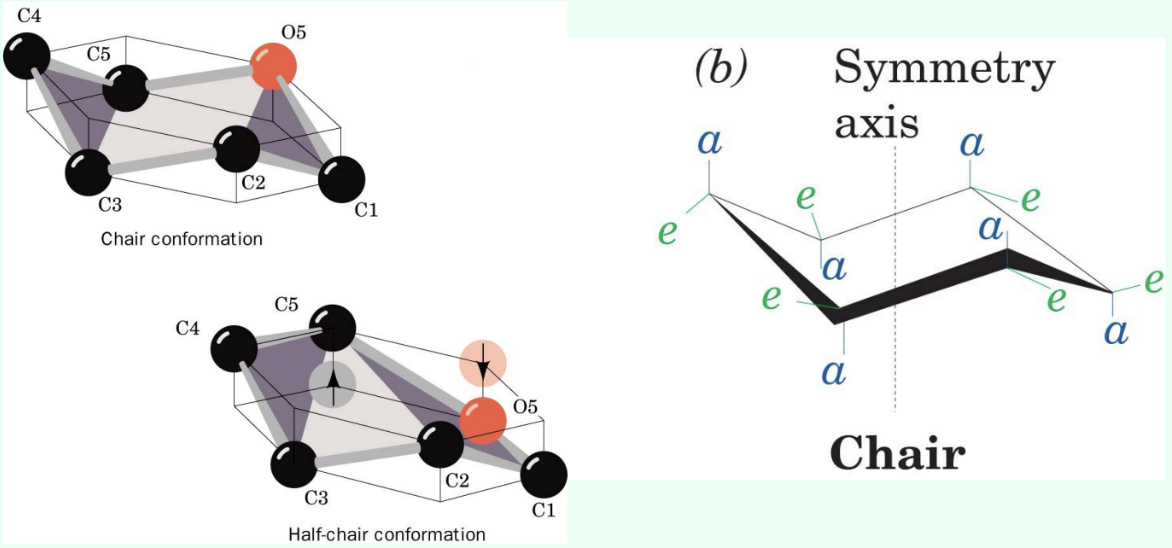
What is the most energetically stable conformation of a pyranose?

The chair conformation.
<p>The <strong>chair</strong> <strong>conformation</strong>.</p>
9
New cards
<p>What is the <strong>half-chair conformation?</strong></p>

What is the half-chair conformation?

An energetically less favorable distorted conformation where C1, C2, C5, and O5 lie in a plane.
<p>An <strong>energetically less favorable</strong> distorted conformation where C1, C2, C5, and O5 lie in a plane.</p>
10
New cards

Why is the half-chair conformation important in lysozyme catalysis?

It resembles the transition state and increases the reaction rate.
11
New cards
<p>What does <strong>lysozyme</strong> do?</p>

What does lysozyme do?

Breaks down Gram-positive bacterial cell walls.
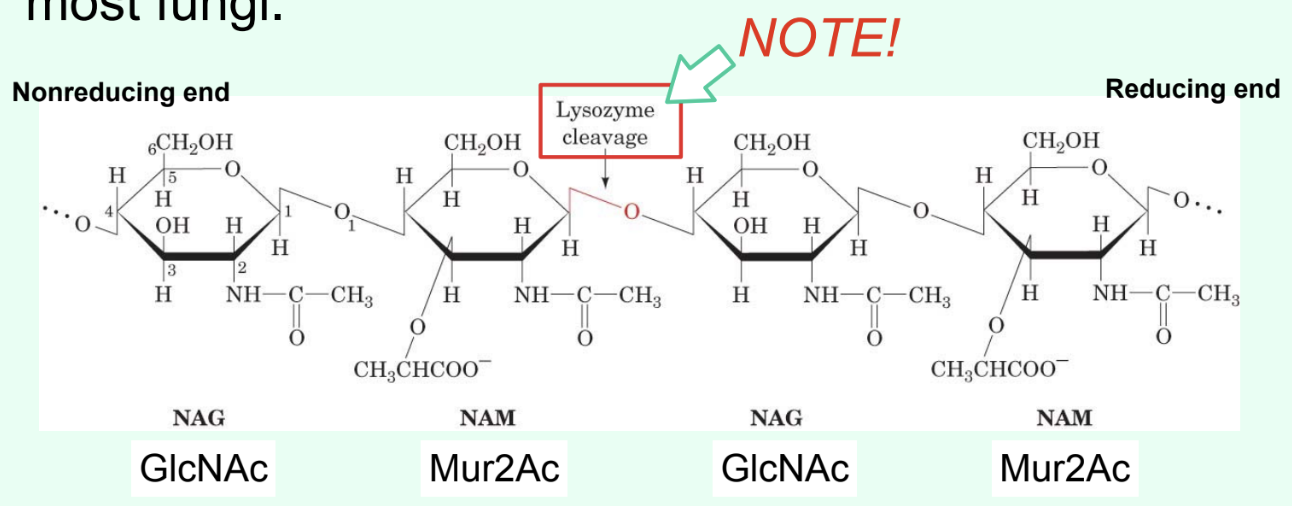
<p><strong>Breaks down Gram-positive bacterial cell walls</strong>.</p>
12
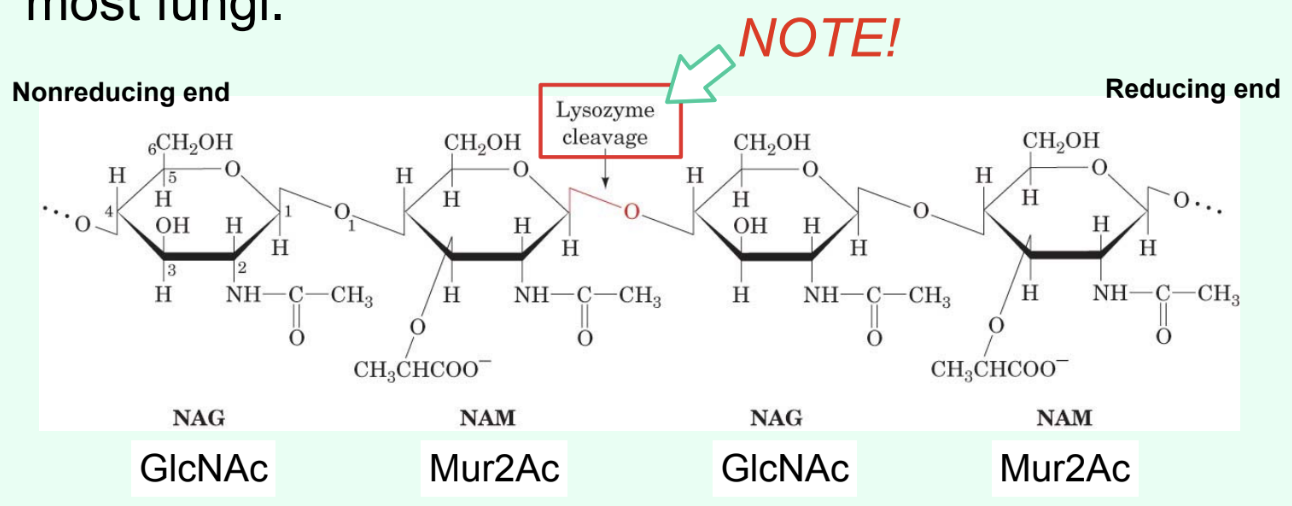
New cards
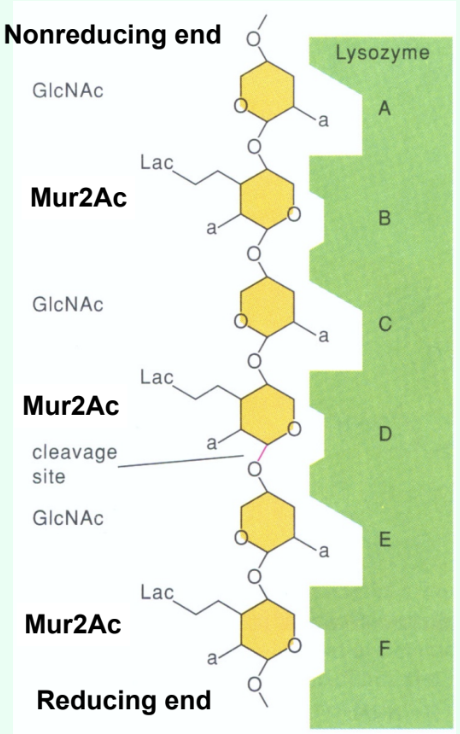
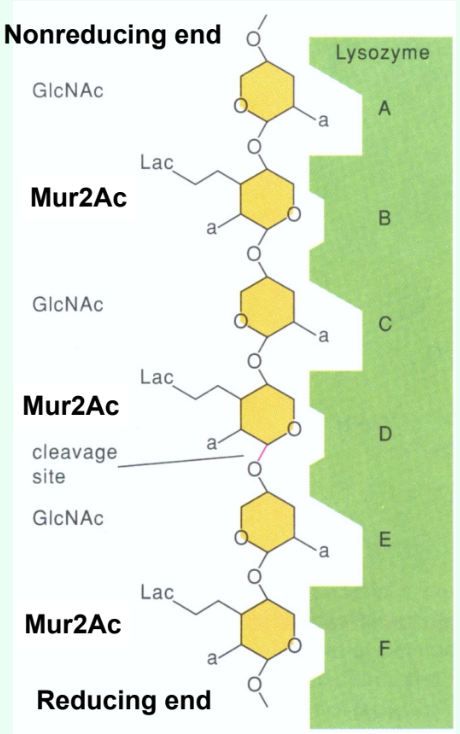
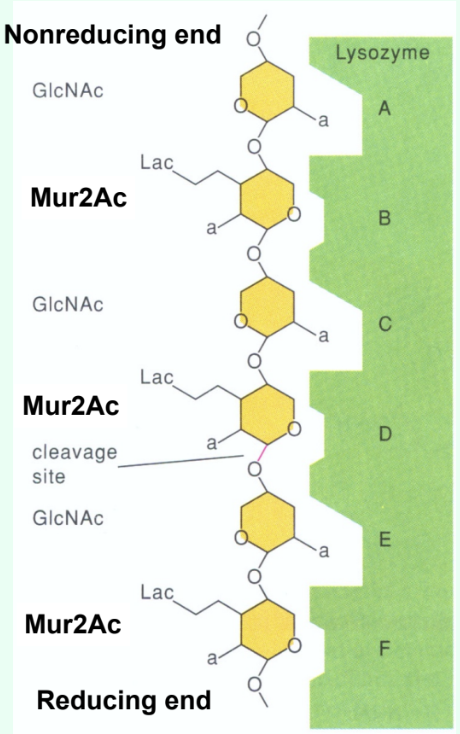
<p>What specific bond does lysozyme <strong>catalyze</strong>?</p>

What specific bond does lysozyme catalyze?

The hydrolysis of the β(1→4) glycosidic linkage between Mur2Ac and GlcNAc.
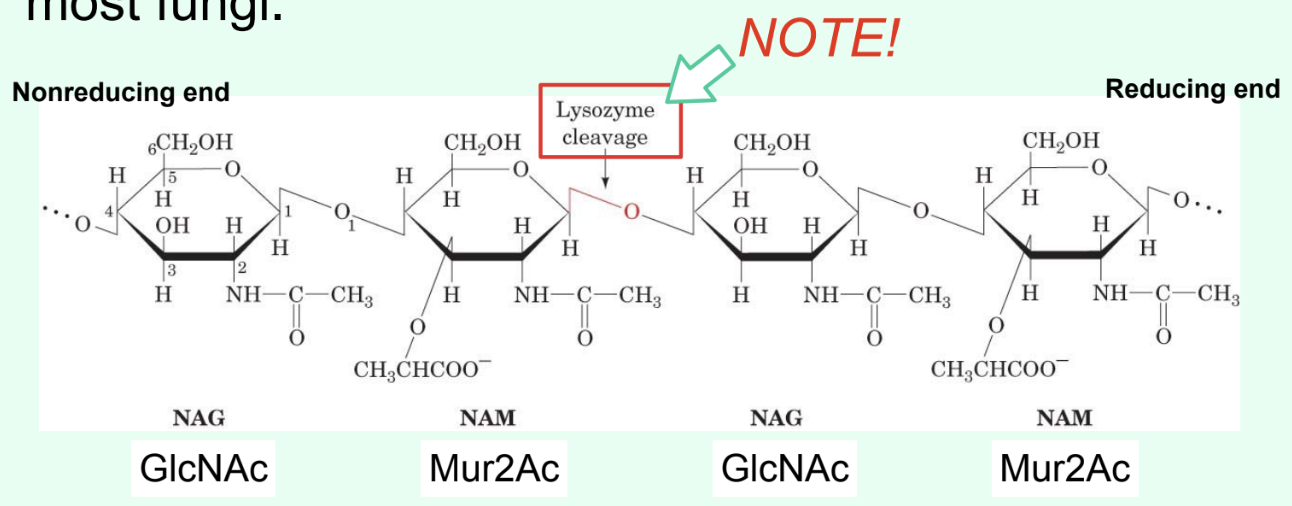
<p>The <strong>hydrolysis of the β(1→4) glycosidic linkage between Mur2Ac and GlcNAc</strong>.</p>
13
New cards
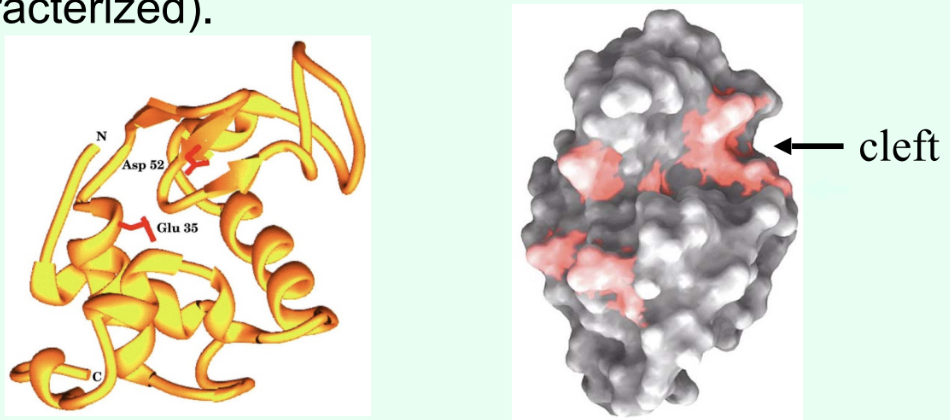
<p>How were catalytic residues in HEWL identified?</p>

How were catalytic residues in HEWL identified?

By functional testing of specific residues:

  • Chemical modification of active-site groups → loss of activity

  • Site-directed mutagenesis (swap one amino acid by changing its codon), then express + assay mutant enzyme

  • Residues whose alteration dramatically reduces catalysis are catalytic (classically Glu35 & Asp52).
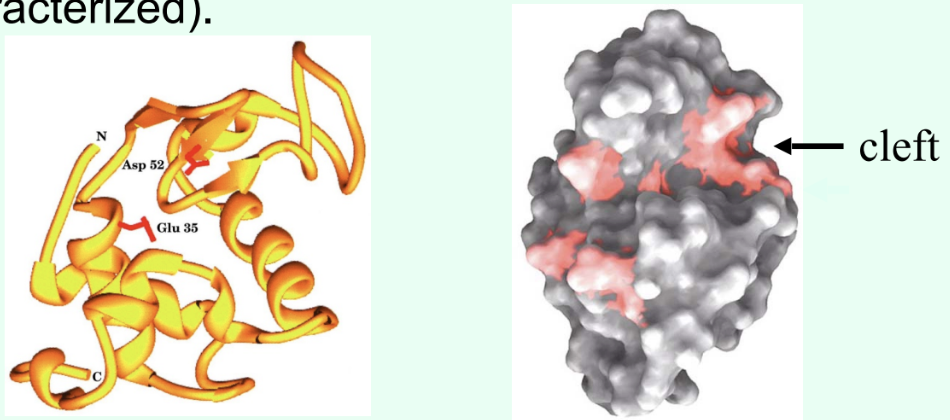
<p>By <strong>functional testing of specific residues</strong>:</p><ul><li><p><strong>Chemical modification</strong> of active-site groups → <strong>loss of activity</strong></p></li><li><p><strong>Site-directed mutagenesis</strong> (swap one amino acid by changing its codon), then <strong>express + assay</strong> mutant enzyme</p></li><li><p>Residues whose alteration <strong>dramatically reduces catalysis</strong> are catalytic (classically <strong>Glu35 &amp; Asp52</strong>).</p></li></ul><p></p>
14
New cards
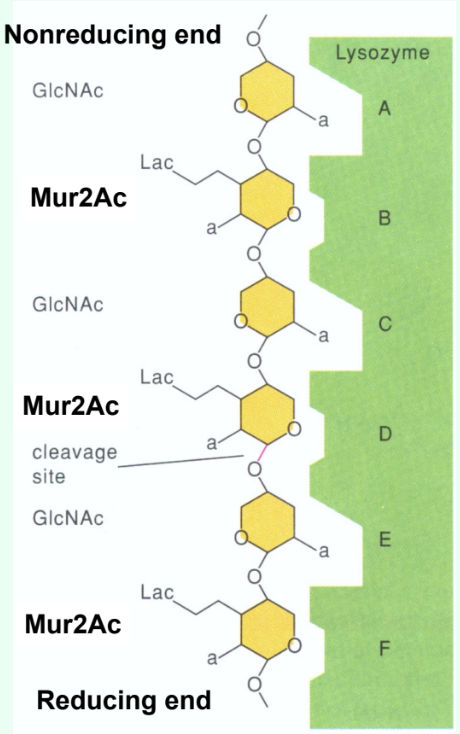
<p>How many sugar-binding subsites does lysozyme have?</p>

How many sugar-binding subsites does lysozyme have?

Six: A, B, C, D, E, F.
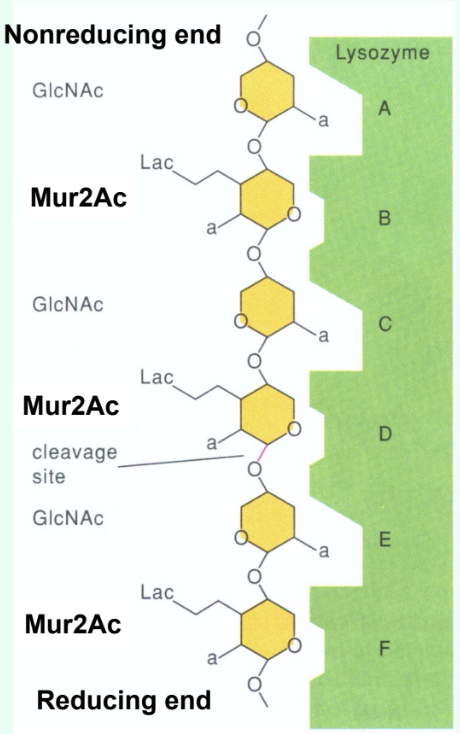
<p>Six: A, B, C, D, E, F.</p>
15
New cards
<p>How are <strong>short GlcNAc oligosaccharides (&lt;5 residues)</strong> hydrolyzed by lysozyme?</p>

How are short GlcNAc oligosaccharides (<5 residues) hydrolyzed by lysozyme?

They are very slowly (several weeks) hydrolyzed by lysozyme.
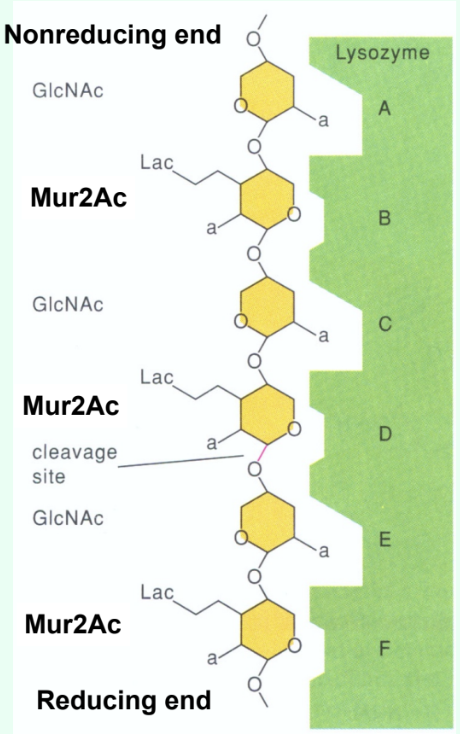
<p>They are <strong>very slowly (several weeks) hydrolyzed by lysozyme.</strong></p>
16
New cards
<p>Why do <strong>short GlcNAc oligosaccharides inhibit lysozyme</strong>?</p>

Why do short GlcNAc oligosaccharides inhibit lysozyme?

They bind the active site but react slowly, acting as competitive inhibitors.
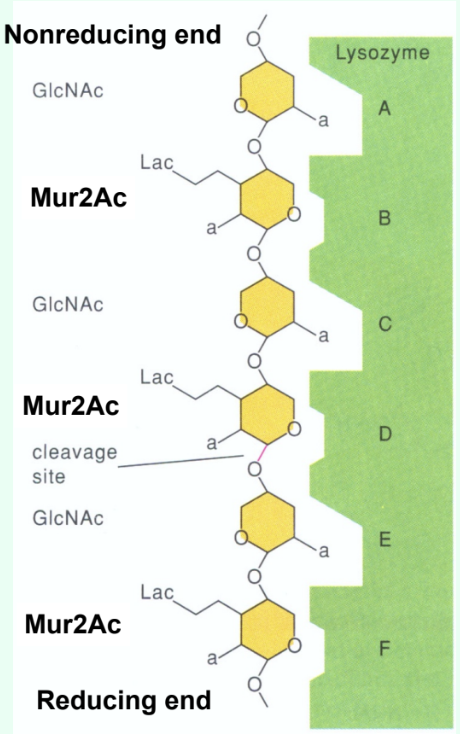
<p>They <strong>bind the active site</strong> but react <strong>slowly</strong>, acting as <strong>competitive inhibitors.</strong></p>
17
New cards
<p>What<strong> type of inhibitors</strong> do short substrate analogs act as when they bind the lysozyme active site?</p>

What type of inhibitors do short substrate analogs act as when they bind the lysozyme active site?

Competitive inhibitors.
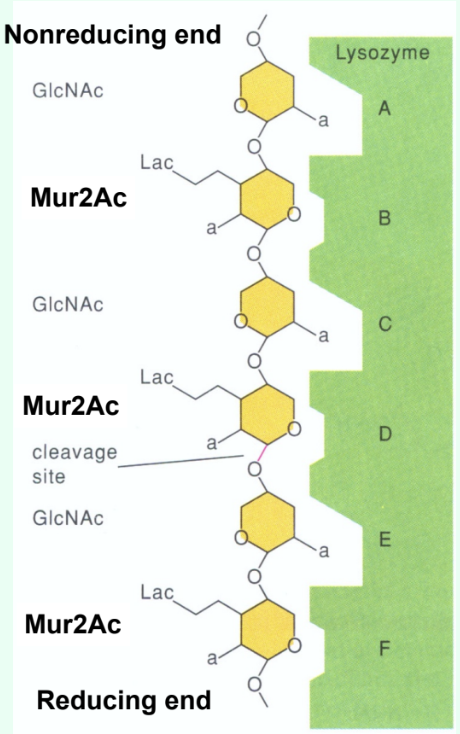
<p><strong>Competitive</strong> <strong>inhibitors</strong>.</p>
18
New cards
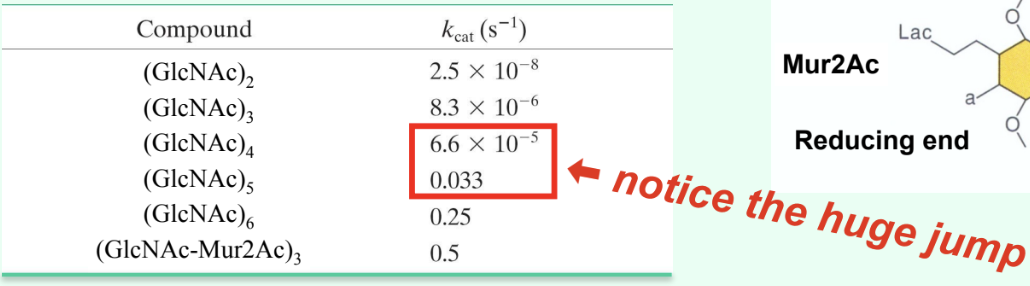
<p>Why is there a large jump in kcat (s-1) between (GlcNAc)4 and (GlcNAc)5?</p>

Why is there a large jump in kcat (s-1) between (GlcNAc)4 and (GlcNAc)5?

Due to binding across the D site allows transition-state distortion (half-chair) and proper positioning for cleavage.
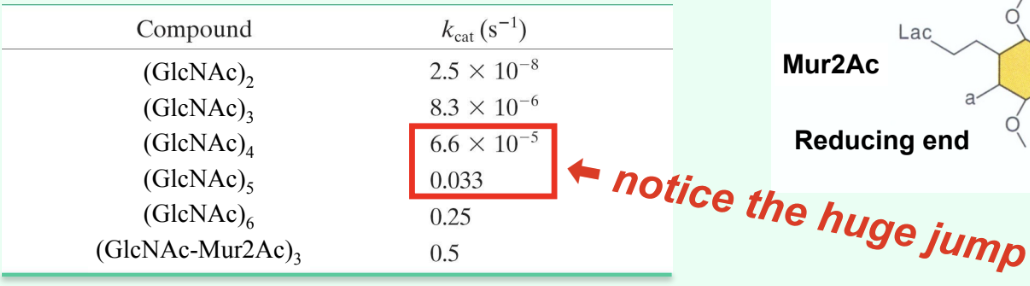
<p>Due to <strong>binding across the D site allows transition-state distortion (half-chair) </strong>and <strong>proper positioning for cleavage.</strong></p>
19
New cards

What important concept is illustrated by the huge jump in kcat between (GlcNAc)₄ and (GlcNAc)₅?

Lysozyme becomes much more catalytically efficient once the substrate length reaches ~5 sugars.

Explore top notes

note
Excretory system
Updated 713d ago
0.0(0)
note
Module 1.5a Sleep: Consciousness
Updated 187d ago
0.0(0)
note
Chapter 14-Natural Resources
Updated 1040d ago
0.0(0)
note
Napoleon
Updated 1169d ago
0.0(0)
note
AP World Unit 2
Updated 349d ago
0.0(0)
note
Excretory system
Updated 713d ago
0.0(0)
note
Module 1.5a Sleep: Consciousness
Updated 187d ago
0.0(0)
note
Chapter 14-Natural Resources
Updated 1040d ago
0.0(0)
note
Napoleon
Updated 1169d ago
0.0(0)
note
AP World Unit 2
Updated 349d ago
0.0(0)

Explore top flashcards

flashcards
Así se dice 2 Cap. 2
51
Updated 1006d ago
0.0(0)
flashcards
List 1B
86
Updated 934d ago
0.0(0)
flashcards
Chapter 9- Management
91
Updated 1105d ago
0.0(0)
flashcards
Key Terms ITI Exam 2
58
Updated 784d ago
0.0(0)
flashcards
Exam 1
89
Updated 1149d ago
0.0(0)
flashcards
Economics
61
Updated 894d ago
0.0(0)
flashcards
Así se dice 2 Cap. 2
51
Updated 1006d ago
0.0(0)
flashcards
List 1B
86
Updated 934d ago
0.0(0)
flashcards
Chapter 9- Management
91
Updated 1105d ago
0.0(0)
flashcards
Key Terms ITI Exam 2
58
Updated 784d ago
0.0(0)
flashcards
Exam 1
89
Updated 1149d ago
0.0(0)
flashcards
Economics
61
Updated 894d ago
0.0(0)