HLTH 358 Unit 7: Neurobiology of Stress and emotion (PTSD)
 Call Kai
 Learn
Learn Practice Test
 Spaced Repetition
 Match
Match Flashcards
 Knowt Play
 Podcast
1/35

There's no tags or description
Looks like no tags are added yet.
Name | Mastery | Learn | Test | Matching | Spaced | Call with Kai |
|---|
No analytics yet
Send a link to your students to track their progress
36 Terms
Criteria A for PTSD
- person was exposed to death, threatened death, actual or threatened serious injury, or actual or threatened sexual violence
=> does not have to be direct exposure; can be witnessed
=> PTSD liklihood decreases as direct exposure decreases
-
Criteria B for PTSD
Traumatic event is persistently re-experienced in the following ways
- unwanted upsetting memories
- nightmares
- flashbacks
- emotional distress after exposure to traumatic reminders
- physical reactivity after exposure to traumatic reminders
=> only one of these are required for PTSD
Criteria C for PTSD
Avoidance
Persistent avoidance of stimuli associated with trauma and numbing of general responsiveness (1 or both)
Efforts to avoid thoughts, feelings, or conversations
Efforts to avoid activities, places, or people
=> ppl will try to keep themselves constantly busy to prevent the mind from wandering to the trauma
Criteria D for PTSD
Negative alterations in mood and cognition
2 or more, not existent before trauma
- Inability to recall certain aspects of the event
- Nexaggerated blame of self or others for causing the trauma
- negative affect
- decreased interest in activitires
- feeling isolated
-difficulty experiencing positive affect
Criteria E for PTSD
Trauma-related arousal and reactivity that began or worsened after the trauma, in the following ways (2 required)
- irritability or agression
- risky or destructive behavior
- hypervigilance
- heightened startle reaction
- difficulty concentrating
- difficulty sleeping
Criteria F for PTSD
Symptoms > 1 month
Criteria G (PTSD)
The disturbance causes clinically significant distress or impairment in social, occupational, or other important areas of functioning.
Criteria H for PTSD
The disturbance is not attributable to the physiological effects of a substance (e.g., medication, alcohol) or another medical condition.
specifications for PTSD diagnosis
1. dissociative specification
2. delayed specification
dissociative specification
High levels of depersonalization or derealization.
Depersonalization
feelings of detachment from one's mental processes or body
derealization
experence of unreality, distances or distortion
Delayed Specification
Full diagnostic criteria are not met until at least 6 months after the trauma(s), although onset of symptoms may occur immediately.
EMT and PTSD Video
- first responders make a large portion of PTSD patients
- healthy life outside work = healthy life at work
- peer support helps destigmatize mental health
- first responders must care for eachother and themselves
- peer support teams help create trust (anonymous)
=> current systems make First responders stay anonymous bc they are afraid of consequences
- social dynamic of peer support group
=> demographic factors (sex) may prevent ppl from obtaining trust and help
- stigma against admitting having PTSD
Emotions - Intro
Emotions - characteristics
- universal across cultures and geographic regiosn
=> not completely universal
=> most common: Anger, disgust, fear, hapiness, sadness, surprise
- humans have an evolved capacity for emotional expression (Form that it takes is shaped by needs for survival via affiliation and communication of risks, counterfactuals and others things that go beyond semantics of spoken language)
Importance of emotion
- help communicate info in the abscence of langauge
- serve as a communicative function fo much of our evolutionary history, before formal langauge was adopted
=> The fact that basic emotional circuitry is "old brain" is supports this argument re the ancient origins of emotions as communication devices to others
exceptions for emotion
- emotions do not communicate to you
- communicate to those around you
- therefoer have a fundamental, social, communiative function
- groups can organize and work better, and presumabely survive better with this form of communication
- we have parallel system that mobilizes us to respond to stimuli, COMPLETELY SEPARATELY fro outward emotions
Emotional expression systems across species
- not automatically evolved in all species
=> some have outward expressions, others do not
- outward expression more observed in complex organisms that live in social groups
- basic theory of emotion suggest that they operate parallel with perception
=> option for the nervous system to react directly to environment without emotion as mediator
Emotions and the brain - intro
Phineas gage
his survival of a horrible industrial accident taught us about the role of the frontal lobes (okay, he's not really a psychologist...)
- illustrates the significance of the medial PFC for emotion and decision-maling
mPFC and emotion
important role in emotional regulation, decision making and behavior.
, reactive negative emotionality—and the influence of emotions on decisions and behavior—are regulated by the mPFC.
- damage to mPFC produces similar behavioru observed in Gage
- subtle differences in mPFC explain individual differecnes in emotional behaviour
Additional Characteristics of MPFC
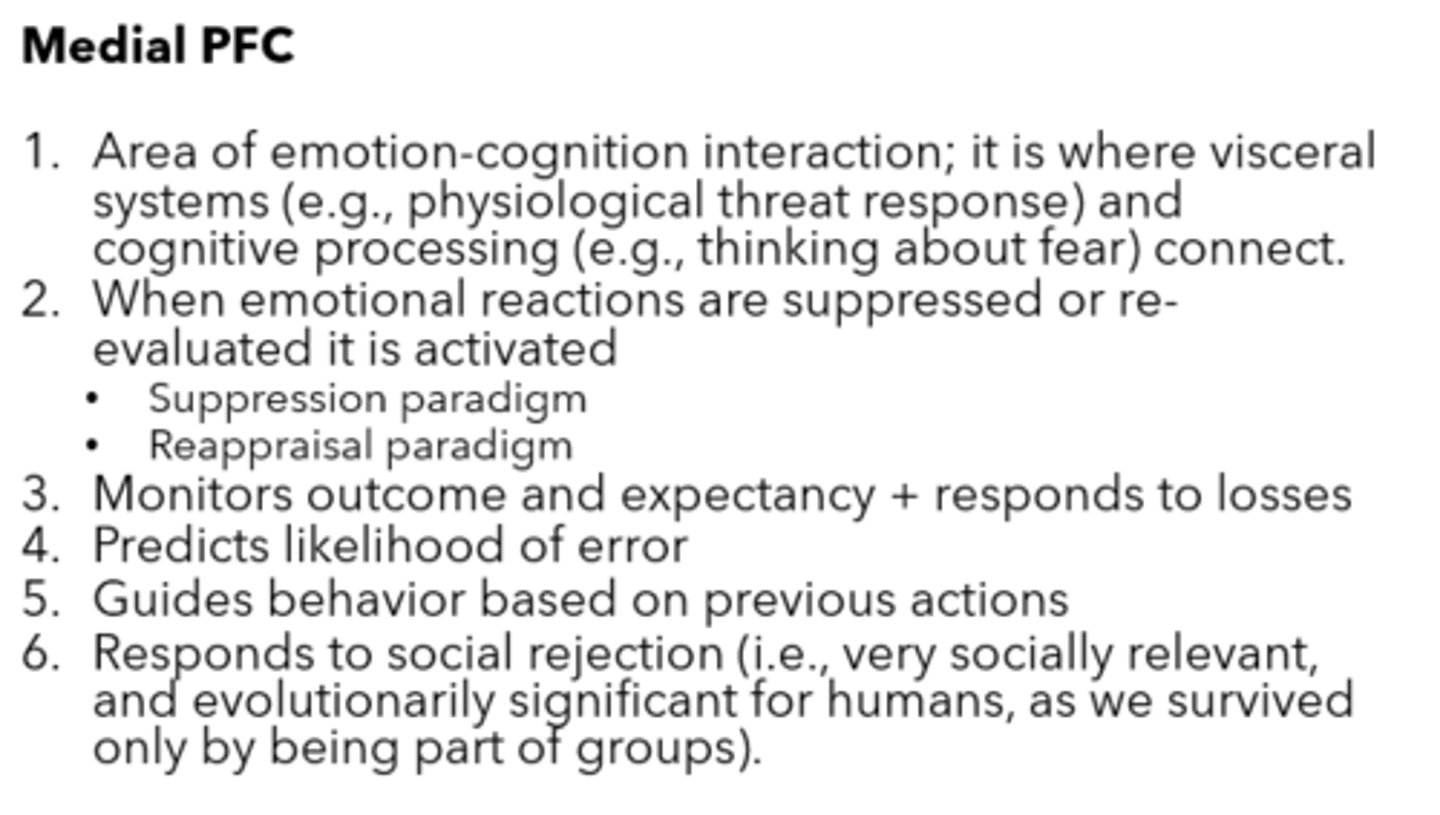
suppression paradigm
an experimental method for studying emotion; subjects are asked to inhibit their emotional reactions to unpleasant films or photos while their brain activity is recorded
reappraisal paradigm
an experimental method for studying emotion; subjects are asked to reinterpret a film or photo to change their emotional reaction to it while their brain activity is recorded
Theoretical perspectives on emotion (3)
- james-lange theory
- cannon-bard theory
- modern view
james-lange theory
-Emotions are simply our reading of our physiological reactions to stimuli
- Visceral changes in the body (e.g., increased heart rate, sweating) are triggered without conscious thought, as the body mobilizes to whatever is happening
Cannon-bard theory
-Environmental stimuli provoke PARALLEL visceral and emotional responses (e.g., increased heart rate and the feeling of fear).
Modern view of emotions
-There is a cyclical relationship between emotional experience and physiology, such that they reinforce each other in a dynamic manner.
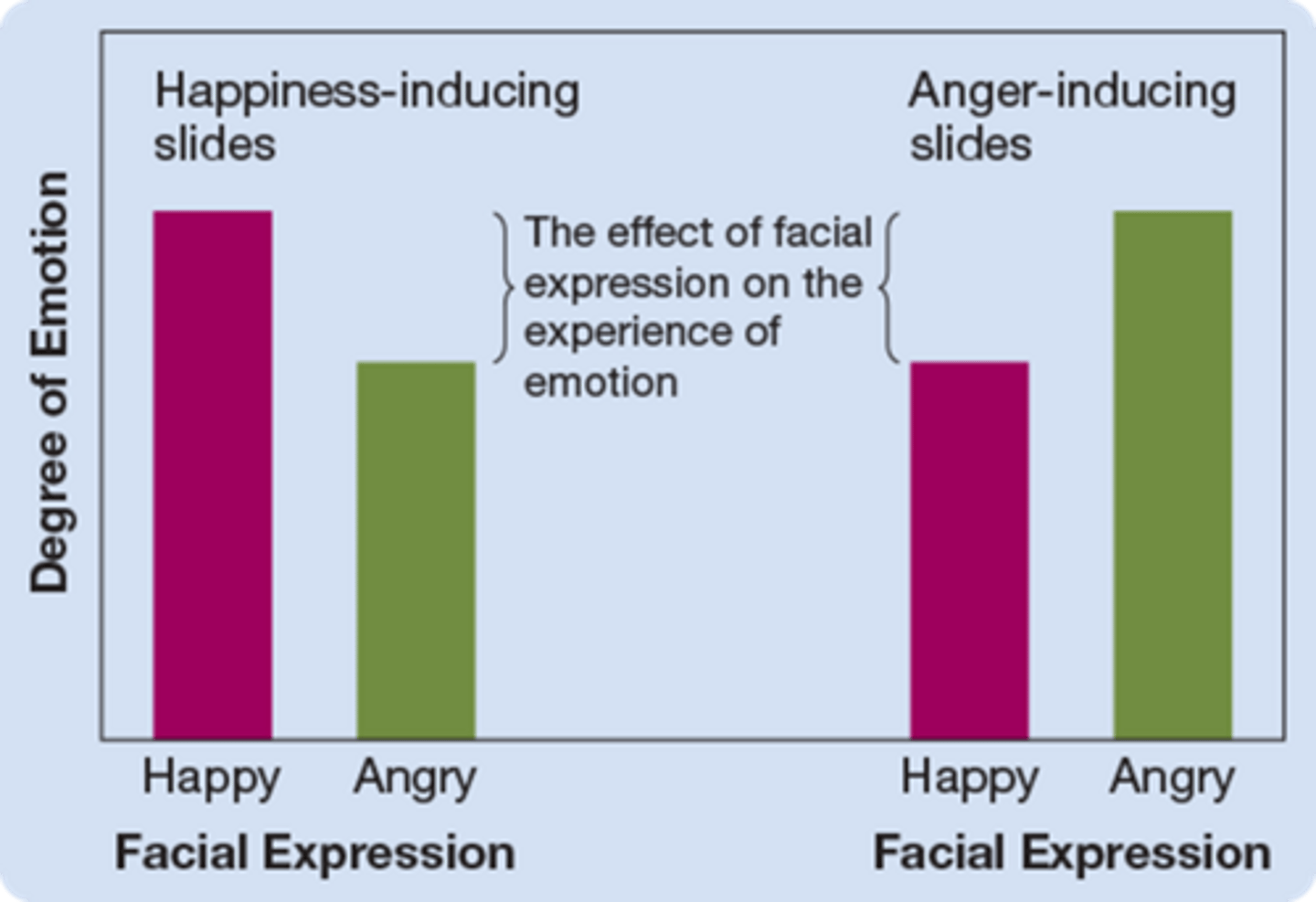
Inner experience effects due to expressed emotion
producing an expression mechanically can alter a subjective feeling.
Communication of emotional states and gestures
are emotional expressions that are complex displays involving both facial features and gestures.
Without both, the meaning is lost.
Take this example... without the body language vs with...

Fear - Intro
Fear characteristics
very evolutionary important, and problems with the fear system are implicated in at least ½ dozen psychiatric disorders.
=> ex PTSD
Basis of fear and fear conditioning
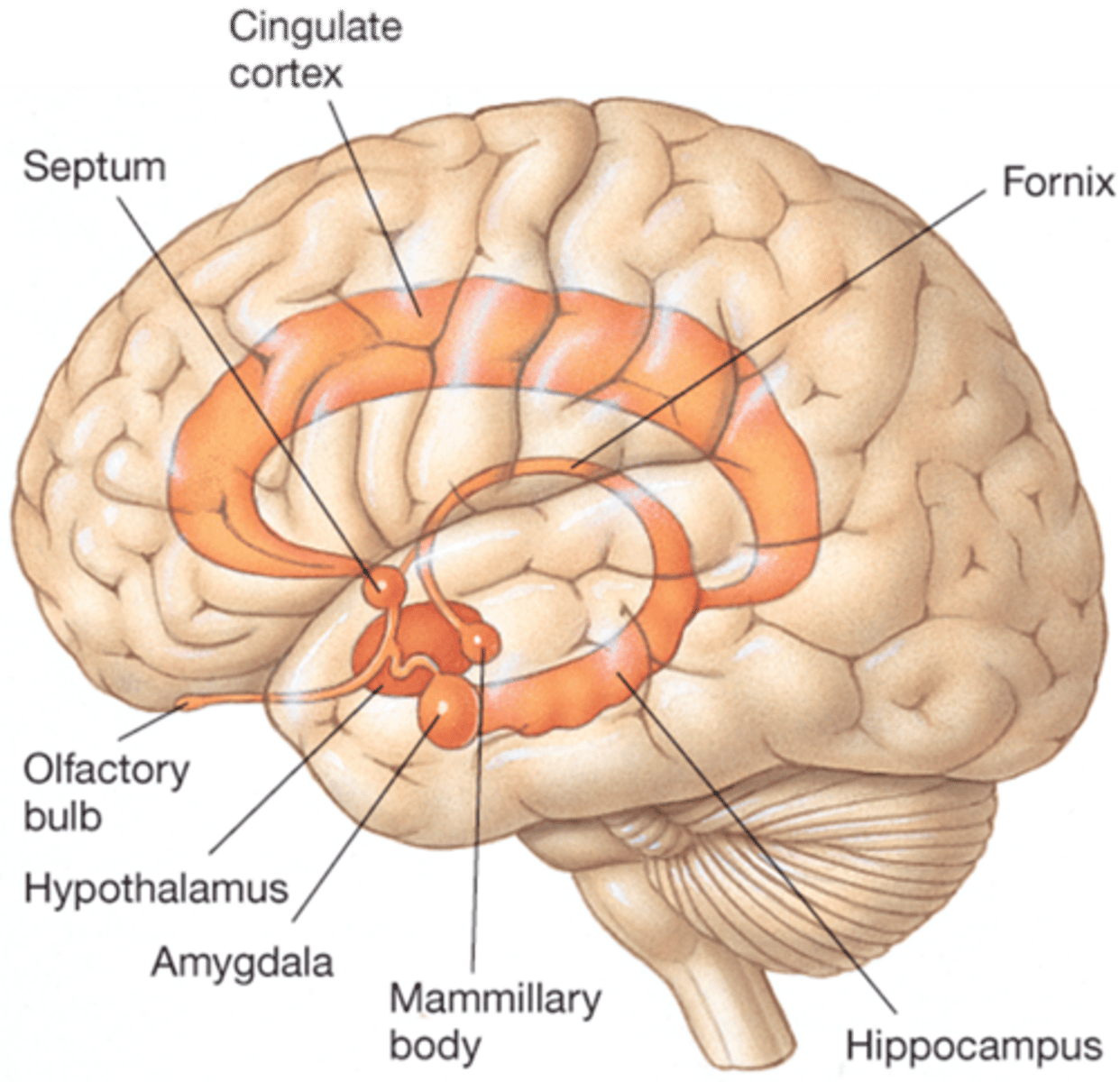
Papez believed that these structures largely controlled emotional expression.
The amygdala was particularly central, but the limbic system overall was thought to the be core of emotional expression.
=> memory structures
=> sensory structures
LeDoux
psychiatrust
- fear is the interaction of the low-road (amygdala mediated fear response) and the high road (cortically mediated fear response)
Treatmetnt for Fear/PTSD
Target: hyperarousal, intrusive memories, avoidance behaviors.
•SSRI medication; antipsychotics x (reduce paranoia)
=> not a complete solution, requires help of other treatements
•Cognitive Processing Therapy (CPT)
=> longer than CBT (up to 20-30 sessions)
=> good for PTSD
=> most effective
•rTMS and neuromodulation
=> magnetic brain stimulation
=> moderate efficacy
- all 3 effective, but CPT most effective

