Legal Unit 3 AOS 1 (2/2)
 Call Kai
 Learn
Learn Practice Test
 Spaced Repetition
 Match
Match Flashcards
 Knowt Play
1/115

There's no tags or description
Looks like no tags are added yet.
Name | Mastery | Learn | Test | Matching | Spaced | Call with Kai |
|---|
No analytics yet
Send a link to your students to track their progress
116 Terms
Jurisdiction
the lawful authority or power of a court, tribunal or other dispute resolution body to decide legal cases.
Original jurisdiction
the power of a court to hear a case for the first time (i.e. not on appeal from a lower court).
Appellate jurisdiction
the power of a court to hear a case on appeal.
Victorian Court Hierarchy
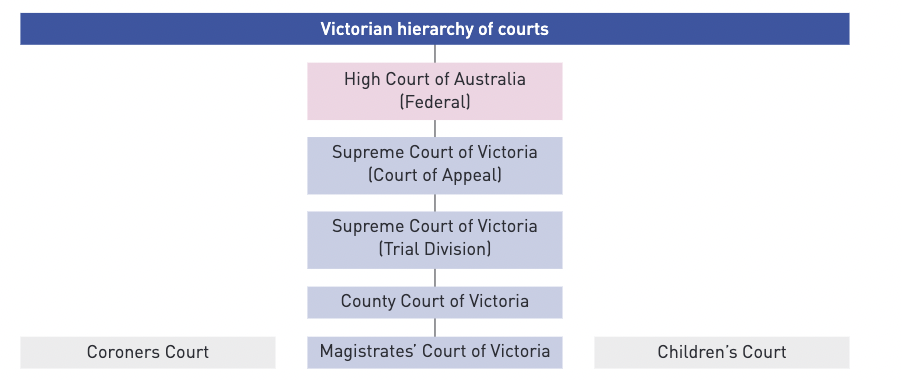
Jurisdiction can be broken down into 2 types:
Original jurisdiction- the power of a court to hear a case for the first time
Appellate jurisdiction- the power of a court to hear a case in which a decision is being reviewed or challenged on a particular ground (i.e. being appealed to a higher court).
Specialisation
The ability of each court in the court hierarchy to develop areas of expertise in the specific cases they hear
The Supreme Court (Court of Appeal) specialises in:
Determining criminal appeals in indictable offences, and has expertise in sentencing principles
The Supreme Court (Trial Division) specialises in:
Most serious indictable offences eg. murder and manslaughter and has developed its own specialisation in those types of crime and the elements of each crime, as well as developed expertise in trial processes such as giving evidence.
The County Court is specialised in:
Hearing particular types of indictable offences (such as cases involving drug offences, sexual offences and theft).
The Magistrates' Court is specialised in:
Cases involving summary offences that need to be dealt with quickly and efficiently (such as drink-driving and traffic offences), as well as committal proceedings.
The Magistrates' Court also has experience in dealing with self-represented accused people, because the number of people charged with a summary offence who choose to represent themselves is high.
Other specialist courts such as the Children's Court and Coroners Court specialise in:
The Children's Court> specialises in cases where young people have been charged with a crime.
Coroners Court> specialises in investigating deaths and fires involving suspicious circumstances or where the cause of death is unknown.
Appeal
An application to have a higher court review a decision.
Strengths & Weaknesses of Appeals
+ Allows appeals to be made by both parties if there is an error in the original decision.
- The court must determine that there are sufficient grounds for appeal and if parties struggle to provide adequate evidence to meet the grounds of appeal they will be unable to review an error that was made in the original decision.
- The accused has a limited ability to appeal, especially if they are financially disadvantaged as it is highly costly to lodge an appeal
Appellant
A person who applies to have the decision of a lower court reviewed or reversed by a higher court.
Respondent
Tne party against whom an appeal is made.
Appeals
If there are grounds for appeal, a party who is dissatisfied with a decision in a criminal case can take the matter to a higher court to challenge the decision.
A party who appeals is known as the appellant, and the other party is the respondent.
The system of appeals provides fairness and allows for any mistakes made in the original decision to be corrected.
If there were no higher courts, there could be no system of appeals, which would create unfairness if a court incorrectly determined a case.
Grounds for appeal in a criminal case can include:
Appealing on a question of law (where some law has not been followed; eg. if the court was allowed to hear inadmissible evidence or the court misinterpreted a statute)
Appealing a conviction (which can only be appealed by the offender)
Appealing because of the severity (or leniency) of a sanction imposed. The prosecution will appeal on leniency, and the offender will appeal because of severity. An offender will usually appeal the sanction on the basis that it was 'manifestly excessive'.
Prosecutors are not able to appeal an acquittal (i.e. where an accused person has been found not guilty).
Generally, the appellant will need the leave (consent) of the court that will hear the appeal.
This includes where an offender is appealing a conviction or sentence to the Court of Appeal, or appealing a decision of the Court of Appeal to the High Court.
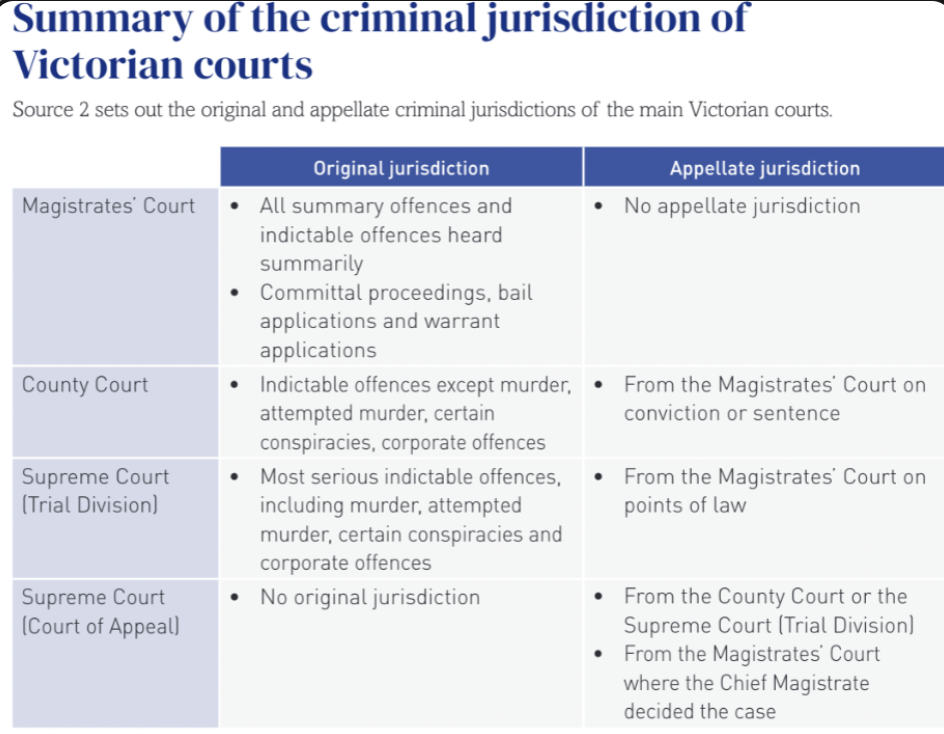
Summary of the criminal jurisdiction of Victoria courts -
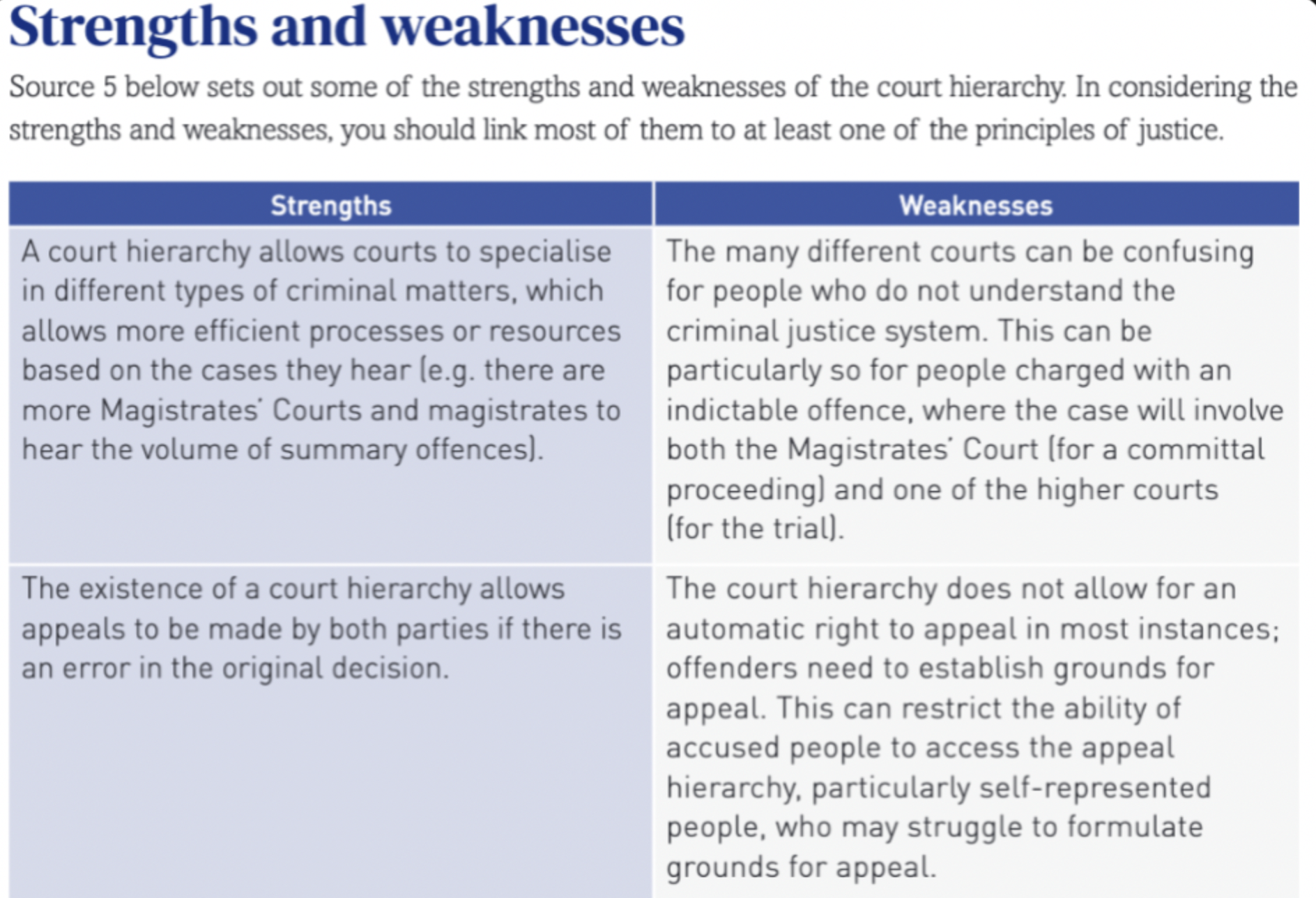
Strengths & Weaknesses of the court hierarchy
The roles of key personnel in a criminal case: The judge & Magistrate (P(dO)SI)
Ensure court Procedures are carried out correctly
Decide or oversee the Outcome of the case
Sentence an offender
Act Impartially
Act impartially, not favour any side, and have no connection with the prosecution or accused.
Ensure court Procedures are carried out correctly- MMA
Make sure the correct court procedure is followed for equality
This requires a judge/magistrate to:
Manage witnesses (which would occur during questioning)
Make decisions such as the admissibility of evidence.
Adjust trial processes ensuring equality
Decide or Oversee the outcome of the case (M-dlm) (Jgsd)
Magistrate: Determine guilt, listen, make decisions based on facts
Judge: Give directions to jury, Summarise the case to the jury, Decide whether or not to accept a majority verdict
Sentence an offender
Requires them to;
Consider information provided by both parties, review the victim impact statement to ensure procedural fairness and hand down a sentence to comply with legislation such as the Sentencing Act 1991 (Vic)
act Impartially
Ensure they are unbiased and are viewed to not have an apprehended bias
This is known as apprehended bias: a situation in which a fair-minded observer reasonably believes a person hearing a case may not be impartial
The difference between a judge and a magistrate
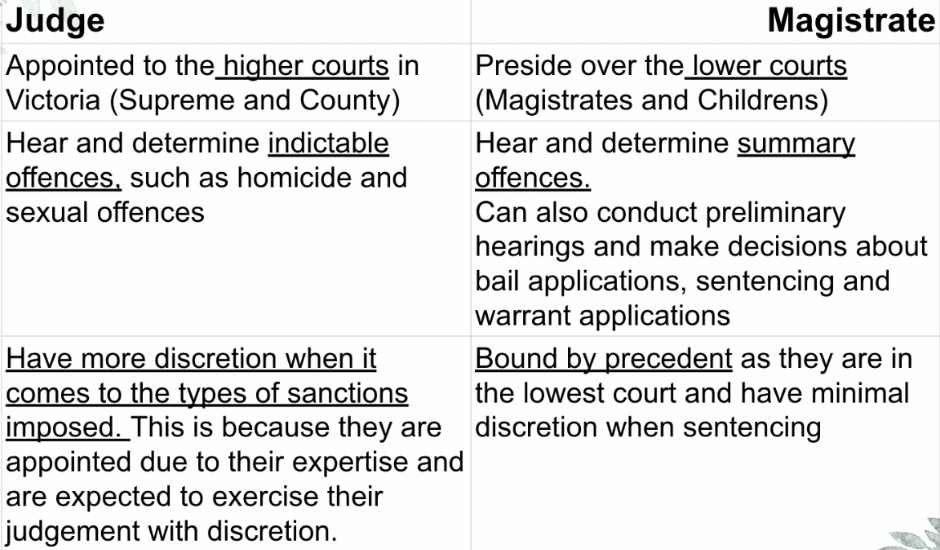
Strengths & Weaknesses of Judges & Magistrates IMA BLC
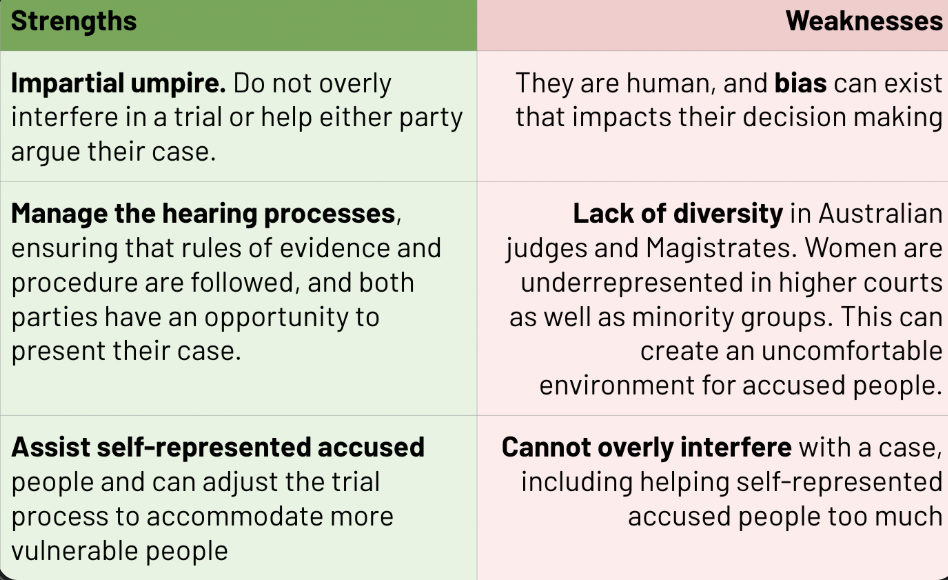
Strengths & Weaknesses of Judges & Magistrates in achieving fairness
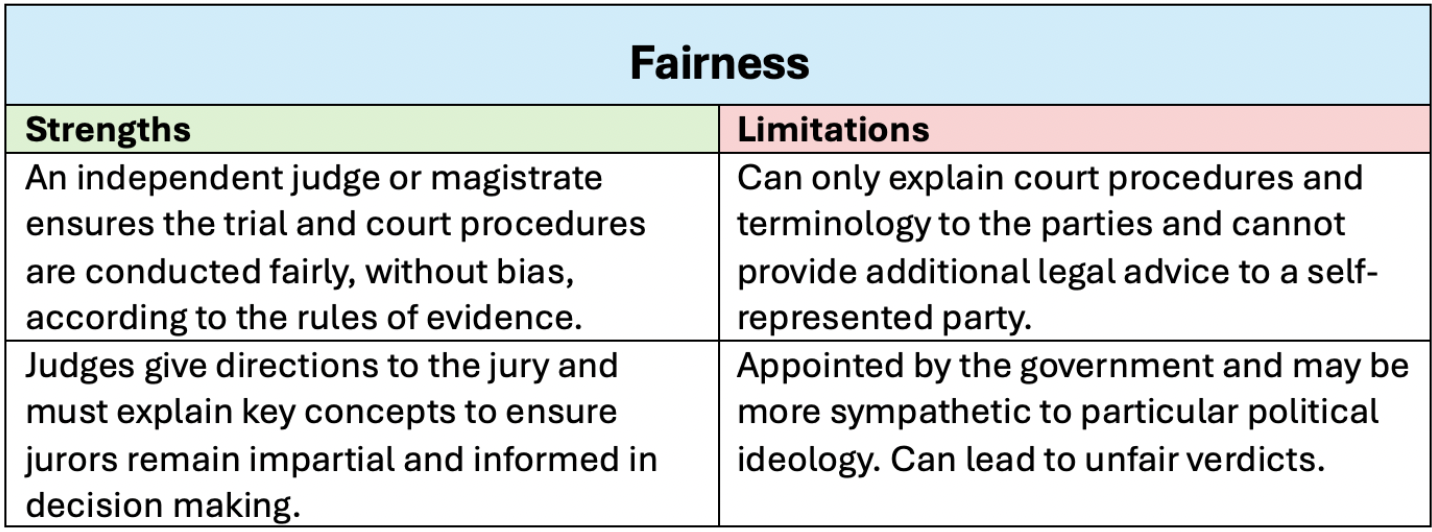
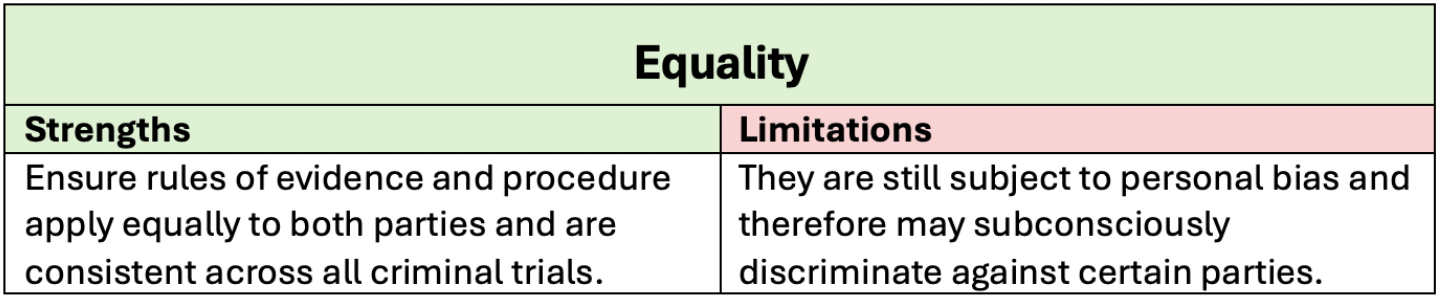
Strengths & Weaknesses of Judges & Magistrates in achieving Equality
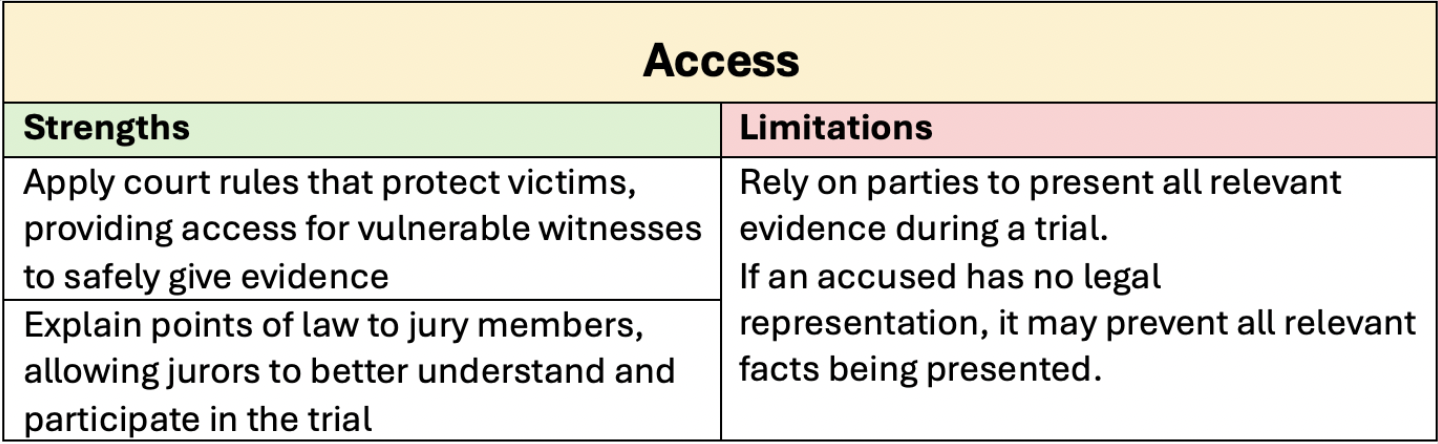
Strengths & Weaknesses of Judges & Magistrates in achieving Access
The roles of key personnel in a criminal case: The jury (BLUD)
Be objective
Listen to and remember evidence
Understand directions and summing up
Deliver a verdict
Jurors can be challenged by the prosecution or the defence - but these challenges are limited.
Be objective
Be unbiased and bring an open mind
No connection with any of the parties
Must decide on guilt based on evidence and facts of the case.
Listen to and remember the evidence
Can take notes to help them remember, but must ensure they are paying attention at all times.
Must not undertake its own research on the case or make enquiries about trial matters
Understand directions and summing up
Listen to directions given by judge
Can ask for an explanation of any points they don't understand
Deliver a verdict
Take part in deliberations and form an opinion
Deliberations are confidential
Make decisions based on the facts of the case
Aim to reach a unanimous verdict/majority
Strengths & Weaknesses of the Jury
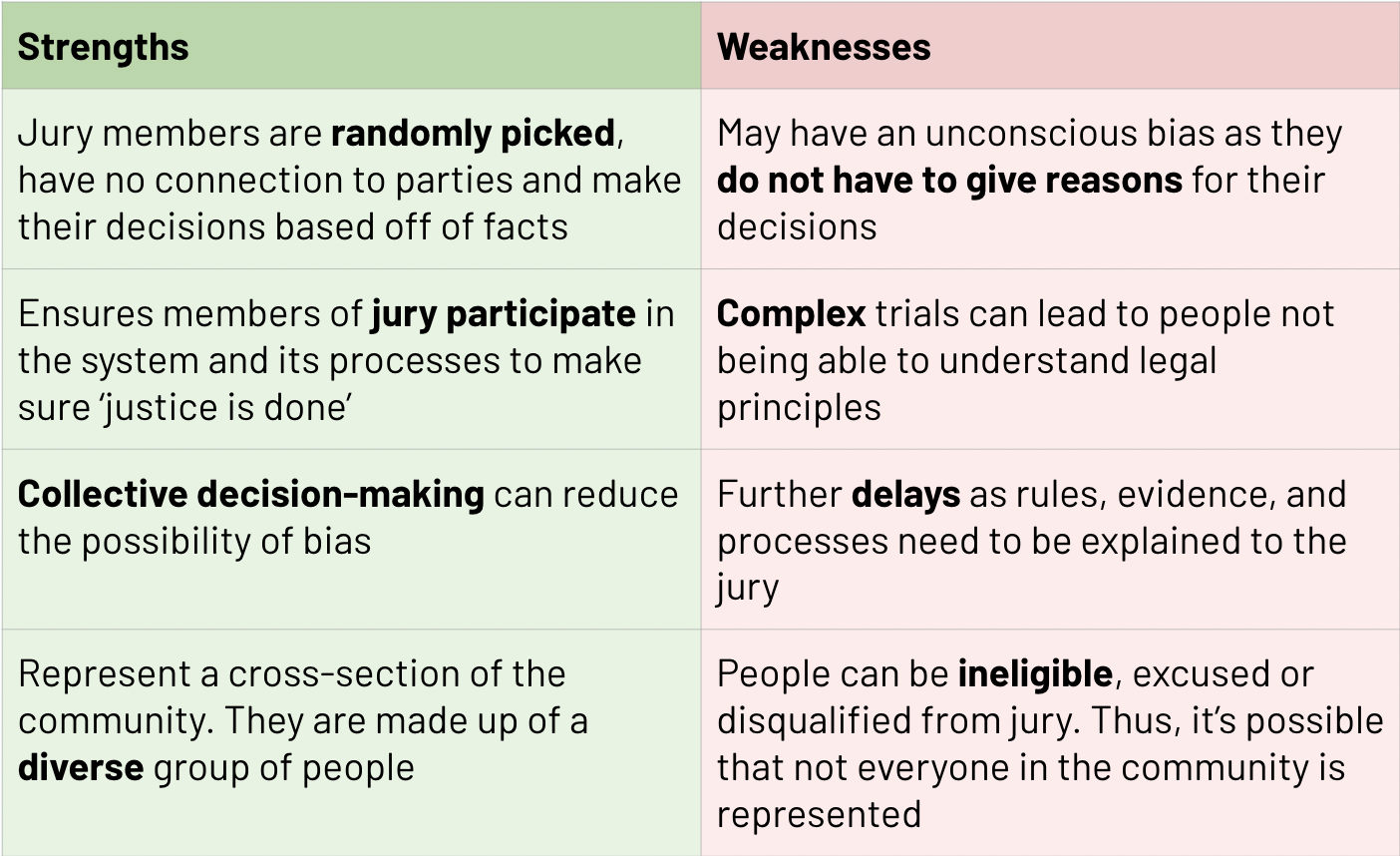
Strengths & Weaknesses of the Jury in achieving Fairness
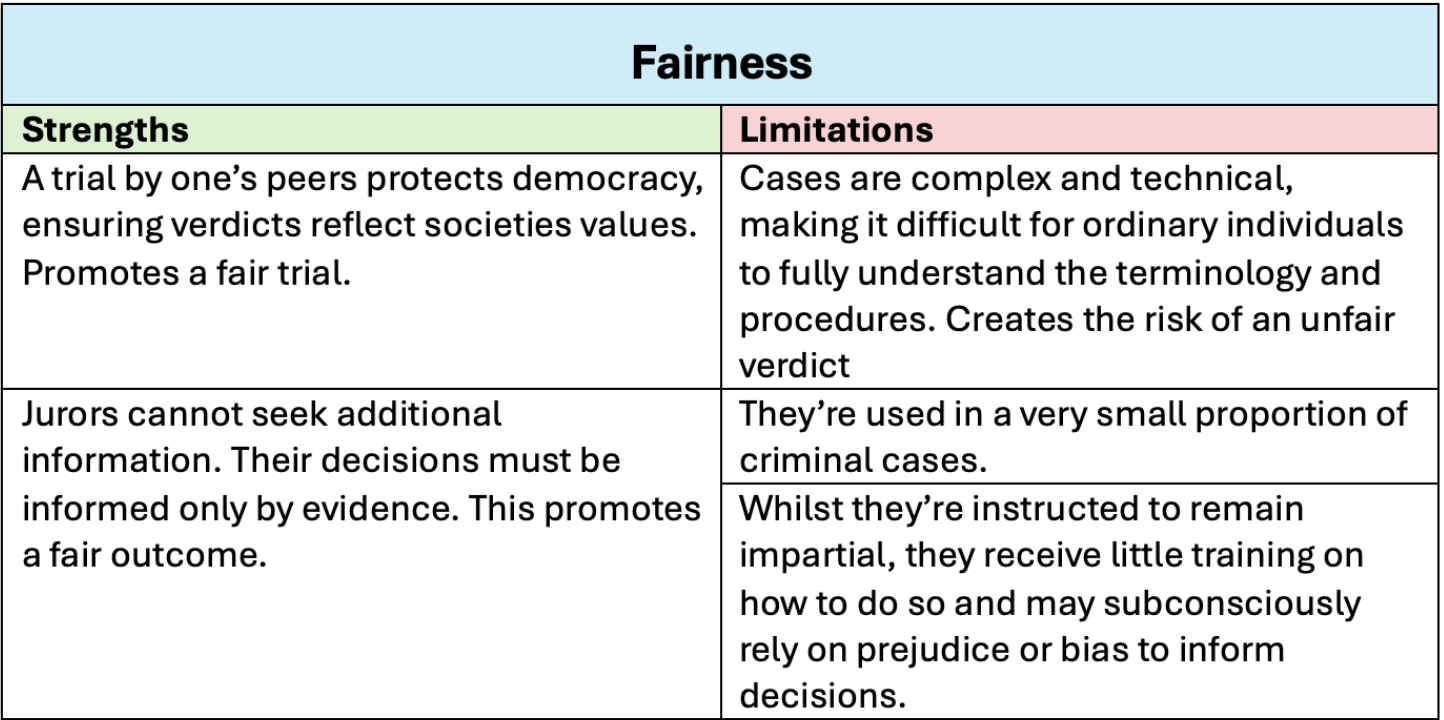
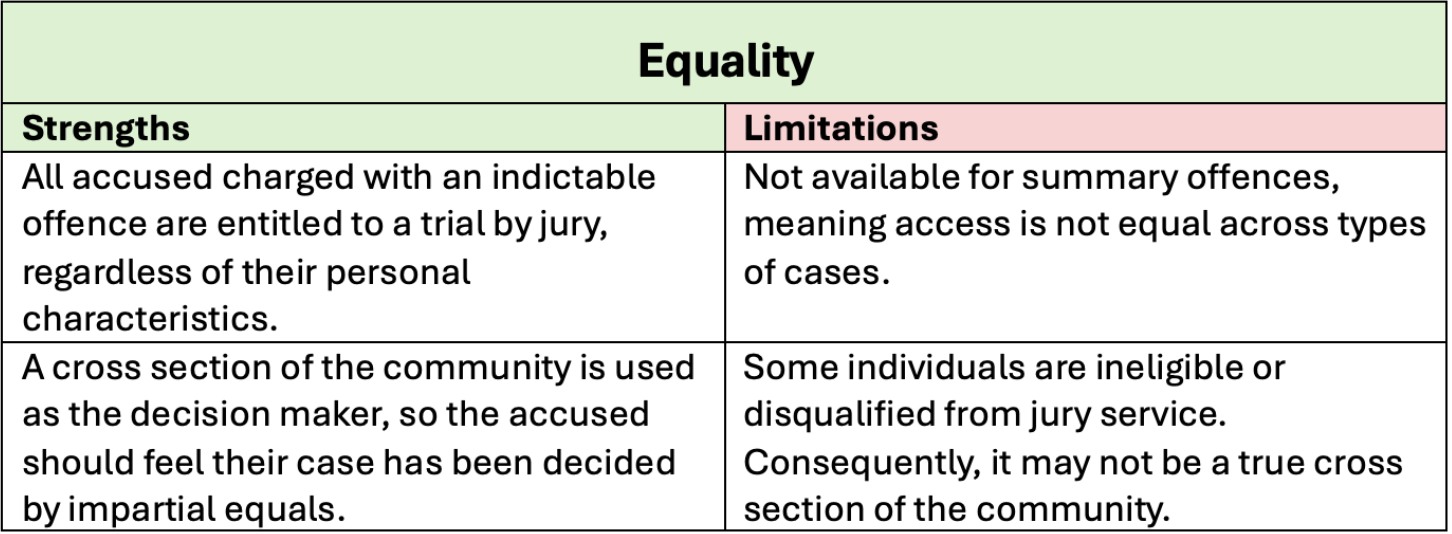
Strengths & Weaknesses of the Jury in achieving Equality
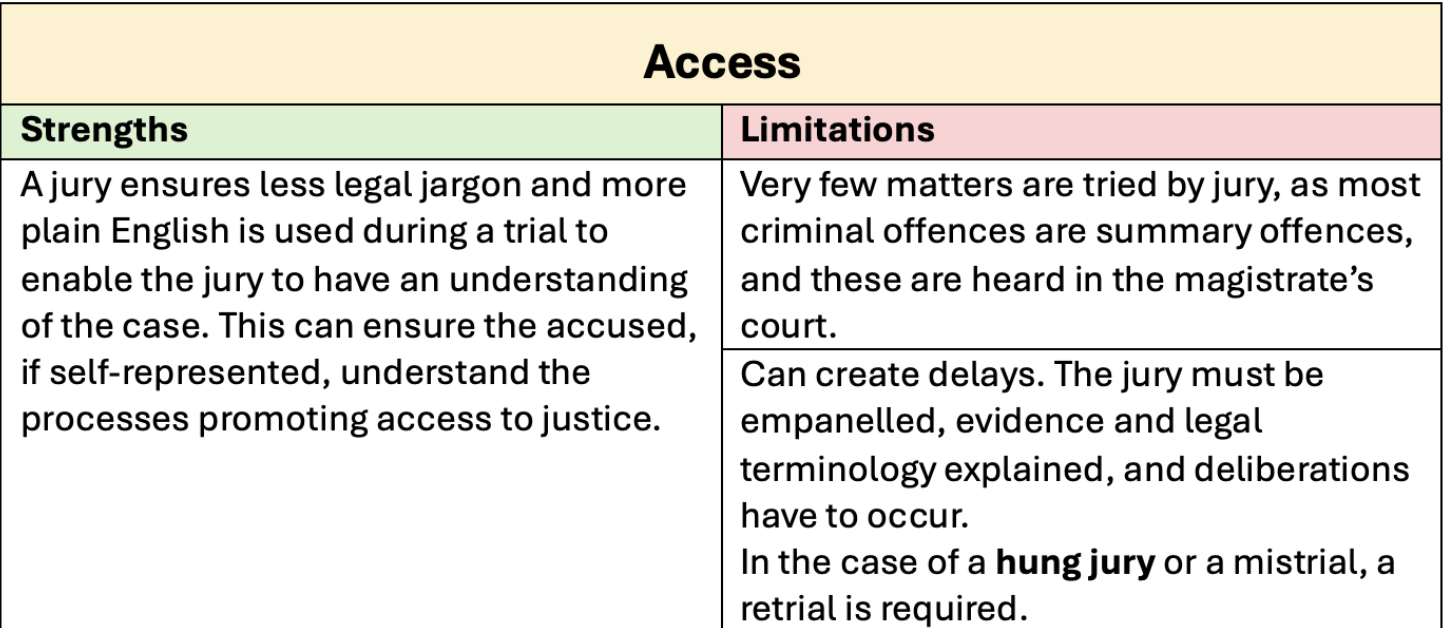
Strengths & Weaknesses of the Jury in achieving Access
Role of prosecution (DPM)
Disclose information to the accused
Participate in the trial or hearing
Make submissions about sentencing
The Accused (PM)
Participate in the trial or hearing
Make submissions about sentencing
(Prosecution) Disclose information to the accused
Disclose all relevant matters to the accused including;
The evidence used against them (names and statements of witnesses)
Any materials that may assist the accused's case.
An ongoing disclosure obligation that the DPP is required to comply with(even after the case has concluded)
Includes relevant prior convictions of prosecution witnesses.
This enables cross examination.
Participate in the trial or hearing (prosecution & accused)
Prosecution: POPICM
Presenting an opening address
Outlines the case (in summary hearings if leave is granted).
Present evidence that supports the case
Includes witnesses and experts
Cross-examining witnesses called by the accused
Making a closing address.
Accused- PSPCCM
Present their opening address
Summarise evidence (Only given in summary hearings if leave is granted).
Present evidence to support their case
Can give evidence themself
Cross examine witnesses called by the prosecution
Make a closing address.
Make submissions about sentencing (Prosecution & Accused)
Prosecution
Should not make submissions about sentencing range and can;
Inform the court about the laws that apply
as well as, anything else about the offence or offender that is relevant to sentencing.
Accused
Entitled to make submissions about sentencing
Provide information on factors that contributed to their offending in order to receive the least severe sentence possible.
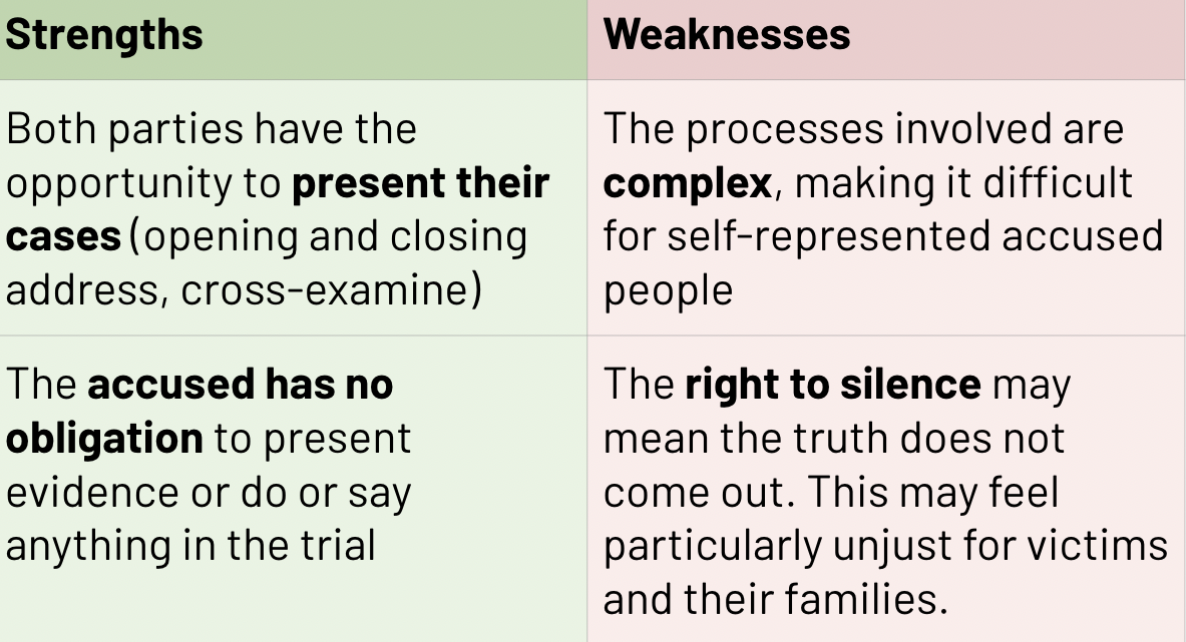
Strengths & Weaknesses of the role of the Prosecution & Accused
Lawyer
Someone admitted to the broader legal profession. This includes being a barrister, solicitor, or judge.
Solicitor
Someone with a certificate to practice law who is not a barrister or judge.
Barrister
A lawyer who has passed the 'Bar' examination in their respective state, studied the bar course, and undertaken their readership with a senior Barrister. They appear in court to advocate on behalf of clients but technically work for the solicitor.
REMEMBER THIS ACT BITCH
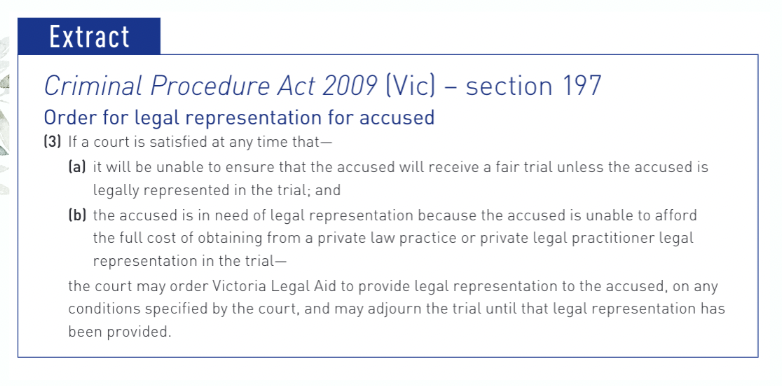
Criminal procedure act 2009
Evidence act 1995 for indictable offences
Why lawyers are needed
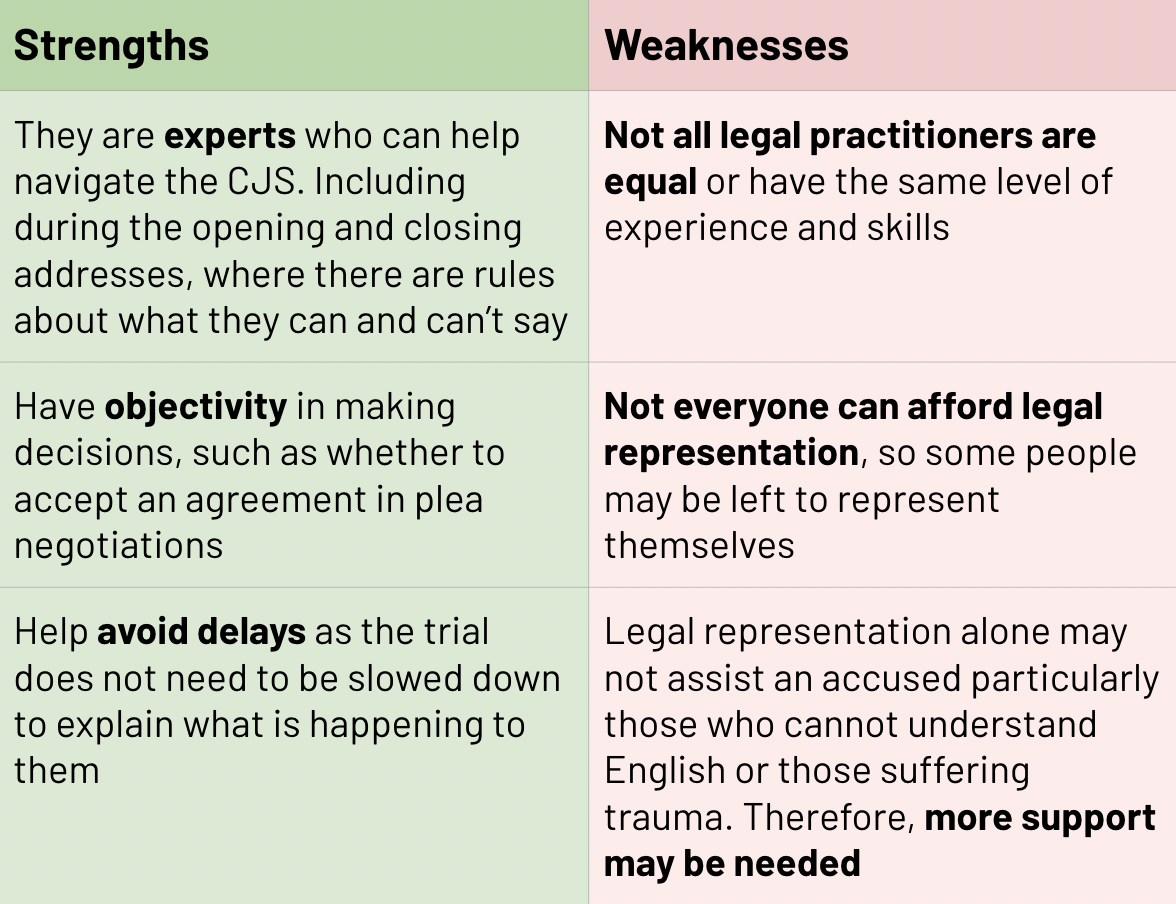
A person who is representing themselves lacks the skills and experience to navigate the criminal justice system and test the evidence, including being able to navigate procedures such as plea negotiations, trial processes and the examination of witnesses.
A self represented accused generally does not have the objectivity to make the right decisions. Might be overly invested or emotional about the outcome and might not be able to 'stand back' and assess the risks and facts of the case
For traumatic and difficult cases, it avoids a situation where the accused is directly questioning witnesses (leads to retraumatisation)
Though the court and judges can assist self-represented, they cannot advocate on behalf of the self represented person.
Strengths & Weaknesses of Lawyers
Cost of legal representation
Accused - cost of engaging a lawyer to provide advice or representation.
Victims - require legal assistance to assert their rights, contact investigative and prosecution agencies and understand procedures.
Public - costs associated with prosecuting a criminal case.
Costs of legal representation for the accused
Every accused person has a right to a fair hearing. (This right is protected Charter of Human Rights and Responsibilities Act 2006 (Vic)).
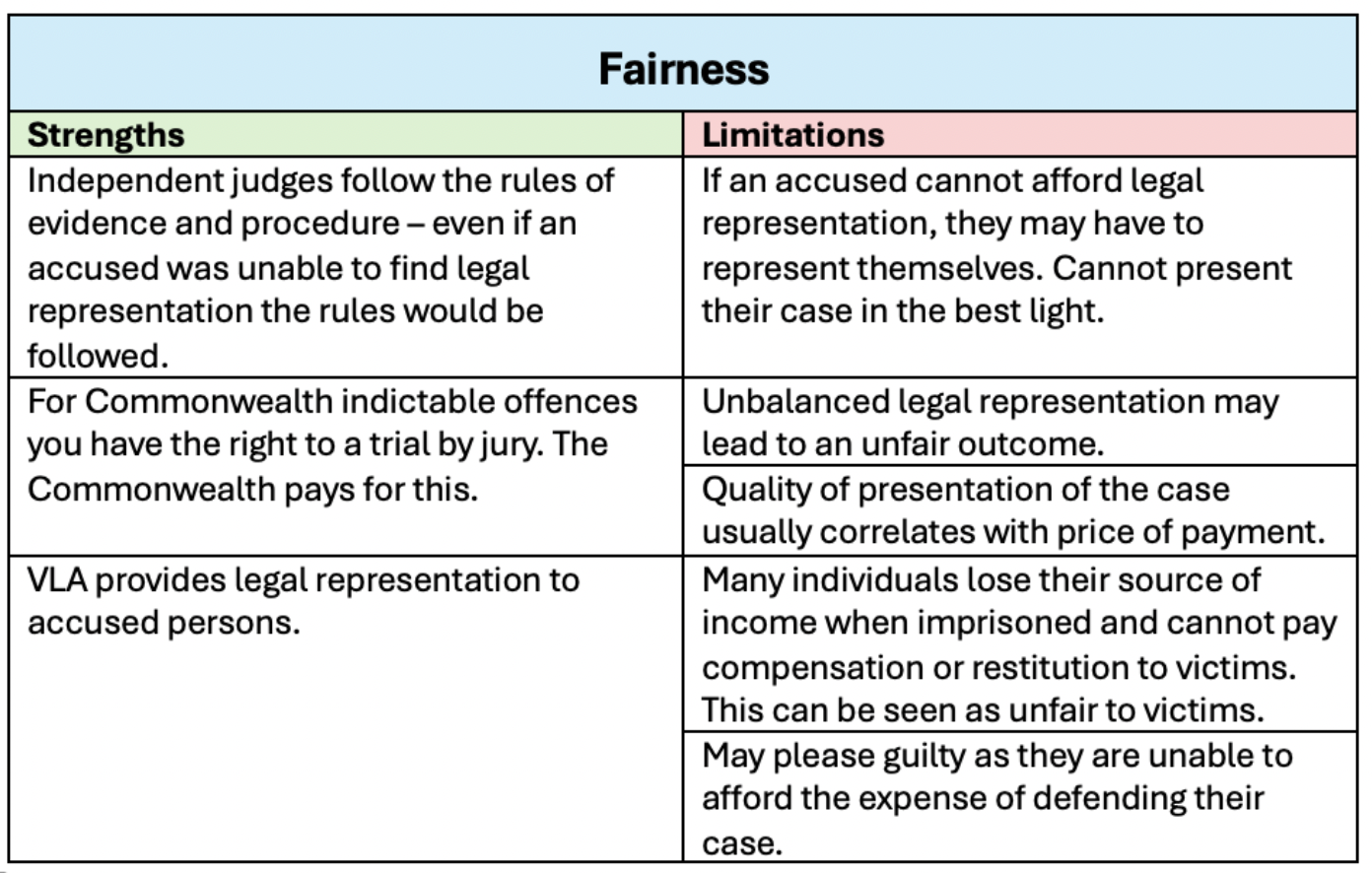
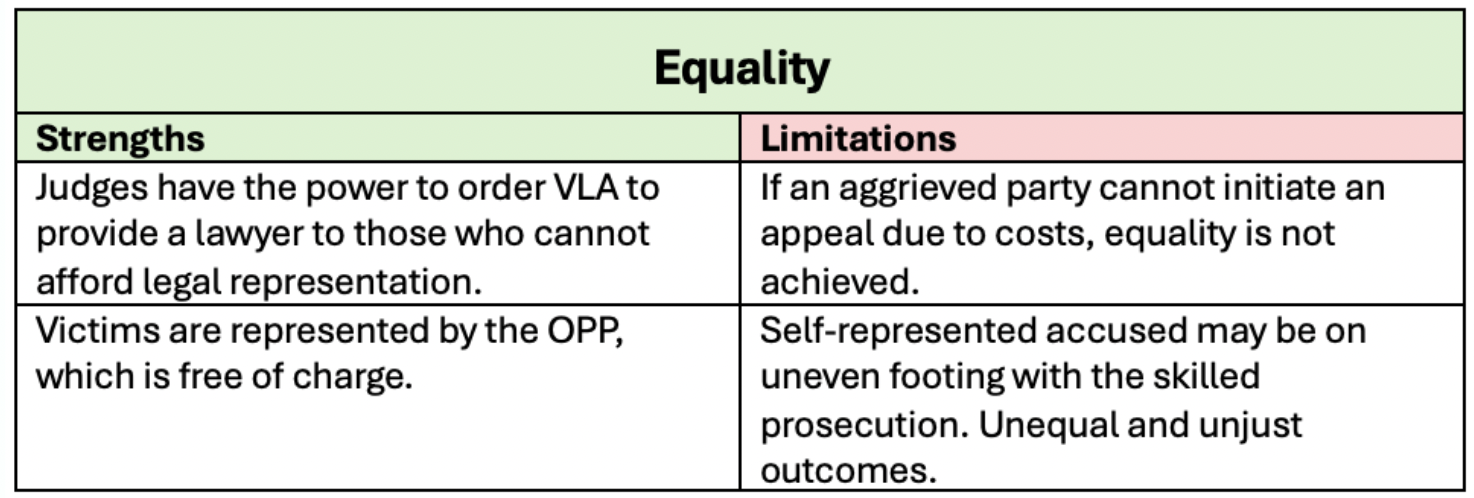
An accused who cannot afford legal representation can seek legal aid through institutions such as Victorian Legal Aid (VLA) or free legal services through Community Legal Centres (CLC).
They can also seek assistance from private legal practitioners in the form of pro-bond representation.
Measures to address costs
The provision of free legal aid through Victoria Legal Aid (VLA) and Community Legal Centres.
Due to increased demand on VLA's services and management of budgets, a large part of the community is not eligible for legal aid, meaning they're stretched in their ability to offer legal aid to those affected by crime.
Using committal proceedings to filter out weak cases so they don't go to unnecessary trials.
Committal proceedings are for indictable offences and provide an opportunity for an accused to plead guilty.
Some see this as ineffective because most cases are committed to trial.
The cost of legal representation
Sources of legal costs are:
Solicitor's fees - in the preparation for a criminal trial a solicitor prepares the defence, reviews prosecution's evidence, plans which witnesses will go to trial.
Barristers' fees - presentation of defence case at trial. Not needed if resolved before trial.
Witness' fees - if expert witnesses are called to give evidence, perhaps to challenge forensic evidence, they will often charge fees.
Appealing to a higher court - pay the filing fee in the appeal court, solicitor costs in preparing written documents about the appeal, barrister costs in presenting legal arguments to the judge.
Orders to pay a sum of money to the victims compensation for injury or lost or stolen property. Orders are only made in a small proportion of cases.
Challenges for the courts
If someone cannot afford legal representation they are more likely to represent themselves. Many self-represented are vulnerable - eg homeless, youth or have a disability.
They lack understanding of the law, procedure, evidence and language.
Trials often take longer because the judge or magistrate needs to explain things the long way and allow the parties more time to complete processes they are unfamiliar with.
Costs: Strengths and Weaknesses in achieving Fairness
Costs: Strengths and Weaknesses in achieving Equality
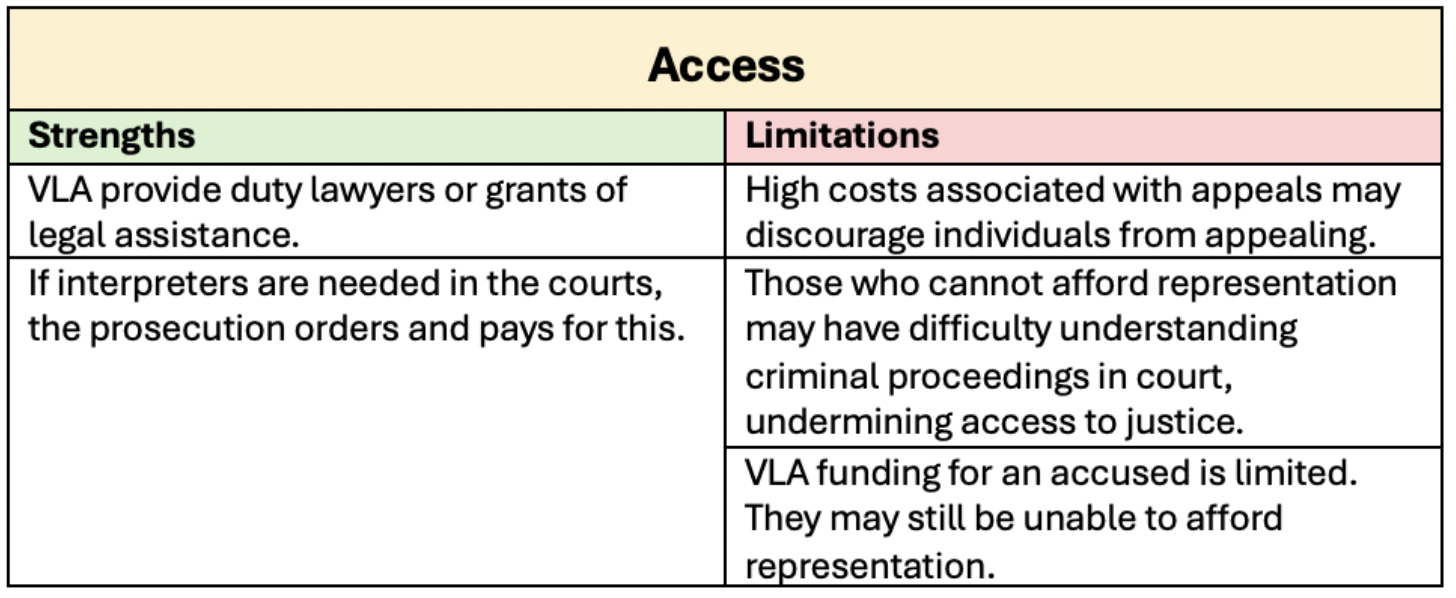
Costs: Strengths and Weaknesses in achieving Access
Time- Court delays
Tasks required that can cause delays:
Gathering evidence
Locating and interviewing witnesses
Determining what happened.
Determining what charges should be laid against an accused.
The over-reliance of hard-copy documents.
Committal proceedings.
Waiting for a hearing case in court.
Courts are having to deal with an increasing load of:
Self-represented parties
More complex matters
Society wanting a 'tough on crime' approach - means more cases through the system.
Case delays are undesirable because:
For victims (and their families), the delay before 'justice' is done compounds their suffering.
Giving evidence is stressful for witnesses, delays add to the stress
The community remains at risk if those charged with violent offences are out in the community prior to trial
Awaiting trial without an outcome resolved is stressful for an accused (and their family)
Criminal trials rely on oral evidence, but memory fades over time and the accuracy and reliability of such evidence may be diminished
Measures to address delays: Plea negotiations
Have significantly helped to address the delays faced by the courts and prosecution.
Reduce delays by achieving an early guilty plea in a case.
The case is heard more quickly and saves time (costs, stress and inconvenience)
By resolving a case before it goes to trial ensures the courts are freed up to hear and determine other cases where the prosecution is unwilling to negotiate or where it is in the best interests of the public that they are heard by a judge or jury.
Measures to address delays: Judge alone trials
During covid the Victorian Parliament passed temporary legislation for judge alone trials.
Only if the accused consented, they had legal advice and it was in the interests of justice
Measures to address delays: Digital technology
Allows for remote hearings
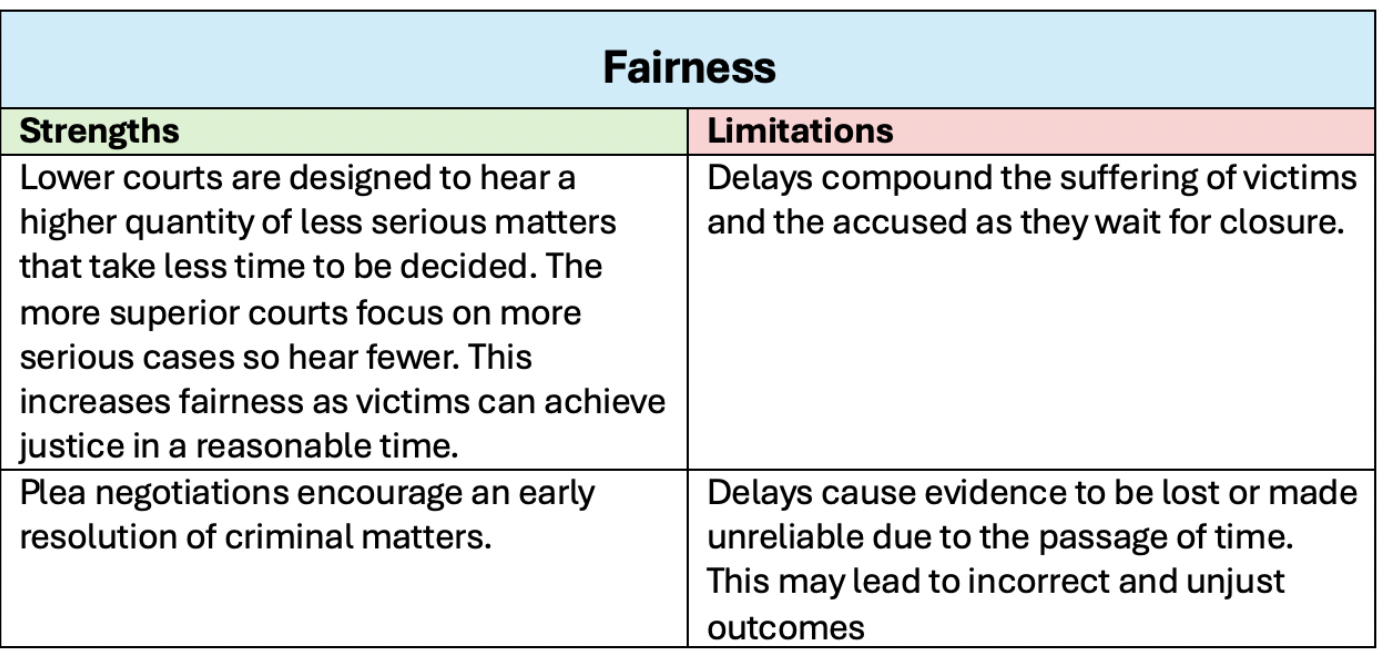
Time: Strengths and Weaknesses in achieving Fairness
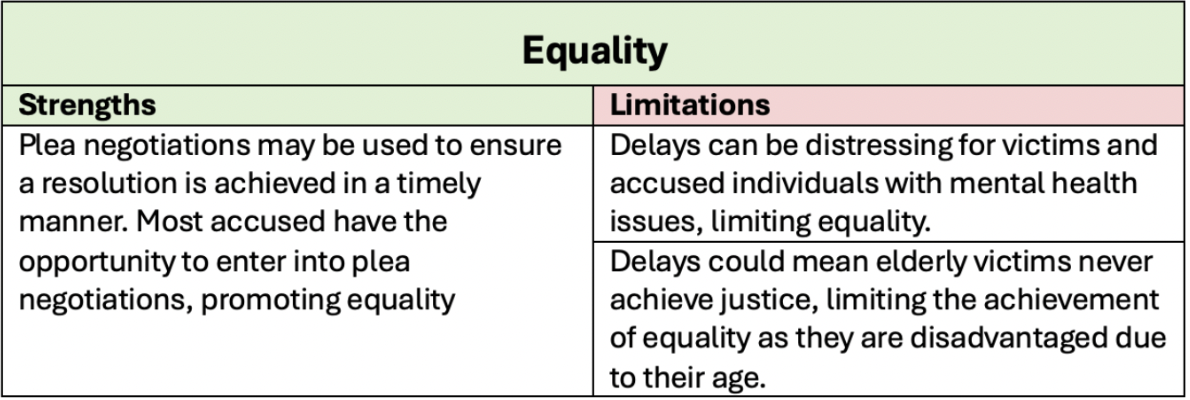
Time: Strengths and Weaknesses in achieving Equality
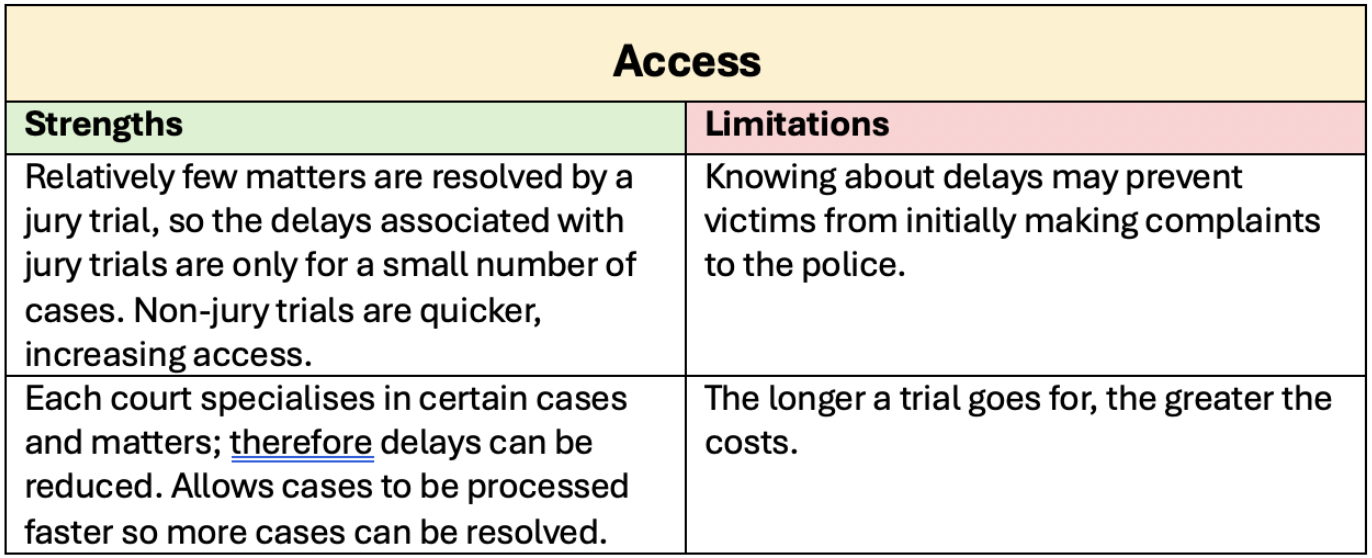
Time: Strengths and Weaknesses in achieving Access
Cultural differences: Difficulties faced includes
Language barriers- eg. Kill may mean to hit someone, probably causing injury but not necessarily ending their life
Direct questioning;
Directness is impolite
Rather, long discussions and stories is polite.
Body language
Direct eye contact is inappropriate. It makes them appear uninterested or unreliable
Cultural taboos- EG. the names of deceased people is taboo.
Forbidden to mention gender based knowledge in front of the other gender.
Lack of understanding of courts procedures
Language Barriers
Not having English as their first language can make it difficult to understand their legal rights, the different types of agencies that exist and the legal processes that happen in the courtroom. It also impacts the documents, processes and language used in criminal cases.
Under the Human Rights Charter, one of the rights guaranteed to a person charged with a criminal offence is the right to an interpreter (at no cost) if they cannot understand or speak English.
Measures to address cultural differences
Koori Court
Needs to be a First Nations person
Plead guilty
Live/charged within the relevant area of the Koori Court
The provision of free interpreters
Magistrates court will arrange for and pay for an interpreter
For an indictable offence, the prosecution will arrange and pay for an interpreter.
Access can vary greatly from court to court
Information
From the courts
VLA and CLCS
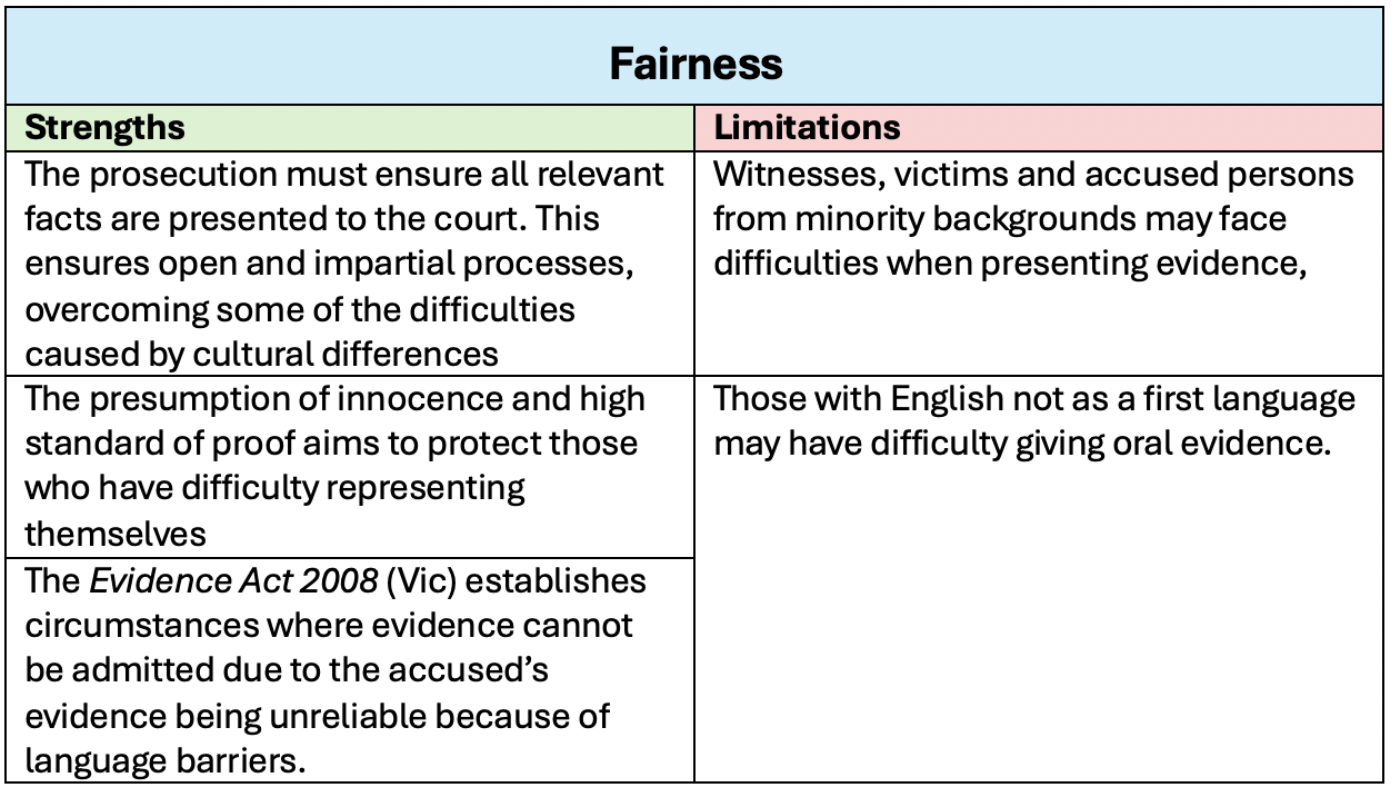
Cultural: Strengths and Weaknesses in achieving Fairness
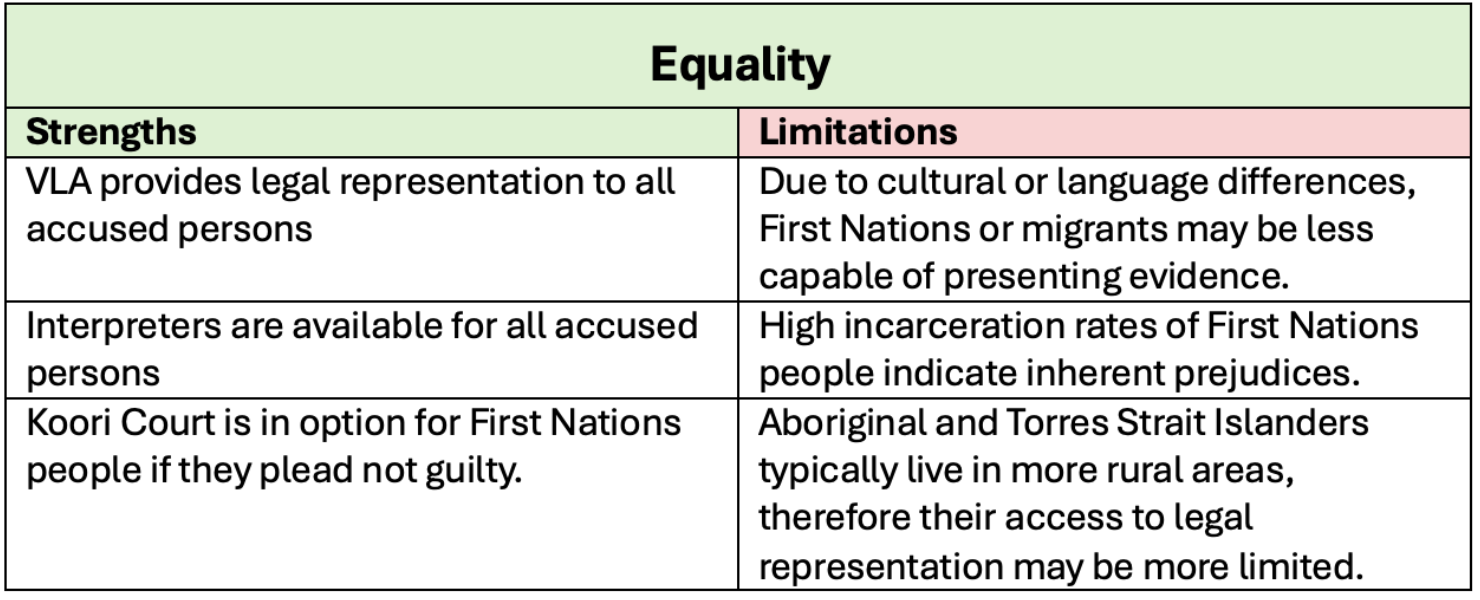
Cultural: Strengths and Weaknesses in achieving Equality
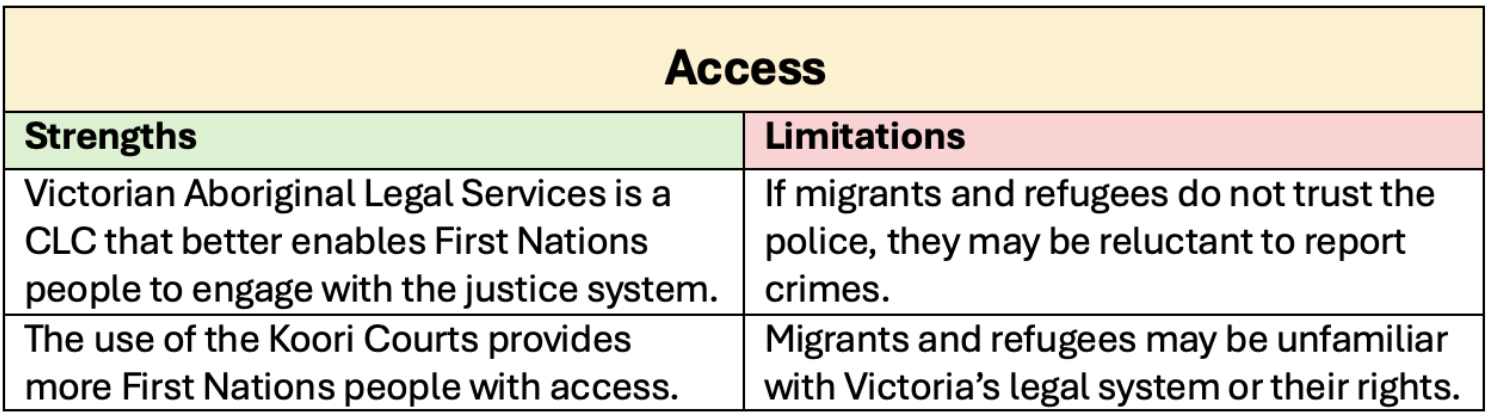
Cultural: Strengths and Weaknesses in achieving Access
Outline of Sanctions
If a person is guilty of a crime, the judge or magistrate will decide on the appropriate sanction (penalty) resulting from their conviction (finding of guilt).
The Sentencing Act 1991 (Vic) sets out the powers of the courts to impose sanctions and established various types of sanctions.
3 Purposes of the Sentencing Act are to; (ppp)
Promote consistency in sentencing,
Provide fair procedures for imposing sanctions,
Prevent crime and promote respect for the law.
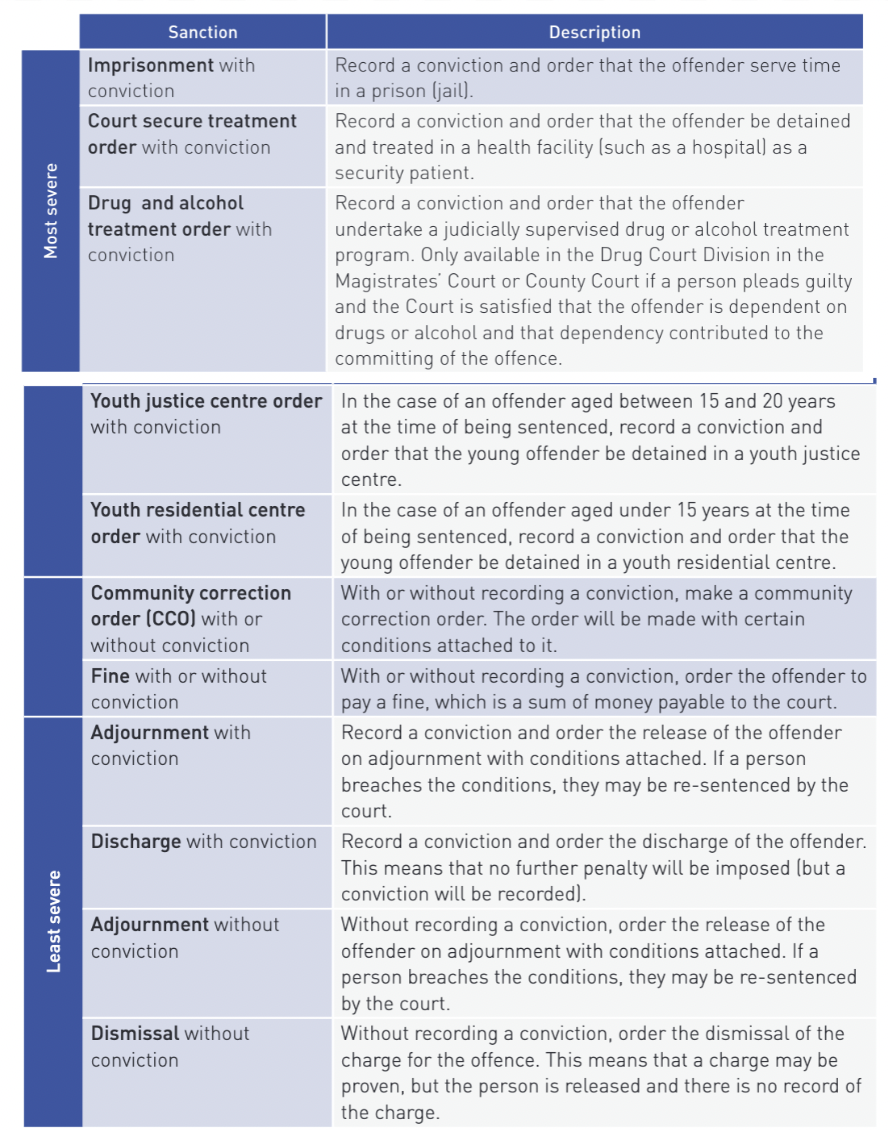
The nature of sanctions have changed over time, from harsh, inhumane penalties to addressing the underlying cause of the offending and seek to reduce the risk of recidivism.
Levels of severity of sanctions
The purposes of sanctions (RPPDD)
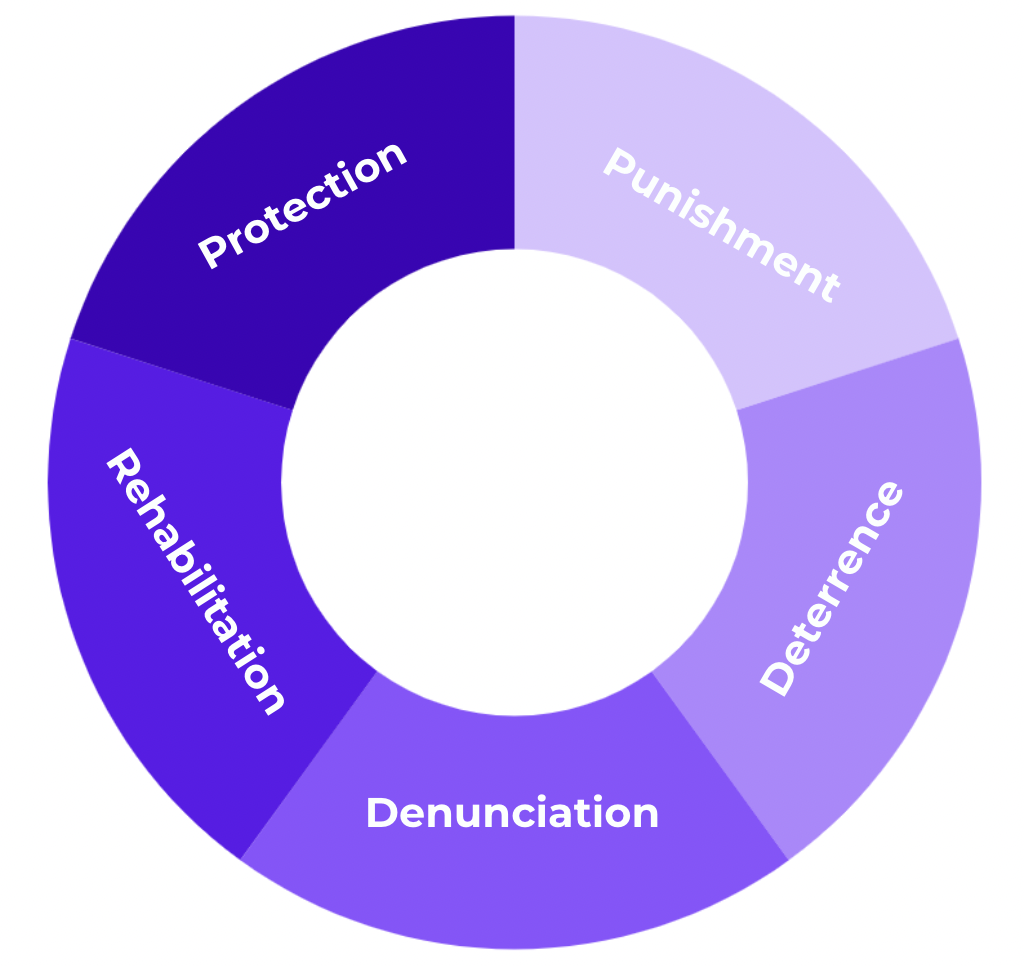
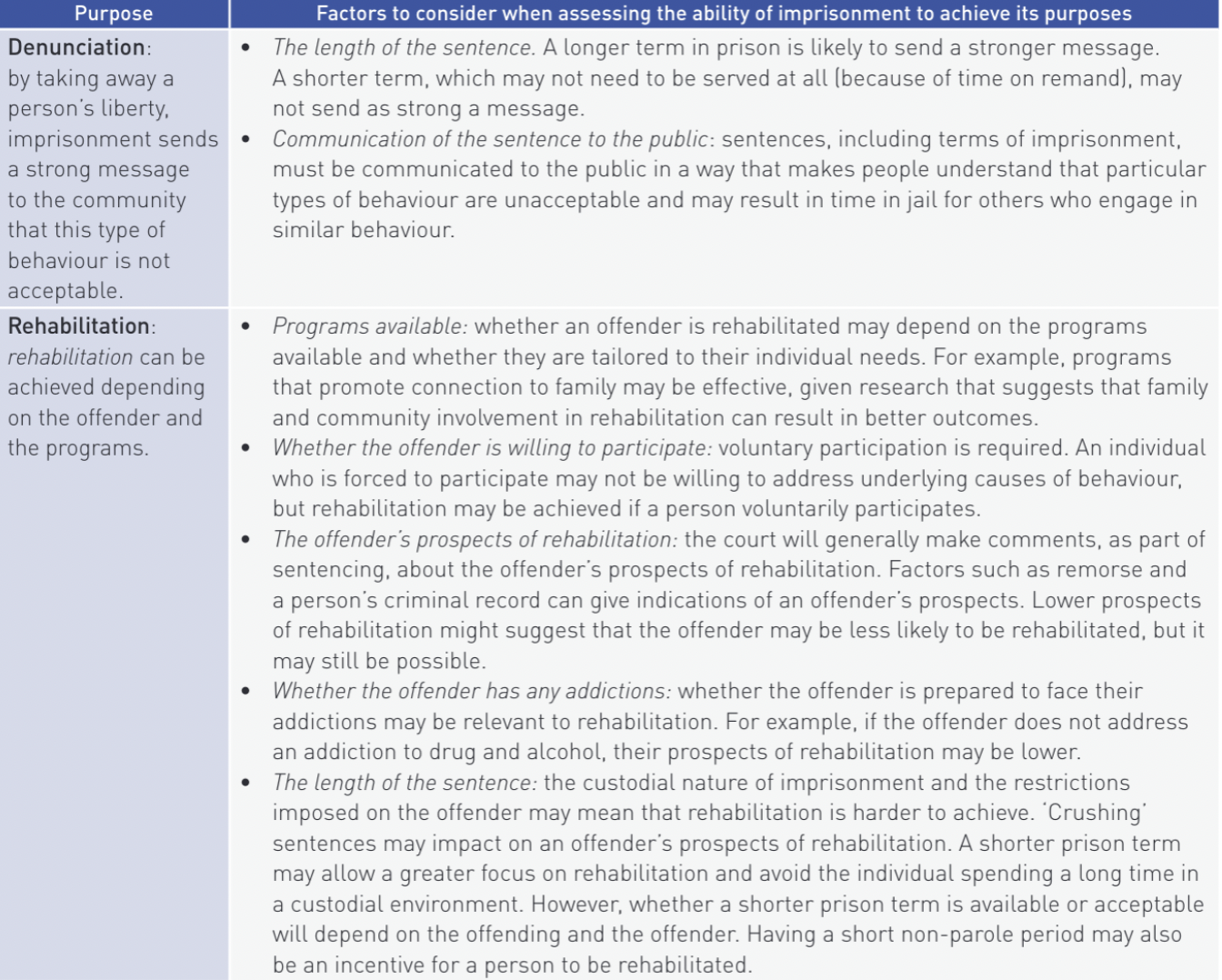
Rehabilitation
Designed to address the underlying causes of offending, and treat the offender based on those causes.
The aim of the sanction will be to help an offender to change their attitude and behaviour and prevent reoffending (this helps them and the community).
To be eligible, they must demonstrate remorse.
eg. a person may have a drug and/or alcohol addiction which led to them committing the crime. Rehabilitation will focus on treating that addiction.
Usually through conditions attached to Community Corrections Orders.
Rehabilitation programs are also carried out within prisons for offenders when released from prison.
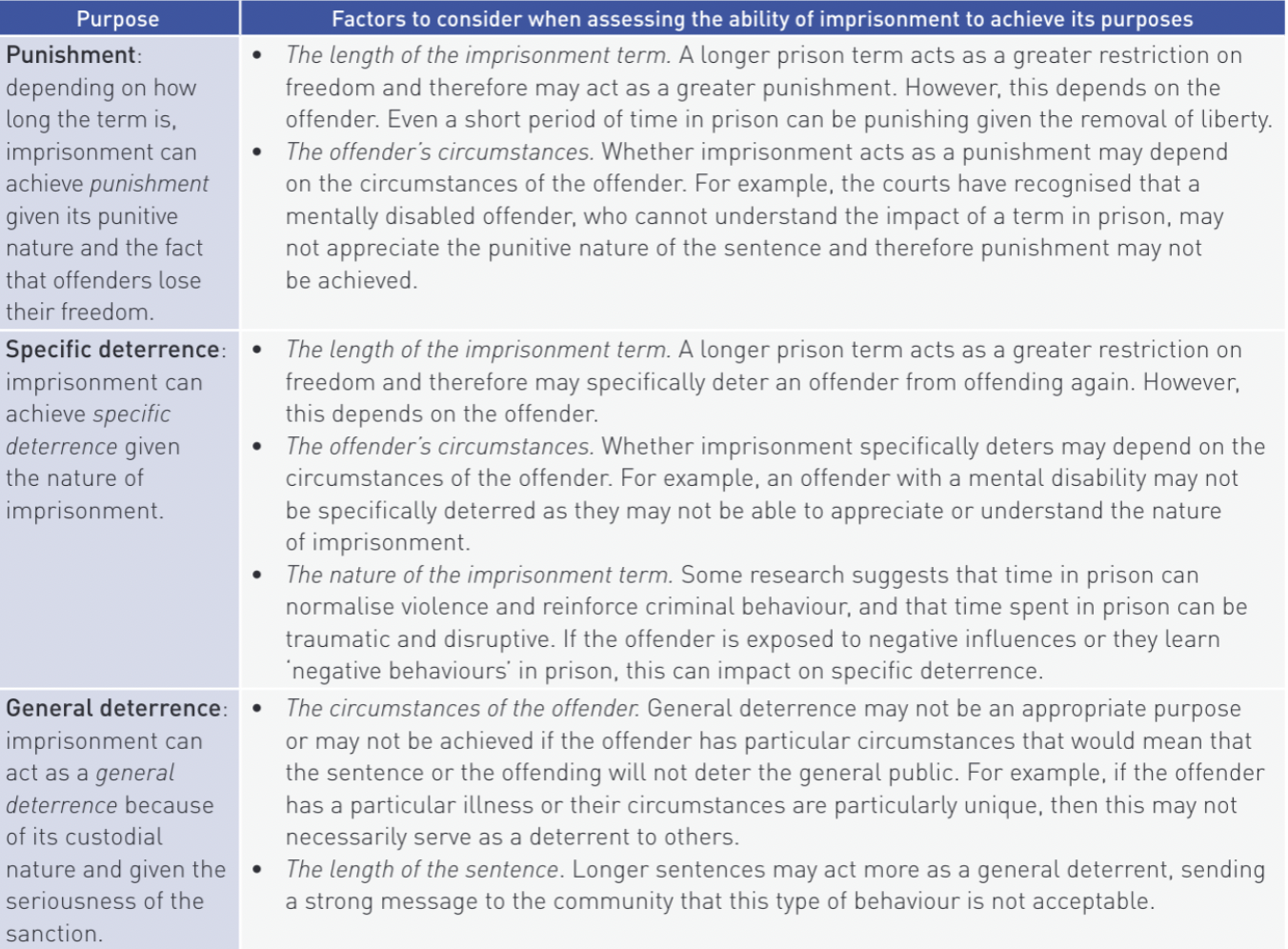
Punishment
Ensures the offender is penalised so the victim of the crime and the community feel justice has been done, as the offender has done something unacceptable to society.
The process of punishment through the courts avoids the need for the victim(s) of a crime to take the matter into their own hands however, punishment must be proportionate to the offence committed.(the purpose of punishment is combined with another purpose such as deterrence or denunciation).
Punishment is a purpose usually for serious or violent cases involving; death, serious injury, dangerous driving, or sex offences.
Punishment is commonly seen as depriving someone of their freedom and imprisoning them, but other sanctions can also be used to punish offenders. eg. fines can punish individuals or companies that have broken the law, such as in cases related to workplace safety.
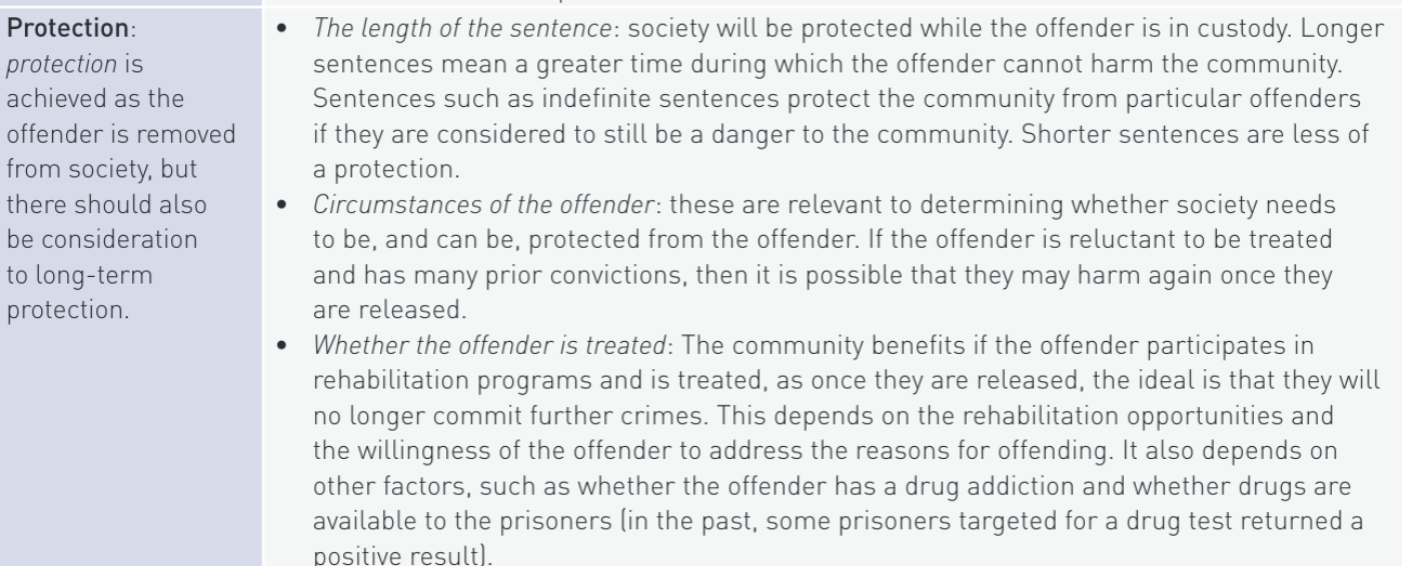
Protection
Ensures that the community is safe from any further harm that can be caused by the offender.
Sometimes it is necessary to remove an offender from the community to achieve this aim.
Protection may be particularly relevant where an offender refuses to participate in rehabilitation programs, shows no remorse, or where there is significant criminal history.
In some cases, the court can impose an indefinite sentence (a term of imprisonment with no set end date in most cases where an offender has committed serious violent or sexual offences) and only the court can decide whether to release a person on an indefinite sentence.
In other cases, parliament has intervened and has created specific legislation for specific offenders, preventing them from easily getting released from prison.
Deterrence
Aimed at discouraging people from committing similar crimes.
2 types of deterrence: General & Specific.
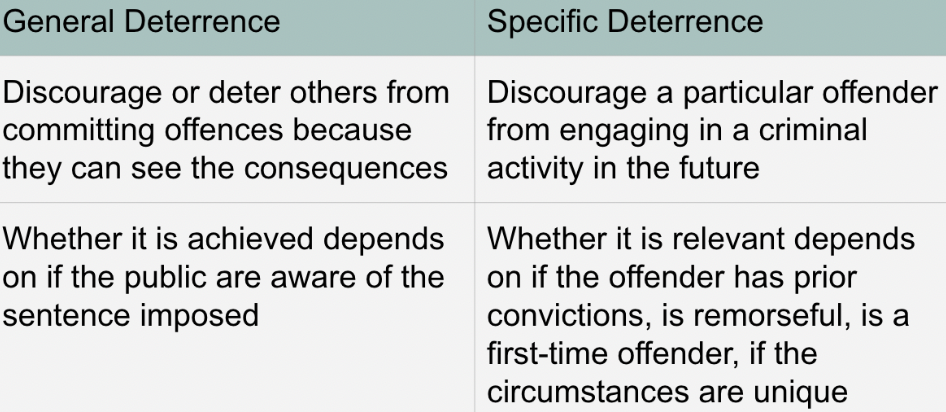
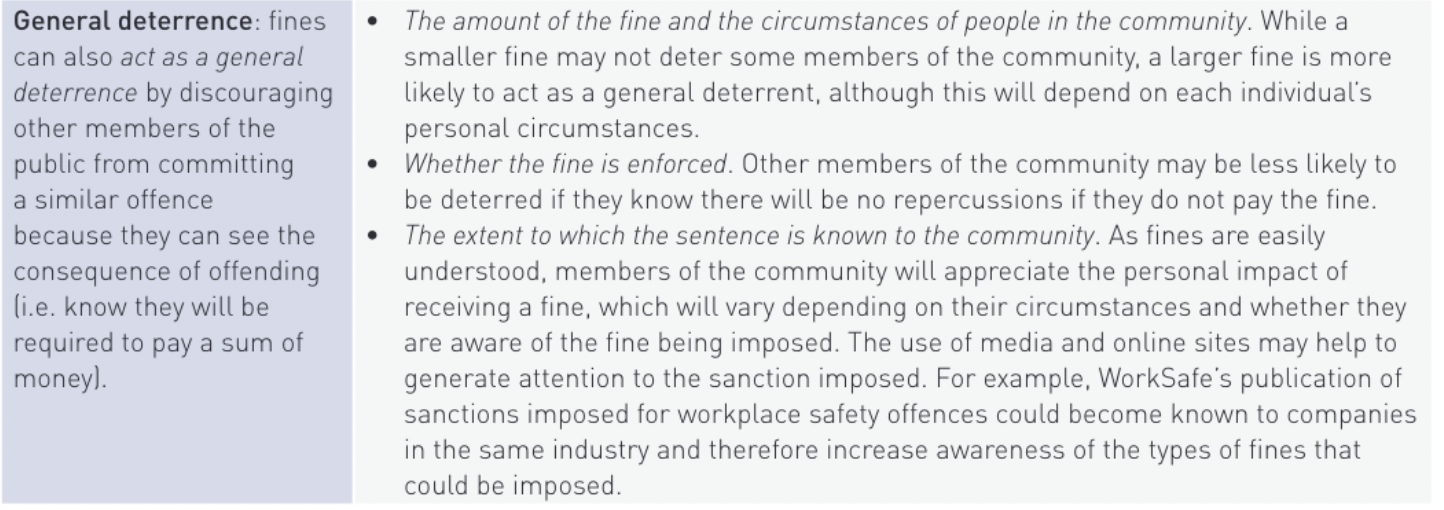
General VS Specific Deterrence table
Denunciation
Refers to the disapproval of the court and is a sanction that may be given to show the community that the court and society disapproves of and condemns the offender's conduct.
eg. the judge may give a harsh sentence for a particularly violent rape and comment that the court is showing disapproval of this type of behaviour.
Over recent years, public denunciation of offences has been seen in offending related to family violence, significant violent acts, and offences motivated by hatred or prejudice.
On the other hand, there may be a situation where the rehabilitation of an offender is given more weight, or is more important, than the need to show the community's disapproval of an action.
Fine
A sanction ordered by the court that requires the offender to pay an amount of money to the state of Victoria.
A fine can be imposed as the only sanction, or it can be imposed with any other sanction and it can also be imposed with or without a conviction.
The amount of the fine will often depend on the maximum penalty that may be imposed for a certain offence, which is normally stated in the statute setting out that offence.
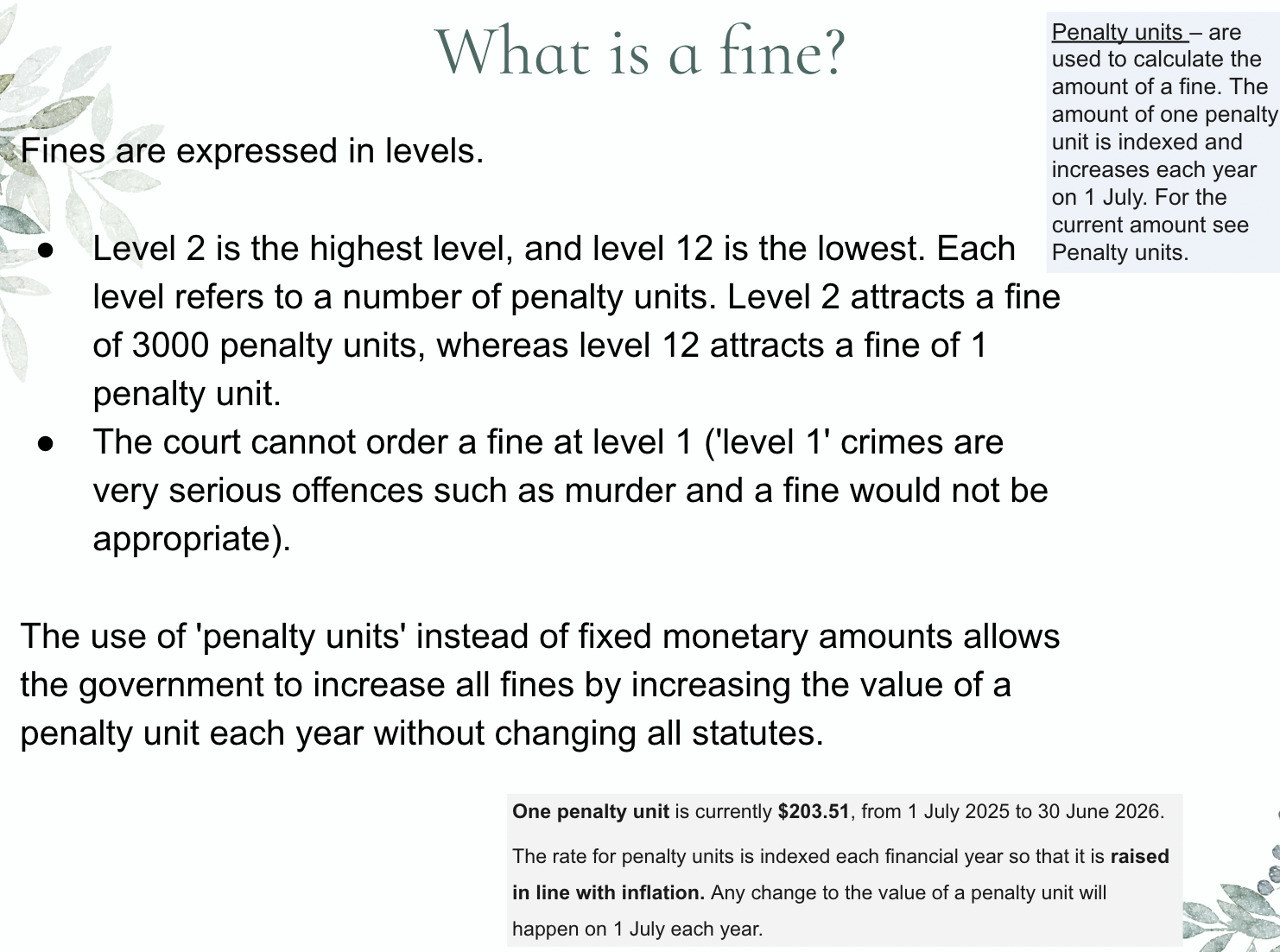
How do they determine the amount of a fine
Under the Sentencing Act, when determining the amount of a fine, the court must consider:
The financial circumstances of the offender (helps determine amount)
Whether any other orders have been made in relation to taking an offender's property - an order requiring the restoration of property or paying compensation takes preference over a fine
Any damage or loss to property because of the offender
The value of any benefit to the offender as a result of the offence
Note: If the offender is a company, a fine can be imposed that is no greater than 5x the amount of the max fine that could be imposed on a individual.
What happens if a fine cannot be paid or is not paid
A court can vary or charge the fine if the circumstances of the offender substantially change. eg. a fine can be converted into a requirement to perform unpaid community work if;
the circumstances of the offender have changed such that they are no longer able to pay the fine
the fine is not greater than 100 penalty points.
If an offender refuses to make payment:
steps may be taken to enforce payment (e.g. warning notices may be sent
)the offender may be ordered to do community work (to a max of 500 hours)
a warrant may be obtained to seize property to satisfy payment of the fine
the offender may be imprisoned (1 day for each penalty unit that is unpaid, to a maximum of 24 months), but only if this is the only appropriate order that can be made
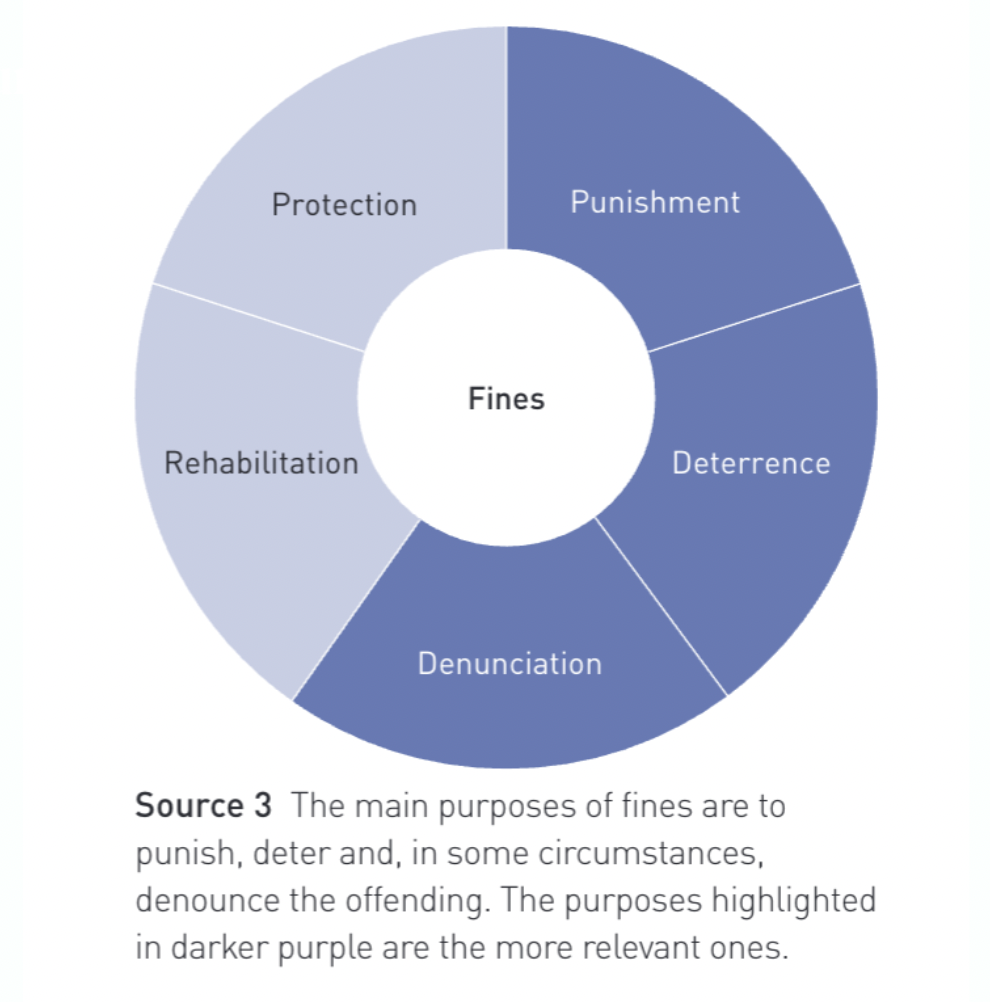
Main purposes of fines
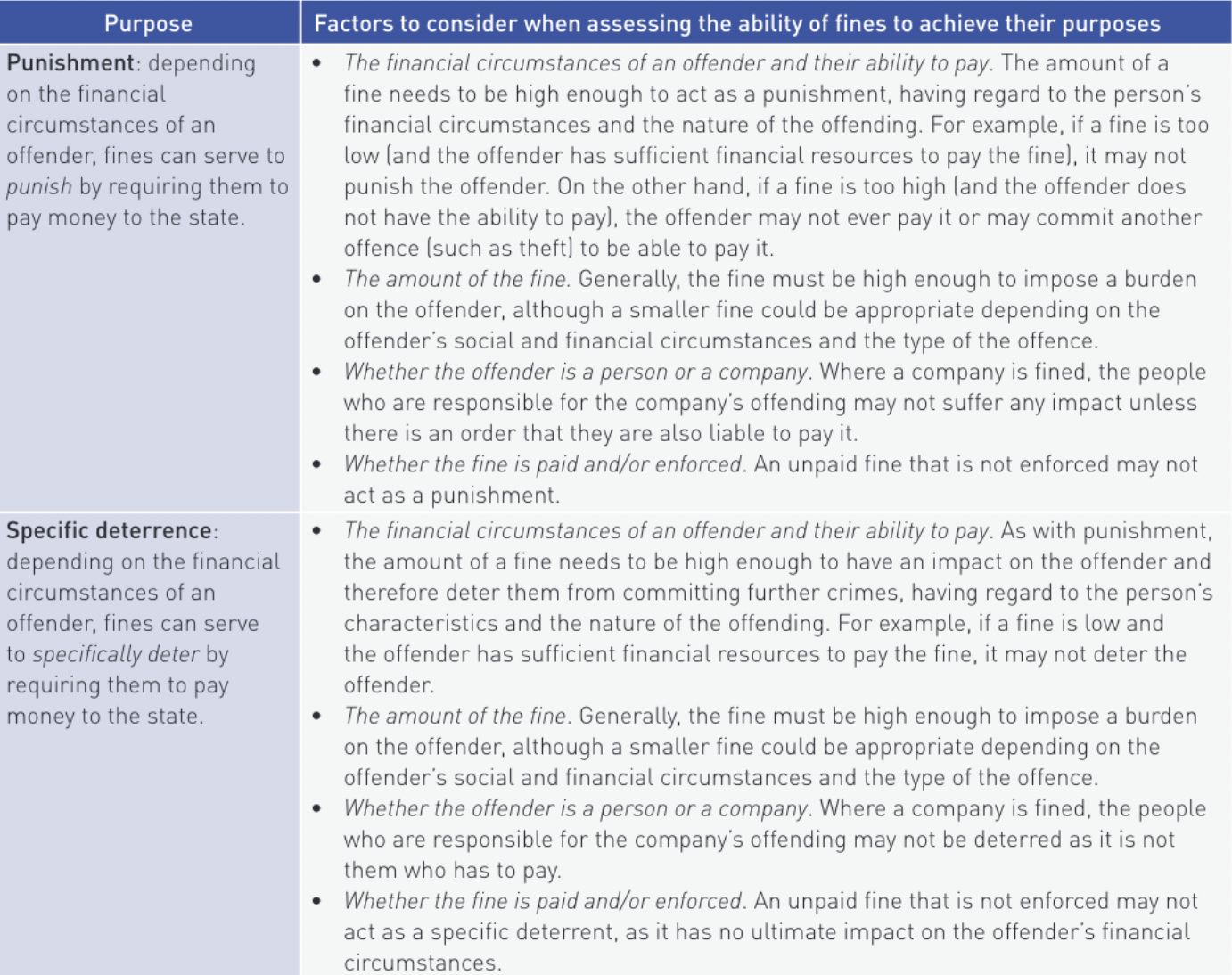
Factors to consider when assessing the ability of fines to achieve their purposes
Community correction order (CCO)
a sentence that can be served by the offender whilst remaining in the community.
Can only be imposed if the offender has been convicted and found guilty of an offence punishable by more than 5 penalty units.
A judge or magistrate will set a time period for which the offender must comply with the CCO (up to 2 years in the Magistrates Court or 5 years in other courts).
Cannot be be imposed for:
very minor offences
Some serious offences, including (but not limited to); murder, trafficking large quantities of commercial drugs, causing serious injury intentionally.
A CCO may be imposed with a fine or a term of imprisonment. If imposed with a term of imprisonment, the CCO commences once the offender is released.
Core conditions attached to CCOs
Must not commit another offence punishable by imprisonment during the term of the order.
Must report to a specified community corrections centre within two working days of the order coming into force.
Must report to and receive visits from a community corrections officer.
Must notify an officer of a change of address
Must not leave Victoria without permission
Must comply with any directions of community corrections officers.
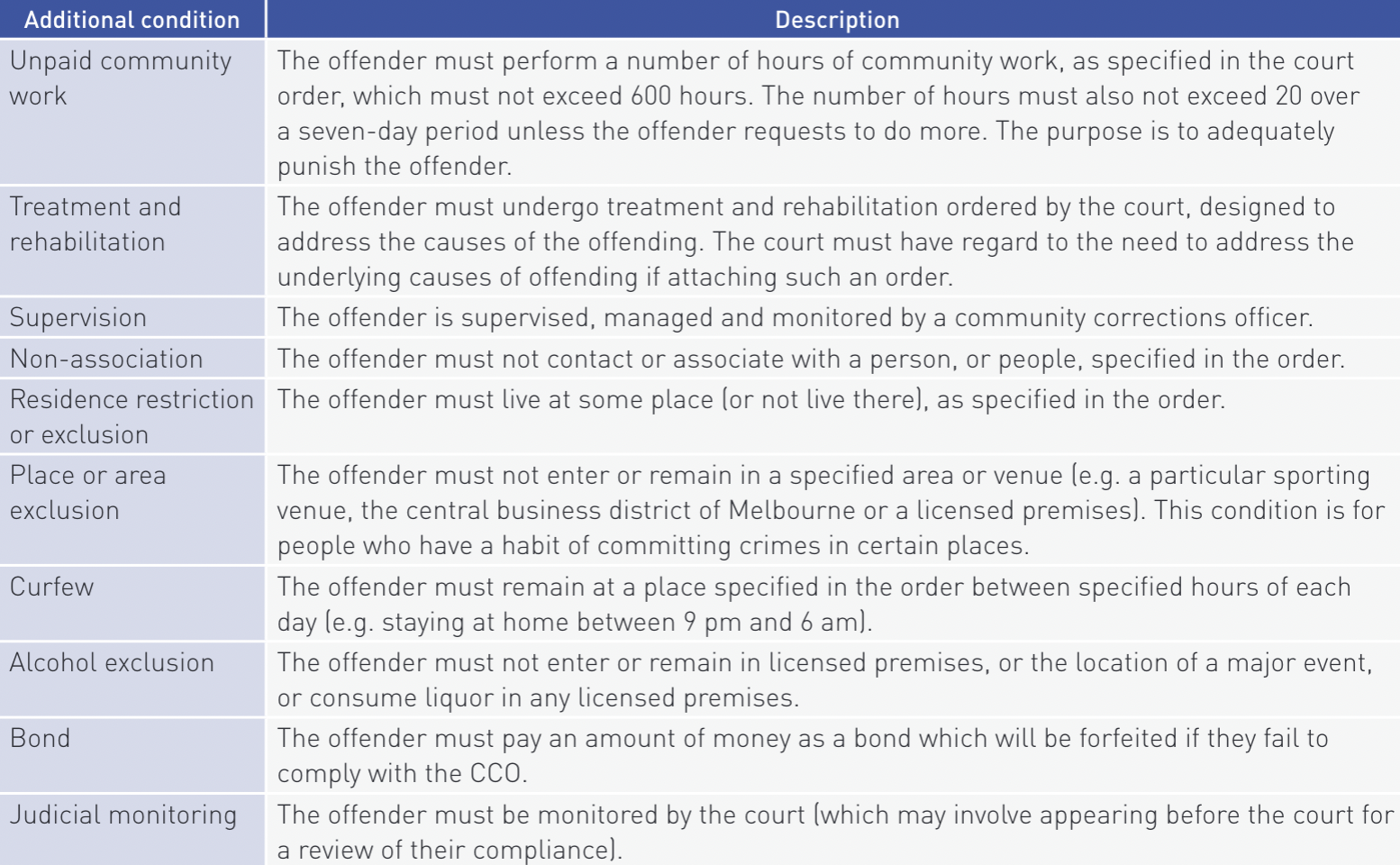
A CCO will impose other special conditions that punish or rehabilitate an offender
Breaching the conditions to a CCO is an offence. If this happens, the CCO can be cancelled and the offender resentenced. Often the sentence is harsher.
At least 1 of these additional conditions must be attached to CCOs

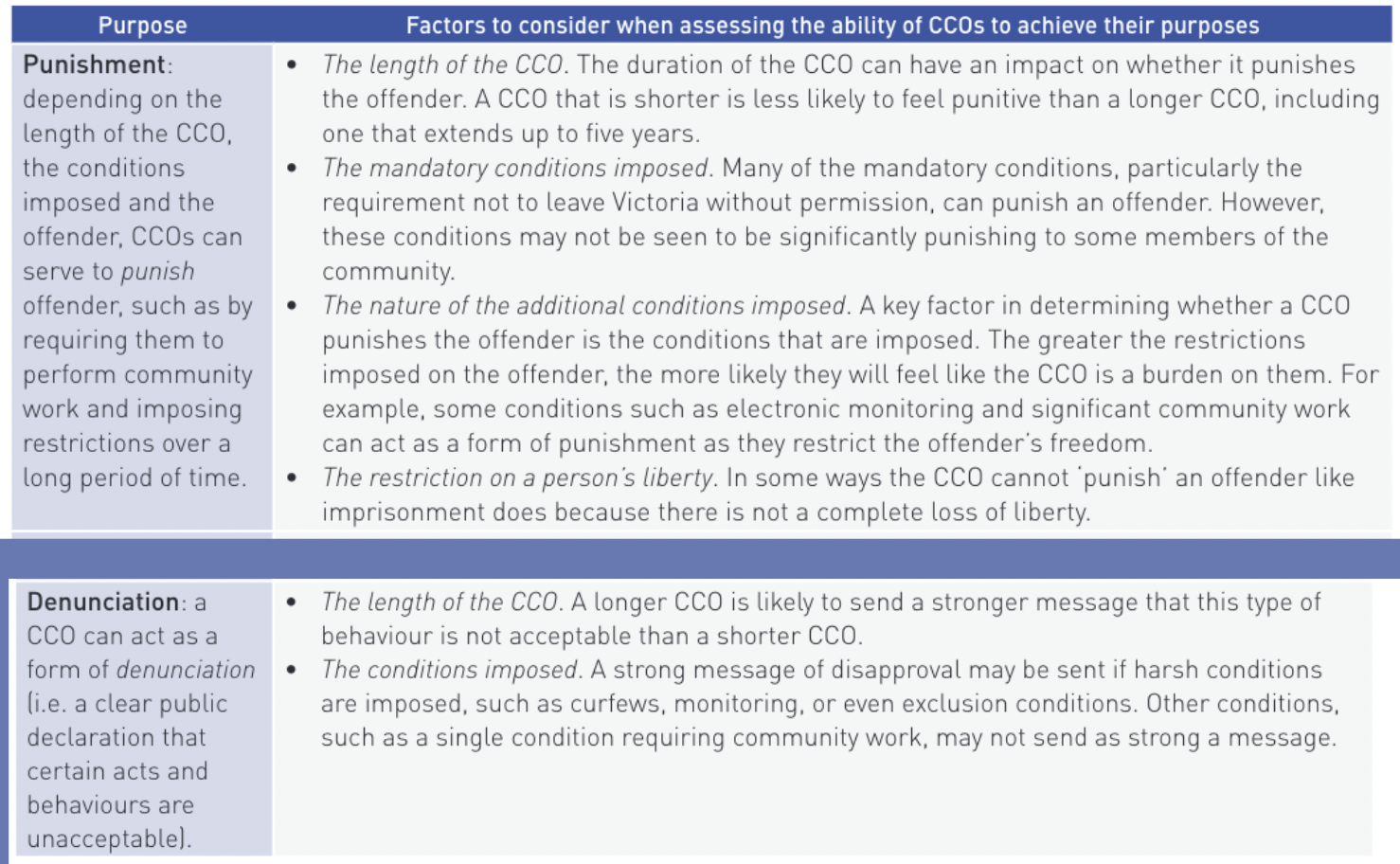
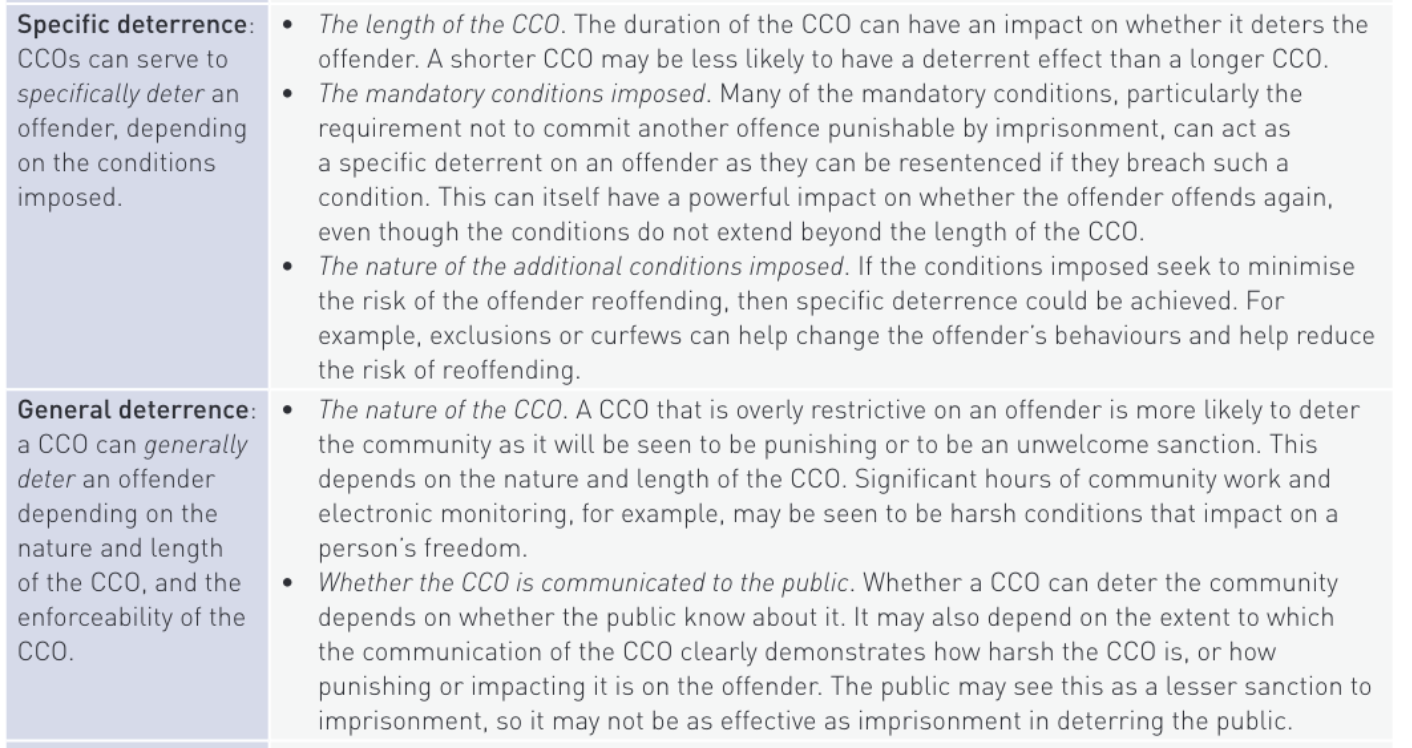
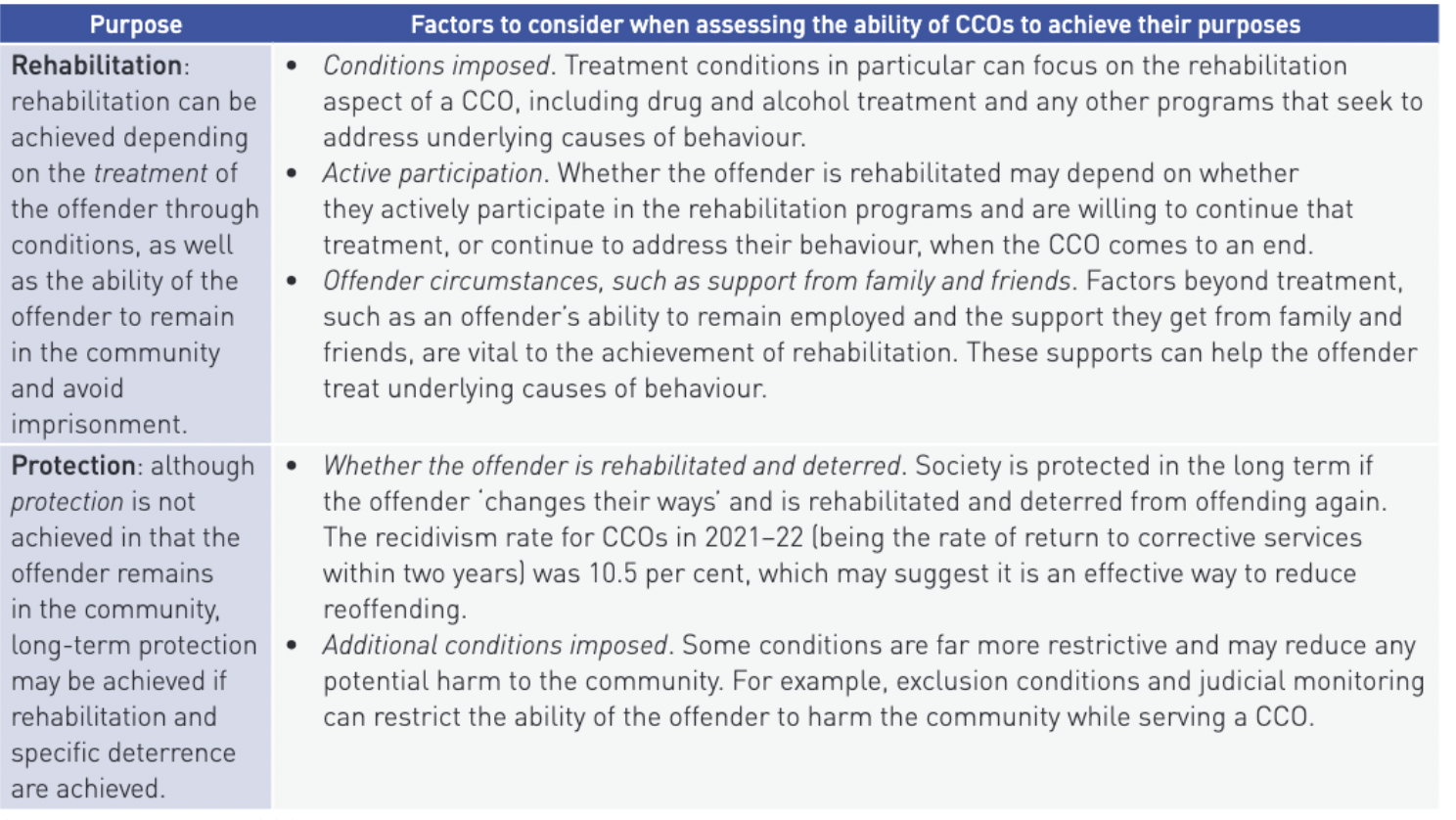
Main purposes of CCOs
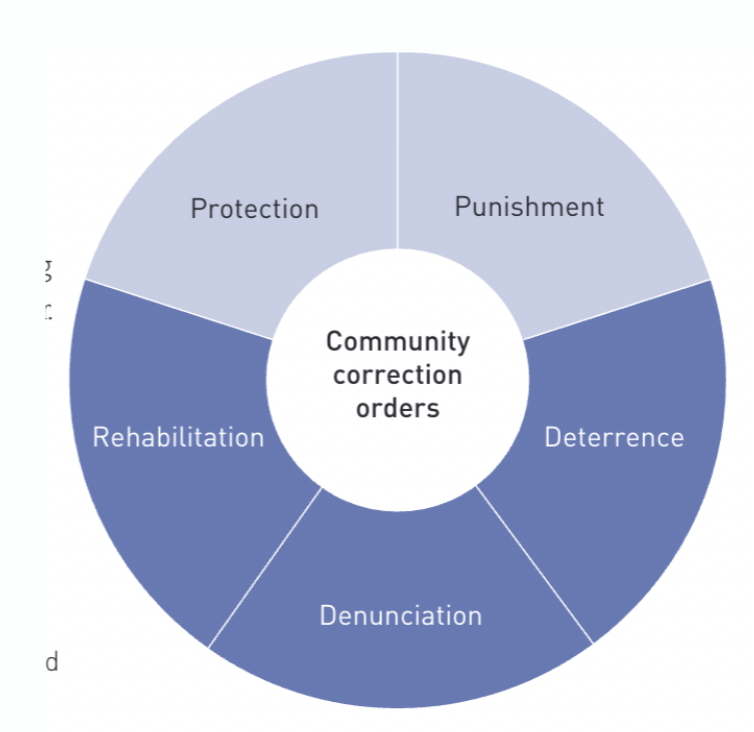
Factors to consider in CCOs ability to achieve its purposes
Imprisonment
A sanction that involved removing an offender from society for a stated period of time and placing them in a prison.
In some instances, imprisonment is the only appropriate sanction that can or should be imposed. It is the most serious sanction as the imprisoned person loses their freedom and liberty.
If a court sentences an offender to 2+ years imprisonment, it must also state a non-parole period. After this minimum period, the Adult Parole Board reviews the prisoners suitability for parole - parole is the conditional release of a prisoner after the minimum period of imprisonment has been served.
If there is no non-parole period or parole is rejected, this means the term must be served in full.
Severity of jail terms
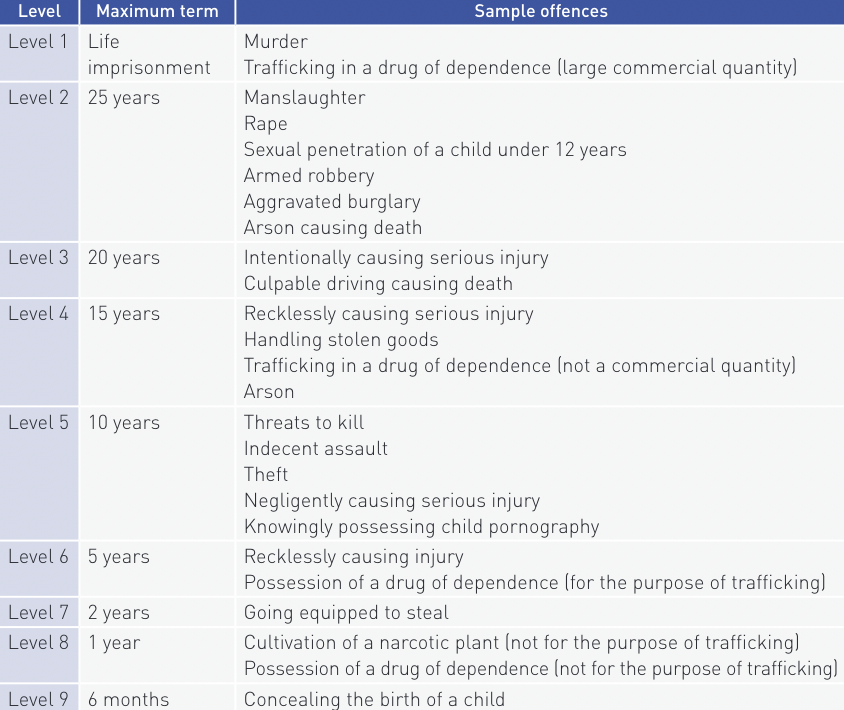
Concurrent sentence
Runs at the same time as another sentence.
eg. someone has been sentenced to 6 months for theft and 2 years for assault 'to be served concurrently' will only serve 2 years.
Sentences are usually ordered to be served concurrently.
Cumulative sentence
Served straight after another sentence.
In the example above, they would serve 2 years and 6 months.
A cumulative sentence must be given for the following offences:
Certain serious offences (arson, drug, sexual and serious violent offences).
For an offence by a prisoner or an escape offence
For an offence committed by a person released on parole or bail.
The court can impose an indefinite sentence if it is satisfied that the offender is a high danger to the community because of:
Their character, past history, health, age or medical condition.
The nature and gravity of the serious offence (murder, manslaughter, child homicide, rape, kidnapping, armed robbery and sexual offences involving children under 16).
Can be discharged if they are no longer considered a high threat, but the offender must undertake a 5 year reintegration program.
Main purposes of imprisonment
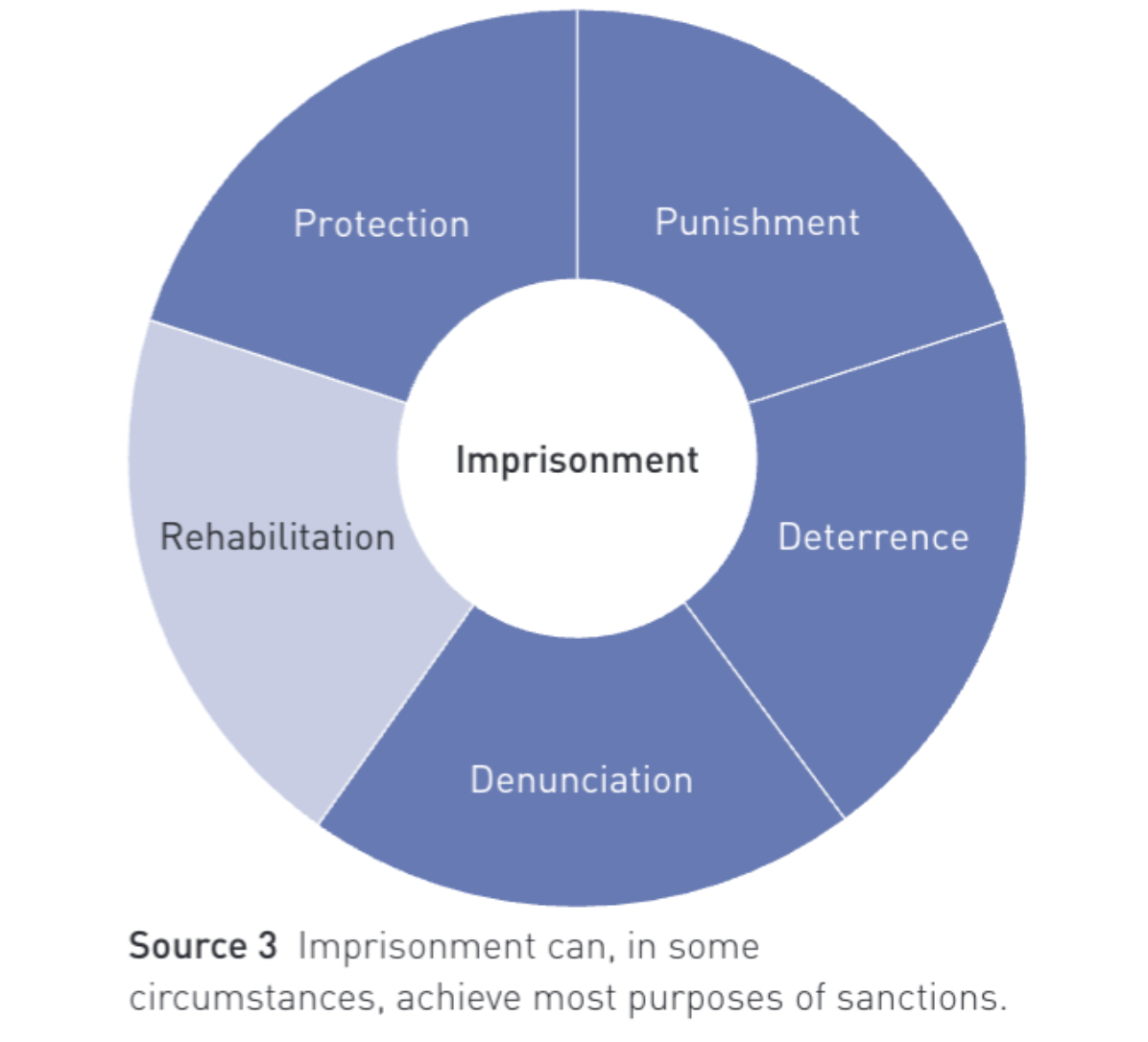
Factors to consider in imprisonments ability to achieve its purposes