BCS 111 Lecture 8.1
 Studied by 0 people
 Call Kai
 Learn
Learn Practice Test
 Spaced Repetition
 Match
Match Flashcards
 Knowt Play
1/19

There's no tags or description
Looks like no tags are added yet.
Name | Mastery | Learn | Test | Matching | Spaced | Call with Kai |
|---|
No analytics yet
Send a link to your students to track their progress
20 Terms
What’s the role of language in our cognition?
Effective communication
Survival: signaling food resource and danger
Socialization
Passing down the knowledge
Verbalizing emotions and thoughts
Language and cognitive functions
Labeling of objects – recognition
Categorization
Long-term memory
Working memory – phonological loop
…etc.
Chomsky
Nativism
Universal Grammar
Skinner
Behaviorism
Reinforcement and conditioning
Stimulus-response
Behavioral studies of verbal behavior
More about Koko the Gorilla (1971-2018)
Use of sign language (~1000 signs)
Claimed to be able to understand a large number of spoken words
Another famous ape: Kanzi
Use of lexigrams (symbol-meaning pairings)
Learned it by observation
Clever Hans effect
Watch out for experimenter’s cues!
When experimenter cues affects animal communication
At least two major features that differentiate human language from animal communication
Productivity of utterances – unlimited in human
Displacement: ability to talk about space and time freely
Human language: future, past, here, there
Animal: very limited
Sapir-Whorf Hypothesis
-
Linguistic determinism
The form of our language determines our cognition: how we think, remember and perceive
Linguistic relativism
Different languages generate different cognitive structures (e.g. categorization, description of objects, etc.)
Strong version (linguistic determinism)
Language determines thought and every aspect of our cognition.
Weaker version (linguistic relativism)
Language affects only perception/categorization.
Weakest version (linguistic
relativism)
The influence of language is “task- dependent” (tasks requiring language)
Language and thought
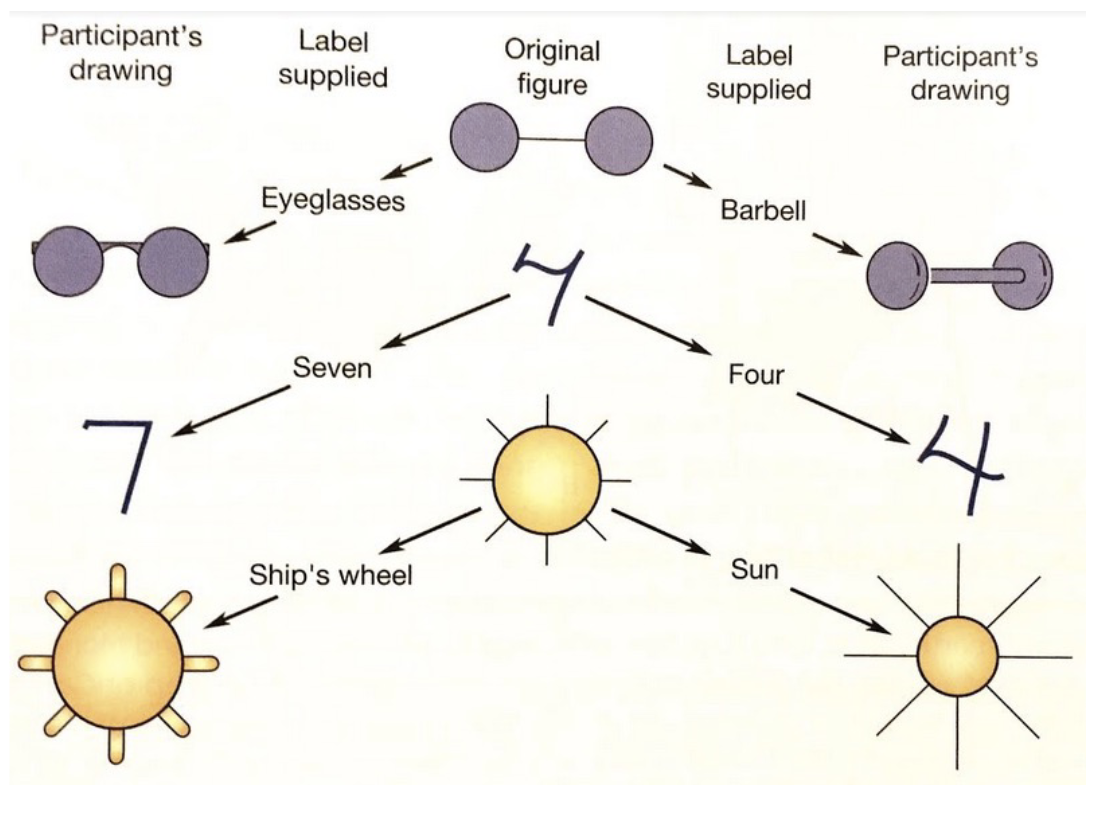
One interesting experiment:
1. Show the original pic to the participant
2. Each person gets a different label for the pic
3. After some time, ask them to draw the pic again
4. The drawing heavily influenced by the verbal descripton!!
Recap: Structural equivalence: Kosslyn et al.(1983)
Complex description → slower
Effect of language on structural complexity
Supports linguistic relativism!
Assess intelligence without language?
Our IQ tests rely heavily on language!!
Hard to assess our IQ w/o language!
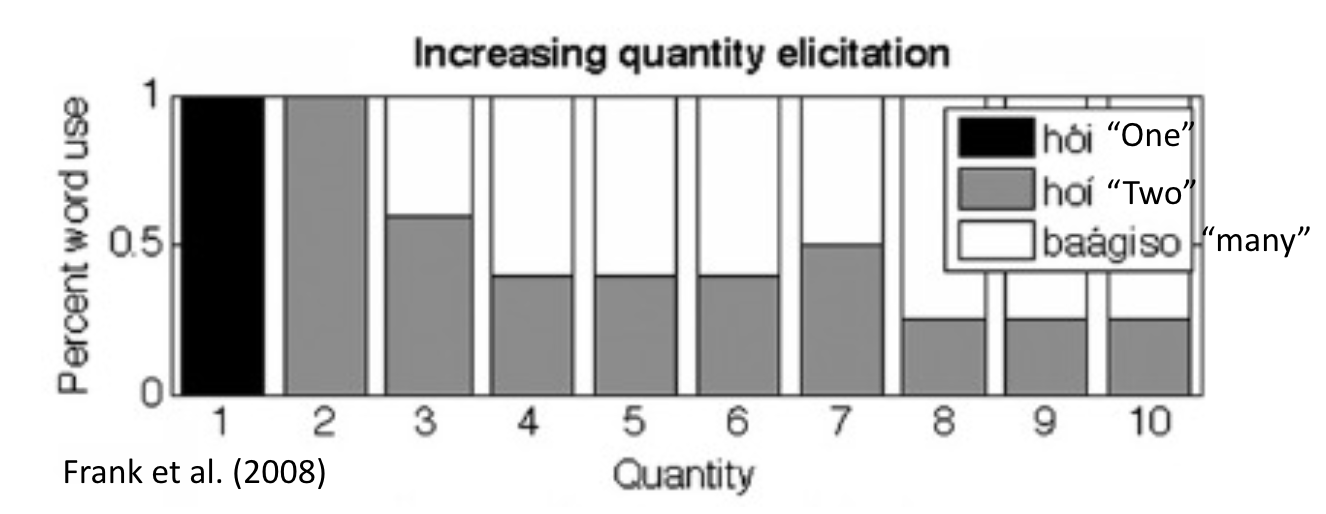
Testing Sapir-Whorf : Pirahã language
Three words for counting: One, two, many
Sense of quantity influenced by their language
(cont)
Subjects respond by showing a matching number of balloons
Sense of quantity influenced by their language: evidence for relativism: the larger the quantify, the larger the error rate
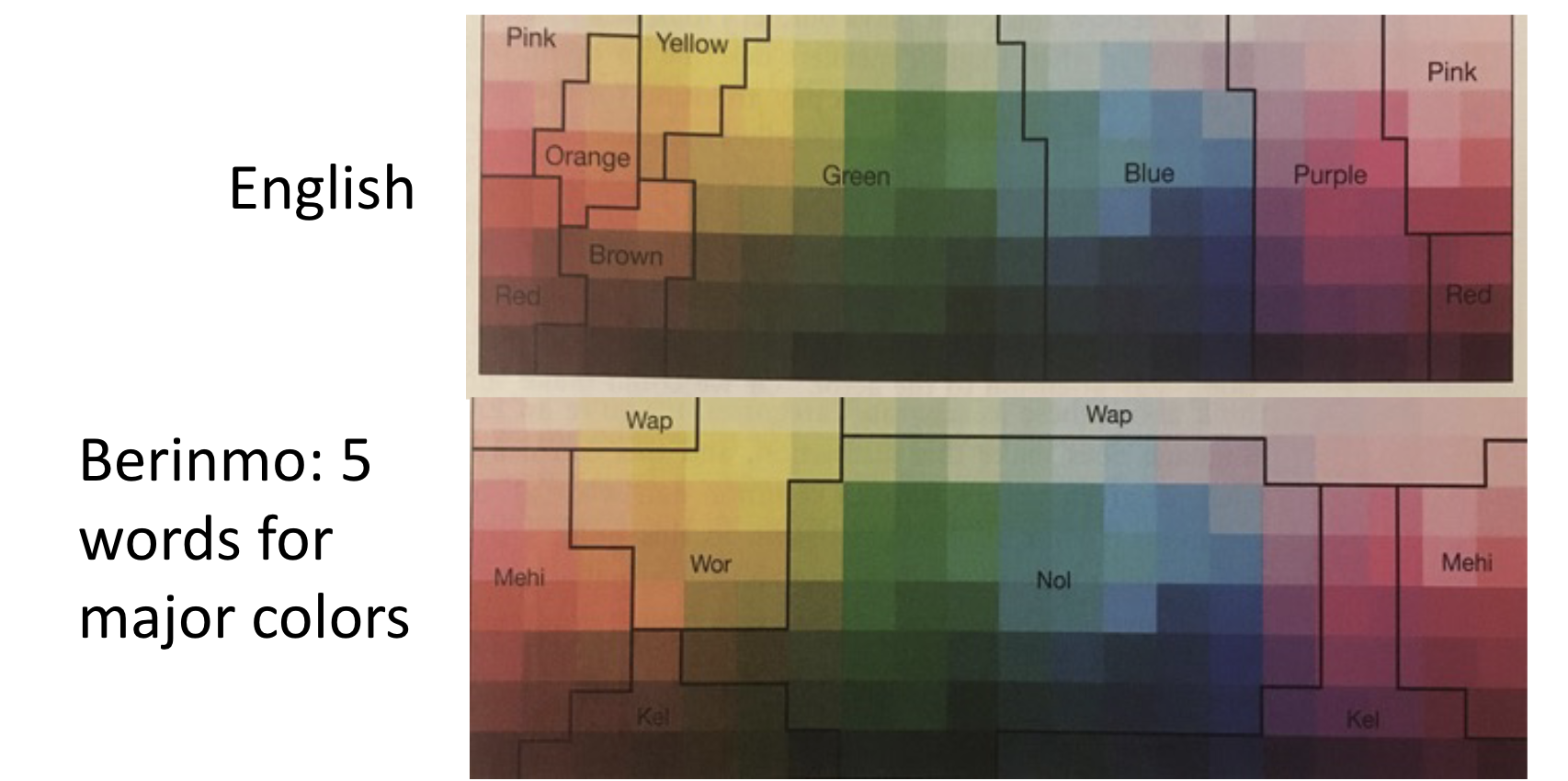
Another evidence for relativism
How language influences categorization: a color may be categorized differently by speakers of different languages!
 Note
Note  Flashcards (161)