"I think i need a 2nd opinion"
 Call Kai
 Learn
Learn Practice Test
 Spaced Repetition
 Match
Match Flashcards
 Knowt Play
1/89

There's no tags or description
Looks like no tags are added yet.
Name | Mastery | Learn | Test | Matching | Spaced | Call with Kai |
|---|
No analytics yet
Send a link to your students to track their progress
90 Terms
(Case study #1) Click to highlight the findings below that would indicate that the client has a potential problem.
a. Client reports tightness in chest that radiates to left arm.
b. States pain as 7 on a scale of 0 to 10.
c. Started to feel nauseous after breakfast.
d. Client is diaphoretic and short of breath.
e. Heart rate is irregular and tachycardic.
f. +1 pedal pulses.
g. Skin is cool to touch.
(Case study #2) A nurse is admitting a client who reports tightness in their chest that radiates to left arm. A nurse is reviewing the client’s medical record. Select the four findings that require immediate follow-up
a. Blood pressure
b. Pain level
c. Electrocardiogram findings
d. Troponin T level
(Case study #3) The nurse should first address the client's pain level followed by the client's ECG results
PAIN LEVEL and ECG results
(Case study #4) A nurse is reviewing the client’s diagnostic results and vital signs. Which of the following actions should the nurse take?
a. Anticipate client to be prepped for cardiac catheterization.
b. Assist with a continuous heparin infusion.
c. Anticipate an increased dosage of metoprolol.
d. Obtain a prescription for client to be NPO.
(Case study #5)
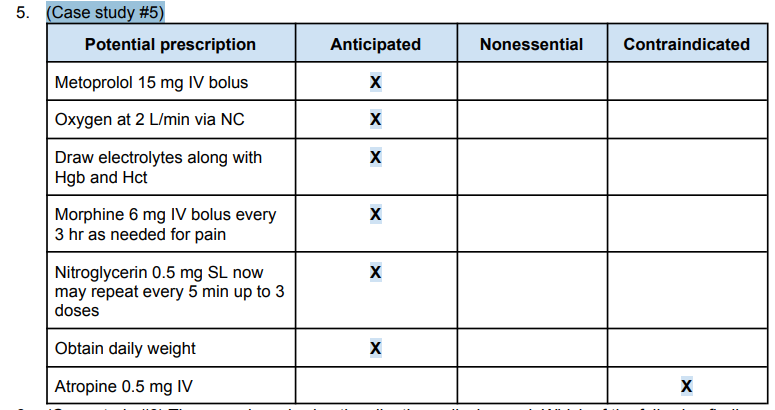
(Case study #6) The nurse is reviewing the client’s medical record. Which of the following findings indicates the client’s condition has improved? (D/n pick urinary output and ECG)
a. BP
b. RR
c. HR
d. Pain
e. O2
(Case study #1) A nurse is caring for a client in the emergency department. For each assessment finding, click to specify if the assessment finding is consistent with DKA or HHS.
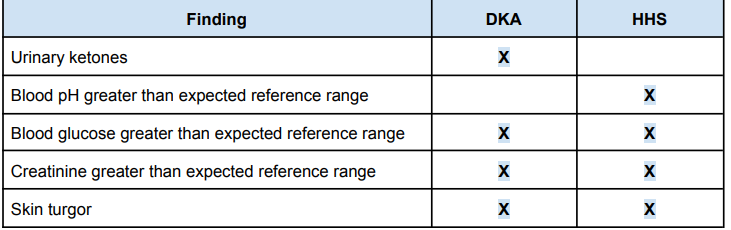
(Case study #2) 0900: A nurse is caring for a client in the emergency department. Nurses' Notes 0900: Client came to the emergency department this morning and reports not feeling well for the last 12 hr and increase blood glucose. Client has a history of type 1 diabetes mellitus and hypertension. Client weight is 88 kg (194 lb). The client was recently treated for bronchitis and pneumonia. Client reports nausea and decreased appetite. Client is alert and orientated x4, heart and lung sounds are clear. Client states that they have been frequently urinating and are extremely thirsty. Bowel sounds are hyperactive in all 4 quadrants. Bilateral pedal pulses 1 . Slight tenting of skin. Peripheral IV established and labs drawn. The nurse is caring for the client in the ED. The nurse understands that the client is at risk of developing which of the following complications? Select all that apply
a. Renal failure
b. Cardiac dysrhythmias
c. Hypotension
d. Cerebral edema
e. Respiratory alkalosis
f. Septic shock
a. Renal failure
b. Cardiac dysrhythmias
c. Hypotension
d. Cerebral edema
(Case study #3) Which of the following 3 provider prescriptions does the nurse anticipate?
a. 0.9% sodium chloride at 15 ml/kg/hr for 1 hr and then reduce to 10 ml/kg/hr
b. Regular insulin continuous IV infusion
c. Potassium chloride 20 mEq/L IV PRN
(Case study #4) The nurse should plan to first administer fluids followed by insulin.
FLUIDS followed by INSULIN
(Case study #5) The nurse should administer a total of 1320 mL 0.9% sodium chloride in the first hour and 880 mL each subsequent hour.
1320 mL and 880 mL
(Case study #6) Click to highlight the findings that indicate that the client’s condition is improving at 1400. Double-check what’s improved.
a. Alert and oriented x4, heart and lung sounds clear
b. Client is tolerating soft diet and oral fluids
c. Bowel sounds are hyperactive in all 4 quadrants
d. Bilateral pulses 2+
e. Blood glucose 310 md/dL
f. Temperature 36.8 C (98.2 F)
b. Client is tolerating soft diet and oral fluids
d. Bilateral pulses 2+
(Bowtie) Client is brought to the ED by partner who states the client became acutely ill over the past few hours and "developed a high fever and reported chest pain." According to partner, client is recovering from influenza diagnosed 2 weeks ago, still experiencing fatigue. Client is diaphoretic. States, "I feel hot all the time." Oriented x3, appears nervous and agitated. Visible tremors to upper body. Febrile. Partner reports client has been experiencing insomnia. Hypertensive with tachycardia and palpitations. Client reports chest pain as 3 on a scale of 0 to 10. Respirations rapid, shallow. Auscultation reveals diminished breath sounds and bilateral crackles. Pulse oximetry 89% on room air. Hyperactive bowel sounds x4 quadrants. Partner reports that client has been experiencing diarrhea and weight loss over the past few weeks in spite of a “good appetite.” Client reports no blood in stool. Reports no difficulty with urination.
a. Hyperthyroidism
b. Actions to take:
i. Place client on telemetry ii. Initiate hydration therapy
c. Monitor:
i. Cardiac dysrhythmias ii. Neurological status
(Bowtie) 2200: Client admitted from the ED. Client has a history of CHF and type 1 diabetes mellitus. Client presented to ED with shortness of breath, bilateral lower extremity edema, and a weight gain of 3 kg (6.6 lb) in the past 2 days. The client was given 2 L of 02 via nasal cannula and a peripheral IV was established in the left antecubital. The client was administered 80 mg of IV furosemide prior to leaving the ED for admission. 0100: The client reports dizziness, especially when getting up from the bed to go to the bathroom. Client also reports thirst. Lung sounds are clear. Bilateral pedal pulses are +1.
a. Hypovolemic shock
b. Actions to take:
i. Elevate the client's feet ii. Administer IV
c. Monitor:
i. Pulse pressure ii. Mental status
Monitor O2 as evidenced by hematocrit
O2 as evidence by HEMOTOCRIT
16. (Bowtie) Meningitis
MENINGITIS
(NGN) A nurse is caring for a client receiving TPN. Which of the following actions should the nurse take? For each potential nursing intervention, click to specify if the potential intervention is anticipated, nonessential, or contraindicated for the client. Exhibit 1: Medical history: Dehydration, HLD, HTN, CAD. Exhibit 2: Diagnostic results: WBC 14,000 (5,000-10,000); Hgb 14 (12-16); Hct 40% (34-47%); Sodium 132 (136-145); Potassium 6.2 (3.5-5); Calcium 10 (9-10.5); BUN 20 (10-20); Albumin 2.8 (3.5-5); Fasting blood glucose 140 (74-106); Triglycerides 134 (34-106)
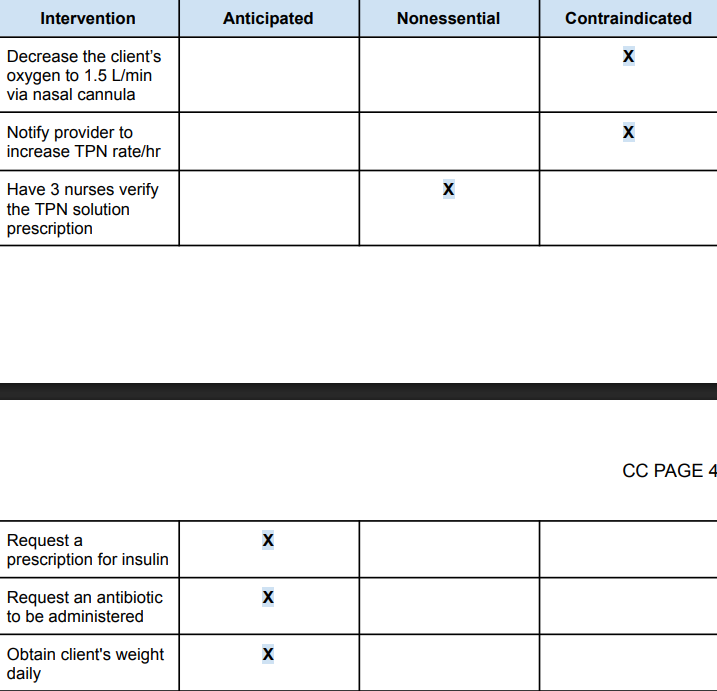
(NGN) The client is at highest risk for wound infection as evidenced by the blood glucose level.
wound infection
blood glucose level
(NGN) Main risk is CHF and the patient is at risk for cardiogenic shock.
CHF and CARDIOGENIC SHOCK
(Medmath) Patient receiving medications 125 mL/hr bolus with 50 mL every 4 hours. How many mL will the patient receive in 24 hours?
3,300
A nurse is teaching a new grad nurse about the use of an Automated External Defibrillator (AED). What statement indicates the new grad nurse understands the teaching?
Lie the patient on a flat surface
A nurse is caring for a client who has moderate Alzheimer’s disease. During weekly home visits, the nurse notices that the client’s caregiver is tired, irritable, and impatient with the client. Which of the following actions should the nurse recommend to the caregiver?
Consider respite care services
A nurse is performing a cranial nerve assessment on a client following a head injury. Which of the following findings should the nurse expect if the client has impaired function of the vestibulocochlear nerve (cranial nerve VIII)?
Disequilibrium with movement
A nurse is planning to meet with the interprofessional team about the care of a client who has a new diagnosis of ulcerative colitis. Which of the following recommendations should the nurse plan to make during the meeting?
“The client should be referred to a dietitian.”
A nurse is planning care for a client who has developed nephrotic syndrome. Which of the following dietary recommendations should the nurse include?
Decrease protein intake
A nurse is caring for a client who has a duodenal ulcer. Which of the following actions should the nurse take?
Infuse packed RBCs
A nurse is assessing a client who is receiving morphine for pain and has a respiratory rate of 8/min and a blood pressure of 80/40 mm Hg. Which of the following medications should the nurse administer?
Naloxone
A nurse enters a client’s room and observes the client having a tonic-clonic seizure. Which of the following actions should the nurse take first?
Turn the client on their side.
A nurse is caring for a client who is experiencing a seizure. Which of the following actions should the nurse take first?
Lower the client to the floor
A nurse is admitting a client who has meningitis. Which of the following findings should the nurse expect?
Photophobia
(SATA) A nurse is planning care for a client who is experiencing seizures secondary to meningitis. Which of the following interventions should the nurse include in the plan of care?
a. Have suction equipment at the bedside
b. Dim the overhead lights
c. Assist the client to ambulate every 4 hr
d. Place a tongue blade at the bedside
e. Apply a warming blanket
a. Have suction equipment at the bedside
b. Dim the overhead lights
A nurse is caring for a client after total hip replacement surgery. Which of the following actions should the nurse take?
Use an elevated toilet seat
A nurse is providing discharge teaching to an older adult client following total hip arthroplasty. Which of the following instructions should the nurse include in the teaching?
Install a raised toilet seat in your bathroom
A nurse is providing discharge teaching to a client who is postoperative following a total hip arthroplasty. Which of the following statements should the nurse make?
Use a raised toilet seat to maintain your hips above your knees.
A nurse is caring for a client who had a total hip arthroplasty. Which of the following actions should you take to prevent hip dislocation?
Place two bed pillows between the legs when in bed
A nurse is teaching a client who has angina about sublingual nitroglycerin. Which of the following instructions should the nurse include?
Lie down when taking the medication.
A nurse is assessing a client’s response to receiving morphine for postoperative pain management. Which of the following findings is the nurse’s priority?
Bradypnea
A nurse is assessing a client who has a new diagnosis of colon cancer. Which of the following findings should the nurse expect?
Hematochezia
A nurse finds a client in bed, unresponsive and breathing. Which of the following actions should the nurse take first?
Palpate for the client’s carotid pulse
A nurse is caring for a client who has advanced liver disease. Which of the following lab results should the nurse monitor when assessing this client?
Serum ammonia
A nurse is providing discharge teaching to a client who will be self-administering insulin at home. Which of the following information should the nurse include regarding needle disposal?
You can discard needles in an empty bleach bottle with a lid
A nurse is providing discharge teaching to a client who has a permanent pacemaker. Which of the following statements by the client indicates an understanding of the teaching?
“I need to check my pulse rate every day for a full minute.”
A nurse is caring for a client who has cancer. The client tells the nurse, “I would prefer to try vitamins and minerals instead of chemotherapy.” Which of the following responses should the nurse make?
Tell me what you know about chemotherapy
A nurse is caring for a client who has a new onset of hyperglycemic hyperosmolar state (HHS). Which of the following interventions by the nurse is the highest priority?
Initiate IV fluid replacement.
A nurse is providing teaching to a client and his partner about performing peritoneal dialysis at home. When discussing peritonitis, which of the following manifestations should the nurse identify as the earliest indication of this complication?
Cloudy effluent
A nurse is caring for a client who takes Lisinopril for hypertension. Which of the following client statements indicates an adverse effect of the medication?
I have a nagging, dry cough
A nurse is caring for a client who has Haemophilus influenza type B. Which of the following types of isolation should the nurse implement?
Droplet
A nurse is providing discharge teaching to a client who has tuberculosis. Which of the following information should the nurse include in the teaching?
"You will need to return in 2 weeks to provide a sputum specimen.”
Patient has UC. What can you give them?
Eggs
A nurse is assessing a client who has a UTI and is receiving cefaclor. The nurse should monitor the client for which of the following adverse effects of the medication?
Diarrhea
A nurse is assessing a client who has myasthenia gravis. Which of the following client statements should indicate to the nurse that the client needs a referral for occupational therapy?
“I have a hard time with brushing my hair.”
A nurse is caring for a client immediately following a cardiac catheterization through the right femoral artery?
Instruct the client not to bend the affected leg
A nurse is planning care for a client who is postoperative following insertion of an arteriovenous graft in their left forearm. Which of the following actions should the nurse include in the plan of care?
Check the pulse distal to the graft.
A nurse is caring for a client who is scheduled to receive hemodialysis and has an internal arteriovenous (AV) graft in the left forearm. Which of the following is an appropriate intervention to verify adequate circulation on the AV graft?
Palpable thrill (Choice might also say “Auscultate for a bruit”)
A nurse suspects that a client who has Diabetes mellitus is experiencing hypoglycemia. Which of the following assessment findings support this suspicion?
Cool, clammy skin
A nurse is assessing a client who has a new diagnosis of type 1 diabetes mellitus. Which of the following findings indicates that the client is experiencing hypoglycemia?
Increased perspiration
A home health nurse is teaching a client who has a new diagnosis of diabetes mellitus. Which of the following statements by the client indicates an understanding of the teaching?
I will use a mirror to inspect my feet daily
A nurse is teaching a client who has diabetes mellitus about foot care. Which of the following instructions should the nurse include?
Wear cotton rather than nylon socks
A nurse is providing teaching for a client who has diabetes mellitus about the self-administration of insulin. The client has prescriptions for regular and NPH insulins. Which of the following statements by the client indicate an understanding of the teaching?
I will draw up the regular insulin into the syringe first.
A nurse is caring for a client who is experiencing diabetic ketoacidosis (DKA). Which of the following is the priority intervention by the nurse?
Administer 0.9% sodium chloride
A nurse is assessing a client following the insertion of a central venous catheter. Which of the following findings indicates a pneumothorax?
Diminished breath sounds
A nurse is teaching a client who is to begin chemotherapy about a peripherally inserted central catheter (PICC). Which of the following statements should the nurse include in the teaching?
We can draw blood samples from the PICC for diagnostic tests
A home health nurse is reviewing safety with the family of a client who uses home oxygen therapy. Which of the following interventions should the nurse include?
Notify the fire department that oxygen is in use in the home
A nurse is assessing an older adult client at a health fair. Which of the following statements by the client is the nurse’s priority?
In the last day, I have had a severe headache and pain around my right eye
A home care nurse is planning to use non-pharmacological pain relief measures for an older adult client who has severe chronic back pain. Which of the following guidelines should the nurse use?
Distraction changes the client’s perception of pain, but does not affect the cause
A nurse is planning care for a client who has dementia. Which of the following interventions should the nurse plan to include?
Place the client’s bed at the lowest height
A nurse on a medical-surgical unit is planning care for a client who has dementia and a history of wandering. Which of the following actions should the nurse plan to implement?
Use a bed alarm
A nurse is caring for a client who is receiving continuous bladder irrigation following a transurethral resection of the prostate (TURP). The client reports bladder spasms and the nurse observes urinary output. Which of the following actions should the nurse take?
Flush the catheter manually with 0.9% sodium chloride
A nurse is caring for a client who has a PICC line in her left forearm. The client is receiving an antibiotic via intermittent IV bolus every 12 hr. Which of the following actions should the nurse take in managing the client’s PICC line?
Flush the catheter with a 0.9% sodium chloride solution after each use.
A nurse is caring for a client who was admitted with nausea, vomiting, and a possible bowel obstruction. An NG tube is placed and set to low intermittent suction. Which of the following findings should the nurse report to the provider?
The client’s abdomen becomes distended and firm
A nurse is teaching a newly licensed nurse about reportable communicable diseases. Which of the following diseases should the nurse include in the teaching?
Mumps
A nurse is planning care for a client who has osteoarthritis of the knees. Which of the following interventions should the nurse include in the plan?
Place a large pillow under the client’s knee when resting
A nurse is teaching a group of clients who have cancer about radiation therapy. Which of the following activities should the nurse include in the teaching?
Limit socializing in large crowds
TPN question 1
Taper down
TPN question 2
Monitor for hypoglycemia
ADHD med
Amotixitene
Montelukast (it was alone)
Montelukast
UTI med
a. Starts w/ C (Cefaclor?)
b. Side effect of cefaclor = Diarrhea
TB med
Starts w/ R (Rifampin?)
A nurse is caring for a client who has tuberculosis and is taking rifampin. The client reports that her saliva has turned red-orange in color. Which of the following responses should the nurse make?
"This is an expected adverse effect of this medication."
A nurse is assessing equipment needs in order to perform tracheostomy suctioning on a client. Which of the following pieces of equipment should the nurse gather for the procedure?
Sterile water
CABG teaching
Walk 400 feet
After CABG
Check graft site
Signs of respiratory failure
Increase in CO2
Burn patient
Reduce contractures (early intervention with physical therapy, proper positioning, and scar management)
Power of attorney
The patient can give verbal consent, and a witness (such as the nurse) will sign the consent form. If the patient can't consent, the nurse should contact the POA to give consent on their behalf
Pacer spike EKG (maybe this picture → Option C)
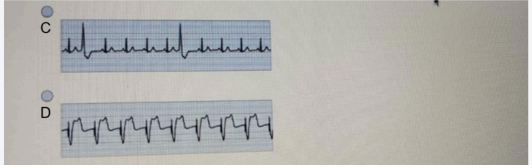
What would EKG look like after cardioversion?
Normal Sinus Rhythm
Central tunnel
Walang answer Central tunnel (Look up)
Upper GI bleeding
Walang Answer Gi bleeding (Look up)

